Otter Tracks: 5 Toes, Webbing and the Slide That Proves It
Otter tracks are five-toed prints about 2 to 3.5 in (5 to 9 cm) long, wider than those of a comparable dog track, with small claw dots and often a faint web line between the toes. In snow they come with something no other animal leaves: a smooth belly slide, 8 to 12 in (20 to 30 cm) wide, running for yards between sets of prints.
North American river otters (Lontra canadensis) travel along water, so otter tracks turn up on snow-covered ice, in river mud and on sand bars. Each substrate shows a different amount of detail, and knowing which features survive in which surface is the difference between a confident call and a guess.
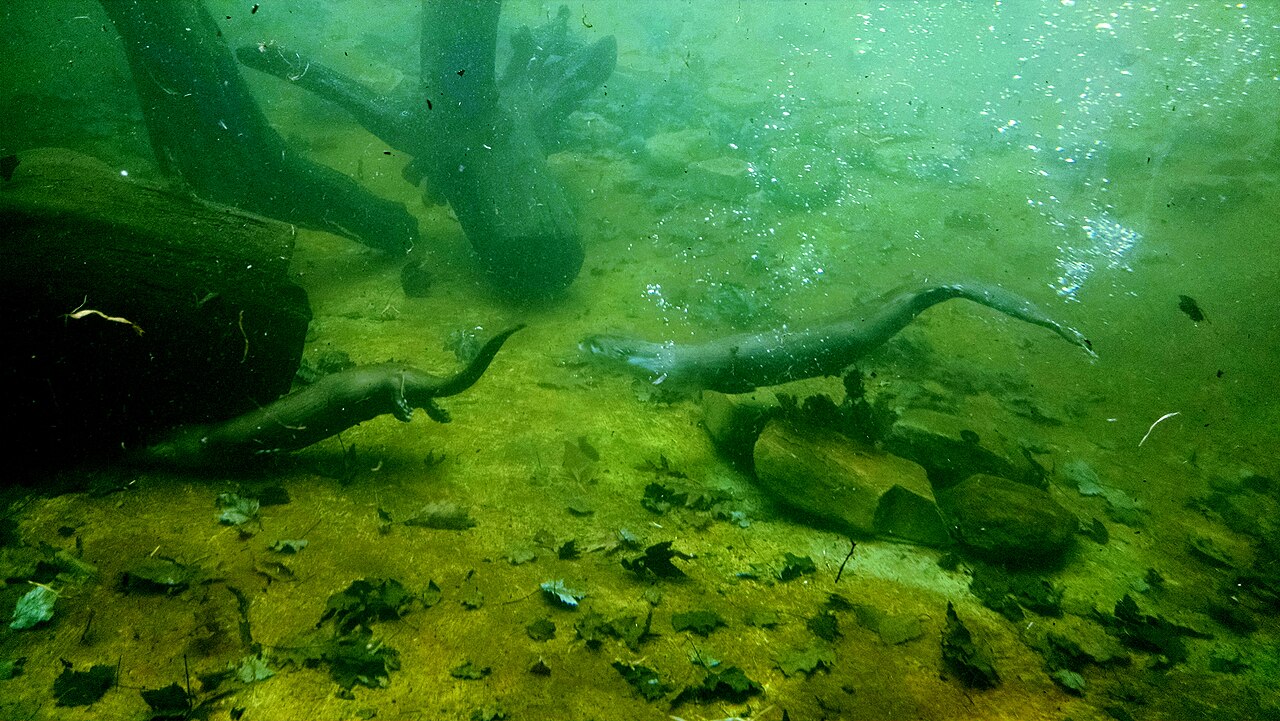
River otter tracks show five toes on both front and hind feet, a chunky asymmetric pad, and short claw marks. Front prints measure 2 to 3 in (5 to 7.5 cm), hind prints 2.5 to 3.5 in (6 to 9 cm) and look webbed. Belly slides and bounding groups of four prints confirm otter.
What Do Otter Tracks Look Like?
An otter print is round to slightly oval, broad for its length, and set up by a thick central pad with five splayed toes above it. The toes are stubby and teardrop shaped, not the long fingers of a raccoon, and the outer toe sits low and often fails to register in shallow substrate.
Webbing is the signature feature. Between the toes, skin stretches almost to the tips, so in soft mud or wet sand you see shallow ridges or a filled-in triangle rather than clean gaps. Claws are small and blunt from constant contact with rock and gravel, printing as faint dots just ahead of the toe pads.
Otter Track Size, Toes and Claws
Four-toe prints are common even in good conditions, which trips up beginners. When only four toes show, the print still reads wide and heavy relative to its length, and the asymmetry of the toe arc points to the outside of the foot. Use measurements with the table below rather than counting toes alone.
| Feature | Front foot | Hind foot |
|---|---|---|
| Length | 2 to 3 in (5 to 7.5 cm) | 2.5 to 3.5 in (6 to 9 cm) |
| Width | 2 to 2.75 in (5 to 7 cm) | 2 to 3 in (5 to 7.5 cm) |
| Toes | 5, often 4 register | 5, often 4 register |
| Claws | Small blunt dots | Small blunt dots |
| Webbing | Partial, faint | Clear in mud and wet sand |
| Stride, bounding | 10 to 30 in (25 to 76 cm) | Groups of 4 prints |
| Trail width | 4 to 6 in (10 to 15 cm) | Slide 8 to 12 in (20 to 30 cm) |
How to Identify Otter Tracks in Snow
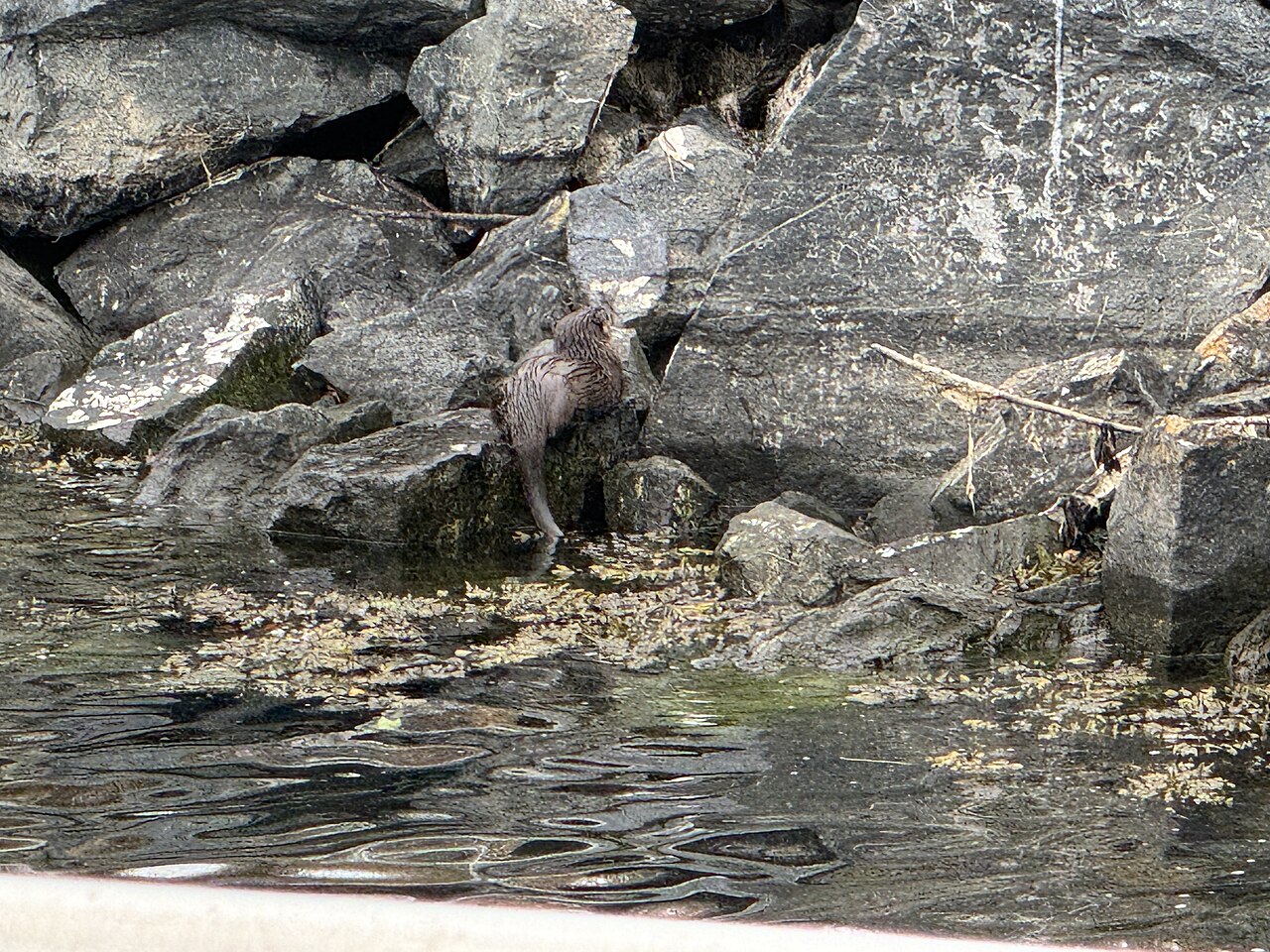
Winter is the best season for otter sign, and snow is where the animal gives itself away. Otters run a few bounds, then drop onto the chest and belly and push with the hind feet, cutting a continuous trough across flat snow and ice. Slides can run 10 to 25 ft (3 to 7.5 m) on the level and much farther down a bank.
Individual prints in snow lose toe detail fast. Expect blurred ovals with a tail drag line and periodic slide troughs, and read the pattern instead of the print: bound, bound, slide, repeated along a frozen shoreline, between two open holes in the ice. No other animal of that size alternates bounding and sliding by choice.
Otter Tracks in Mud

River mud gives the clearest prints of all. On a soft bank below the waterline you can see five toes, the full pad outline, claw dots and the webbing between the toes, sometimes with a drag mark where the belly brushed the ground. These are the prints worth photographing for reference.
Look at haul-out points: low spots where the bank flattens, beaver dams, sandbar tips, culvert mouths and log jams. Otters leave muddy, matted landing areas with trampled vegetation and scat full of fish scales. In the same mud you may find raccoon tracks with their long finger-like toes, which is the easiest pair to tell apart.
Otter Tracks in Sand
Dry sand collapses, so prints go round and shapeless and lose both claws and webbing. What survives is size, depth and spacing, which is still enough when the trail runs straight from water to water across a bar.
Damp sand at the edge of the current works much better. Take measurements there, and check the overall trail for the groups of four prints that come from a lope. On larger rivers, otter trails on sand often cross those of mink and fox, so measure one clean print instead of judging the group by eye.
Otter Slides and Latrines: The Sign That Settles It
Slides are diagnostic year round, not only in snow. On a muddy bank an otter slide is a polished chute 8 to 12 in (20 to 30 cm) wide running down to the water, worn free of vegetation, often with prints at the top and a splash zone at the bottom.
Latrines sit beside them. Otters mark haul-outs with scat, a jelly-like anal secretion and rolled-flat grass. Fresh otter scat is loose and dark with visible fish scales, crayfish shell and small bones, and it smells strongly of fish. Scat plus slide plus five-toed prints is a complete, unambiguous identification.
Otter Gait and Stride Patterns
Otters bound. Their normal travel gait on land groups the four prints in a tight cluster, with the hind feet landing near or ahead of the front, then a gap of 10 to 30 in (25 to 76 cm) before the next cluster. On ice and hard snow the gap stretches as the animal loads up for a slide.
Walking trails appear near latrines and fishing spots, where the gait shortens and prints overlap. A straight line of evenly spaced single prints over long distances usually means a canine instead, since dogs and coyotes trot and otters rarely do on land.
Otter Tracks vs Dog and Coyote Tracks
Dogs and coyotes have four toes, not five, and that remains the fastest check. Their prints are longer than wide, with two clear front claw marks, a distinctly lobed heel pad, and no hint of webbing. Coyote prints run narrow and tidy, dog prints wider and sloppier.
A wet dog on a river bank can still cause trouble, so look at the trail. Canines travel in a direct register line and ignore the waterline; otters cluster their prints, cross and recross the water, and leave slides. Compare the shapes in our coyote track guide before you commit.
Otter Tracks vs Beaver and Muskrat Tracks
Beavers share the water and the webbing but not the size. Beaver hind prints reach 5 to 7 in (13 to 18 cm) with obvious full webbing, and their trails show heavy tail drag plus dragged branches. Front prints are small and hand-like, which makes the front-to-hind mismatch extreme.
Muskrat prints are much smaller, about 1 to 1.5 in (2.5 to 4 cm), with long thin toes and a thin snaky tail drag. Both species leave feeding sign that otters never produce: cut saplings for beaver, clipped cattails and vegetation platforms for muskrat. Otter sign is all fish, shell and slide.
Otter Tracks vs Mink and Fisher Tracks
Mink are the closest match in shape and the easiest to separate by size. A mink print is 1 to 1.5 in (2.5 to 4 cm), roughly a third the area of an otter print, five-toed and only slightly webbed, and mink trails stay tight to the bank with 10 to 20 in (25 to 50 cm) bounds. Side by side details are in our mink track guide.
Fishers are forest animals with five toes and a larger, more spreading foot that shows a C-shaped toe arc and visible fur between the pads in snow. They move through uplands rather than along shorelines, and they never slide. See fisher tracks for the comparison.
Other Otter Sign and How Far They Range
Otters cover ground. A river otter commonly moves 2 to 5 mi (3 to 8 km) in a day along its waterway and may use a home range of 10 to 30 mi (16 to 48 km) of shoreline over a season, which is why fresh tracks one morning can mean nothing the next.
Follow the water instead of the individual trail. Check haul-outs, dam crossings, beaver lodges, bridge abutments and the narrow necks between ponds, where otters shortcut overland and leave the clearest prints. The U.S. Fish and Wildlife Service and state wildlife agencies publish distribution maps that tell you whether otters are even in your watershed. In drier terrain, scat is often the better entry point, as with porcupine droppings at a den.
Frequently Asked Questions
How far do river otters travel in a day?
Typically 2 to 5 mi (3 to 8 km) along a river or lake shore, with longer moves when food runs thin or ice forces them to new open water. Males range farther than females with pups. Over a year an individual may use dozens of miles of connected waterway.
Why do otters spin around?
Rolling and spinning at haul-out sites dries and re-fluffs the fur, which is what keeps an otter warm in cold water, and it works scent from the anal glands into the ground as a territorial mark. The flattened, musky rolling spots beside slides are good places to look for prints.
Can an otter climb a fence?
Yes. Otters climb chain link and wooden fencing surprisingly well, squeeze through gaps of about 4 in (10 cm), and dig underneath. Pond owners who want them out need smooth barriers buried at the base and at least 4 ft (1.2 m) high, and even that is not a guarantee.
What is a herd of otters called?
A group of otters is called a romp, and also a raft, a bevy or a lodge depending on the source. River otters are usually seen alone or as a female with pups, while groups of several animals most often mean a family unit traveling together.
What are otter kids called?
Young otters are pups, sometimes called kits. River otters produce one to three pups in late winter or spring in a bank den, often a reworked beaver or woodchuck burrow, and the pups stay with the female for about eight months to a year.
Are otters friendly or good pets?
No. Otters are powerful, highly active wild carnivores with a serious bite, they mark their space with pungent scat, and they need water and space no household can supply. Keeping one is illegal in most states, and wild otters near people are curious or food conditioned, not tame.