Eastern Box Turtle: Identification, Diet, Lifespan and Yard Rules
The eastern box turtle (Terrapene carolina carolina) is a land turtle with a domed shell and a hinged plastron that closes like a lid, and it is the turtle most people in the eastern United States actually meet. It walks through backyards, gardens and woodland edges from Massachusetts to Georgia and west to Illinois, and it does all of that at a pace of a few hundred yards a day.
Almost everything people want to know about this animal comes down to three questions: is it dangerous, can you keep it, and what should you do when one shows up on your lawn. The short version is that it is harmless, that keeping one is illegal in much of its range, and that the best help you can give a wild individual is to leave it exactly where it is.
The eastern box turtle is a small, harmless land turtle of the eastern US, 4.5 to 6 in (11 to 15 cm) long, with a hinged shell it can shut completely. It eats insects, worms, berries and mushrooms, lives 50 to 100 years, and is protected in most states, so wild ones should never be collected or relocated.
| Quick fact | Eastern box turtle |
|---|---|
| Scientific name | Terrapene carolina carolina |
| Adult length | 4.5 to 6 in (11 to 15 cm) |
| Weight | 0.8 to 1.5 lb (360 to 680 g) |
| Lifespan | 50 to 100 years in the wild |
| Range | Maine to Georgia, west to Illinois and Tennessee |
| Home range | Usually under 5 acres for life |
| Status | Vulnerable, protected in most states |
How to identify an eastern box turtle
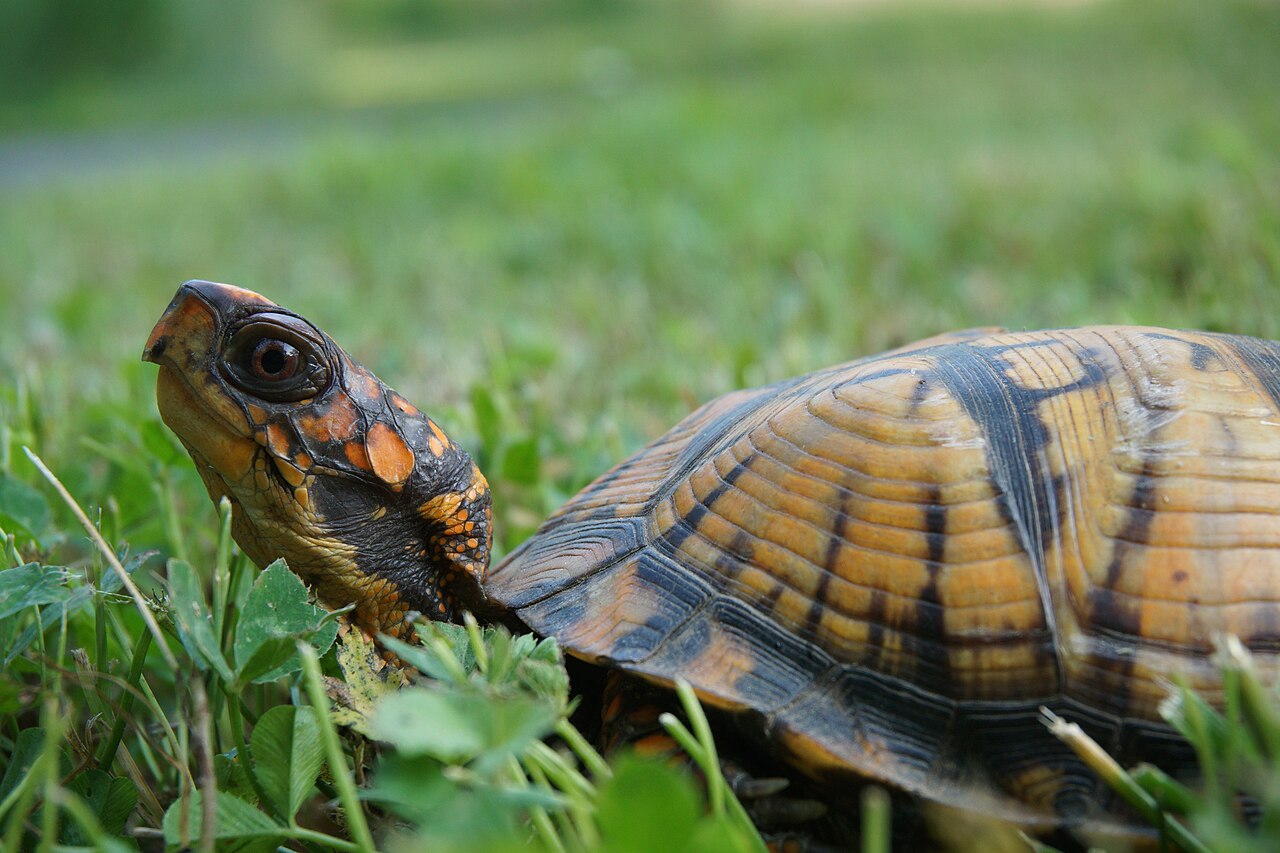
A high, domed upper shell with yellow or orange markings on a dark brown background is the first clue, and the hinge across the lower shell is the confirmation. No pond turtle in the eastern US can fold its plastron shut, which is why a turtle walking on dry land that seals itself into a closed box is almost certainly this species.
Adults reach 4.5 to 6 in (11 to 15 cm) of shell length, so a full grown animal fits comfortably in two hands. The pattern varies enormously between individuals, from bold yellow starbursts to nearly plain olive, and it is not a reliable way to tell subspecies apart in the field.
Males usually have red or orange eyes, a slight hollow in the plastron and a thicker tail, while females tend toward brown or yellow eyes and a flat plastron. If you find a much smaller version with a soft looking shell and a pale keel down the back, see our guide to the hatchling box turtle instead.
Eastern box turtle range and habitat
The species occupies moist deciduous woodland, forest edges, old fields and the brushy margins of wetlands across the eastern US, from southern Maine down to Georgia and west into Illinois, Tennessee and eastern Kansas. It is a woodland animal that tolerates suburbs, which is why so many sightings happen on lawns and driveways.
Individuals stay astonishingly local. A single turtle will spend its entire life inside a home range that often measures less than 5 acres, using the same brush piles, the same soft soil for nesting and the same damp hollows in July. That fidelity is the reason relocation is so damaging: a moved turtle spends the rest of its life wandering to get home.
Can eastern box turtles go in water?

Yes, but only shallow water. Box turtles are poor swimmers with flat, unwebbed feet, and they drown in steep sided ponds and pools. What they do use is puddles, seeps and the shallow edge of a creek, where they soak for hours in hot weather to rehydrate and cool down.
That habit separates them cleanly from the semi aquatic turtles that share their range. The eastern painted turtle and the eastern mud turtle both spend most of their time in the water and only come ashore to bask or nest, while a box turtle on land is simply at home.
What do eastern box turtles eat?

They are omnivores that shift with age and season. Hatchlings and juveniles are mostly carnivorous, taking earthworms, slugs, snails, beetles and caterpillars, while adults eat a far higher share of plant matter: berries, fallen fruit, flowers and a remarkable quantity of mushrooms.
The mushroom habit has a strange consequence. Box turtles can eat fungi that are toxic to people, and old accounts of poisoning after eating box turtle meat are usually traced to that. It is another good reason to admire the animal rather than handle it as food.
In a garden, a resident box turtle is quietly useful. It works slugs, snails and soft bodied insects out of the mulch all summer, and it does no damage beyond the occasional bite out of a low strawberry.
Are eastern box turtles harmless, and does a box turtle bite hurt?
Eastern box turtles are harmless. They carry no venom, they cannot injure a person, and their first response to a human is to pull in and close the shell rather than defend themselves. Bites are rare and almost always the result of a finger being mistaken for food.
A box turtle bite does not really hurt. The jaws are strong enough to crush a snail and the beak is sharp, so a determined bite from a large adult can pinch and occasionally break the skin, but it is nothing like the wound a snapping turtle inflicts. Wash the spot and that is the end of it.
The real health consideration is Salmonella, which reptiles carry in their gut without being sick. Wash your hands after any contact, and keep turtles away from kitchen surfaces and from children under five.
What is a predator of a box turtle?
Adults are well protected by the closing shell, so the serious predation falls on eggs and hatchlings. Raccoons, skunks, foxes, opossums and crows dig up nests, and a large share of clutches never produce a single turtle. Hatchlings, with shells that stay soft for their first years, are also taken by snakes, shrews and large birds.
Adult mortality is mostly caused by people. Cars kill enormous numbers each year, mowers and string trimmers injure turtles hidden in tall grass, and dogs chew shells badly enough to be fatal. A species that survives by living a century simply cannot absorb that rate of adult loss.
Can you keep an eastern box turtle as a pet, and in what states are box turtles illegal?
Taking a wild eastern box turtle home is illegal in most of its range and is a bad idea everywhere else. Many states, among them North Carolina, Virginia, Tennessee, Indiana, Illinois, Michigan, Maryland, Massachusetts, Connecticut and New York, either ban collection outright or restrict it to zero animals per person. Check your own state wildlife agency before assuming anything, because rules change.
Where captive bred animals are legal, they are a decades long commitment, not a starter pet. A single adult needs a large outdoor pen with real soil, shade, a shallow soaking dish and a genuine winter, and captive bred stock from a licensed breeder costs roughly 150 to 400 USD. The animal may well outlive the person who bought it.
Wild caught individuals do poorly indoors and stop reproducing, which is one of the drivers behind the species being listed as Vulnerable by the IUCN. The population math is brutal: removing a single breeding adult costs a local population more than losing an entire nest.
What to do if you find an eastern box turtle in your yard
Leave it alone. A box turtle crossing your lawn is inside its own home range and knows exactly where it is going, so watching it from a few feet away is the whole correct response. Do not take it indoors, do not feed it, and do not carry it to a park or a pond that looks nicer.
The one time to intervene is a turtle on a road. Move it across in the direction it was already facing, set it down off the shoulder and walk away. Carrying it back to the side it came from only means it tries again an hour later.
If a turtle is injured, call a licensed wildlife rehabilitator rather than treating it yourself; cracked shells heal remarkably well with proper care. In autumn, resist the urge to tidy the brush pile it disappears into, because box turtles dig into loose soil and leaf litter to overwinter much as other species do when they shut down for the season.
Frequently Asked Questions
What is the lifespan of a box turtle?
Wild eastern box turtles commonly live 50 to 80 years, and verified individuals have passed 100. They do not breed until age 7 to 10, which means a population recovers from losses extremely slowly and depends on a handful of very old adults surviving decade after decade.
Are eastern box turtles dangerous to people or pets?
No. They have no venom, they do not chase or threaten anything, and their defense is to close the shell and wait. The only realistic risk is Salmonella from handling, which plain soap and water solves. Dogs are far more dangerous to turtles than the reverse.
How much does it cost to buy a box turtle?
Captive bred eastern box turtles from licensed breeders run roughly 150 to 400 USD, with unusual color forms higher. The purchase price is the small part. A proper outdoor enclosure, veterinary care from a reptile vet and 50 plus years of upkeep cost far more than the animal.
How can I tell an eastern box turtle from other box turtle subspecies?
Eastern box turtles have four toes on each hind foot and a high, strongly patterned dome. Three toed box turtles, common further west, show three hind toes and much plainer shells. Range is the fastest check, since the subspecies barely overlap outside a narrow zone in the Mississippi valley.
Why should a box turtle never be relocated?
Each turtle lives inside a home range it learned as a juvenile, usually under 5 acres. Moved even a mile away, it walks in the direction of home for months or years, crossing roads it does not know. Most relocated box turtles die, which is why wildlife agencies treat relocation as harm.
For state by state rules and current conservation status, the US Fish and Wildlife Service and your state wildlife agency are the authoritative starting points. Readers interested in the region’s other native reptiles can continue with our guide to the mud turtle.