Eastern Mud Turtle: Size, Diet, Bite, and Care Explained
The eastern mud turtle (Kinosternon subrubrum) is a small, plain-shelled freshwater turtle of the eastern United States that rarely grows past 4 inches (10 cm) and spends most of its life walking along the bottom of shallow, muddy water instead of swimming in open ponds. If you found a dark, smooth-shelled turtle the size of a deck of cards in a ditch, a marsh edge, or crossing a wet road after rain, this is the species you most likely met.
Its plain looks hide a genuinely unusual animal: a double-hinged plastron that closes like a box, musk glands that work as a chemical defense, and a documented life span that runs past 40 years. This guide covers identification, range, diet, behavior, whether the species bites, and what the law and the tank math actually say about keeping one.
The eastern mud turtle is a 3 to 4 in (8 to 10 cm) semi-aquatic turtle found from Connecticut to Florida and west to Texas. It has a smooth olive-brown shell, a hinged plastron, and chin barbels. It is not a snapping turtle, it bites only defensively, and adults need at least a 20-gallon long tank.
| Quick Fact | Eastern Mud Turtle |
|---|---|
| Scientific name | Kinosternon subrubrum |
| Adult shell length | 3 to 4 in (8 to 10 cm), rarely 5 in (13 cm) |
| Weight | About 4 to 8 oz (110 to 230 g) |
| Range | Atlantic and Gulf coastal plain, Connecticut to Texas, north up the Mississippi Valley |
| Diet | Omnivore: insects, snails, crustaceans, carrion, some plant matter |
| Life span | Commonly 15 to 25 years, documented past 40 in captivity |
| Temperament | Shy, musks and hides far more often than it bites |
What Is an Eastern Mud Turtle?
The eastern mud turtle belongs to the family Kinosternidae, the American mud and musk turtles, a group defined by small size, a hinged lower shell, and a bottom-walking lifestyle. It is a close relative of the musk turtles (Sternotherus) and shares their habit of releasing a sharp odor when handled roughly.
Two subspecies are generally recognized. The nominate eastern mud turtle (K. s. subrubrum) occupies the Atlantic coastal plain, while the Mississippi mud turtle (K. s. hippocrepis) ranges through the lower Mississippi Valley and shows two pale stripes on the side of the head. The Florida mud turtle, once treated as a third subspecies, is now usually listed as its own species, Kinosternon steindachneri.
Unlike basking specialists such as the painted turtle, this species is rarely seen sunning on a log. It prefers to warm up in shallow water or under floating mats of vegetation, which is why plenty of people who live beside good mud turtle habitat have never knowingly seen one.
Eastern Mud Turtle Identification: Size, Shell, and Color
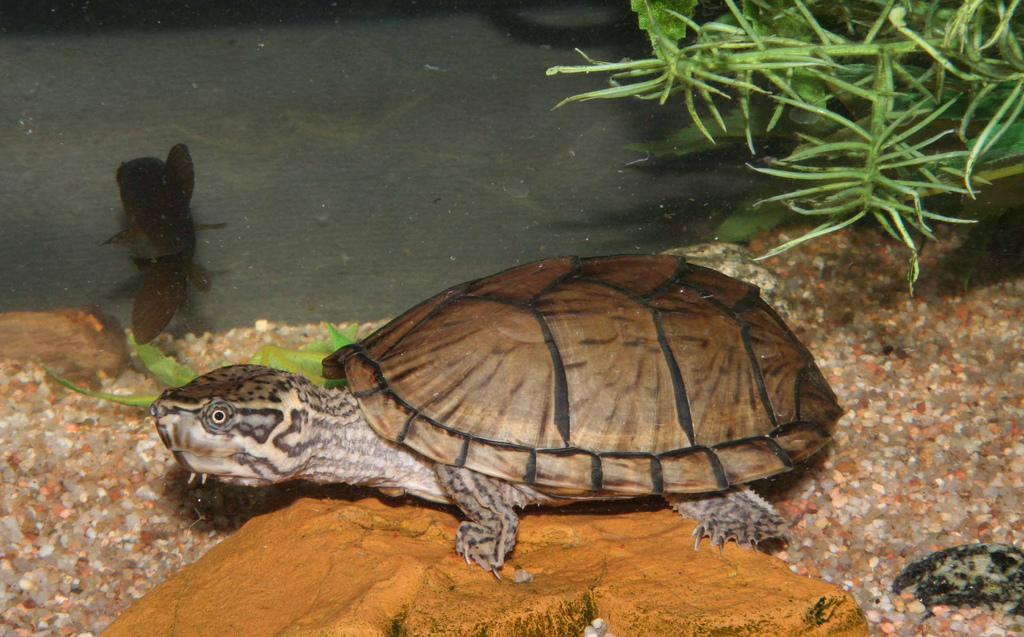
An adult eastern mud turtle has an oval carapace 3 to 4 in (8 to 10 cm) long, smooth and unmarked, colored olive, dark brown, or nearly black. There are no keels, no serrations along the rear edge, and no yellow stripes on the shell. Wet specimens often look glossy and almost featureless, which is the single most useful field mark.
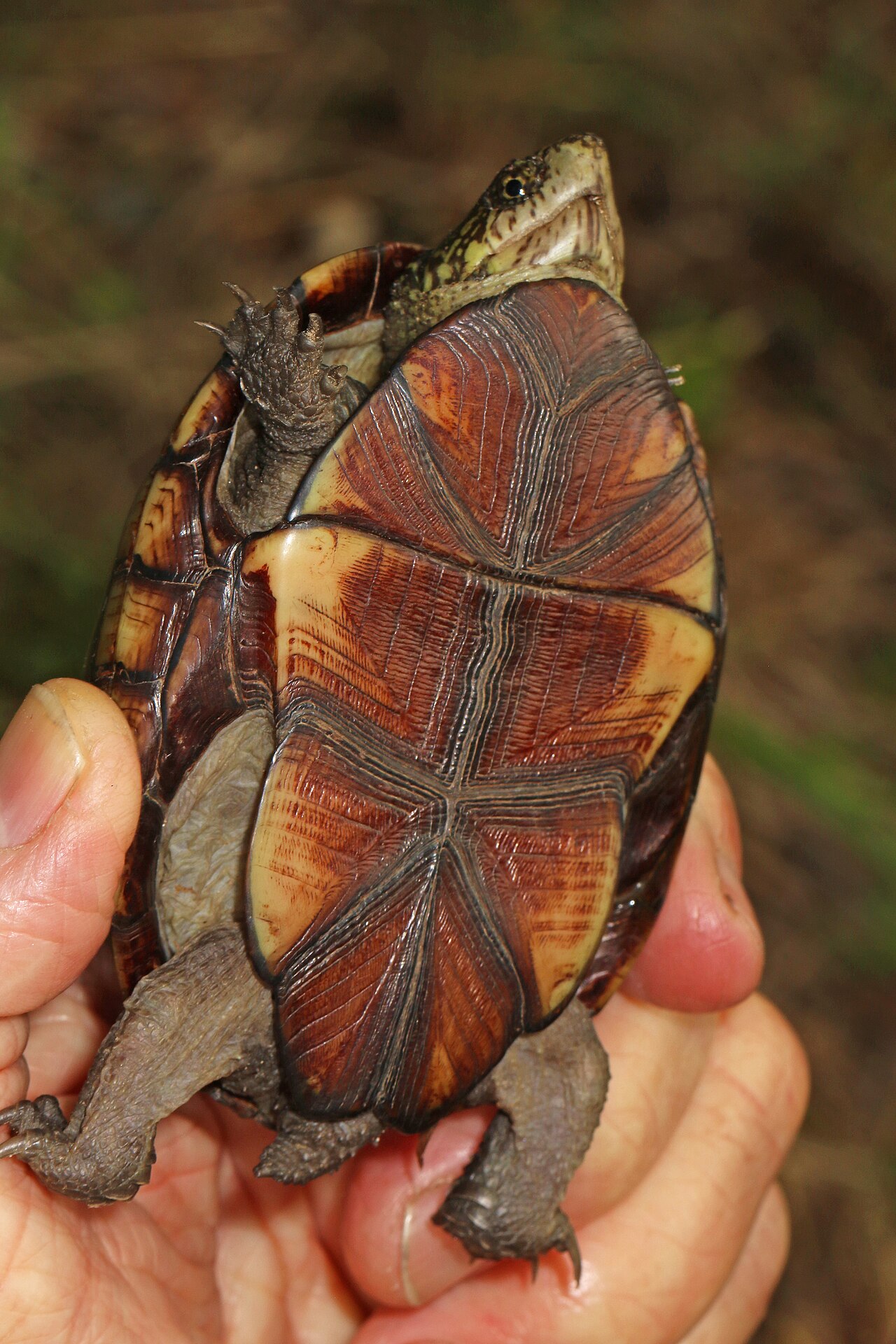
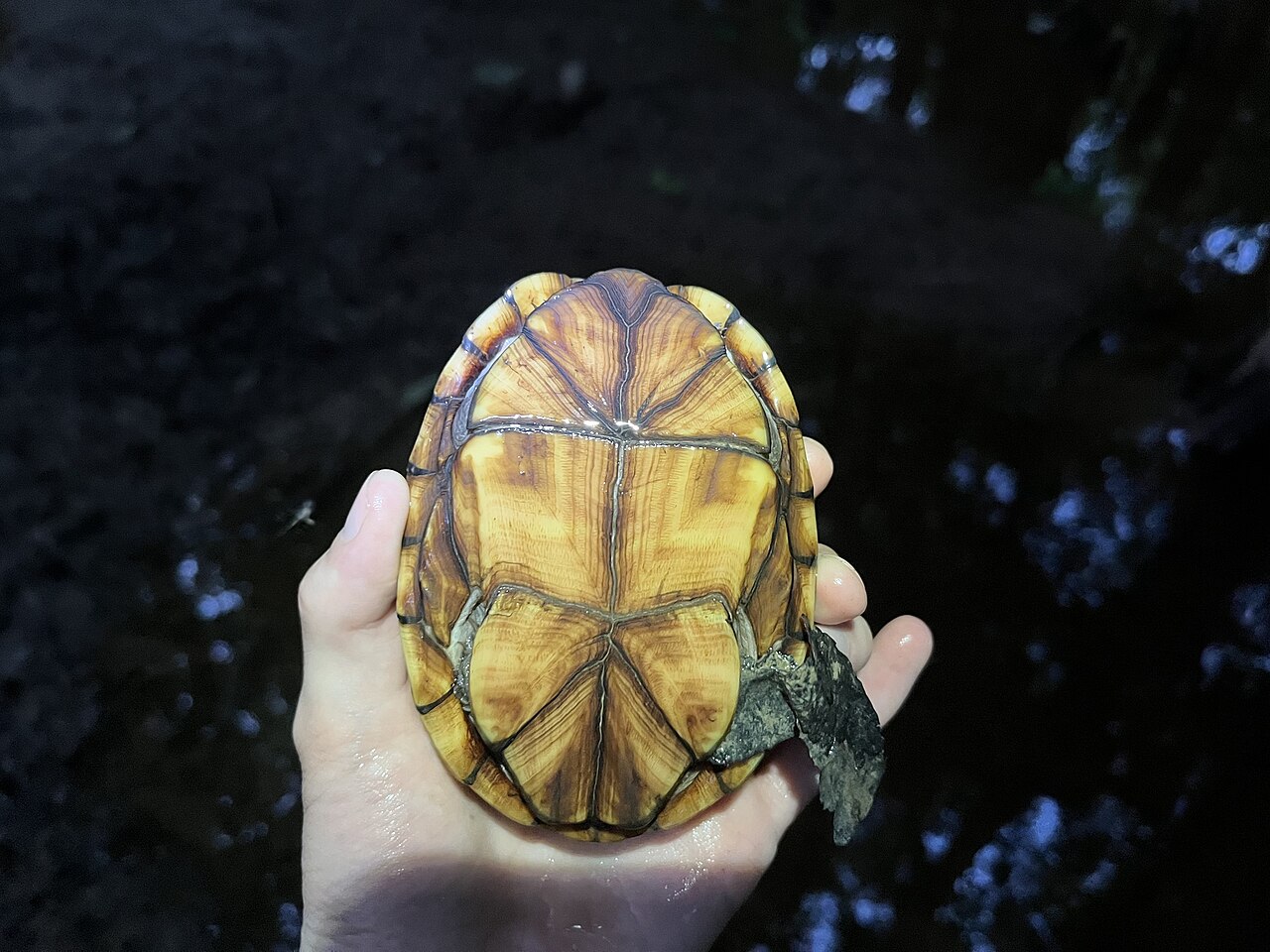
Turn the animal over carefully and the identification gets easier. The plastron is yellowish to brown and carries two hinges, so the turtle can pull both the front and rear lobes up against the carapace and close itself in. Two pairs of fleshy barbels hang from the chin and throat, a feature shared with musk turtles but absent in pond sliders and box turtles.
Males have longer, thicker tails ending in a blunt nail, plus rough patches on the inner hind legs that help them grip during mating. Females have short tails and a flatter plastron. Hatchlings are around 1 in (2.5 cm) and look darker and rougher than adults, similar in size to a baby box turtle but with a much plainer shell.
Is an Eastern Mud Turtle a Snapping Turtle?
No. The eastern mud turtle is not a snapping turtle, and the two are not closely related. Common snapping turtles (Chelydra serpentina) reach 8 to 18 in (20 to 46 cm) of shell, weigh 10 to 35 lb (4.5 to 16 kg), and carry a long, saw-toothed tail and a small, cross-shaped plastron that leaves the legs exposed.
The confusion is understandable, because both turtles are dark, muddy, and bottom-dwelling, and juvenile snappers pass through a size range that overlaps with adult mud turtles. Check the tail and the underside: a snapper’s tail is nearly as long as its shell and ridged like a saw blade, and its plastron is too small to close. A mud turtle’s tail is short and its plastron shuts like a door.
Behavior separates them too. A cornered snapper lunges and strikes hard enough to matter, which is why a snapping turtle bite is a genuine injury risk. A cornered mud turtle withdraws, clamps its shell shut, and musks.
Where Eastern Mud Turtles Live
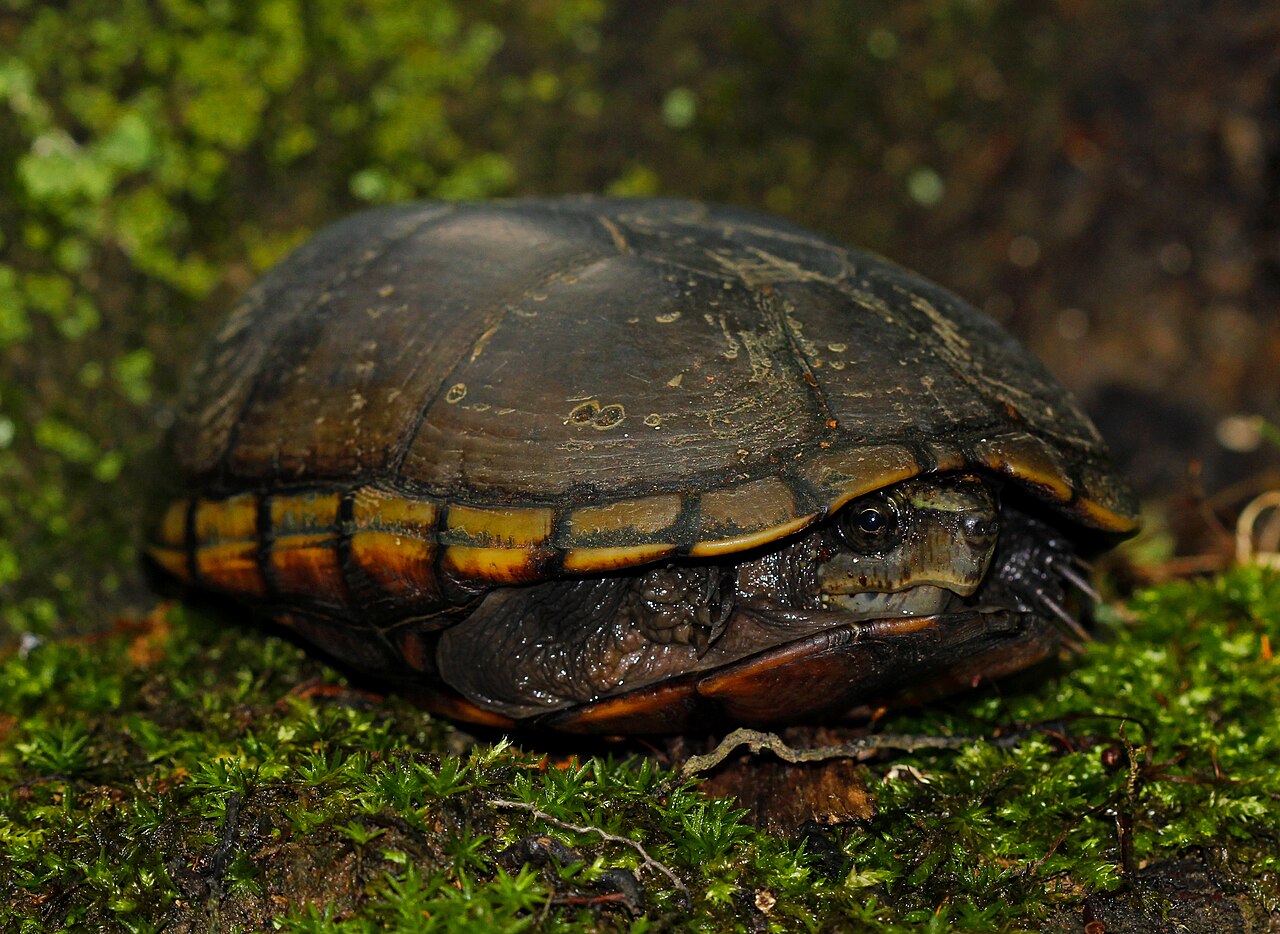
The range runs along the Atlantic and Gulf coastal plain from southern Connecticut and Long Island south through Florida, west to eastern Texas, and north through the Mississippi Valley into Missouri, Illinois, and Indiana. Populations at the northern edge are scattered and in several states carry legal protection.
Preferred habitat is shallow, slow, soft-bottomed water: cypress swamps, wet meadows, farm ponds, drainage ditches, oxbows, and the margins of tidal marshes. The species tolerates brackish water better than most freshwater turtles and turns up on barrier islands and in salt marsh creeks where few other turtles live.
Eastern mud turtles are also surprisingly terrestrial. They travel overland between wetlands, bury themselves in soil or leaf litter for weeks at a time, and are frequently found hundreds of feet from open water. Many road-crossing records come from this habit rather than from nesting.
What Eastern Mud Turtles Eat
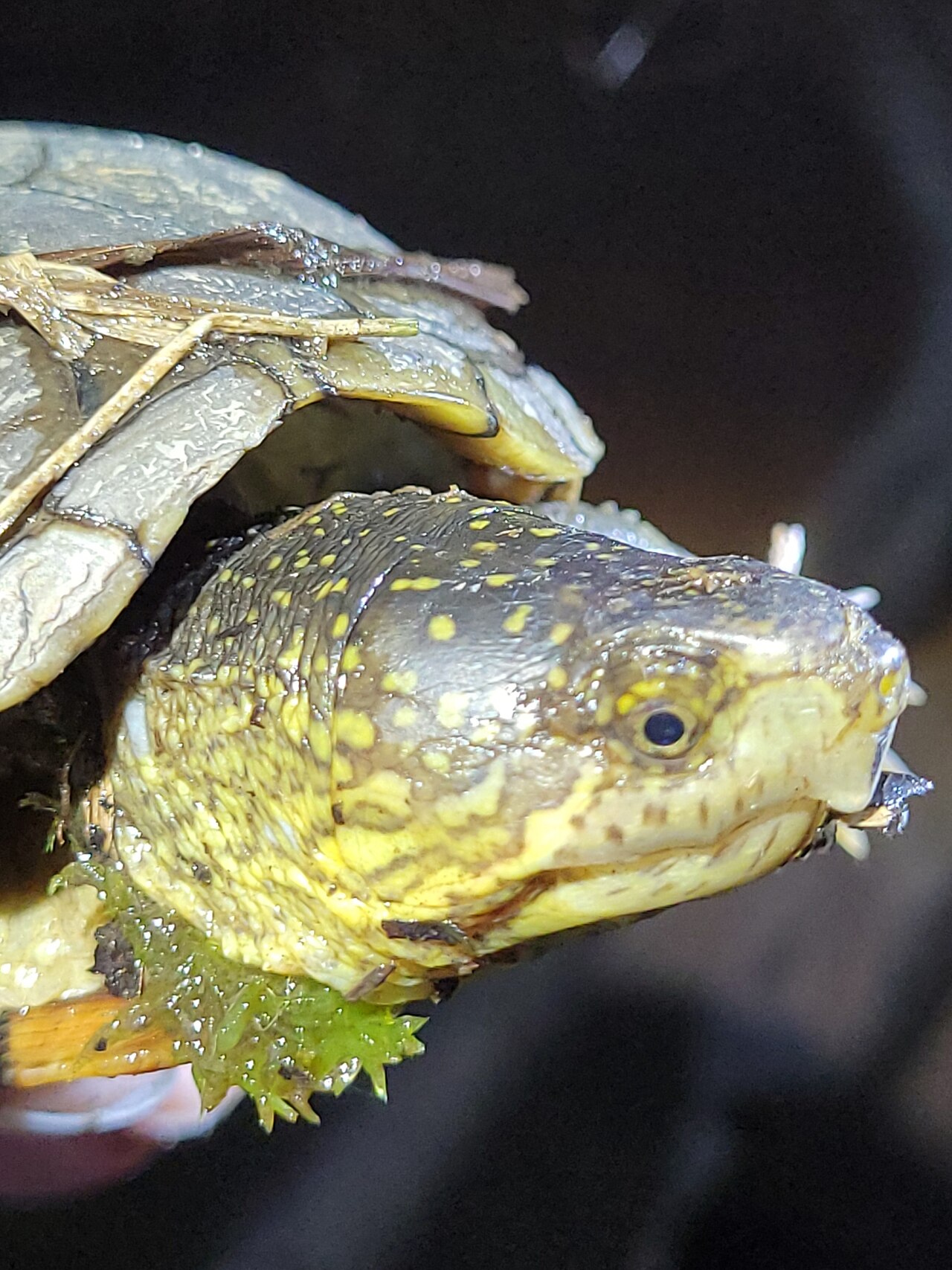
This is an opportunistic omnivore that forages by walking along the bottom and probing mud and vegetation. The diet is dominated by aquatic insects and their larvae, snails, small crustaceans, worms, tadpoles, and carrion. Aquatic plants and algae are eaten regularly but make up a smaller share than in sliders.
Prey is taken by a quick forward lunge of the head, and the jaws have crushing surfaces suited to snail and clam shells. Because the species is a poor swimmer, nearly all feeding happens in water shallow enough for the turtle to keep its feet on the substrate and stretch its neck to the surface for air.
In captivity a varied diet works best: a quality aquatic turtle pellet as the base, plus earthworms, crickets, blackworms, and the occasional piece of thawed fish. Feed adults every two to three days rather than daily, since kinosternids gain weight easily in a small tank.
Eastern Mud Turtle Lifespan and Life Cycle
Females reach maturity at 5 to 8 years and lay 1 to 6 elongated, hard-shelled eggs in a shallow nest, sometimes in leaf litter or even in a muskrat lodge rather than in dug soil. Two clutches per season are normal in the south. Incubation runs 75 to 100 days and, as in most turtles, nest temperature influences the sex of the hatchlings.
Typical wild life spans run 15 to 25 years, with well-kept captives documented past 40. That longevity is the reason casual collection hurts local populations so much: adults are built to breed for decades, and a population cannot absorb the loss of breeding females the way a short-lived species can.
For a sense of scale among pet reptiles, a mud turtle outlives most lizards by a wide margin but falls short of the sulcata tortoise, which can pass 70 years on the right diet.
Do Eastern Mud Turtles Bite?
Yes, eastern mud turtles can bite, but they do it far less readily than their reputation suggests, and the bite of a 4 in (10 cm) turtle rarely breaks skin on an adult hand. The jaws are strong for the animal’s size and built for crushing snails, so a firm bite pinches hard and can leave a bruise or a shallow scrape.
Bites almost always come from one of three situations: a turtle grabbed from above, a turtle held while it is hungry and mistakes a finger for food, or a turtle picked up during an overland move when it is already stressed. Given any option, the animal withdraws into its shell and closes the hinges instead of fighting.
If you are bitten, wash the wound with soap and water and watch it for a few days. Reptile mouths carry bacteria, including Salmonella, and any puncture that reddens or swells needs medical attention. The CDC recommends washing hands after every contact with a turtle or its water, regardless of whether a bite occurred.
Can You Hold a Mud Turtle?
You can hold a mud turtle, and the safe grip is from the sides of the shell just behind the front legs, with the animal kept low over a table or your lap. Never lift a turtle by the tail: the tail carries the spine, and lifting that way can cause permanent injury.
Expect musk. Mud turtles have glands at the shell bridge that release a pungent yellowish fluid when the animal feels threatened, and it takes soap to get the smell off skin. The habit gives their close relatives the name stinkpots, and it works: most predators drop the turtle immediately.
Handling should also stay short. Turtles do not enjoy being held, and every minute out of water is a stress event, not enrichment. Wash your hands afterward, and keep young children from holding turtles at all, since the Salmonella risk falls hardest on them.
Can Eastern Mud Turtles Be Pets?
Eastern mud turtles can be kept as pets where state law allows, and captive-bred animals make hardy, low-drama residents that stay small for life. The species handles a modest tank better than any slider or cooter, tolerates a wide temperature range, and eats almost anything offered.
The legal side matters more than most buyers expect. Federal rules prohibit the commercial sale of turtles with a shell under 4 in (10 cm), which covers virtually every mud turtle hatchling, and several states protect wild kinosternids outright or cap collection at one animal. Check your state wildlife agency before you buy or collect anything; the U.S. Fish and Wildlife Service maintains links to state regulations.
Take a wild turtle home and you remove a breeder from a slow-reproducing population, and you import whatever parasites it carries. Buy captive-bred instead, the same rule that applies to popular pet reptiles like the mud turtle group as a whole.
Can a Mud Turtle Live in a 20 Gallon Tank?
A single adult eastern mud turtle can live in a 20-gallon long tank, which is the practical minimum, though a 29 or 40-gallon breeder gives a much better result. Floor space matters more than water volume here, because the turtle walks the bottom rather than swimming laps.
Keep the water shallow, roughly 6 to 10 in (15 to 25 cm), with plenty of structure the turtle can climb to reach the surface. Mud turtles are weak swimmers and drown in deep, open tanks with nothing to brace against. Add a dry basking platform, a UVB bulb, a basking spot near 90 F (32 C), and water at 72 to 78 F (22 to 26 C).
Filtration should be rated for at least twice the actual water volume, since kinosternids are messy eaters. Two adults in a 20-gallon tank is too many, and two males will fight regardless of tank size.
Do Eastern Mud Turtles Hibernate?
Northern populations overwinter, but not always underwater. Eastern mud turtles frequently spend the cold months buried in soil, leaf litter, or stream banks on land, sometimes several hundred feet from the nearest wetland, which is unusual among North American freshwater turtles.
In the Deep South the pattern flips. Turtles there may stay active through mild winters and instead aestivate during summer drought, sealing themselves into mud when their ditch or pond dries out and waiting weeks for rain. Both behaviors are metabolic shutdowns triggered by different stress.
Captive turtles do not need a cold season to stay healthy, and brumating one badly is a real risk. If you want the full picture of how the process works in wild turtles, see our guide on whether turtles hibernate.
Conservation Status and What to Do If You Find One
Globally the eastern mud turtle is considered a species of least concern, but that number hides a patchy reality. Northern populations in New York, Connecticut, New Jersey, Indiana, and Illinois are listed as endangered or of special concern, largely because the small, seasonal wetlands they depend on are the easiest kind of wetland to drain or fill.
Road mortality is the other pressure. A species that regularly walks overland between wetlands loses adults to traffic at a rate its slow reproduction cannot match, and each lost adult female represents decades of future eggs.
If you find one, leave it in place unless it is in immediate danger. Photograph it, note the location, and report the sighting to a state herp atlas or a platform like iNaturalist. Northern records in particular are genuinely useful data, and unlike the widespread softshell turtle, mud turtle distribution at the range edge is still poorly mapped.
Frequently Asked Questions
Do eastern mud turtles bite?
Yes, but seldom. They withdraw into the shell and release musk long before they resort to biting. A bite from an adult feels like a hard pinch and rarely breaks skin. Wash any wound with soap and water, since reptile mouths carry bacteria that can infect even a shallow scrape.
What is the friendliest turtle?
Among commonly kept species, the eastern box turtle and the red-eared slider tolerate people best, and both learn to associate keepers with food. Mud turtles sit in the middle: calm, rarely aggressive, but shy and happiest when left alone. No turtle is friendly in the way a dog is.
Why did my turtle hiss at me?
That sound is not a threat display. A startled turtle pulls its head and legs in fast, and the air forced out of its lungs makes a hiss. It means the animal felt cornered. Move slower, approach from the side rather than from above, and it usually stops.
Do turtles get attached to owners?
Turtles recognize the person who feeds them and will approach the glass at feeding time, which is learned association rather than affection. They do not bond the way social mammals do, and they show no distress when a keeper is absent. Expect recognition, not attachment.
What’s the most aggressive turtle?
The alligator snapping turtle and the common snapping turtle are the most dangerous North American species to handle, though both are defensive rather than aggressive and would rather escape. Softshell turtles bite quickly too. An eastern mud turtle is nowhere near this group.
Can turtles hear you when you talk to them?
Yes, within limits. Turtles lack external ears but detect low-frequency sound and vibration through a thin membrane on the side of the head, hearing best between about 100 and 500 Hz. A low voice registers; a high-pitched one largely does not. They feel footsteps more clearly than speech.