Mud Turtle: Size, Lifespan, and Care of 5 US Species
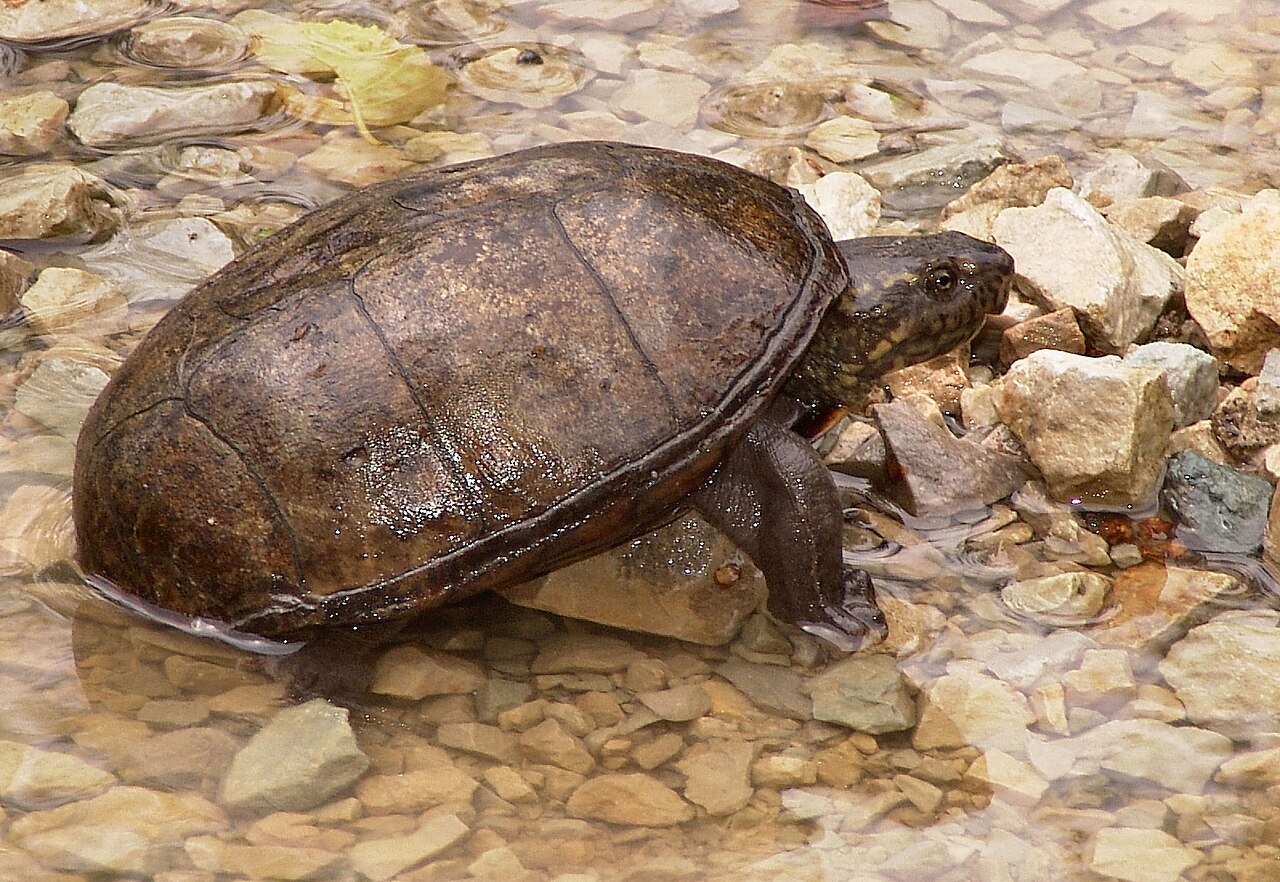
A mud turtle is a small, dark, semi-aquatic turtle of the genus Kinosternon, and adults of the five species found in the United States stay between 3 and 6.5 in (8 to 17 cm) of shell length for life. They spend most of the day walking along the bottom of shallow, muddy water instead of basking on logs, which is why many people who live beside good mud turtle habitat have never seen one.
Mud turtles matter to keepers for the same reason: they are among the few native turtles small enough to house properly in a normal room, and several states allow them in captivity. The trade-off is that they are shy, they bite when cornered, and a wild-caught animal is both illegal in much of their range and a poor pet.
Mud turtles are small Kinosternon turtles reaching 3 to 6.5 in (8 to 17 cm) and living 40 to 50 years. Five species occur in the United States, led by the eastern mud turtle. They need shallow water, soft substrate, and a warm basking spot, and they can be kept legally only where state law allows captive-bred animals.
| Species | Scientific name | US range | Adult shell length |
|---|---|---|---|
| Eastern mud turtle | Kinosternon subrubrum | New York south to Florida, west to Texas | 3 to 4 in (8 to 10 cm) |
| Striped mud turtle | Kinosternon baurii | Florida, Georgia, coastal Carolinas | 3 to 5 in (8 to 13 cm) |
| Yellow mud turtle | Kinosternon flavescens | Nebraska and Kansas south to Texas, Arizona | 4 to 6 in (10 to 15 cm) |
| Sonoran mud turtle | Kinosternon sonoriense | Arizona, New Mexico | 5 to 6.5 in (13 to 17 cm) |
| Rough-footed mud turtle | Kinosternon hirtipes | Big Bend region of Texas only | 4 to 6 in (10 to 15 cm) |
How Big Will a Mud Turtle Get?
A mud turtle will get to 3 to 6.5 in (8 to 17 cm) of straight carapace length depending on species, and the eastern mud turtle, the one most people meet, tops out around 4 in (10 cm). Adult weight runs from 4 to 16 oz (110 to 450 g). Females average slightly larger shells, while males have longer, thicker tails and rough patches on the hind legs used for gripping during mating.
Growth is slow after the first two years. A hatchling emerges at under 1 in (2.5 cm) and reaches adult size in four to six years, which means the animal you buy at the size of a quarter is not going to surprise you later. That predictability is the single biggest practical difference between a mud turtle and a red-eared slider, which triples in shell length.
Mud Turtle Species in the United States
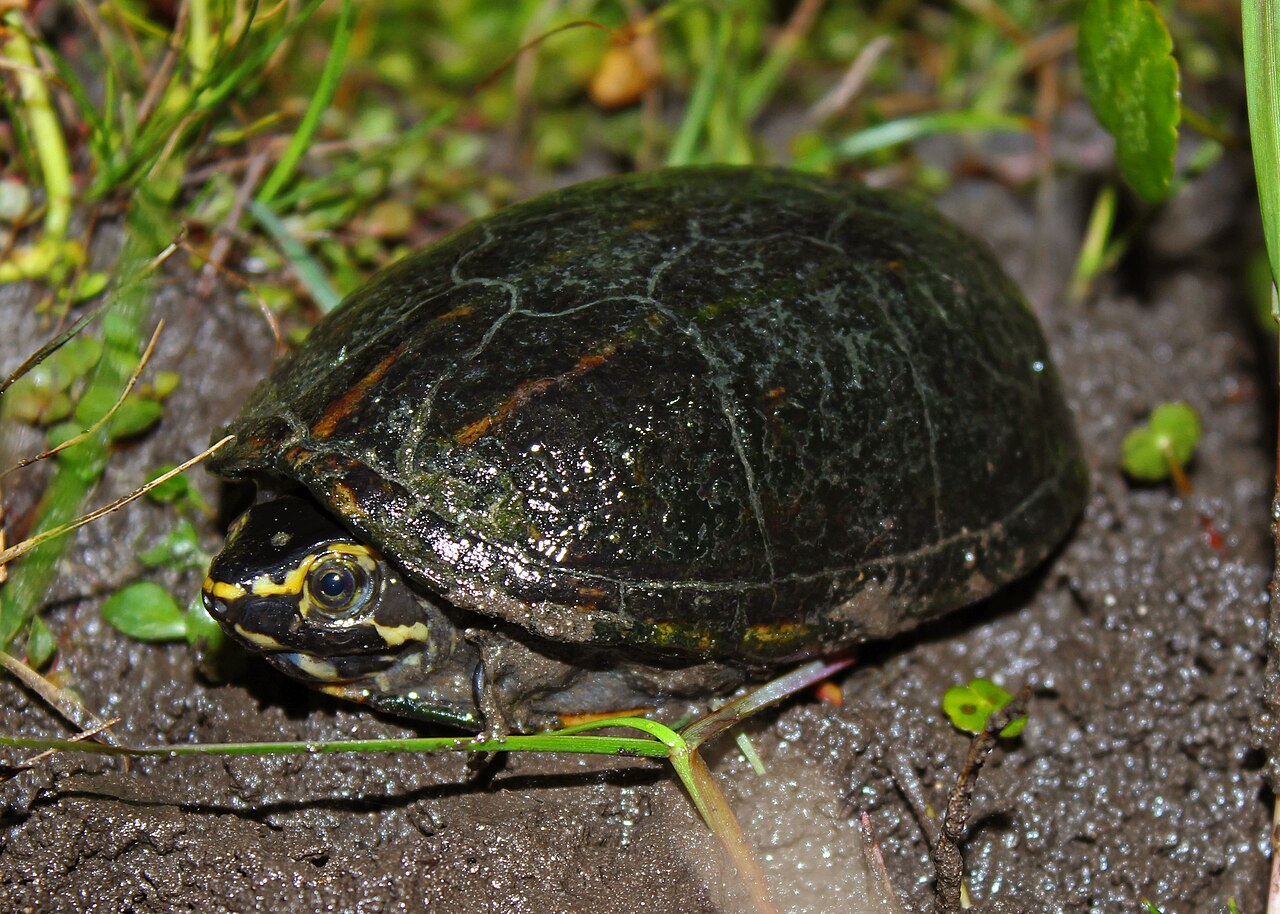
Five species occur north of Mexico. The eastern mud turtle covers the largest range, from Long Island down the Atlantic coastal plain and west into Texas, and it is the plainest looking: an unmarked olive to dark brown shell with no keel. The striped mud turtle carries three pale lines along the carapace, though Florida populations often lack them, and light stripes on the side of the head.
West of the Mississippi the picture changes. The yellow mud turtle has a distinctly yellow chin, throat, and jaw, and it tolerates far drier country, including cattle tanks and temporary pools. The Sonoran mud turtle is the largest of the five and sticks to permanent desert streams in Arizona and New Mexico. The rough-footed mud turtle reaches the United States only in the Big Bend region of Texas, where it is state listed as threatened.
Mud Turtle vs Musk Turtle: How to Tell Them Apart
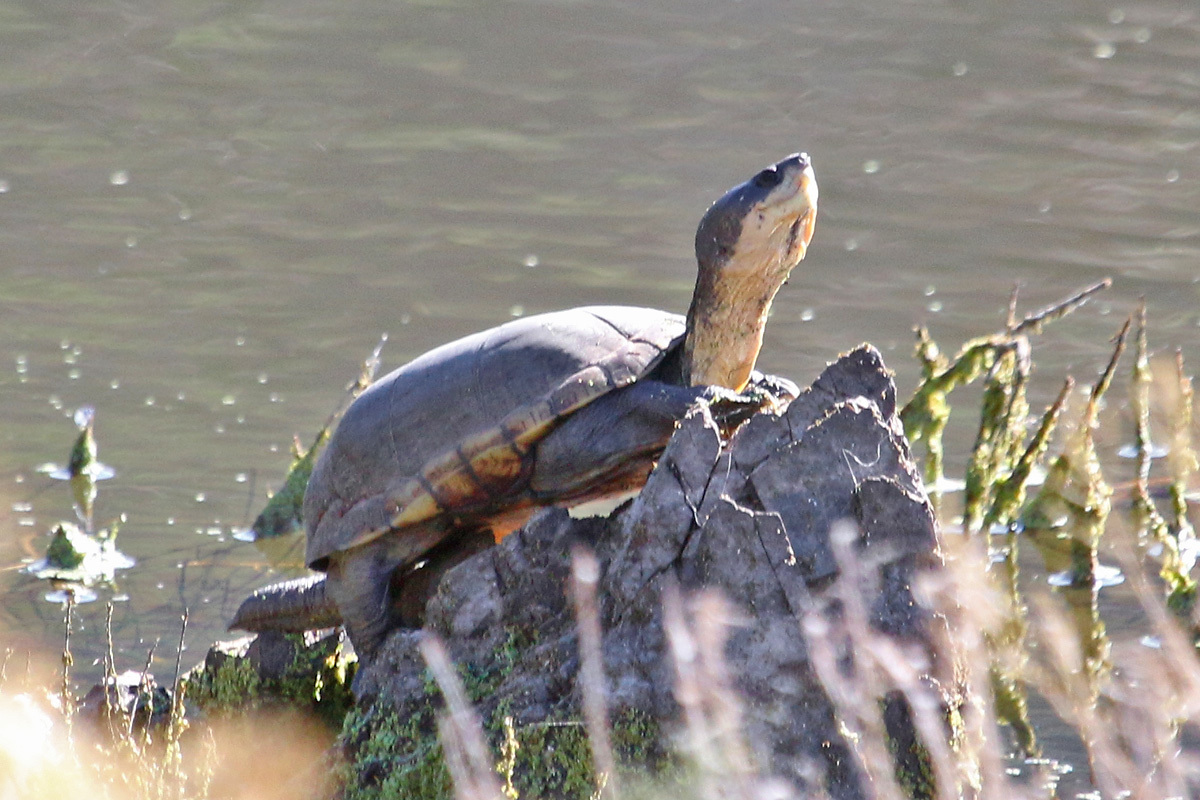
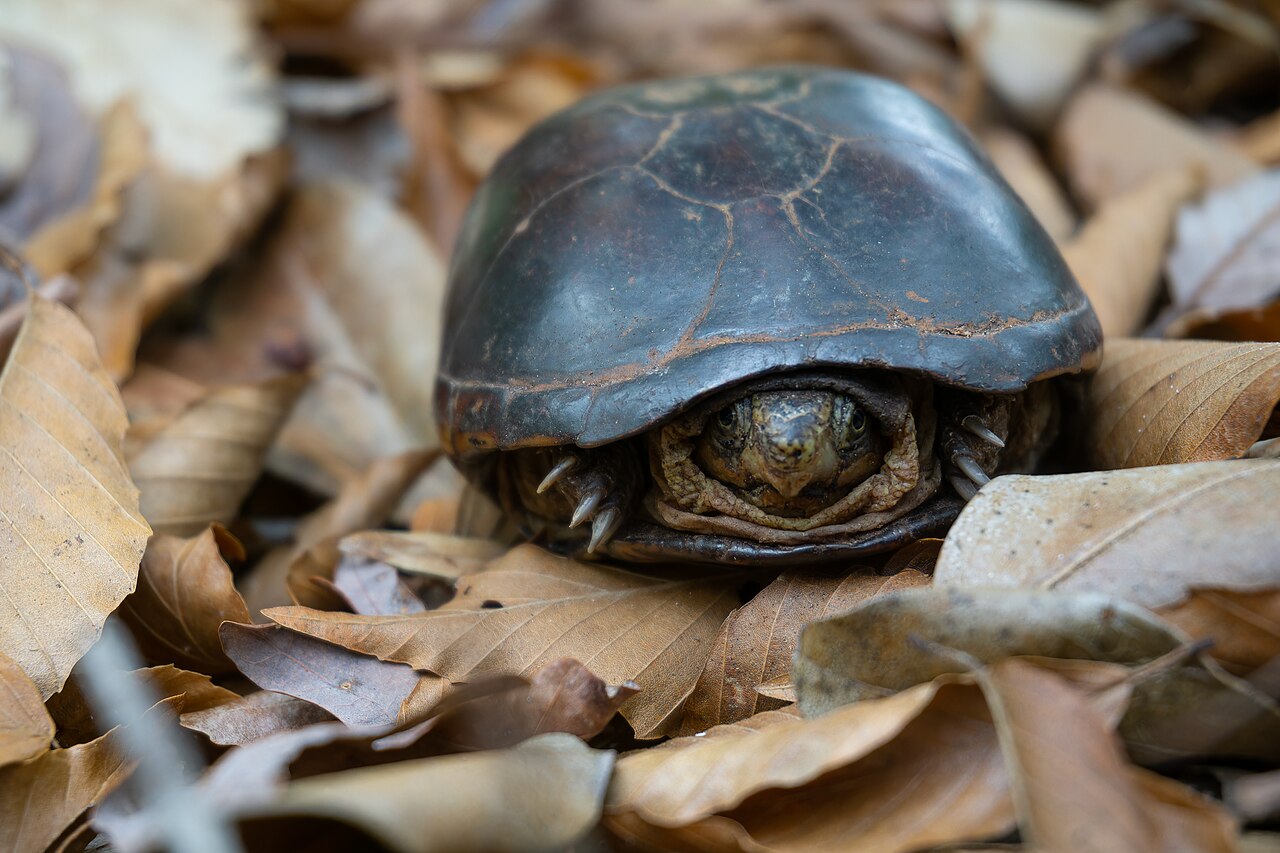
Mud turtles and musk turtles share the family Kinosternidae and look alike at a glance, but two features separate them reliably. Look at the underside: a mud turtle has a broad plastron with two movable hinges that let it close up almost completely, while a musk turtle has a narrow plastron with much more exposed skin at the sides and only a weak front hinge.
The second check is the barbels, the small fleshy projections under the head. Mud turtles have them on the chin only. Musk turtles have them on the chin and on the throat. Musk turtles also usually show a more domed, keeled shell and, in the common musk turtle, two pale head stripes. Shape alone is unreliable in worn adults, so use the plastron and the barbels together.
Where Mud Turtles Live: Habitat and Range
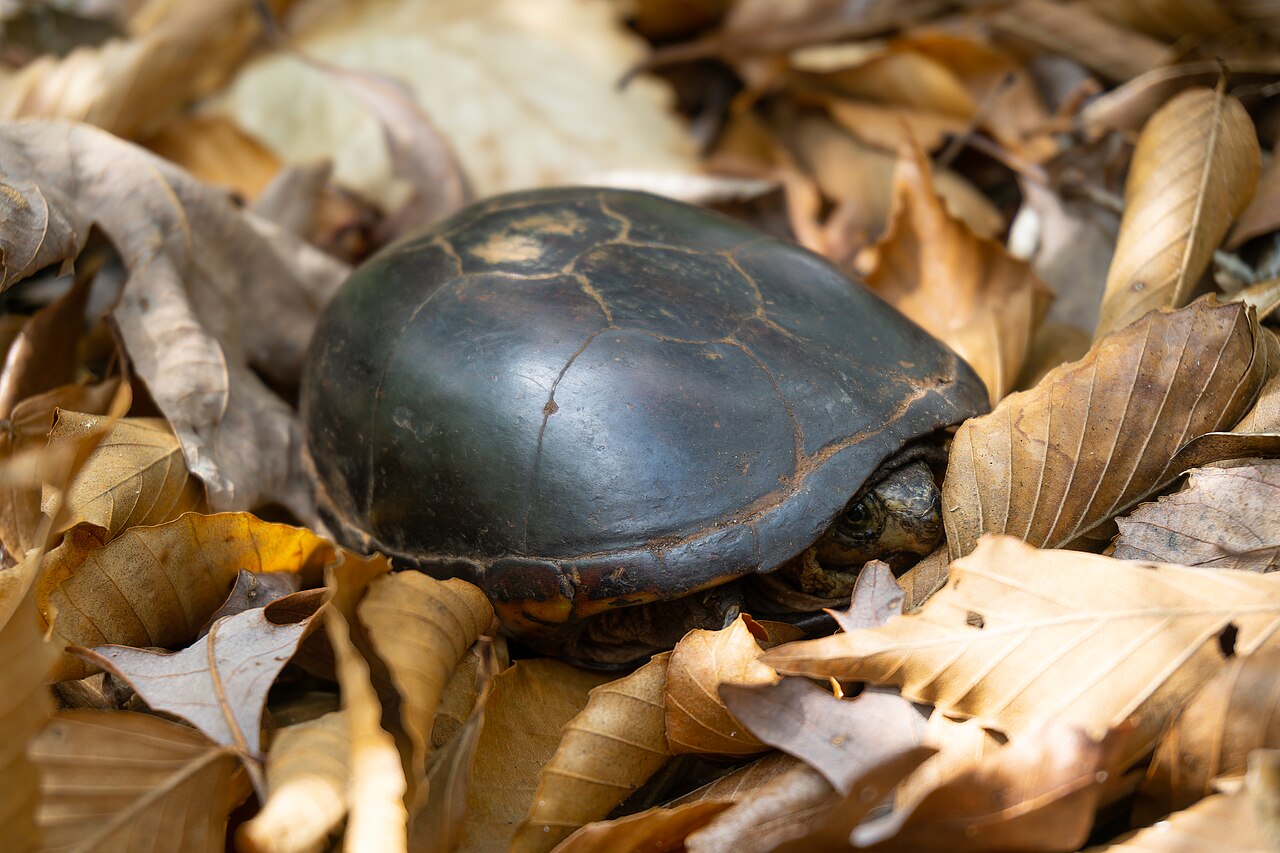
Mud turtles prefer shallow, slow, soft-bottomed water: ditches, farm ponds, cypress swamps, brackish tidal creeks, and seasonal wetlands under 3 ft (1 m) deep. Heavy vegetation matters more than water volume. Eastern mud turtles handle salinity well enough to live in salt marsh, which is unusual among freshwater turtles and explains records from barrier islands.
They are also more terrestrial than their common name implies. Adults regularly walk hundreds of yards overland between wetlands, and radio-tracking studies summarized by university herpetology programs such as the Savannah River Ecology Laboratory show individuals spending weeks buried in upland soil. That overland travel is why road mortality is the leading threat to local populations, and why a mud turtle found crossing a road should be moved in the direction it was already heading.
What Mud Turtles Eat in the Wild and in Captivity
Mud turtles are omnivores that forage by walking the bottom rather than by chasing prey. Wild diets are dominated by aquatic insects, snails, crayfish, worms, tadpoles, small fish, and carrion, with algae and seeds making up a smaller share. They feed underwater and cannot swallow on land, a trait shared with most aquatic turtles.
In captivity, a quality aquatic turtle pellet should form about half the diet, with the rest split between live or frozen protein and plant matter. Earthworms, blackworms, snails, and the occasional piece of thawed shrimp are taken readily. Feed juveniles daily and adults every second or third day; overfeeding is the most common husbandry error and shows up as pyramiding shell growth. Compare this with the more herbivorous adult diet of a painted turtle.
What Is the Lifespan of a Mud Turtle?
A mud turtle lives 40 to 50 years, and marked wild eastern mud turtles have been recaptured past 50. Captive animals with clean water and correct heat commonly pass 30 years, so this is a multi-decade commitment rather than a starter pet. Females do not breed until they are five to seven years old, which is also why local populations recover very slowly from losses.
Most deaths in captivity are avoidable and happen early. Respiratory infection from cold water, shell rot from dirty substrate, and metabolic bone disease from missing UVB or calcium account for the bulk of them. A turtle that stops eating, floats unevenly, or keeps its mouth open needs a reptile vet, not a change of diet.
Can I Keep a Mud Turtle as a Pet?
You can keep a mud turtle as a pet in many states, but only under two conditions: the animal must be captive bred, and your state must allow possession of that species. Several species are protected, including the rough-footed mud turtle in Texas and populations of eastern mud turtle in northern states, and collecting from the wild is illegal in much of the range. Check your state wildlife agency before buying, not after.
As a pet, a mud turtle is best described as a fascinating animal to watch and a poor animal to handle. It is hardy, small, long-lived, and active during the day. It is also shy, quick to hide, and willing to bite. For a household expecting interaction, a mud turtle disappoints; for a keeper who wants a native species in a well-planted aquatic setup, it is one of the better choices.
Can a Mud Turtle Live in a 20 Gallon Tank?
A single adult eastern or striped mud turtle can live in a 20-gallon long tank, and that is the realistic minimum. The usable footprint of 30 by 12 in (76 by 30 cm) gives about eight times the shell length in swimming room, which suits a 4 in (10 cm) turtle. A yellow or Sonoran mud turtle needs 40 gallons, and any pair needs 55 gallons or more because of aggression over basking space.
Footprint matters more than volume. Height above the waterline is wasted on a bottom-walking turtle, so a long, shallow tank or a stock tub beats a tall aquarium of the same gallonage. Add a canister or internal filter rated for twice the water volume, since turtles produce far more waste than fish of comparable size.
Mud Turtle Care: Water, Heat, and Basking
Keep water at 72 to 78 F (22 to 26 C) with a guarded aquarium heater, and provide a dry basking platform under a heat lamp reaching 88 to 92 F (31 to 33 C). Mud turtles bask less than sliders but still need the option, and a turtle that never dries off develops shell problems. A UVB bulb replaced every 9 to 12 months supports calcium metabolism.
Substrate should be sand, fine gravel too large to swallow, or nothing at all for easier cleaning. Add sunken wood, floating plants, and at least two hiding places, because a mud turtle with no cover stays in the corner. Perform a 25 percent water change weekly and a full clean monthly. The same setup logic applies to a softshell turtle, which needs even softer sand.
Do Mud Turtles Like to Be Held?
Mud turtles do not like to be held. Unlike box turtles, they never habituate well to hands, and picking one up triggers the same response as being grabbed by a raccoon: it withdraws, closes its hinged plastron, and may release a strong musk from glands at the shell margin. Persistent handling causes chronic stress and refusal to feed.
Handle only when necessary, for health checks, moves, or vet visits. Support the animal from below with both hands, hold it low over a soft surface, and keep fingers away from the front of the shell. Wash hands afterward, since turtles commonly carry Salmonella. Children should observe rather than hold, which is also the rule for a baby turtle of any species.
Mud Turtle Price and Where to Buy Legally
Captive-bred mud turtles cost 60 to 150 USD for eastern and striped species, and 150 to 300 USD for Sonoran and yellow mud turtles, which are bred in smaller numbers. Expect to spend more on the setup than on the turtle: tank, filter, heater, lamps, and thermostat come to 250 to 450 USD before the first feeding.
Buy from a breeder who states the hatch date and the parent stock, ideally at a regional reptile expo where you can inspect the animal. Federal rules prohibit the sale of any turtle with a shell under 4 in (10 cm) as a pet in the United States, so hatchlings are sold under educational or scientific exemptions. Avoid any seller who cannot say where an adult came from.
Winter Behavior: Brumation and Estivation
Wild mud turtles brumate through the cold months, burying themselves in mud, leaf litter, or upland soil from roughly November to March depending on latitude. Northern eastern mud turtles often overwinter on land rather than underwater, which is unusual. Body processes slow enough that they neither feed nor surface for weeks. Turtle brumation is not true hibernation, since they still respond to warm spells.
They also estivate in summer. When a seasonal pond dries, yellow mud turtles in particular dig into the bottom and wait, sometimes for months. Captive turtles kept at steady indoor temperatures do not need either behavior, and cooling a pet turtle down without a vet-checked health screen is risky. Leave brumation to breeders who need it for reproduction.
Frequently Asked Questions
What is the friendliest turtle?
The eastern box turtle and the red-eared slider are the two friendliest turtles commonly kept, both of which learn to approach their keeper for food. Mud turtles do not reach that level of confidence. If interaction is the goal, a box turtle in a well-planted indoor enclosure gives far more of it than any Kinosternon species.
What’s the most aggressive turtle?
The common snapping turtle and the alligator snapping turtle are the most aggressive turtles in North America, both capable of serious injury. Mud turtles are defensive rather than aggressive: they bite only when held. For scale, a mud turtle bite breaks skin at worst, while a snapping turtle bite can crush bone.
Do turtles get attached to owners?
Turtles recognize their keeper and associate that person with food, and some species clearly learn routines such as feeding time and lamp schedules. That is conditioning, not affection. Mud turtles show it weakly at best; most stay wary for their entire lives regardless of how long they have been in the same enclosure.
Which turtle is best for beginners?
For a first aquatic turtle, a captive-bred common musk turtle or a striped mud turtle is the strongest choice, because both stay under 5 in (13 cm) and tolerate normal indoor conditions. Red-eared sliders are easy but reach 10 to 12 in (25 to 30 cm) and need 100 gallons or more as adults.
Do mud turtles bite?
Yes. A cornered or handled mud turtle will bite, and its jaws are strong for its size because it eats snails and crayfish. The bite pinches and can break skin on a finger, but it causes no lasting damage. Bites are almost always a response to handling, not an unprovoked attack.
Are mud turtles protected by law?
Protection varies by state and species. The rough-footed mud turtle is listed as threatened in Texas, the eastern mud turtle is protected in several northeastern states, and collecting any native turtle is banned outright in some jurisdictions. Always confirm current rules with your state wildlife agency, since several states tightened turtle collection limits after 2020.