Black and White Butterfly: 5 Species and What They Mean
A black and white butterfly in North America is most often one of five species: the zebra swallowtail with its knife-edge stripes and long tails, the white admiral banded in bold white across black wings, the zebra longwing of southern gardens, the checkered white of open fields, or the day-flying eight-spotted forester moth that fools nearly everyone. Which one you saw comes down to three quick features: the pattern (stripes, bands, or checkers), the wing shape (tails or rounded), and where you are standing.
Black and white butterflies also carry an outsized symbolic reputation, sitting at the meeting point of two colors loaded with meaning: transformation and balance, endings and clarity. This guide identifies every common black and white species in the United States, explains the lookalikes, and covers what a black and white butterfly means in folklore and spiritual traditions, so you can name your visitor and decode it in the same read.
| Species | Pattern and Where |
|---|---|
| Zebra swallowtail | White with black stripes, long tails; East, near pawpaw |
| White admiral | Black with one bold white band; Northeast and northern woods |
| Zebra longwing | Long black wings, thin yellow-white stripes; Florida, Gulf South |
| Checkered white | White with gray-black checkers; open fields nationwide |
| Eight-spotted forester | Black with 8 white-cream spots; a day-flying moth |
| Idea leuconoe (rice paper) | Giant white with black veins; butterfly houses only |
A black and white butterfly in North America is usually a zebra swallowtail, a white admiral, a zebra longwing, a checkered white, or the eight-spotted forester, which is a day-flying moth. Tail streamers mean zebra swallowtail; one bold white band across black means white admiral.
Zebra Swallowtail: The Striped Showpiece
The zebra swallowtail (Protographium marcellus) is the most striking black and white butterfly in the eastern United States: greenish-white wings slashed with black zebra stripes, sword-like tails longer than any other native swallowtail, and small red and blue accents at the hindwing base. With a wingspan of 2.5 to 4 inches and a fast, low flight, it reads as a flying pinstripe suit.
Its whereabouts are dictated by one plant. Zebra swallowtail caterpillars eat only pawpaw (Asimina), so the butterfly lives where pawpaw thickets grow: moist woodlands, river bottoms, and forest edges from the Great Lakes to Florida and west to Texas. Find a pawpaw patch in spring and you have found the zebra swallowtail’s entire universe.
Seasonal form is a fun wrinkle: spring individuals are smaller and whiter with shorter tails, while summer broods grow larger, darker, and longer-tailed, enough that early naturalists described them as separate species. If your striped butterfly appeared in April and looked petite, and a bigger, bolder version patrols the same trail in July, you have met both editions of one insect.
White Admiral: The Banded Beauty
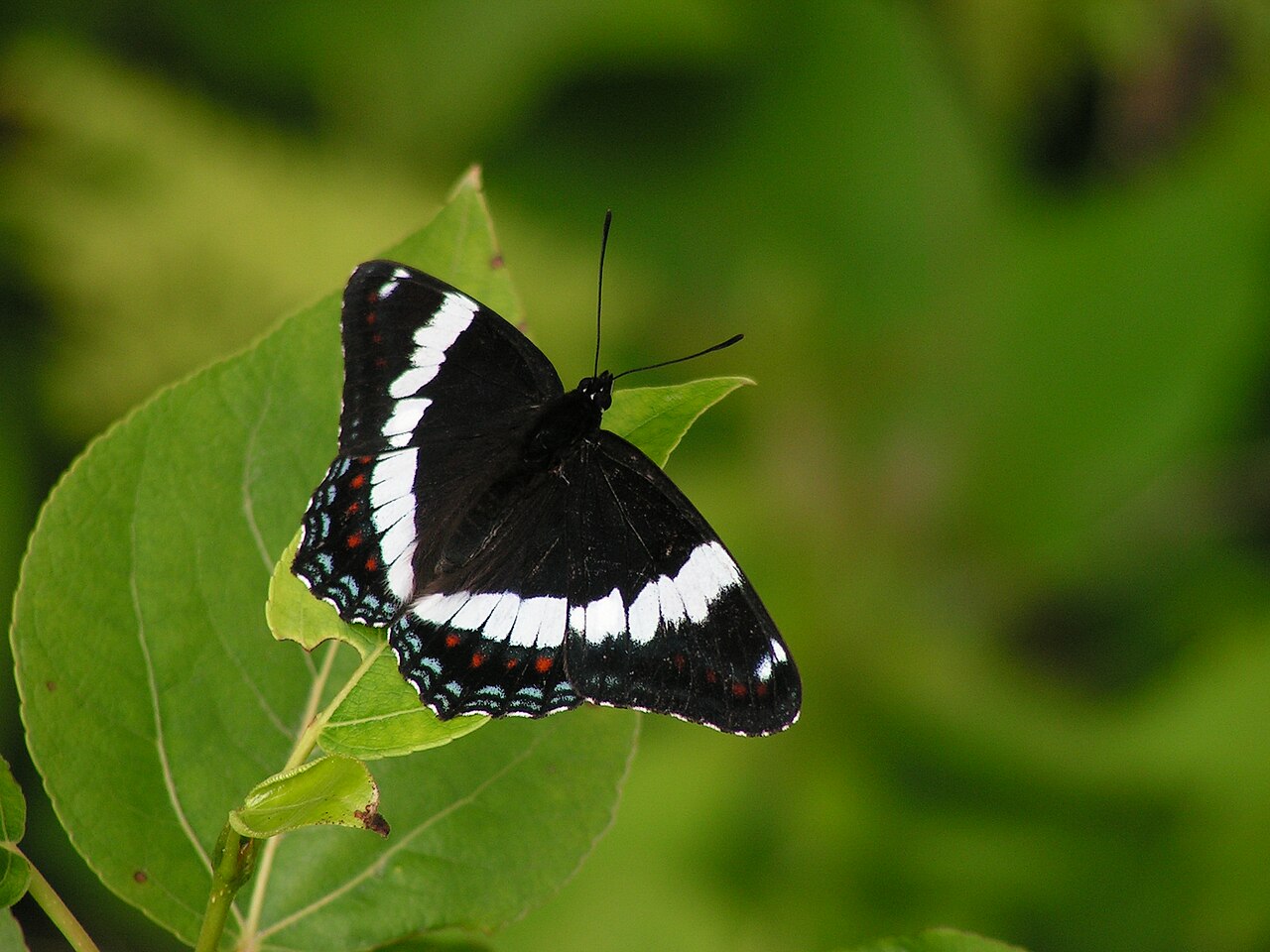
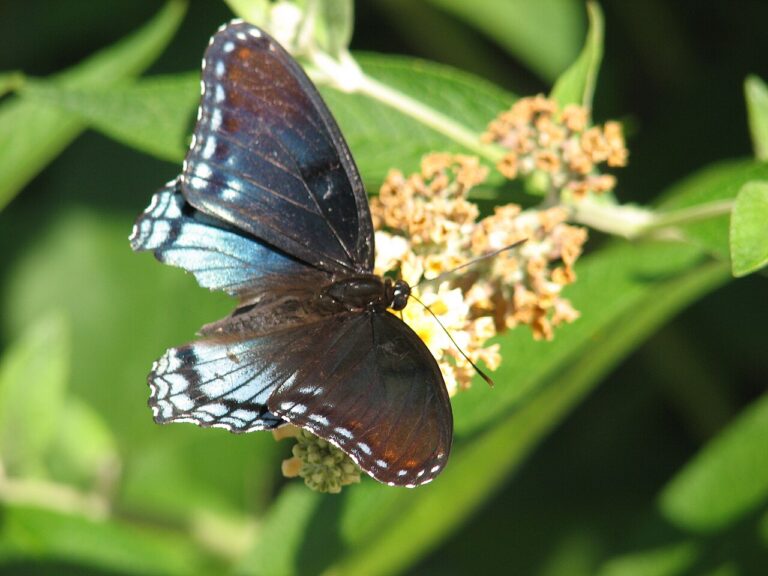
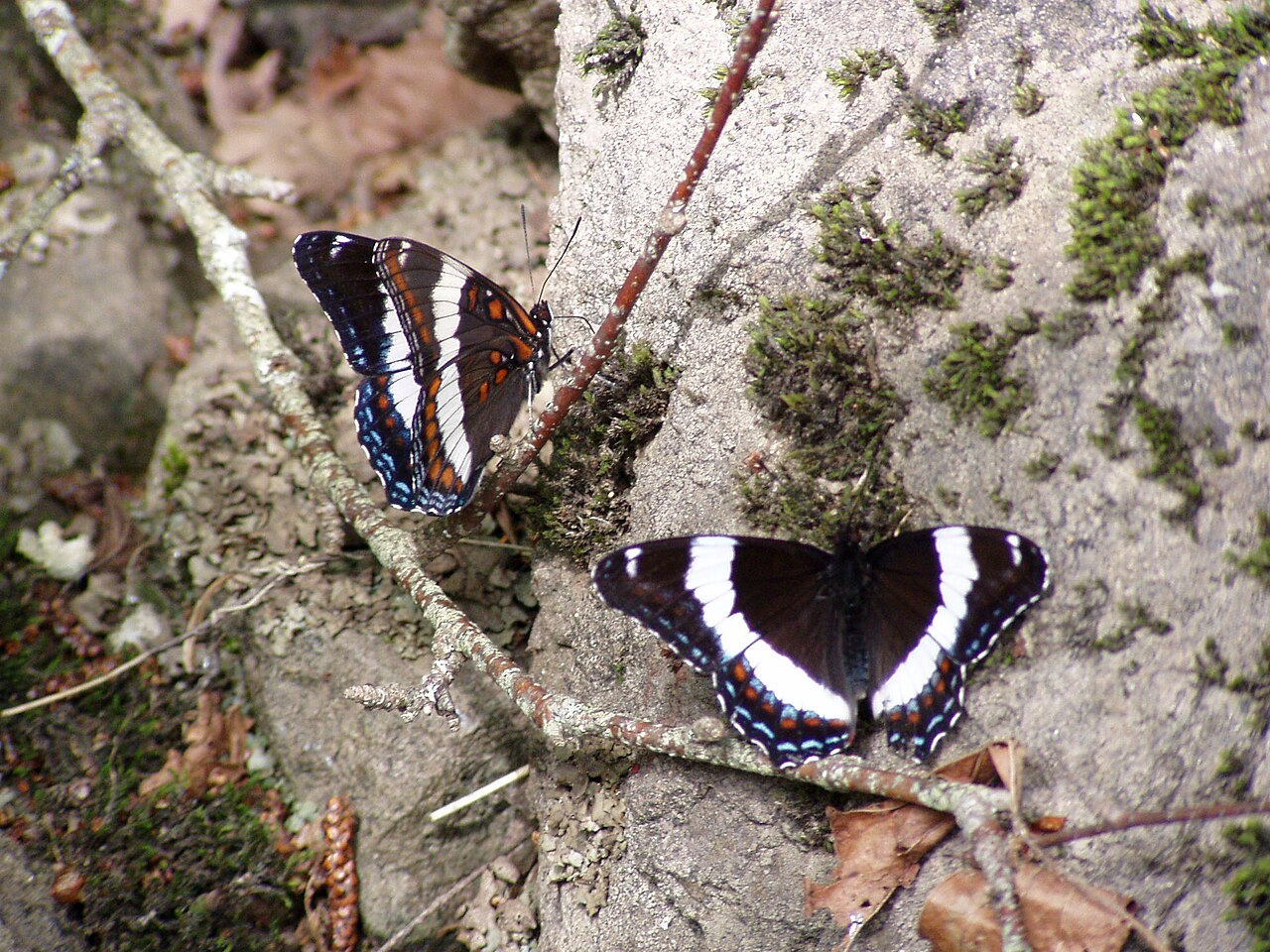
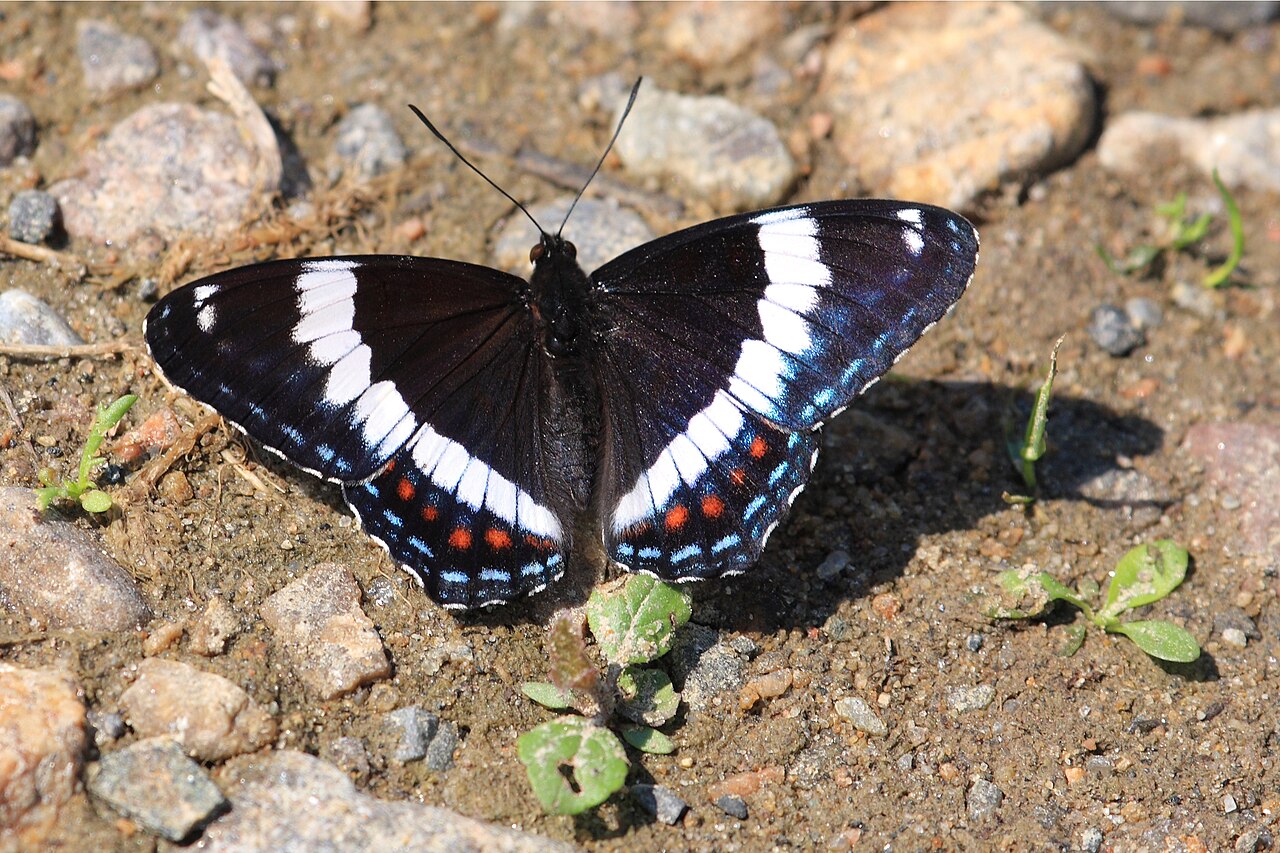
The white admiral (Limenitis arthemis arthemis) inverts the scheme: velvet-black wings crossed by a single, unbroken white band that arcs through both forewings and hindwings, with a row of blue crescents and red spots along the trailing edge. Spanning 3 to 4 inches and gliding between flaps in a flat-winged sail, it is a butterfly of dappled forest light in the Northeast, Great Lakes, and across Canada.
Its identity comes with a twist known to every field guide: the white admiral and the red-spotted purple are the same species in two costumes. South of roughly New York and the Great Lakes, the same Limitenis arthemis drops the white band and shifts to iridescent blue-black, mimicking the toxic pipevine swallowtail; where the zones meet, intermediate butterflies wear partial bands. A banded individual in Pennsylvania and a blue one in Virginia are cousins in the most literal sense.
Habits make admirals easy to meet without a flower garden: they feed less at blooms and more at sap runs, rotting fruit, animal droppings, and mineral-rich mud, and males perch on sunlit leaves 3 to 10 feet up, launching to inspect anything that passes, including you. A banana peel left on a woodland stump is a better white admiral lure than any nectar plant.
Zebra Longwing: Florida’s State Butterfly
The zebra longwing (Heliconius charithonia) trades stripes-on-white for stripes-on-black: long, narrow jet wings crossed by thin pale yellow to whitish bands, spanning 2.5 to 4 inches and carried in a slow, floating flight that looks almost unhurried. It is Florida’s official state butterfly and a year-round resident of the Deep South, wandering north in warm years.
Its biology explains the leisurely flight: zebra longwings are unpalatable. Caterpillars feed on passionflower vines and carry the plants’ toxic compounds into adulthood, and adults uniquely eat pollen as well as nectar, a protein source that fuels lifespans of several months instead of the usual few weeks. Predators learn the striped warning and leave them alone, so the butterfly can afford to drift.
They are also famously social sleepers. Zebra longwings return each evening to communal roosts of a dozen or more butterflies on the same branch, night after night, one of the few butterflies with a fixed address. Gulf Coast gardeners who plant passionvine often acquire a resident colony, floating through the yard by day and reassembling at dusk like commuters.
Checkered White and the Small Field Butterflies
Not every black and white butterfly is a showpiece. The checkered white (Pontia protodice) is a modest 1.5 to 2 inch butterfly of open, disturbed ground nationwide: white wings scattered with charcoal checkering, heavier on females, flying low over fields, roadsides, and vacant lots from spring through fall. Its caterpillars eat mustards and it thrives where lawns end. For a closely related question, see our guide to black and white beetle.
Two relatives cause most of the confusion. The abundant cabbage white shows only one or two black dots on cleaner white wings, not true checkering, and the western white replicates the checkered pattern in mountain and northern regions. A checklist helps: full checkerboard means checkered or western white; a mostly clean white wing with a spot or two means cabbage white.
The American snout deserves a mention for the Southwest: brown-black above with white-spotted forewing tips and a comically long snout, it stages mass migrations in Texas after rains, when thousands of small dark-and-white butterflies stream past for days. Small black and white butterflies in numbers, in Texas, in fall, are snouts until proven otherwise.
The Great Impostor: Eight-Spotted Forester
The black and white “butterfly” visiting flowers in broad daylight with orange leg tufts is often not a butterfly at all. The eight-spotted forester (Alypia octomaculata) is a day-flying moth with velvety black wings marked by eight bold spots, two pale yellow on each forewing and two white on each hindwing, plus unmistakable fluffy orange leg warmers. It nectars in gardens across the eastern half of the country in spring.
Telling moth from butterfly takes one look at the antennae: butterflies end theirs in clubs, while the forester’s taper to points. Day flight, bright pattern, and flower visits are butterfly behaviors this moth borrowed, which is why it generates a steady stream of mistaken identifications every May. Its caterpillars feed on grape and Virginia creeper, so it is common wherever those vines climb.
It has company in the confusion business. The white-striped black moth repeats the banded look in miniature along woodland paths, and at dusk the big pale wings of a white moth can read as black and white in half light. When a black and white flier defies your butterfly guides, check the moth pages before doubting your eyes.
Black and White Butterfly Meaning and Symbolism
Symbolically, a black and white butterfly merges two loaded colors into one messenger. All butterflies carry the core meaning of transformation, and the black and white palette layers on balance and duality: endings and beginnings held together, clarity emerging from a complicated season, and in many readings a call to see a situation in honest contrast rather than comfortable gray. It is often interpreted as a sign that a transition is completing and equilibrium is returning.
The two colors bring their separate traditions with them. Black butterflies are widely read as marking profound change and honored endings, while white butterflies carry the old soul-and-spirit associations found in cultures from Ireland to Japan, where a white butterfly is a visiting soul. Their combination is popularly taken as a message from a loved one who has passed, delivered at the boundary the two colors share, similar to the messenger role that folklore assigns in the spiritual meaning of black birds.
These readings are folklore, not field biology, and holding both at once is the healthiest way to enjoy them. The zebra swallowtail that crosses your path is following a pawpaw thicket, and it can still serve as a genuine prompt for reflection about what is ending and balancing in your own season; meaning-making is what humans add to the encounter. Readers drawn to carry the symbol permanently can explore the design side in our butterfly tattoo meaning guide, where black and white pieces signal exactly this balance-through-change reading.
How to Attract Black and White Butterflies
Host plants decide which species you can recruit, because females only lay where caterpillars can eat. Plant pawpaw for zebra swallowtails (two or more trees, in part shade, patience required), passionflower vine for zebra longwings in the South, native cherries, willows, and birches for white admirals, and let a corner of mustards and cresses stand for checkered whites. No host plant, no resident breeding population; it is that direct.
Feed the adults on their own terms. Nectar generalists like the longwing and checkered white come to zinnias, lantana, verbena, and native milkweeds and asters, but the white admiral wants the woodland buffet: overripe bananas or melon on a plate, a sap-run tree left unpruned, and a wet sand or mud patch for minerals. A fruit dish in dappled shade regularly pulls admirals that would never visit a flower bed.
Then protect the nursery. Skip insecticides anywhere near host plants, since a single broad-spray treatment erases eggs and caterpillars invisibly, and tolerate chewed leaves as the receipt for future butterflies. The National Wildlife Federation (nwf.org) certifies backyard habitat on exactly these pillars: host plants, nectar, water, and pesticide-free cover, and black and white species respond to them as reliably as monarchs do.
Quick Identification Checklist
Run the three-question test on your sighting. First, pattern: stripes running with the wing (zebra swallowtail on white, zebra longwing on black), one bold band crossing black (white admiral), scattered checkers on white (checkered white), or discrete spots on black (eight-spotted forester). Pattern alone separates the five common species in most encounters.
Second, shape and size: long tails mean zebra swallowtail, full stop; long narrow oar-shaped wings mean zebra longwing; broad rounded wings with a 3 inch plus span mean white admiral; under 2 inches and flitting low means the checkered white group; and pointed antennae with orange leg tufts mean you have the moth. Third, place: pawpaw woods, northern forest edge, Florida garden, open field, or spring grape arbor each vote for their own species.
Color tells stories beyond this palette too, and the rarest wing colors have their own guides: compare your sighting against the structural shimmer explained in our blue butterfly guide or the even scarcer species in the purple butterfly roundup. Between pattern, shape, and place, a black and white butterfly is one of the most satisfying quick identifications in the yard: five suspects, three questions, one answer.
Related reading: Yellow and Black Butterfly.
Related reading: Black and Blue Butterfly.
Related reading: Orange and Black Butterfly.
Related reading: Black Swallowtail Butterfly.
Related reading: White Peacock Butterfly.
Related reading: Cabbage White Butterfly.
Related reading: Black Butterfly Spiritual Meaning.
Related reading: Black and White Moth.
Black and White Butterfly or Moth? How to Tell
Check the antennae first, because it is the one test that works on every species. A butterfly has thin antennae ending in a small club or knob. A moth has antennae that are either feathery or taper to a plain point with no club at all. That single feature separates the eight-spotted forester from every true butterfly on this list.
Resting posture is the useful backup. Butterflies typically hold the wings closed vertically above the back when perched, or open them flat to bask. Most moths rest with the wings folded flat over the body like a tent or held out to the sides, covering the abdomen. Body build differs too: butterflies are slim-bodied with a narrow waist, while day-flying moths look stouter and furrier through the thorax.
Time of day is the least reliable clue, since plenty of moths fly in full sun and are brightly patterned, which is exactly why the confusion arises. The Smithsonian’s butterfly information sheet sets out the anatomical differences that hold across the whole group.
Frequently Asked Questions
What kind of butterfly is black and white?
In North America, usually a zebra swallowtail (white with black stripes and tails), white admiral (black with a white band), zebra longwing (black with pale stripes, in the South), or checkered white (white with dark checkering in open fields).
What does a black and white butterfly mean spiritually?
Folklore reads it as transformation paired with balance: an ending resolving into a new equilibrium, and popularly a message from a departed loved one, combining the black butterfly’s change symbolism with the white butterfly’s soul associations.
Are black and white butterflies rare?
Not as a group. Checkered whites are common nationwide and zebra longwings abound in Florida, though zebra swallowtails are localized to pawpaw habitat and white admirals to northern woodlands, so any one species can be scarce in your area.
What is the black and white striped butterfly in Florida?
The zebra longwing, Florida’s state butterfly: long, narrow black wings with thin pale yellow stripes, a slow floating flight, and communal evening roosts on passionvine-rich properties.
Is the black moth with white spots a butterfly?
That is the eight-spotted forester, a day-flying moth with eight pale spots and orange leg tufts. Its pointed (not clubbed) antennae give it away despite its butterfly-like flower visits.
What plants attract black and white butterflies?
Host plants first: pawpaw for zebra swallowtails, passionflower for zebra longwings, cherries and willows for white admirals, mustards for checkered whites. Add nectar flowers, overripe fruit for admirals, and a pesticide-free yard.
What butterfly is black with one white stripe?
The white admiral: velvet black wings crossed by a single bold white band, plus blue and red accents near the edges, gliding along forest edges in the Northeast, Great Lakes, and Canada.