Black and White Moth: 4 Species Found in US Yards
A black and white moth resting on a porch light or window screen is usually one of a small handful of striking species, the giant leopard moth, the eight-spotted forester, or a plain white moth with dark speckling. Each has a distinct pattern once you know what to look for.
This guide breaks down the most common black and white moths in the US, how to tell them apart, whether any of them bite or sting, and what people often mean when they say seeing one felt significant.
Common black and white moths in the US include the giant leopard moth, with bold black rings on a white body, and the eight-spotted forester, a smaller day-flying moth with black and white checkered wings. None of these species bite or sting, and all are harmless to handle.
| Species | Pattern | Active |
|---|---|---|
| Giant leopard moth | White wings, black rings and spots | Night |
| Eight-spotted forester | Black wings, white and orange spots | Day |
| Dot-lined white moth | Pale wings, fine black lines | Night |
| Virginian tiger moth | White wings, sparse black spots | Night |
What Is a Black and White Moth?
“Black and white moth” covers several unrelated species that share a pale wing color broken up by black markings, ranging from bold rings to fine speckling. In the US, the giant leopard moth is the species most frequently photographed and asked about.
Unlike a black and white butterfly, moths typically rest with their wings flat or tented over the body rather than held upright, and most species have feathery or thread-like antennae instead of the clubbed antennae seen on butterflies.
Most black and white moths in home gardens are attracted to porch lights at night, which is why they are so often spotted on screens, siding, and window glass after dark.
Giant Leopard Moth

The giant leopard moth has bright white wings marked with bold black rings and solid black spots, giving it a pattern genuinely reminiscent of a leopard’s coat. Its body has an iridescent blue-black sheen with orange markings visible when it opens its wings.
This species is one of the larger moths found in the eastern and central US, with a wingspan that can reach up to 3 inches (7.5 cm), making it one of the more commonly photographed black and white moths.
Its caterpillar stage is the well-known black, bristly “woolly worm” often seen crossing sidewalks in fall, distinct from the black and yellow caterpillar group but sometimes confused with them at a glance.
Eight-Spotted Forester Moth

The eight-spotted forester is a smaller, day-flying moth with mostly black wings marked by two white spots and two orange spots on each forewing, giving it a checkered look distinct from most nocturnal moths.
Because it flies during daylight hours and visits flowers much like a butterfly, it is frequently mistaken for one, though its stout body and different wing-resting posture separate it from true butterflies on closer inspection.
Its caterpillar feeds on grapevine and Virginia creeper, so gardens with either plant are more likely to host this species than gardens without them.
Dot-Lined White Moth
The dot-lined white moth has pale, almost translucent wings crossed by fine, broken black lines rather than bold rings or spots, giving it a much subtler pattern than the giant leopard moth.
This species is nocturnal and commonly attracted to outdoor lighting, where it is often reported as simply “a white moth with black lines” by people unfamiliar with the species name.
It is closely related to several other pale tussock and lappet moths, which share the general strategy of using light coloration and fine markings as camouflage against pale tree bark during the day.
How to Identify Black and White Moths
Start with wing shape and rest posture: moths generally hold their wings flat, tented, or wrapped around the body at rest, while butterflies typically fold their wings upright above their back.
Next, look at the specific markings. Bold, solid black rings on white suggest a giant leopard moth, while a mostly black wing with a few white and orange spots points to the eight-spotted forester.
Finally, note the time of day. A black and white moth seen fluttering around a porch light at night is more likely a giant leopard or dot-lined white moth, while one visiting flowers in bright sunlight is more likely an eight-spotted forester.
Do Black and White Moths Bite or Sting?
No common black and white moth species in the US bites or stings people. Adult moths lack biting mouthparts capable of harming a person, and most feed only on nectar or do not feed at all as adults.
The caterpillar stage of the giant leopard moth, the bristly black “woolly worm,” has stiff hairs that can cause very mild skin irritation in sensitive individuals, though it is not considered dangerous.
Handling adult black and white moths directly can rub off wing scales, which is harmless to the person but can slightly affect the moth’s ability to fly, so a gentle touch or avoiding handling altogether is the better practice.
What Does It Mean When You See a Black and White Moth?
Across various folk traditions, moths are often associated with transformation, intuition, and messages from the unseen, partly because of their nighttime activity and the dramatic change from caterpillar to winged adult.
Some interpretations tie a black and white moth specifically to balance or duality, given its two-tone coloring, while others treat any moth sighting indoors as a simple sign of change or transition in a person’s life.
These meanings are cultural and symbolic rather than scientific, and different traditions assign quite different significance to the same species, so there is no single universally agreed interpretation.
How Rare Are Black and White Moths?
The giant leopard moth is considered fairly common across its eastern and central US range, though sightings vary by season and are most frequent from late spring through summer when adults are actively flying.
The eight-spotted forester is less frequently reported simply because it flies during the day and is smaller, making it easier to overlook compared to moths that gather conspicuously around porch lights at night.
Neither species is considered threatened or of conservation concern in the US, though local abundance can vary with host plant availability and regional habitat quality.
Black and White Moth Tattoo Meaning
Moth tattoos, including black and white designs based on the giant leopard moth’s ring pattern, are frequently chosen to represent personal transformation, resilience, or a period of change the wearer has gone through.
The strong black and white contrast also appeals to tattoo artists working in traditional or blackwork styles, where bold linework and negative space are central to the design’s visual impact.
As with broader moth symbolism, the specific meaning behind a tattoo is ultimately personal to the wearer, with the species and color choice often reflecting individual taste more than any fixed rule.
What Can Be Mistaken for a Black and White Moth?
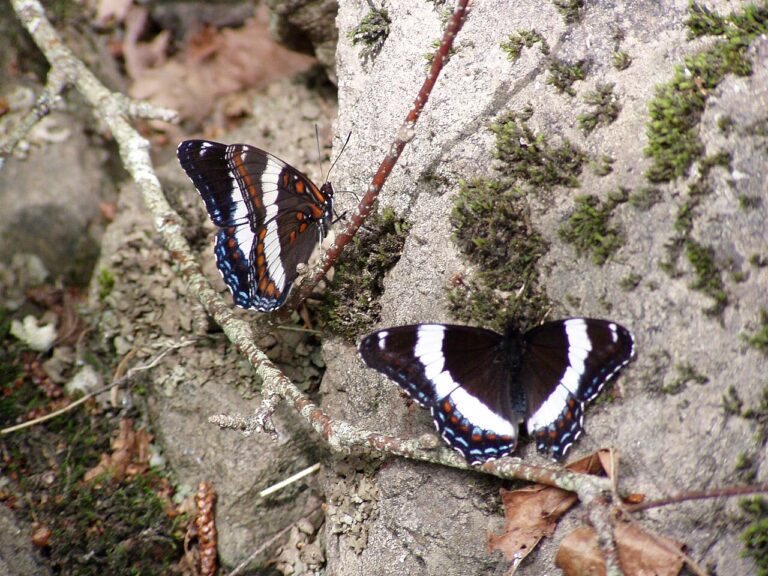
A black and white butterfly, such as certain swallowtail or admiral species, can be mistaken for a moth at a glance, though wing posture at rest usually settles the question.
Black and white beetle species and black and white spider species are sometimes lumped in with moth sightings by people unfamiliar with insect groups, despite having entirely different body plans once examined closely.
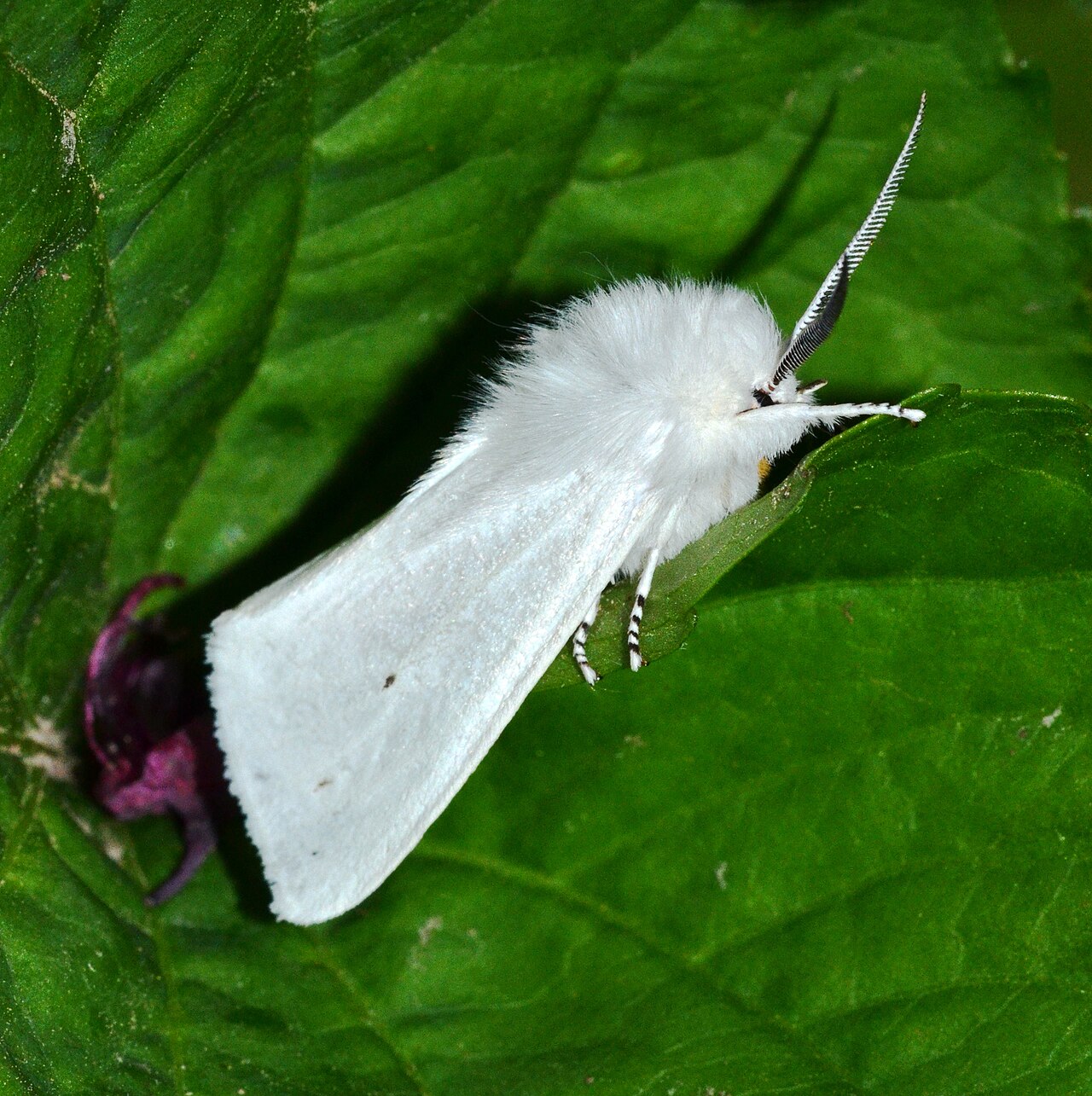
A plain, unmarked white moth is also commonly reported simply as a “black and white moth” if its faint gray shading is mistaken for black markings under porch lighting.
Where Do Black and White Moths Live?
Giant leopard moths are found across much of the eastern and central United States, favoring wooded edges, gardens, and suburban yards where their caterpillars have access to a wide range of low-growing host plants.
Eight-spotted foresters are tied more closely to areas with grapevine or Virginia creeper, making vineyards, woodland edges, and gardens with these plants more likely spots to encounter the species.
Both species overwinter in the caterpillar or pupal stage, sheltering under leaf litter, bark, or in the soil until temperatures warm enough for adult moths to emerge in spring.
Attracting or Discouraging Moths at Home
Porch and outdoor lights are the biggest draw for nocturnal black and white moths like the giant leopard moth, so switching to yellow “bug” bulbs or motion-activated lighting can reduce nightly moth traffic if that is a goal.
Planting native host plants, including violets, dandelion, and plantain for giant leopard moth caterpillars, or grapevine for the eight-spotted forester, supports local moth populations for anyone hoping to attract more of these species instead.
Since none of these moths damage structures or bite people, most household encounters require no action at all beyond simply appreciating an unusual visitor on a window screen.
Black and White Moths and Porch Lights
Many nocturnal black and white moths, including the giant leopard moth and the dot-lined white moth, are drawn to artificial light through a navigation response tied to using the moon and stars for orientation, which artificial bulbs can disrupt at close range.
This is why porch lights, security floodlights, and even indoor lamps visible through open windows can pull in far more moths on a warm summer night than the surrounding yard would otherwise attract. Warmer, whiter light tends to draw in more moths than yellow-toned “bug light” bulbs, which is part of why the latter are marketed specifically to reduce nighttime insect activity around doorways, patios, and other outdoor living spaces.
A moth resting motionless on a wall near a light fixture the morning after is typically just waiting out the daylight hours in a sheltered spot before resuming activity at dusk, not stuck or injured, so it is generally fine to leave it undisturbed until evening, at which point it will typically move on under cover of darkness without any help from anyone nearby.
Frequently Asked Questions
What are black and white moths?
They are several unrelated moth species sharing a pale wing color with black markings, most commonly the giant leopard moth in the eastern and central US.
How rare are leopard moths?
Giant leopard moths are fairly common within their range and are not considered a species of conservation concern, though sightings vary with season and local habitat.
What does it mean when you see a black and white moth?
In folk symbolism, moths are often linked to transformation and change, and a black and white pattern is sometimes read as a symbol of balance, though this meaning is cultural rather than scientific.
How rare is a white moth with black spots?
A white moth with black spots, most likely a giant leopard moth, is a regularly reported species within its range and is not considered rare.
Do black and white moths bite?
No, adult black and white moths in the US do not bite people, and none of the common species pose a bite risk.
What is the rarest type of moth?
Rarity varies widely by species and region; some localized or habitat-specific moths are far rarer than the common black and white species described above, which are generally widespread.
Sources: Xerces Society for Invertebrate Conservation, Encyclopaedia Britannica.