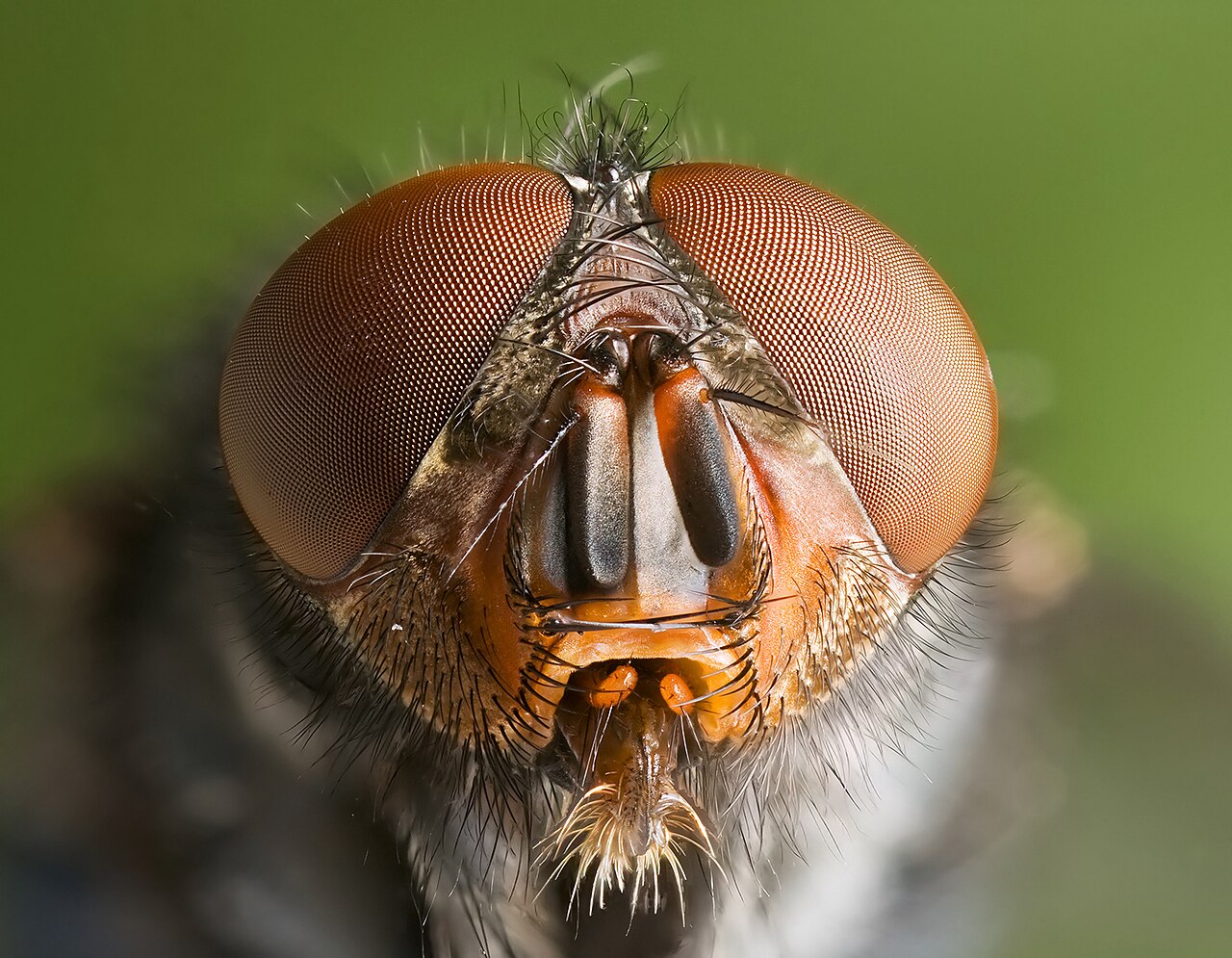
Blue Fly: 8 Metallic Blue Insects and How to Tell Them Apart
A blue fly in the United States is almost always a blow fly, and the one you see most often is the blue bottle fly (Calliphora vomitoria), a heavy, loud, metallic blue insect about twice the size of a house fly. None of the blue flies in North America sting, and none are venomous. What they do carry is bacteria, because the adults feed and breed on carrion, manure and garbage.
Seven or eight species account for nearly every metallic blue insect that people call a blue fly, and a few of them are not flies at all. This guide sorts them by the three things you can actually see from 3 ft (1 m) away: the shade of the sheen, the size, and the way the insect behaves when you approach.
Blue flies are blow flies in the family Calliphoridae, most often the blue bottle fly (Calliphora vomitoria), which is 0.4 to 0.55 in (10 to 14 mm) long with a dull metallic blue abdomen and a loud buzz. They do not bite or sting, but they spread bacteria from carrion and feces and often signal something dead nearby.
Are Blue Flies Dangerous?
No blue fly in North America stings, and none injects venom. Blow flies have sponging mouthparts that cannot pierce skin, so a blue bottle landing on your arm can do nothing worse than walk on it. The one group that does bite, the horse flies and deer flies, is mostly black or brown with blue or green eyes rather than a blue body.
The real risk is contamination. Blow flies move between carcasses, dog waste and your kitchen counter, and they can carry Salmonella, E. coli, Campylobacter and other pathogens on their feet and in their regurgitated fluid. The Centers for Disease Control and Prevention treats filth flies as mechanical vectors, which is why food left uncovered after a fly lands on it should be discarded rather than rinsed.
What Makes a Fly Look Blue
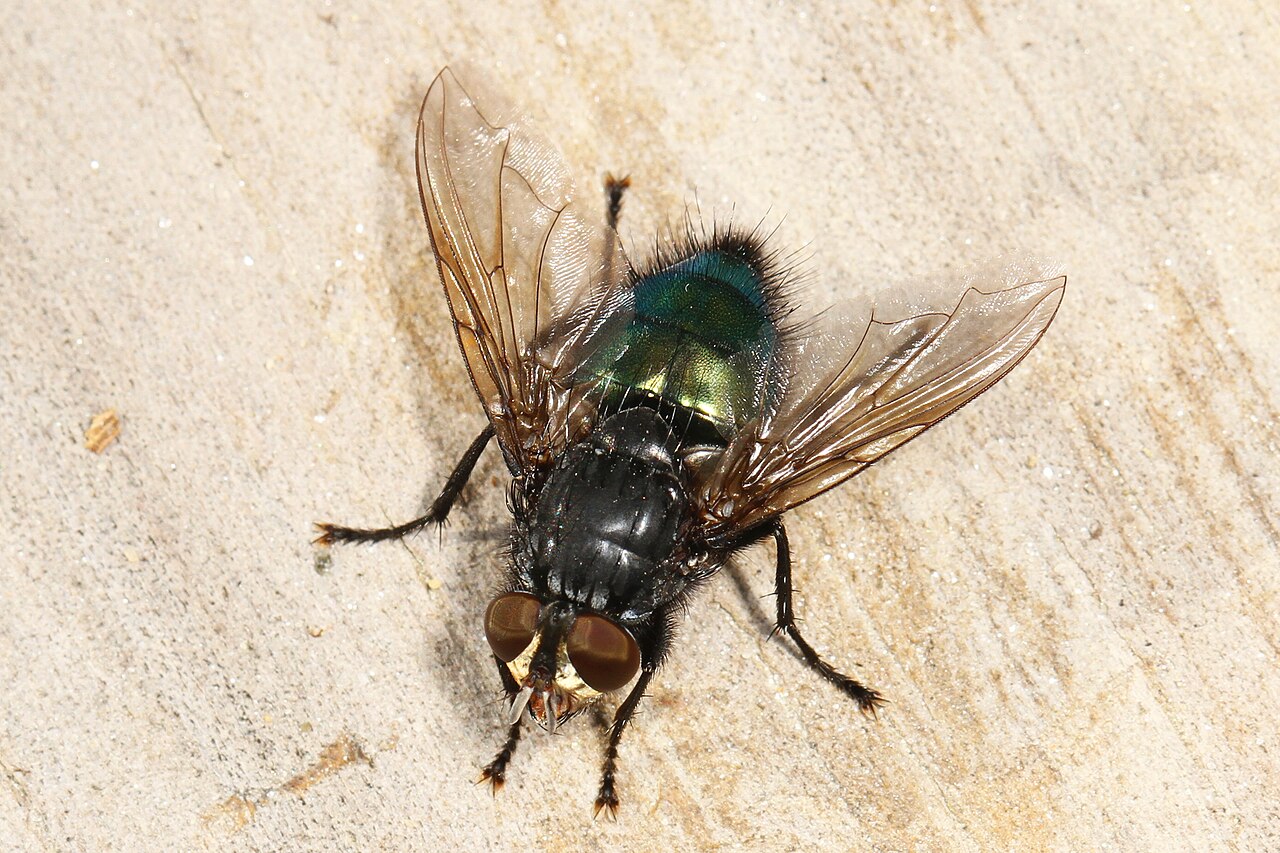
The color is structural, not pigment. Microscopic layers in the cuticle scatter light, so the same fly can read as deep navy, steel blue, violet or near black depending on the angle and the weather. A photograph in direct sun often looks nothing like the insect you remember from a shaded porch.
That instability is why color alone never settles an identification. Shade helps, but size, the texture of the thorax, and the setting matter more. The same effect produces blue in unrelated animals, from the blue carpenter bee to the wing scales of a blue butterfly and the feathers of a blue jay, with no shared ancestry behind the color at all.
| Feature | Blue bottle fly | Green bottle fly | Blue mud dauber |
|---|---|---|---|
| Body color | Dull metallic blue, gray thorax | Bright metallic green | Shiny blue black, long body |
| Length | 0.4 to 0.55 in (10 to 14 mm) | 0.3 to 0.4 in (8 to 10 mm) | 0.4 to 0.9 in (10 to 23 mm) |
| Wings | One pair, clear | One pair, clear | Two pairs, smoky blue |
| Waist | None, body is continuous | None | Thin thread waist |
| Sound | Loud, low buzz | Lighter buzz | Quiet, slow flight |
| Can it sting? | No | No | Yes, rarely does |
Blue Bottle Fly (Calliphora vomitoria)
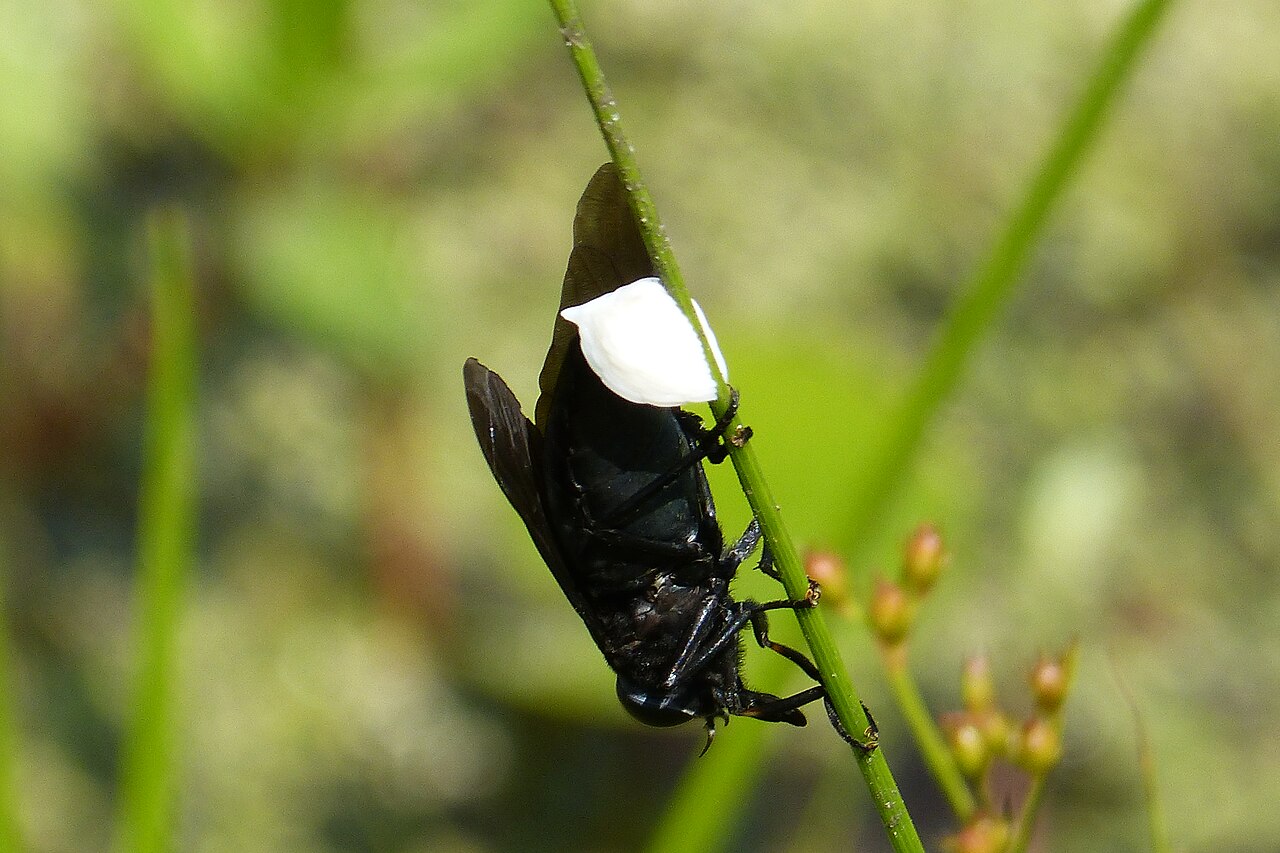
This is the default blue fly across the entire continental United States and Canada. Adults run 0.4 to 0.55 in (10 to 14 mm), with a dull metallic blue abdomen, a dark gray thorax, bristly orange hairs below the eyes, and a buzz noticeably deeper than a house fly’s. It is harmless to handle and impossible to ignore indoors.
Females lay eggs on carrion, raw meat, open wounds on livestock and sometimes dog waste. Larvae reach full size in under a week in warm weather. A single blue bottle at a window is usually an accident; five or more in a closed room nearly always means a dead rodent or bird in a wall, chimney or crawlspace.
Shiny Blue Bottle Fly (Cynomya cadaverina)

Also called the shiny bluebottle, this species is slightly larger and far more brilliantly blue than Calliphora, with a glossy, almost enameled abdomen and a yellowish face. It is common across the northern states, the Rockies and Canada, and it tolerates cold better than most blow flies. For a closely related question, see our guide to blue snake identification.
You see it earliest in spring and latest in fall, often on the first warm day of March when nothing else is flying. It breeds on carrion and is a routine find on roadkill. Harmless, but the same hygiene caution applies as for any blow fly that has just left a carcass.
Oriental Latrine Fly (Chrysomya megacephala)
An introduced species now established in the Southeast, Gulf states, Hawaii, Florida and much of coastal California. It is blue green to bronze green rather than true blue, 0.3 to 0.45 in (8 to 11 mm) long, with conspicuously large reddish eyes that nearly meet in the male.
The common name is literal: it breeds in human and animal waste as well as carrion and fish markets, which makes it one of the more medically relevant filth flies in the country. Where it is common, cover compost and secure trash, because it readily moves from waste to prepared food.
Northern Blow Fly (Protophormia terraenovae)
A cold adapted blow fly found across the northern tier, Alaska and high elevations, dark metallic blue to blue black and 0.25 to 0.45 in (7 to 11 mm) long. The sheen is darker and less showy than a blue bottle’s, and the body looks slimmer.
It is the species most likely to still be active near freezing, which matters in forensic entomology because its presence narrows the season of a discovery. In livestock country its larvae occasionally infest neglected wounds, a condition called myiasis that needs veterinary treatment rather than home remedies.
Common Green Bottle Fly (Lucilia sericata)
Included here because people regularly report it as a blue fly: in overcast light or at certain angles its brilliant green shifts toward blue or bronze. It is smaller than a blue bottle at 0.3 to 0.4 in (8 to 10 mm), with a bright, hard looking sheen over the whole body.
Green bottles arrive at a carcass within minutes, ahead of blue bottles in warm weather, and they also lay on dog waste and compost. Sterile larvae of this species are used in medical maggot therapy to debride wounds, which is the one genuinely useful job in the group.
Black Horse Fly (Tabanus atratus)
This is the large insect people describe as a big blue black fly that actually bites. Females reach 0.8 to 1.1 in (20 to 28 mm), with a smoky blue black body and dark wings, and they take blood from livestock, horses and occasionally people. The bite is a cut, not a puncture, and it hurts.
It is a southern and eastern species common near ponds, pastures and wetlands in midsummer. Deer flies in the genus Chrysops are smaller relatives with patterned wings and iridescent green to blue eyes. If a blue looking fly bit you, it was one of these, not a blow fly.
Blue Mud Dauber: A Wasp, Not a Fly
The blue mud dauber (Chalybion californicum) is the single most common misidentification behind a blue fly search. It is a shiny metallic blue wasp 0.4 to 0.9 in (10 to 23 mm) long with a thread thin waist, smoky blue wings and a slow, deliberate flight that looks nothing like the darting of a blow fly.
It hunts spiders, including black widows, and stocks them in mud nests under eaves. It can sting but is extremely reluctant to, and it is worth leaving alone. Our guide to the blue wasp covers the nesting habits and the handful of other blue stinging species in more detail.
Blue Damselflies Mistaken for Blue Flies
Bluet damselflies (Enallagma species) are slender, powder blue and black insects 1 to 1.5 in (2.5 to 4 cm) long that perch with their wings folded over the back. People near ponds often call them blue flies. They have two pairs of wings, enormous eyes set far apart and no buzz at all.
They are predators of mosquitoes and midges and cannot bite or sting a person. The same confusion happens with blue winged butterflies and moths; the difference is the scaled, broad wing, which you can see in our guide to the black and blue butterfly.
Blue Flies Indoors: What They Mean
One or two blue bottles in a house in spring or fall usually overwintered in the attic or wall void and woke up warm. They head for windows, which is where you find them. Nothing is wrong, and a vacuum handles it.
A sudden group of ten or more, especially with no open window nearby, is a different signal. Blow flies that emerge indoors came from a food source indoors: a dead mouse in a wall, a bird in a vent, a forgotten freezer item, or a sewage leak under a floor. Find the source first, because insecticide treats only the generation already flying.
How to Keep Blue Flies Out
Exclusion beats spraying. Screen attic and soffit vents with 0.25 in (6 mm) hardware cloth, cap chimneys, seal gaps around utility penetrations, and fit tight lids on garbage and compost bins. Rinse recycling, because a single soda can supports a generation in summer heat.
Outdoors, pick up pet waste daily and keep it out of open compost. Remove roadkill and dead wildlife from the yard with a shovel and gloves, never bare hands, and bag it. Fly populations in a yard track available breeding material almost exactly, which is why sanitation holds for months while a spray lasts days.
Why Blue Flies Matter
Blow flies are the first decomposers at almost any vertebrate carcass, which makes them the engine of nutrient recycling in woods and fields alike. Remove them and dead animals would persist for weeks instead of days.
They are also the backbone of forensic entomology. Because each species colonizes a body in a predictable order and develops at a temperature dependent rate, investigators use blow fly larvae to estimate time of death. The same metallic blue insect that ruins a picnic is one of the more useful animals in the field, in the way that bluebirds earn their keep on pasture insects.
Frequently Asked Questions
What is a bluefly?
A bluefly, more often written blue fly, is a metallic blue blow fly in the family Calliphoridae, usually Calliphora vomitoria. It is a scavenger that breeds on carrion and waste. Bluefly is also the name of an online clothing retailer, which is unrelated and accounts for much of the search traffic on the term.
Do blue flies bite humans?
Blue bottle flies and other blow flies cannot bite. Their mouthparts sponge up liquid and cannot break skin. If a large dark blue or blue black fly bit you painfully, it was almost certainly a black horse fly or a deer fly, both of which cut the skin with bladed mouthparts and feed on blood.
What does it mean when you see a blue fly in your house?
One or two usually means an overwintering fly woke up, or a door was left open. A cluster of ten or more indoors points to a breeding source inside the structure, most often a dead rodent or bird in a wall, vent or chimney. Locate and remove the source before treating the flies.
Are blue bottle flies poisonous?
No. Blue bottle flies are neither venomous nor toxic to touch, and they cannot sting. The hazard is mechanical transmission of bacteria such as Salmonella and E. coli picked up from carrion and feces, so discard any uncovered food that a blow fly has landed on and wash surfaces.
What is the big blue fly in my yard?
If it is loud, fast and about 0.5 in (13 mm) long, it is a blue bottle fly. If it is larger, slower, shiny blue with a thin waist and visits mud or eaves, it is a blue mud dauber wasp. If it is close to 1 in (25 mm) long and hangs around livestock or ponds, suspect a black horse fly.
How do I get rid of blue flies naturally?
Remove the breeding material, which is the only step that lasts. Bag carrion and pet waste, seal bins, and clean drains with an enzyme cleaner. For flies already inside, use a vacuum or sticky traps at sunny windows. Fans at doorways work because blow flies cannot hold a course in moving air.