Blue Wasp: What It Is and Whether It’s Dangerous
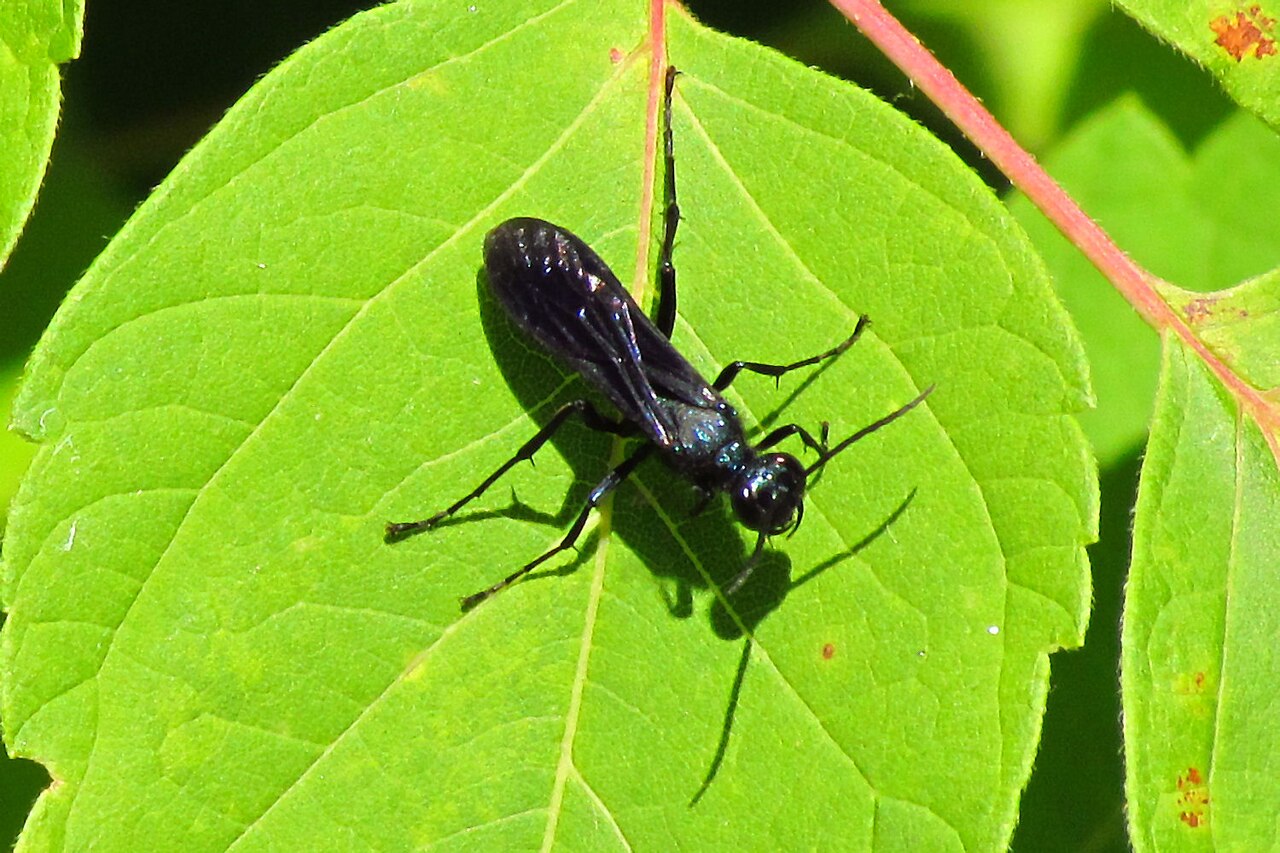
The insect most people mean by “blue wasp” is the blue mud dauber, a solitary wasp with a metallic blue-black body that hunts spiders rather than living in a colony or defending a nest aggressively. It is not a true wasp in the social, nest-defending sense most people fear, and stings on people are rare because the species has little reason to interact with humans at all.
That distinction matters because most wasp anxiety comes from social species like yellowjackets and paper wasps, which defend a shared nest in numbers and sting readily when threatened. A blue mud dauber lives alone, provisions a mud nest with paralyzed spiders for its larva, and generally ignores people entirely unless directly handled. This guide covers identification, behavior, and what to do if you find one.
A blue wasp is most often the blue mud dauber, a solitary, metallic blue-black wasp that hunts spiders and builds small mud nests rather than living in an aggressive social colony. It rarely stings people, is not aggressive, and provides free pest control by removing spiders, including venomous species, from around a home. Leave nests alone unless directly in a high-traffic doorway.
| Feature | Blue Mud Dauber |
|---|---|
| Color | Metallic blue-black, iridescent |
| Social structure | Solitary, not colonial |
| Aggression | Low; rarely stings unless handled |
| Diet of larvae | Paralyzed spiders provisioned by the female |
| Nest | Small mud tubes or reused mud dauber nests |
| Rarity | Uncommon to see up close, but not rare |
What Is a Blue Wasp?
Most sightings of a striking metallic blue insect described as a “blue wasp” are the blue mud dauber, a solitary wasp in the same broad family as the more common black-and-yellow mud daubers, distinguished by its iridescent blue-black body rather than the typical black-and-pale-yellow pattern.
Unlike social wasps, blue mud daubers do not build large paper nests or live in colonies with workers defending a queen. Each female works alone, provisioning her own small mud nest, and there is no coordinated colony defense the way there is with yellowjackets or paper wasps.
This solitary lifestyle is the single most important fact for understanding blue wasp behavior, since almost every wasp-related fear people have, swarming, aggressive nest defense, multiple stings, comes from social species and simply does not apply the same way to a solitary hunter working on its own.
Are Blue Wasps Harmful?
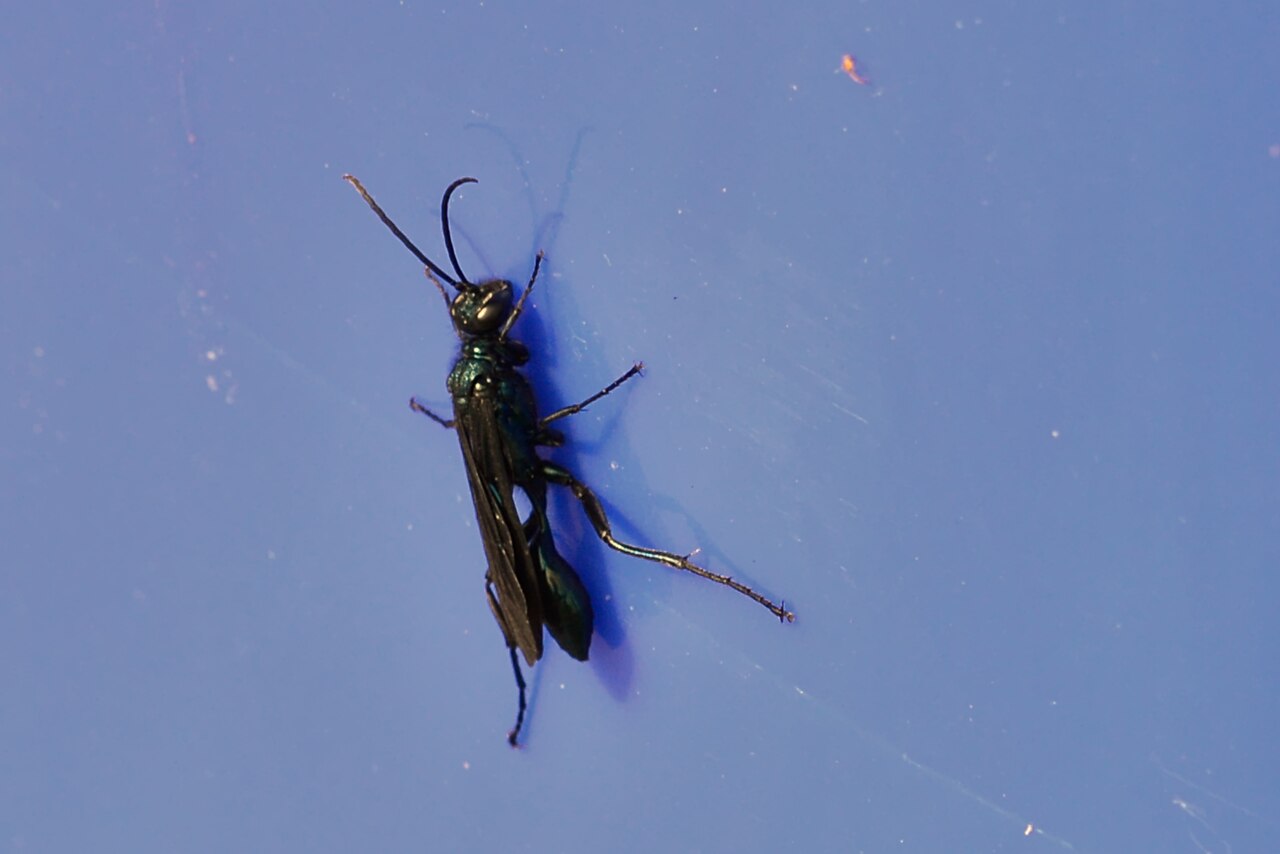
Not meaningfully to people. Blue mud daubers can sting if directly grabbed or trapped against skin, and the sting carries venom like any wasp, but they have no colony to defend and no natural inclination to seek out or attack a person going about normal activity nearby.
Documented stings from blue mud daubers are uncommon and generally involve direct contact, someone stepping on one barefoot or grabbing at a nest with a hand, rather than an unprovoked encounter, a pattern the hornet vs wasp guide also notes across most solitary species. This contrasts sharply with social wasps, where simply walking too close to an active nest can trigger a defensive response from multiple individuals.
For someone with a known wasp sting allergy, any wasp sting deserves the same caution regardless of species, since allergic reaction severity depends on individual sensitivity rather than the specific wasp involved. Ordinary risk to a non-allergic person from a blue mud dauber is genuinely low.
Are Blue Mud Daubers Aggressive?
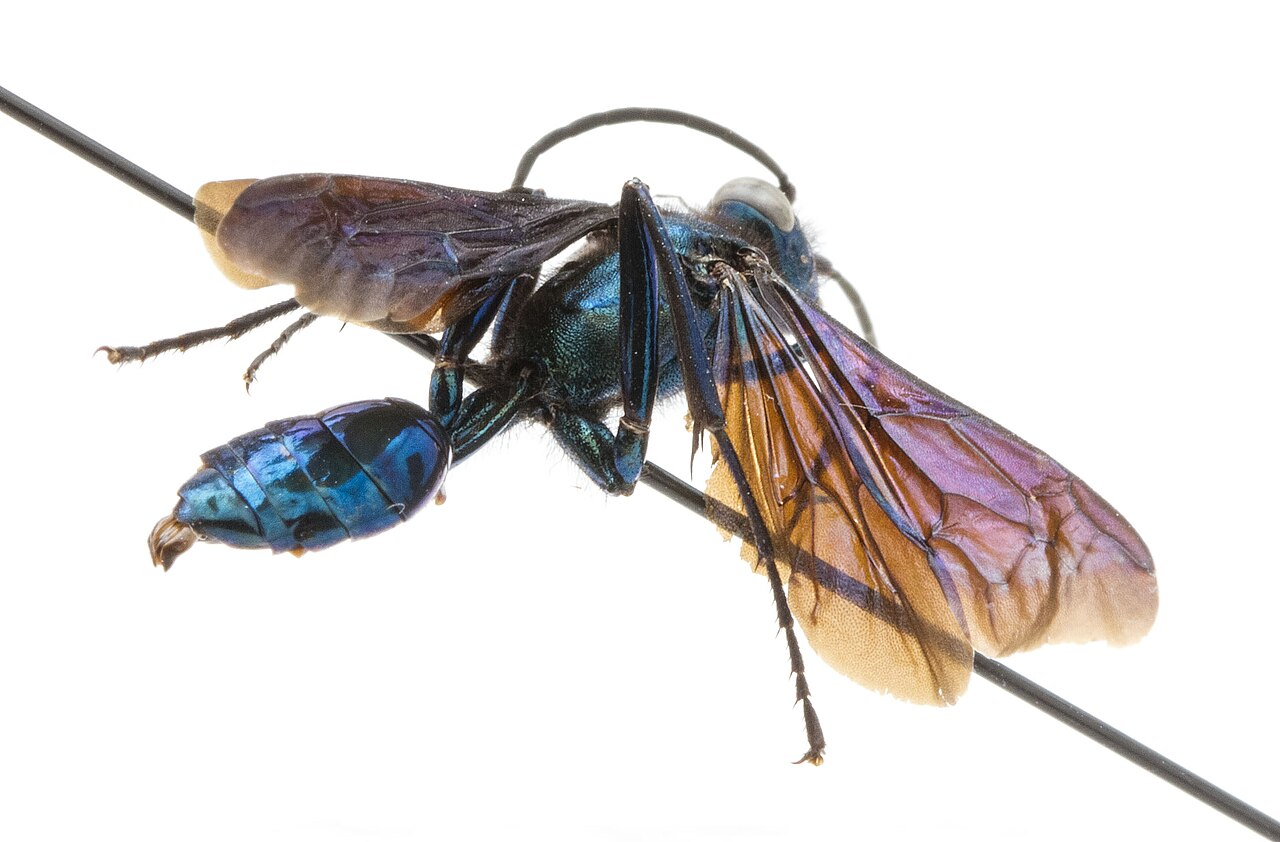
No, they are among the least aggressive wasps commonly encountered. Their entire behavioral strategy centers on hunting spiders and provisioning a mud nest rather than defending territory, and they generally fly away from disturbance rather than toward it.
Females focus their attention almost entirely on locating and paralyzing spiders to stock their nest cells, a task that requires precision and does not benefit from aggression toward unrelated large animals like people. Males, which do not build nests, spend their time seeking mates rather than patrolling territory.
This calm temperament is consistent across observations and is one reason blue mud daubers are frequently found nesting on porches, in garages, and under eaves without incident, close to regular human activity, in a way that would be untenable for a genuinely defensive social species.
Will a Blue Mud Dauber Chase You?
No, chasing behavior is essentially absent in this species. If disturbed, a blue mud dauber typically flies a short distance away and continues its business rather than pursuing whatever disturbed it, which is a marked contrast to some social wasps that will follow a retreating person for a distance.
This lack of pursuit behavior ties directly back to the solitary lifestyle: there is no colony to alert, no pheromone-driven group response, and no evolutionary benefit to a lone hunting wasp expending energy chasing something far larger than any prey it targets.
Sudden movement near an active nest is still worth avoiding as a general precaution with any stinging insect, but the practical risk from a blue mud dauber specifically is low enough that most people who have one nesting nearby never experience a sting at all during the season it is active.
Is a Blue Wasp Rare?
Not rare, but genuinely uncommon to notice, since blue mud daubers are solitary, quiet, and spend much of their time either underground-adjacent in mud nest construction or out hunting spiders rather than visibly patrolling in groups the way social wasps do around a nest.
They occur across a wide range in North America, particularly in warmer climates, and are considered common within their range by entomologists, but their solitary habits mean an individual encounter feels notable even where the species is genuinely present in good numbers.
The striking metallic blue color also contributes to the sense of rarity, since it stands out visually against the more familiar black-and-yellow pattern most people associate with wasps, making an ordinary sighting feel like something unusual even when it is not.
What Do Blue Mud Daubers Eat?
As adults, blue mud daubers feed on flower nectar, the same as many wasp species, playing a minor pollinator role while visiting flowers for energy. The predatory hunting is done for their offspring, not for themselves.
The larvae’s diet is entirely different and is where the species earns its ecological value: females hunt and paralyze spiders, often including black widows and other venomous species, packing several into each mud nest cell as a live but immobilized food supply for a single developing larva.
This spider-hunting habit makes blue mud daubers a genuinely useful presence around a property, quietly reducing spider populations, including potentially dangerous species, in a way that provides real pest control value without the aggression risk associated with social wasps. The animals that eat wasps guide covers the other side of that food chain.
How Do You Identify Their Nests?
Blue mud daubers frequently do not build their own nests from scratch and instead reuse abandoned mud nests built by other mud dauber species, distinguishing them from wasps that build unique nest structures of their own each season.
A typical mud dauber nest appears as a cluster of small, cylindrical or tube-like mud cells attached to a sheltered vertical surface, under eaves, in garages, on porch ceilings, or against exterior walls protected from direct rain. Each cell is provisioned with spiders and sealed once an egg is laid inside.
An old, abandoned nest often gets taken over by other insects too, so finding an occupied-looking mud nest does not automatically confirm which species is currently using it. The hornet nest vs wasp nest guide covers the visual differences between mud dauber nests and the larger paper nests built by social species.
How Do You Get Rid of Blue Mud Daubers?
Removal is rarely necessary given the low sting risk, but if a nest sits somewhere it must go, gently scraping it off with a putty knife or similar tool after dusk, when the wasp is less active, minimizes disturbance and risk compared to daytime removal.
Insecticide is generally unnecessary for a single mud dauber nest, since there is no colony to eliminate and the individual wasp will simply relocate its provisioning effort elsewhere once the nest is removed, unlike a social wasp colony that requires more thorough treatment to eliminate an entire nest population.
Sealing potential nesting sites, gaps under eaves, unused vents, or crevices in siding, is a more effective long-term prevention step than reactive removal, since it addresses the same access points that attract other nesting insects generally, not just mud daubers specifically.
Why Shouldn’t Wasps Be Killed on Sight?
Most wasp species, blue mud daubers included, provide genuine ecological value as pollinators and predators of other insects and spiders, and indiscriminately killing every wasp encountered removes that benefit while addressing a risk, sting potential, that is often quite low depending on the species.
Solitary wasps in particular pose far less risk than social species and are frequently mistaken for the more aggressive types purely because of general wasp anxiety rather than any specific behavior the individual insect has shown. Correct identification changes the calculus considerably.
The more targeted approach, identifying the species before deciding on action, addressing only nests in genuinely problematic locations, and leaving beneficial solitary wasps like blue mud daubers alone elsewhere, gets better outcomes than a blanket kill-on-sight policy for anything with wings and a stinger.
What’s the Worst Wasp to Get Stung By?
Pain intensity from stinging insects is often ranked using the Schmidt Sting Pain Index, and among wasps commonly encountered in the United States, warrior wasps and tarantula hawks rank among the most painful, though tarantula hawks are regionally limited and not something most people ever encounter. The birds that eat wasps guide covers a natural predator that helps keep populations of stinging insects in check regardless of species.
Among more widely distributed species, yellowjackets are frequently cited as producing a particularly sharp, burning sting and are more likely to sting multiple times in a single encounter due to their aggressive colony defense, compared to a solitary species like the blue mud dauber, which rarely stings at all.
For most people, the practical takeaway is that social, colony-defending wasps pose far more real-world sting risk than solitary hunting wasps, regardless of how each individual sting ranks on a pain scale, simply because of how much more often a species like the red wasp actually stings someone compared to a solitary hunter.
Frequently Asked Questions
What is a blue wasp?
Usually the blue mud dauber, a solitary metallic blue-black wasp that hunts spiders to provision its mud nest, distinct from aggressive social wasps like yellowjackets.
Are blue wasps dangerous?
Not meaningfully. They rarely sting people and only when directly handled or trapped. Anyone with a known wasp allergy should still exercise standard caution.
Are blue mud daubers aggressive?
No, they are among the calmest commonly seen wasps, focused on hunting spiders rather than defending territory, and typically fly away rather than toward disturbance.
Is a blue wasp rare?
Not rare, but uncommon to notice due to solitary habits. They are considered common within their range but are rarely seen in the visible numbers social wasps display.
What do blue mud daubers eat?
Adults feed on flower nectar; females hunt and paralyze spiders, including venomous species, to provision cells for their larvae.
Should you remove a blue mud dauber nest?
Only if it’s in a high-traffic spot. Otherwise leaving it provides free spider control, since a single nest can account for dozens of spiders removed over a season.