Black and Orange Caterpillar: 4 Species and How to Tell Them Apart
A black and orange caterpillar in your yard is almost always a woolly bear or a close relative, and the good news is that the vast majority of these fuzzy, banded larvae are harmless to touch and to look at. The tricky part is telling the common, gentle species apart from the handful of look-alikes that can cause skin irritation.
This guide walks through the most frequent black and orange caterpillars found across the United States, how to identify them by band pattern and hair texture, which ones are safe to handle, and what each one eventually becomes.
Most black and orange caterpillars in US yards are woolly bears (Pyrrharctia isabella), recognized by a fuzzy orange-brown middle band flanked by black ends. They are not venomous and are safe to touch gently, though a few less common species with tufted hairs can cause mild skin irritation.
| Species | Pattern | Safe to Touch |
|---|---|---|
| Woolly bear (Pyrrharctia isabella) | Black ends, orange-brown middle band | Yes |
| Milkweed tussock (Euchaetes egle) | Tufted black, white, and orange hairs | Mild irritant |
| Giant leopard moth caterpillar | All black with orange bands between segments | Yes, mostly |
| Saltmarsh caterpillar | Orange-tan with black bristly tufts | Mild irritant |
What Is a Black and Orange Caterpillar?
“Black and orange caterpillar” is not a single species name, it is a color description that applies to several unrelated moth larvae found across North America. The most commonly reported one by far is the banded woolly bear, the caterpillar stage of the Isabella tiger moth.
These caterpillars share a general look: a fuzzy body covered in short, bristly hairs called setae, arranged in bands of black and orange or rust. The exact proportion of each color, and the texture of the hairs, is what separates a harmless woolly bear from a mildly irritating tussock caterpillar.
Because several species overlap in range and appearance, identification usually comes down to checking band width, hair length, and the specific host plant the caterpillar was found feeding on.
Woolly Bear Caterpillar (Pyrrharctia isabella)
The woolly bear is the caterpillar people picture first when they hear “black and orange caterpillar.” It has a wide orange-brown band across its middle segments with solid black bands at both the head and tail ends.
black and yellow caterpillar species are sometimes confused with young woolly bears, since the band colors can look more yellow-brown before the caterpillar matures. Adult woolly bears typically measure 1 to 2 inches (2.5 to 5 cm) long and curl into a tight ball when disturbed.
Woolly bears are generalist feeders, meaning they eat a wide range of low-growing plants, grasses, and weeds rather than a single host species, which is part of why they turn up in gardens, lawns, and roadsides throughout the country.
Milkweed Tussock Caterpillar (Euchaetes egle)
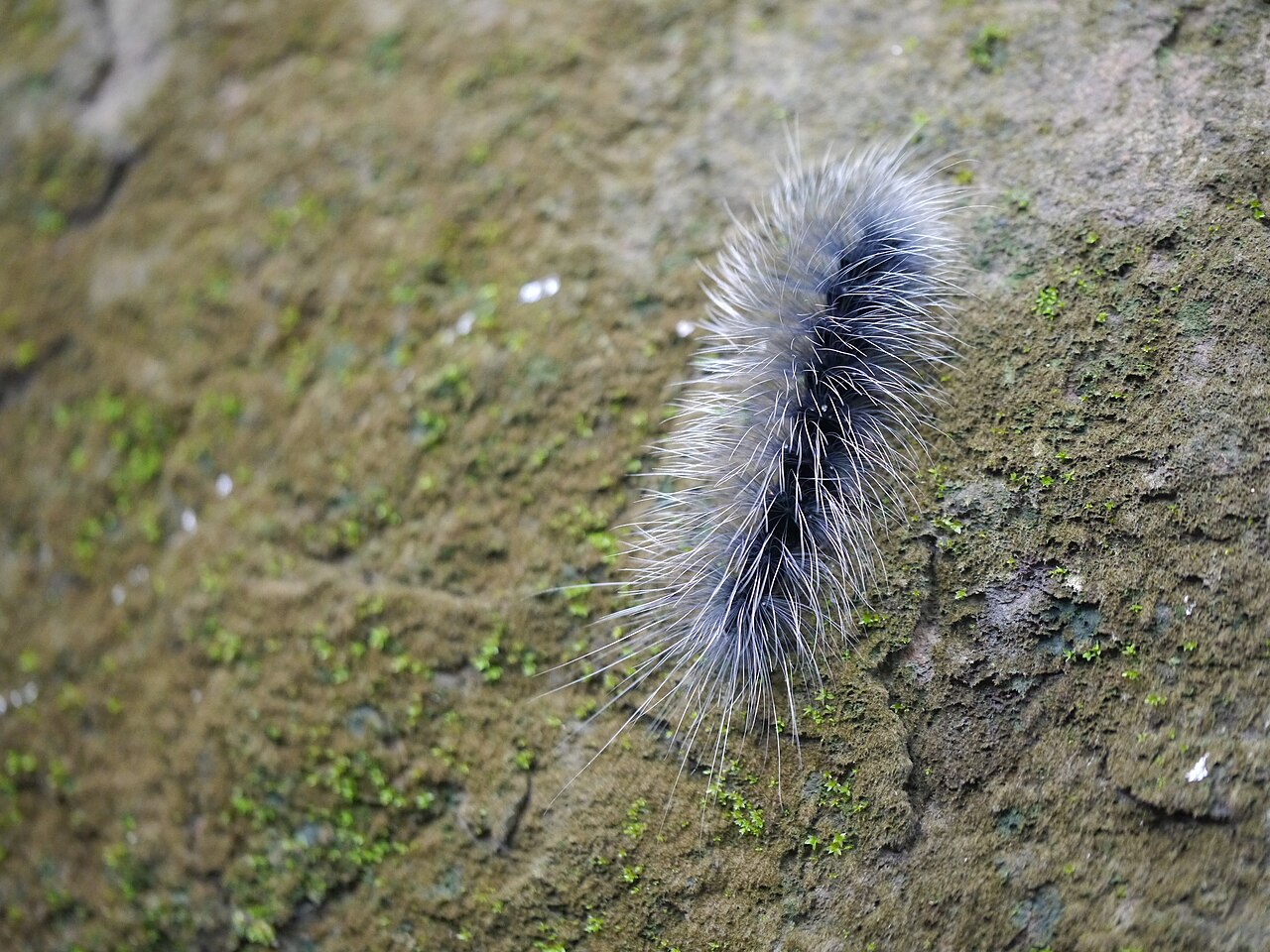
Unlike the smooth-banded woolly bear, the milkweed tussock caterpillar (Euchaetes egle) has distinct tufts of hair in black, white, and orange arranged in clumps along its back rather than continuous bands.
This species feeds exclusively on milkweed, so its presence is a strong clue you are looking at a milkweed patch rather than a lawn or garden bed. The tufted hairs can cause mild skin irritation in sensitive individuals, similar to contact with fiberglass insulation.
Milkweed tussock caterpillars often feed in groups early in their development, stripping leaves side by side before dispersing as they grow larger and more solitary.
How to Identify Black and Orange Caterpillars
Start by looking at band placement: a solid, continuous orange band in the middle with black at both ends points to a woolly bear. Tufted, uneven clumps of hair instead of smooth bands suggest a tussock moth caterpillar.
Next, check hair texture. Woolly bear hairs are short, dense, and uniform, giving the caterpillar its “fuzzy” look. Tussock caterpillars have longer, coarser hair tufts that stick out at odd angles from the body.
Finally, note the host plant. A caterpillar found exclusively on milkweed is far more likely to be a milkweed tussock than a woolly bear, which will typically be found wandering across pavement, driveways, or open ground, especially in fall.
Are Black and Orange Caterpillars Venomous or Dangerous?
Woolly bears are not venomous and cause no reaction in the overwhelming majority of people who handle them. Their bristles are stiff but not connected to venom glands, so a woolly bear crossing your palm is generally a non-event.
Species with tufted hairs, including the milkweed tussock caterpillar and the saltmarsh caterpillar, can cause mild contact irritation, redness, or itching in people with sensitive skin, though this is closer to a mechanical irritation than a true venomous sting.
According to Cornell University’s extension entomology program, most fuzzy caterpillar reactions in North America are mild and short-lived, and severe reactions are uncommon outside of species like the puss caterpillar, which looks quite different from the black and orange caterpillars covered here.
Can You Touch a Black and Orange Caterpillar?
Yes, in most cases you can pick up a woolly bear caterpillar safely with bare hands. Many gardeners do exactly this to move one off a sidewalk or driveway before it gets stepped on.
If you are unsure of the species, a simple precaution is to use a leaf or piece of paper to scoop the caterpillar rather than direct hand contact, then wash your hands afterward as a general good habit around any wild insect.
Children handling caterpillars should be supervised and reminded not to rub their eyes or face afterward, since even non-irritating caterpillar hairs can carry pollen, dust, or plant residue.
What Do Black and Orange Caterpillars Turn Into?
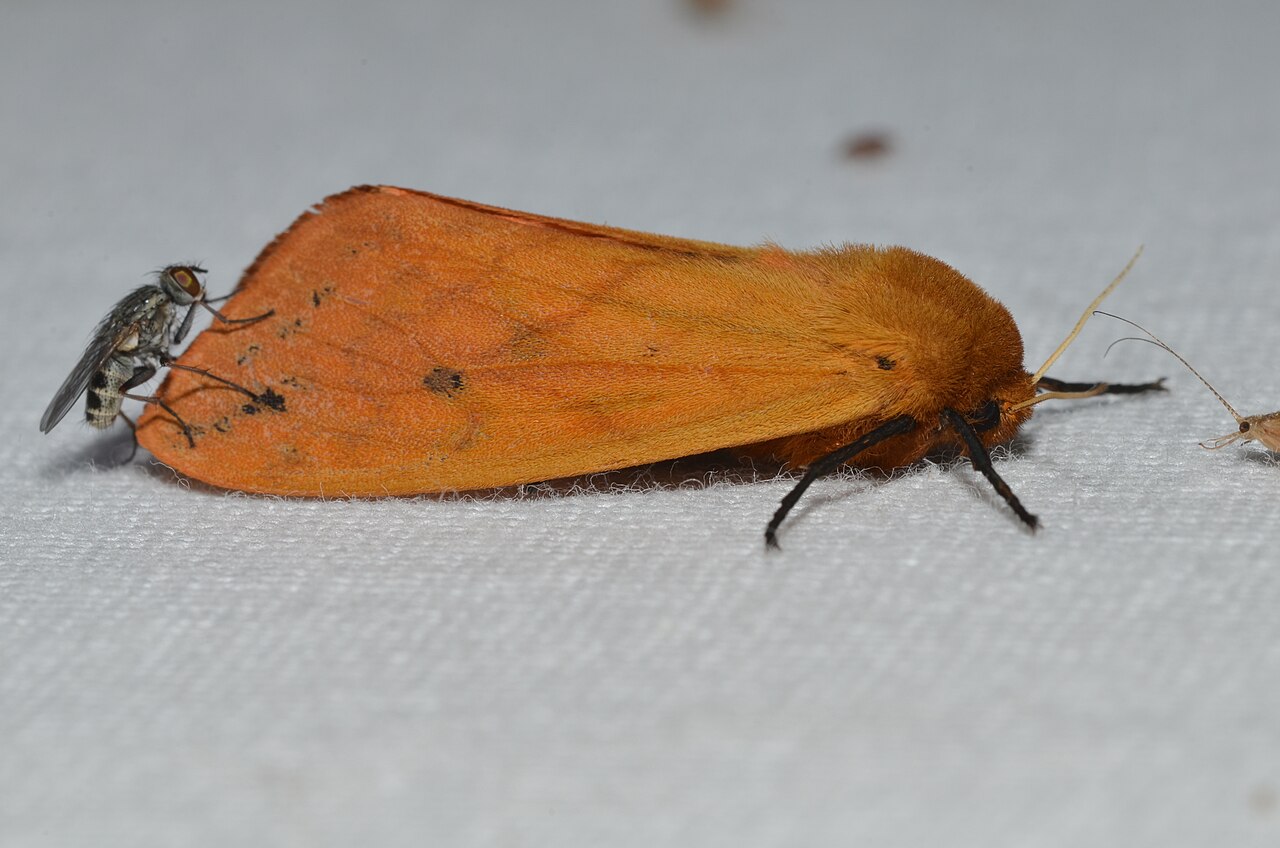
The woolly bear caterpillar transforms into the Isabella tiger moth, a modest yellow-orange moth with small black spots, active mainly at night during the warmer months of the year.
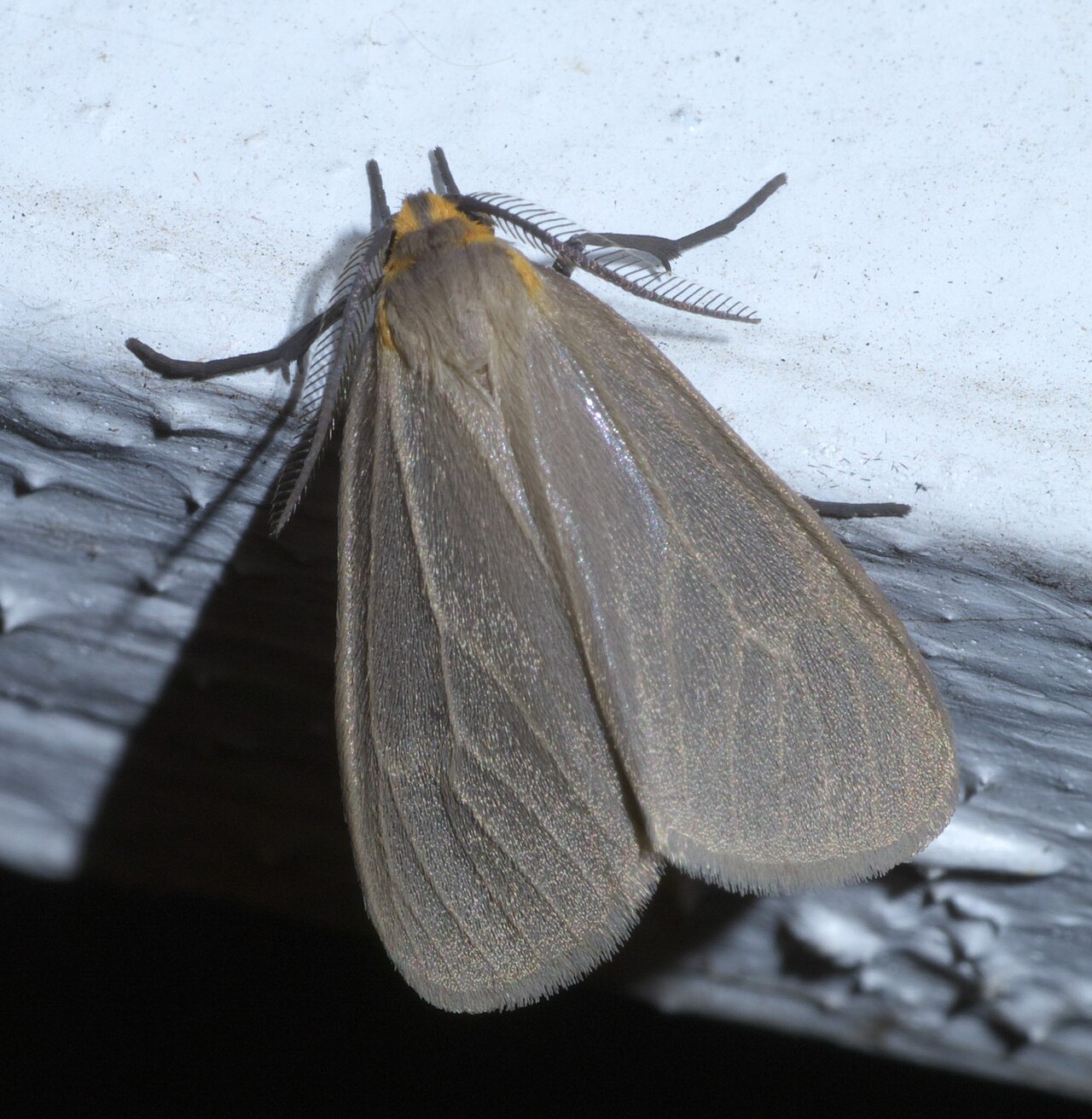
The milkweed tussock caterpillar becomes the milkweed tussock moth, a gray-brown moth with a less flashy appearance than its striking caterpillar stage. orange and black butterfly species are sometimes mistaken for these moths in casual conversation, though butterflies and moths are separate groups with different resting postures and antennae shapes.
In both cases, the adult moth stage lives only a few weeks, focused primarily on mating and egg laying rather than feeding.
Where Do Black and Orange Caterpillars Live?
Woolly bears are found across nearly the entire continental United States and much of Canada, tolerating everything from suburban lawns to open fields and forest edges. They are especially visible in fall, when mature caterpillars wander in search of overwintering shelter.
Milkweed tussock caterpillars are restricted to areas with milkweed present, which makes them common in pollinator gardens, roadside patches, and prairie restorations rather than manicured turf lawns.
Both species overwinter in the larval or pupal stage, tucked under bark, leaf litter, or in loose soil, then emerge or continue development once temperatures rise in spring.
What Do Black and Orange Caterpillars Eat?
Woolly bears are generalists and will feed on dandelions, plantain, grasses, clover, and many other low-growing plants, which is one reason they are so widespread and easy to find.
Milkweed tussock caterpillars, by contrast, feed almost exclusively on milkweed species, ingesting the plant’s toxic compounds and storing them as a defense against predators, a strategy similar to that used by monarch butterfly caterpillars on the same host plant.
Because of this host specificity, finding milkweed tussock caterpillars is actually a useful indicator that a patch of milkweed is healthy and being used by multiple pollinator-supporting insects. Gardeners planting milkweed specifically for monarch butterflies should expect some leaf loss to tussock caterpillars as well, since both species rely on the same limited host plant and neither one is considered a threat to a well-established patch.
Woolly Bear Winter Folklore: Fact or Myth?
Folklore holds that a woolly bear’s band width predicts how harsh the coming winter will be, with a wider orange-brown band supposedly meaning a milder season and more black meaning a harsher one.
The National Weather Service and wildlife researchers who have studied this claim have found no reliable scientific link between band width and winter severity. Band width instead varies with the caterpillar’s age, species, and how recently it molted, not with future weather.
The folklore remains popular at fall festivals and nature centers largely because it is a fun, low-stakes tradition, not because it has held up under controlled study.
What to Do If You Find One in Your Yard
If you find a woolly bear or similar black and orange caterpillar and want to leave it undisturbed, simply let it continue on its way. These caterpillars are not pests and do not damage garden plants in meaningful numbers.
If it is in a spot where it is likely to be stepped on, such as a sidewalk or driveway, gently relocate it to nearby grass, mulch, or a garden bed using a leaf as a scoop.
Avoid pesticide use targeting these caterpillars specifically, since they are not agricultural or garden pests and play a role in the local food web as prey for birds and other insects.
Caterpillar Look-Alikes to Know
The black fuzzy caterpillar group includes several all-black or near-black species that can be confused with woolly bears before their orange band develops fully in later instars.
Black and yellow caterpillar species, and red and black caterpillar species, share the general “banded fuzzy caterpillar” body plan but differ enough in color placement to separate with a careful look. Checking which end of the body carries the darker color, and how sharply the bands transition, usually settles the question within a few seconds.
Orange caterpillar species without black banding, and the black caterpillar group with little to no orange, round out the most commonly confused categories reported by US gardeners.
Frequently Asked Questions
Are orange and black caterpillars venomous?
Woolly bear caterpillars are not venomous and are safe to touch. A few tufted relatives, like the milkweed tussock caterpillar, can cause mild skin irritation but no venom is involved.
What should I do if I find a woolly bear caterpillar?
You can leave it alone or gently move it to a safer spot, such as grass or mulch, if it is in a high-traffic area like a sidewalk or driveway.
What do black and orange fuzzy caterpillars turn into?
Woolly bears become Isabella tiger moths, a plain yellow-orange moth. Milkweed tussock caterpillars become milkweed tussock moths, a gray-brown species with a much less striking adult appearance.
Can you touch orange and black caterpillars?
Yes, woolly bears can be handled safely with bare hands. If you are unsure of the exact species, scooping with a leaf is a simple precaution against mild skin irritation.
Which caterpillar should not be touched?
Caterpillars with long, stinging spines, such as the puss caterpillar or io moth caterpillar, should not be touched. These look quite different from the fuzzy woolly bear described above, since true stinging caterpillars have rigid, needle-like spines rather than soft, dense hair.
What kills caterpillars immediately?
Broad-spectrum insecticides can kill caterpillars quickly, but they are not recommended for woolly bears or milkweed tussock caterpillars since neither is a garden pest and both support local wildlife.
Sources: National Weather Service, Cornell University College of Agriculture and Life Sciences.