Blue Dragonfly: 8 Common US Species and How to Tell Them Apart
A blue dragonfly is almost always a mature male, and in most of the United States it is one of about eight species. The blue is not pigment: it is pruinescence, a pale waxy bloom that grows over the body as a male matures, which is why the females and young males of the same species look brown, green, or yellow instead.
None of them can sting, and none of them is a threat to people or pets. Below, the safety question first, then the species you are most likely to be looking at, with the marks that separate the near-identical ones.
Blue dragonflies in the US are usually mature males of the blue dasher, eastern pondhawk, common whitetail, great blue skimmer, slaty skimmer, spangled skimmer, blue-eyed darner, or common green darner. Their blue comes from pruinescence, a waxy coating that develops with age. No dragonfly stings, and none bites hard enough to break human skin.
| Species | Blue look | Length | Range | Best field mark |
|---|---|---|---|---|
| Blue dasher | Powder blue abdomen, green eyes | 1 to 1.7 in (2.5 to 4.3 cm) | Nearly nationwide | Yellow stripes on a dark thorax |
| Eastern pondhawk | Entirely chalky blue male | 1.5 to 1.8 in (3.8 to 4.5 cm) | East and central US | Bright green female, green face |
| Common whitetail | Chalk white to pale blue abdomen | 1.6 to 1.9 in (4 to 4.8 cm) | Nationwide | One broad dark band per wing |
| Great blue skimmer | Pale blue body, blue eyes, white face | 2 to 2.4 in (5 to 6 cm) | Southeast and mid-Atlantic | Largest blue skimmer, white face |
| Slaty skimmer | Dark slate blue, nearly black | 1.8 to 2.2 in (4.5 to 5.5 cm) | Eastern US | Black head, unmarked wings |
| Spangled skimmer | Blue body with marked wings | 1.7 to 2 in (4.3 to 5 cm) | Eastern US | White and black stigma pair |
| Blue-eyed darner | Blue-spotted abdomen, blue eyes | 2.6 to 3 in (6.5 to 7.5 cm) | Western US | Patrols without landing |
Do Blue Dragonflies Bite or Sting?
No dragonfly has a stinger. What looks like one at the tip of the abdomen is a set of claspers used to hold a mate, and the long body shape that worries people has no venom apparatus anywhere in it. The old names devil’s darning needle and horse stinger are folklore, not biology.
Dragonflies do have strong chewing mandibles, and a large darner held badly can pinch hard enough to be felt. On the biggest US species that pinch may just break skin; on a blue dasher it cannot. There is no venom, no allergic reaction risk beyond ordinary skin irritation, and no reason to treat a bite as anything other than a scratch.
They are also harmless to gardens, pets, and children, and actively useful: adults take mosquitoes, midges, and gnats on the wing, and the aquatic larvae eat mosquito larvae by the hundred. The genuinely defensive blue insects are elsewhere, like the blue wasp, and they are built nothing like a dragonfly.
What Kind of Dragonflies Are Blue?
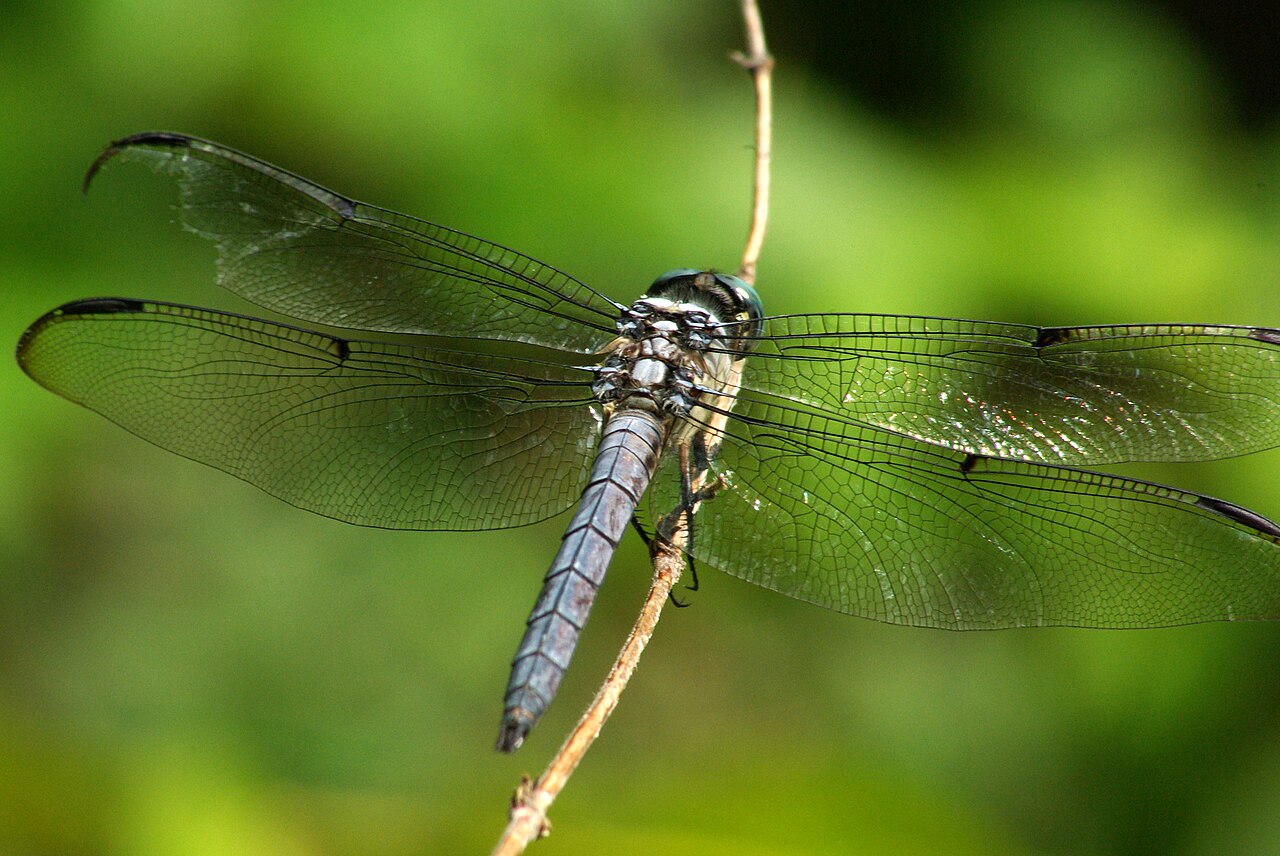
Blue dragonflies cluster in two families. The skimmers (Libellulidae) include the perchers you can walk up to: blue dasher, eastern pondhawk, common whitetail, great blue skimmer, slaty skimmer, and spangled skimmer. The darners (Aeshnidae) are the big patrollers that rarely land, including the blue-eyed darner and the common green darner.
Almost all of the blue belongs to mature males. A young male eastern pondhawk is bright green and indistinguishable from the female at a glance; over roughly one to two weeks of adult life, the waxy pruinescence spreads from the base of the abdomen forward until the insect is chalky blue. Photographs of the same species therefore disagree wildly, and that is normal rather than a misidentification.
True structural blue, the kind that comes from the cuticle itself rather than a coating, shows up mainly in the eyes, as in the great blue skimmer and the blue-eyed darner. Blue in the wings themselves does not occur in US species, which is worth remembering when a photo online looks too good; the same goes for the saturated images behind most blue butterfly searches. Species accounts and pollinator notes for many of these dragonflies are published by the U.S. Fish and Wildlife Service.
Blue Dasher (Pachydiplax longipennis)
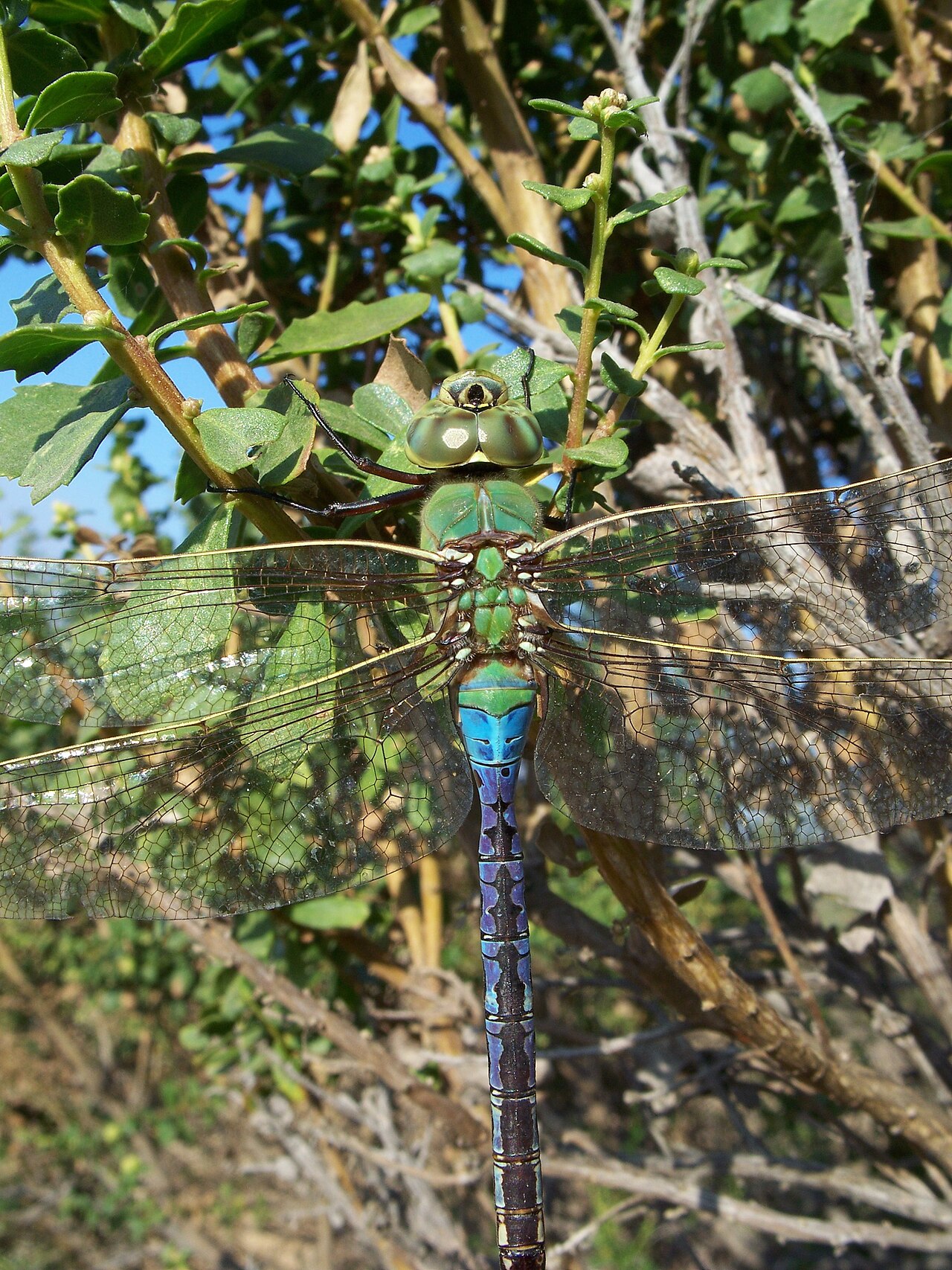
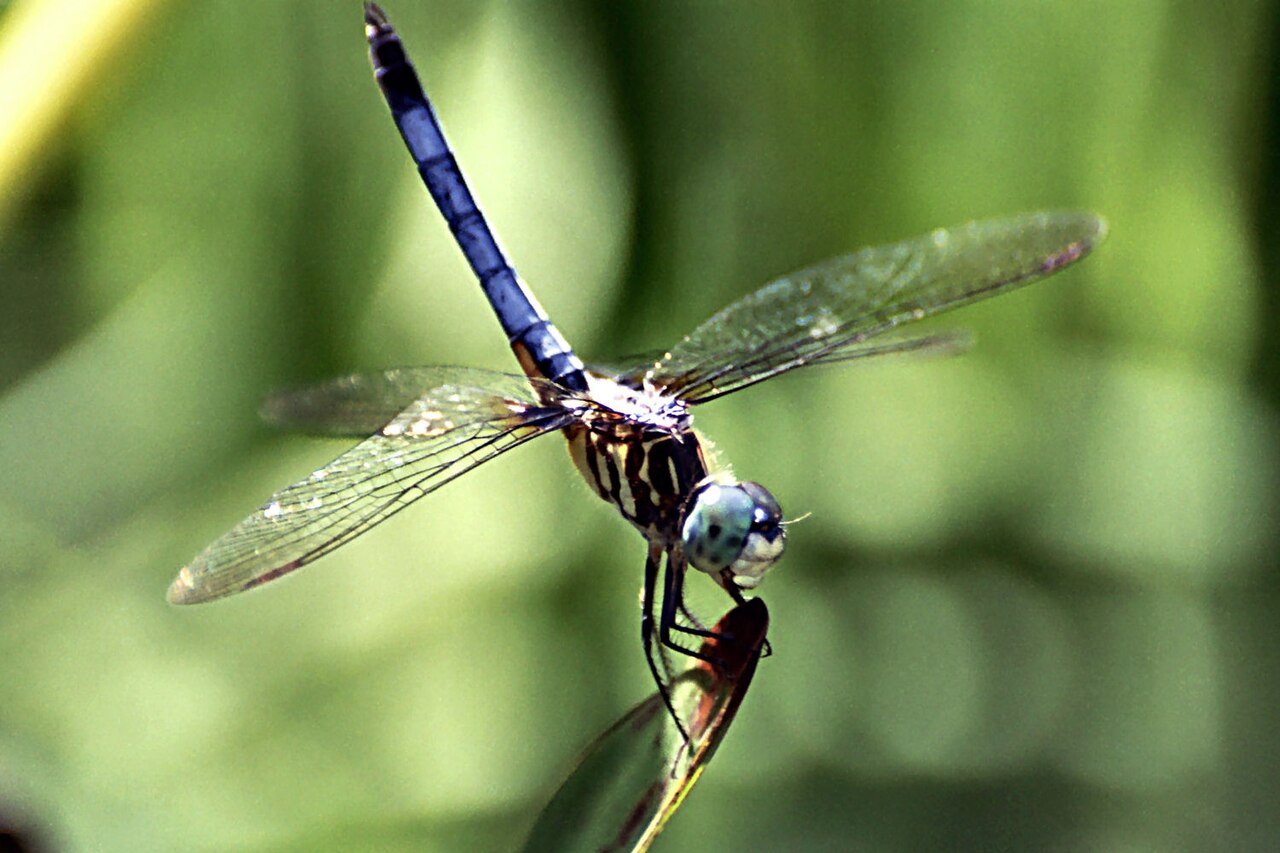
The blue dasher is the default answer across most of the country and almost certainly the dragonfly in your yard. The mature male has a powder blue abdomen that narrows to a dark tip, metallic green to turquoise eyes, and a dark thorax striped with yellow, a combination no other common species repeats.
At 1 to 1.7 in (2.5 to 4.3 cm) it is on the small side, and it perches constantly on stems, fence wire, and plant stakes with its wings angled forward and down. Females and young males wear a brown abdomen with paired yellow dashes along each side, which is where the name comes from.
It tolerates still, warm, weedy water better than most species, including garden ponds, drainage basins, and cattle tanks. That tolerance is why the blue dasher is the first dragonfly to colonize a new backyard pond, often within the first season.
Eastern Pondhawk (Erythemis simplicicollis)
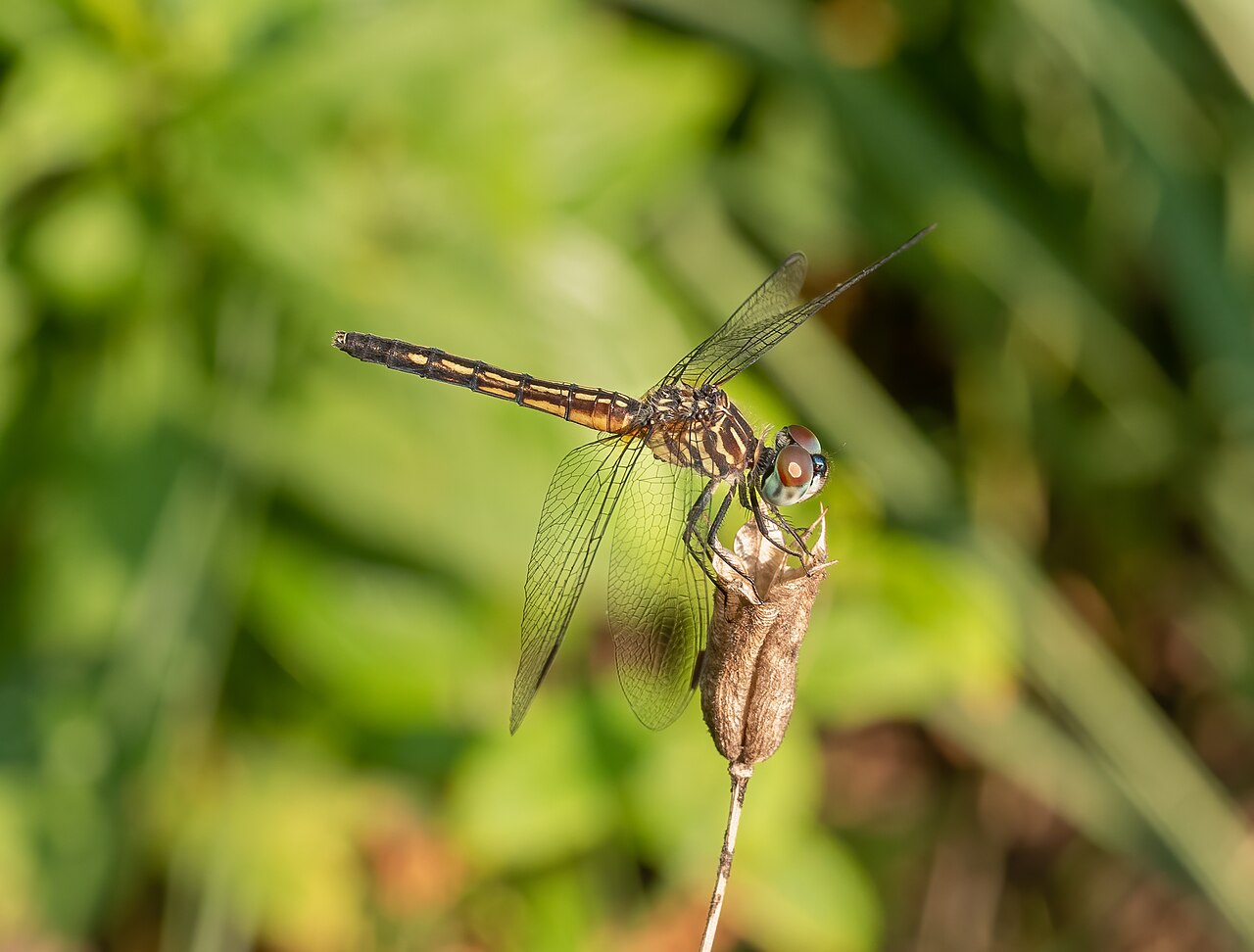
The mature male eastern pondhawk is the most completely blue dragonfly in the eastern US: thorax, abdomen, and all, in a flat chalky powder blue, with pale appendages at the tip. The face stays green, which separates it from every skimmer that looks similar at distance.
The female is unmistakable in the other direction, a vivid grass green with black rectangular markings down the abdomen, and she is often reported as a separate species. Both sexes run 1.5 to 1.8 in (3.8 to 4.5 cm) and hunt from the ground as readily as from a perch, frequently sitting flat on bare soil, gravel paths, and boat docks.
Pondhawks are aggressive predators that take other dragonflies, including damselflies and smaller skimmers. If you watch a blue dragonfly eat something with wings at a pond edge, this is the usual culprit.
Common Whitetail (Plathemis lydia)
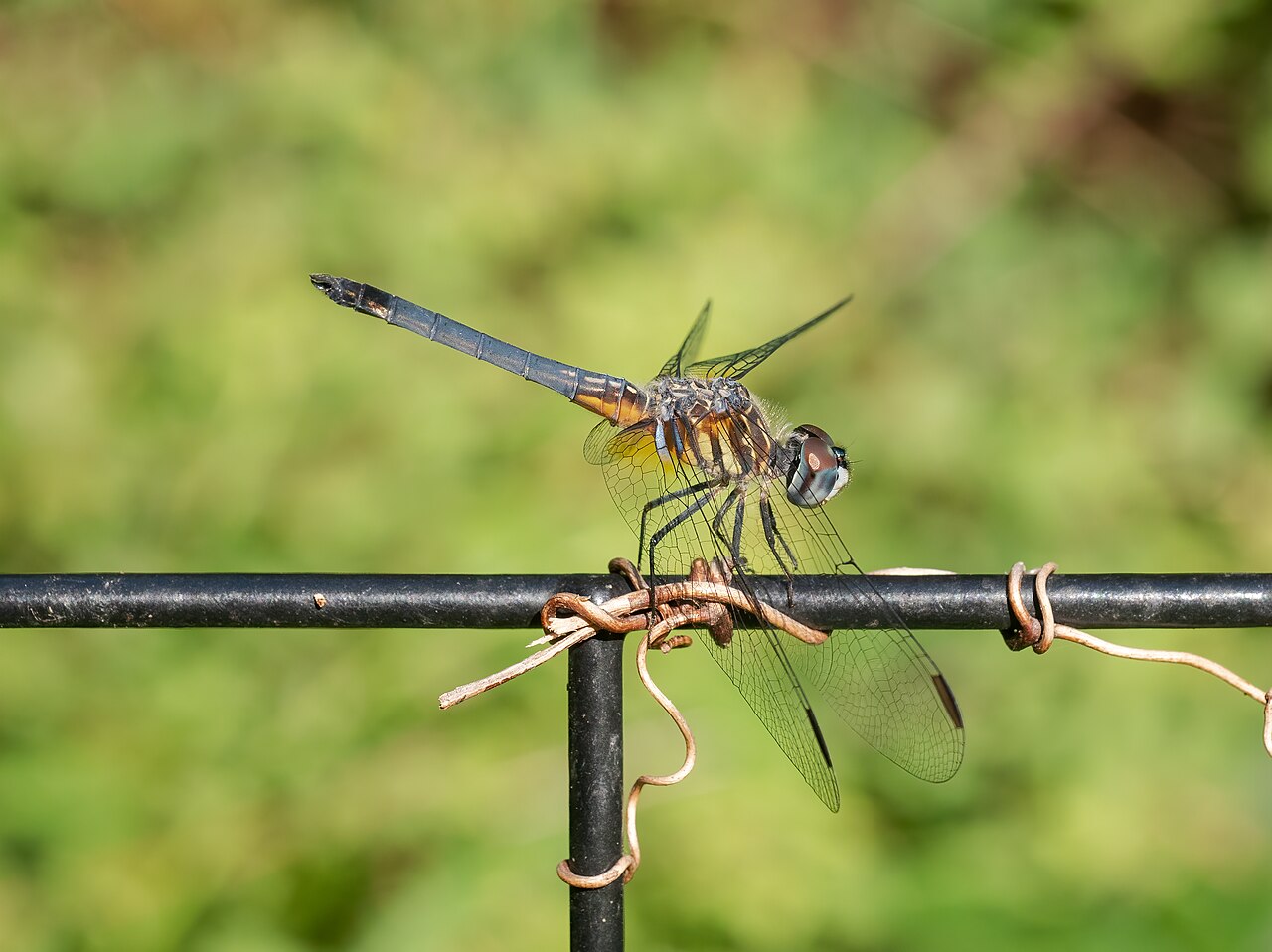
The common whitetail male reads as blue or white depending on the light, because the pruinescence on his short, wide abdomen is thick enough to look like chalk. The clincher is in the wings: one broad blackish band across the middle of each wing, with clear tips, a pattern no other blue species shows.
Length runs 1.6 to 1.9 in (4 to 4.8 cm), and the build is noticeably stockier than a blue dasher’s. Females have a brown abdomen with pale triangular side markings and three dark patches per wing, and they resemble twelve-spotted skimmers closely enough to catch experienced observers.
Whitetails hold territory over muddy, sunlit shallows and defend it by flashing that white abdomen at rivals, a display you can watch from a few feet away. They are abundant at pond edges, ditches, and slow creeks in all 48 contiguous states.
Great Blue Skimmer (Libellula vibrans)
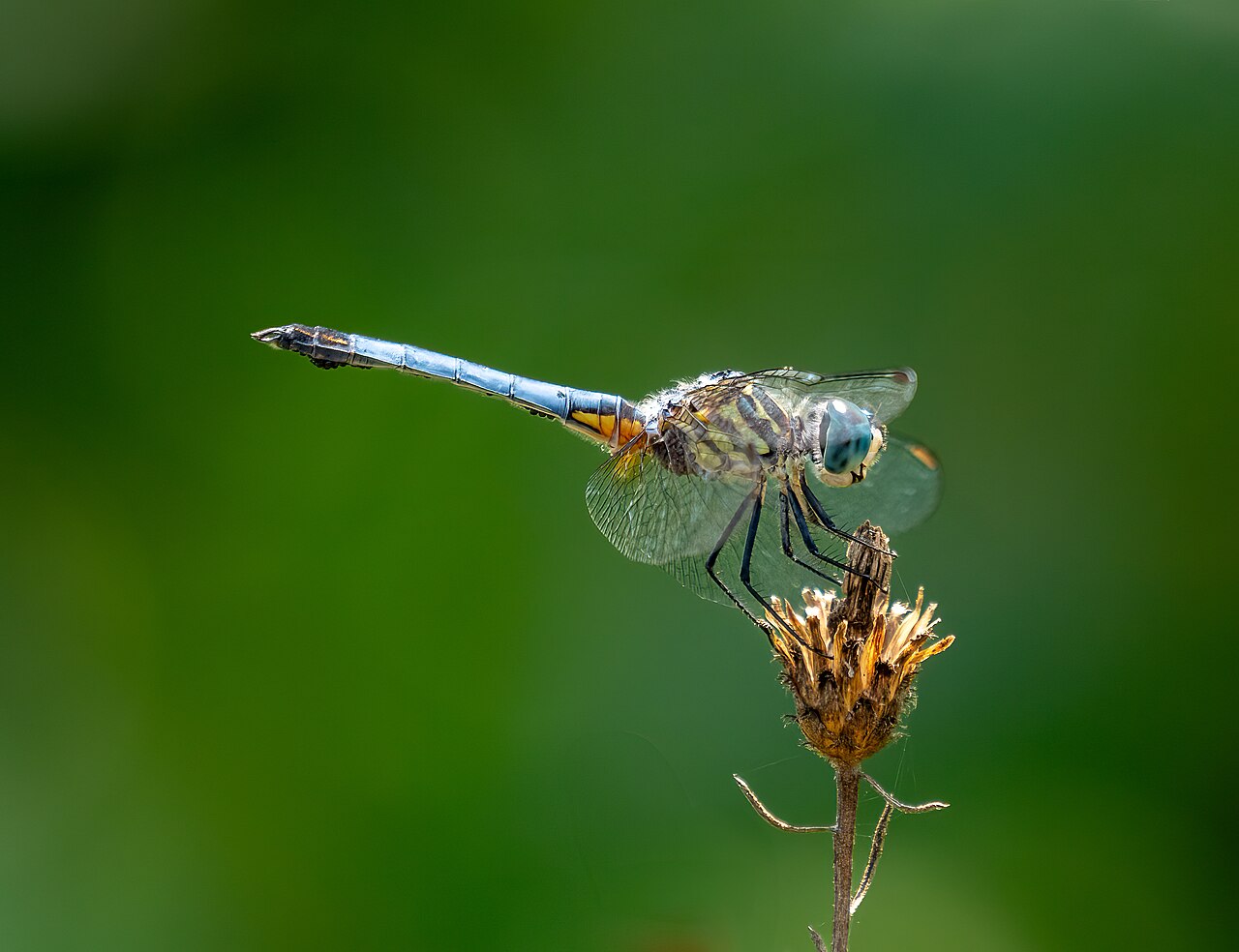
The great blue skimmer is the largest blue skimmer in the eastern US at 2 to 2.4 in (5 to 6 cm), and a mature male is pale powder blue across the body with striking blue eyes and a white face. The combination of size, blue eyes, and white face identifies it on sight.
It prefers shaded, swampy, slow water: wooded seeps, cypress edges, forest ponds, and ditches with leaf litter, from the mid-Atlantic south through Florida and west to Texas. That habitat preference means you usually meet it in woods rather than in an open yard.
Immature individuals are brown with dark wing markings and a white face, and they look so unlike the adult male that they are often mistaken for a separate species. The face color carries through every age, which makes it the one mark worth checking first.
Slaty Skimmer (Libellula incesta)
The slaty skimmer is the dark end of blue. A mature male is deep slate blue over the whole body, so dark that in poor light he photographs as black, with a solid black head that makes the body look darker still. The wings are clear and unmarked except for narrow dark tips in some individuals.
At 1.8 to 2.2 in (4.5 to 5.5 cm) it is a medium large skimmer, common across the eastern states around ponds, lakes, and slow streams with wooded margins. It perches on twig tips with wings held straight out and returns to the same perch repeatedly, which makes it easy to photograph.
Females and immatures are brown with a dark stripe down the abdomen and a pale face, so the all-dark look belongs only to older males. A dark blue dragonfly with a black face in the East is this species far more often than anything else.
Spangled Skimmer (Libellula cyanea)
The spangled skimmer carries the best single field mark of any blue dragonfly in the country. On the leading edge of each wing, the stigma is half white and half black, a two-tone bar that no other US species has. If you see those paired white and black spots, identification is finished.
Mature males are medium blue with a slightly darker thorax, at 1.7 to 2 in (4.3 to 5 cm), and they share ponds and lake edges with slaty skimmers throughout the eastern US. Females and immatures are brown and yellow striped but keep the same white and black stigmas.
Because the mark sits on the wing rather than the body, it survives the pruinescence problem entirely and works at any age. It is the species to show someone who is convinced dragonfly identification is impossible.
Blue-eyed Darner (Rhionaeschna multicolor)
The blue-eyed darner is the common blue dragonfly of the western states, and it behaves nothing like a skimmer. At 2.6 to 3 in (6.5 to 7.5 cm) it patrols back and forth over water for long stretches without perching, which is why most western sightings are of a fast blue insect that never holds still.
The eyes are brilliant blue, the thorax carries blue side stripes, and the abdomen is black with paired blue spots down its length, giving a banded look in flight. It is common from the Great Plains west, in both natural ponds and irrigation water, and it flies well into the evening.
Its eastern counterparts in the same genus group look similar enough that range usually decides the call. Darners also hunt away from water, so a big blue dragonfly working a dry hillside at dusk is almost certainly one of them.
Common Green Darner (Anax junius)
The common green darner is the blue dragonfly most people misname, because only part of it is blue. The thorax is bright apple green, and the long abdomen on a mature male is blue to violet blue, often brightest when he is warm and active. Immatures and females carry a reddish brown or purplish abdomen instead.
It is one of the largest US dragonflies at 2.8 to 3.1 in (7 to 8 cm), with a wingspan over 4 in (10 cm), and it occurs in every state. The species is also genuinely migratory: generations move north in spring and south in fall, sometimes in swarms of thousands along coastlines and ridgelines.
Green darners hawk insects in open air, well away from water, and are often the dragonfly seen over parking lots, ball fields, and lawns in late summer. That habit is also what makes them the species most often caught by bluebirds and other aerial insectivores.
Blue Dragonfly or Blue Damselfly?
Half of all blue dragonfly reports are actually damselflies, and the two groups are easy to separate once you know where to look. Damselflies such as the familiar bluet (Enallagma civile) are thin, weak flying, and fold their wings along the body at rest; dragonflies are stocky, fast, and hold their wings open.
| Feature | Blue dasher (dragonfly) | Familiar bluet (damselfly) |
|---|---|---|
| Wings at rest | Held out flat or angled down | Folded together over the back |
| Body | Thick, 1 to 1.7 in (2.5 to 4.3 cm) | Thread thin, 1 to 1.4 in (2.5 to 3.5 cm) |
| Eyes | Touching, cover most of the head | Widely separated, bulging at the sides |
| Flight | Fast, direct, strong | Fluttery, weak, short hops |
| Blue pattern | Solid powder blue abdomen | Blue with black rings along the abdomen |
Check the eyes if the insect is perched and the wings if it is settled on a stem. Both marks work at any age and from a phone photograph, which is more than can be said for body color. Younger stages are harder still, and our baby dragonfly guide covers the aquatic nymphs that neither group resembles as adults.
How Can You Attract Dragonflies?
You attract dragonflies with water, sun, and vertical perches, in that order. A pond of at least 20 sq ft (1.9 sq m) and 2 ft (60 cm) deep, with no fish, half of it in full sun, and native submerged plants for nymphs to climb, will draw blue dashers in the first summer and more species each year after.
Perches matter more than most people expect. Bare stakes, tall stems, and thin branches 3 to 5 ft (90 to 150 cm) above the water give territorial males somewhere to sit, and a pond with perches holds several times more dragonflies than an identical pond without them. Leave a muddy, open shoreline strip as well, since pondhawks and whitetails use bare ground.
Skip mosquito foggers and larvicides anywhere near the water. They remove the prey base and kill the nymphs, which spend one to three years submerged before emerging. The same chemicals account for most of the local declines in harmless aquatic insects, including the aquatic stages of the blue fly groups and the amphibians that share the pond, like the blue spotted salamander.
Frequently Asked Questions
Are blue dragonflies lucky?
In folklore, often yes. Dragonflies carry meanings of change, adaptability, and renewal in Japanese, Native American, and European traditions, and blue specifically gets linked to calm and clarity in modern symbolism rather than in older sources. Biologically there is nothing to it, but a yard with blue dragonflies does indicate clean water nearby.
How rare is it to see a blue dragonfly?
Not rare at all. Blue dashers and common whitetails occur in nearly every state and are among the most abundant dragonflies in North America, so anyone near still water in summer will see blue dragonflies regularly. What is uncommon is seeing a blue individual early in the season, since the color only develops in mature males.
What is the rarest dragonfly color?
Among US species, strong pink and purple tones are the rarest, appearing in the roseate skimmer and a few western relatives. Pure white bodies are also unusual outside of heavy pruinescence. Red, blue, green, brown, and yellow all occur in many common species, so a genuinely odd color is more often a lighting artifact than a rare dragonfly.
What is the most powerful dragonfly?
By flight performance, the big darners. The common green darner cruises at roughly 20 to 25 mph (32 to 40 kph), migrates hundreds of miles, and captures prey in midair with close to a 95 percent success rate in laboratory tests. The globe skimmer (Pantala flavescens) travels farther still and is credited with the longest insect migration known.
Is the dragonfly rare?
Dragonflies as a group are common and widespread, with about 330 species in North America. Individual species can be genuinely rare, usually because they depend on a narrow habitat such as clean spring-fed streams or bog pools. Those specialists are the ones that disappear when wetlands are drained, while generalists like the blue dasher expand.
What is the prettiest type of dragonfly?
Judged on color alone, the usual nominees are the great blue skimmer for its blue eyes and white face, the roseate skimmer for pink, the calico pennant for patterned wings, and the ebony jewelwing damselfly for metallic green with black wings. For blue specifically, a mature male eastern pondhawk in full pruinescence is as saturated as US species get.