Baby Dragonfly: Nymph Facts, Diet, and Life Underwater
A baby dragonfly is called a nymph or naiad, and it lives underwater. It looks nothing like the adult: a squat, drab, six-legged predator that stalks the bottom of a pond, breathes through gills inside its rectum, and catches prey by firing a hinged jaw forward faster than the eye can follow.
The proportions of the life cycle surprise most people. A dragonfly may spend one to five years as a nymph and only a few weeks to a few months as the winged adult everyone recognizes, so the underwater stage is the animal’s real life and the flying stage is a brief reproductive finale. This guide covers what nymphs look like, the harpoon jaw, jet propulsion, what they eat, how emergence works, and why they matter in a garden pond.
| Quick Facts | Dragonfly Nymph |
|---|---|
| Also called | Naiad, larva, or nymph |
| Time underwater | 1 to 5 years depending on species |
| Molts | Roughly 8 to 17 before emerging |
| Diet | Mosquito larvae, tadpoles, small fish, other nymphs |
| Breathing | Gills inside the rectum |
| Adult lifespan | A few weeks to a few months |
What Is a Baby Dragonfly Called?
The standard terms are nymph and naiad, both used for the aquatic immature stage. Naiad is the more precise word for an aquatic nymph and comes from the water spirits of Greek mythology, while nymph is the general entomological term for the immature stage of an insect with incomplete metamorphosis.
That last point matters. Dragonflies do not pupate. Butterflies, moths, beetles, and flies go through complete metamorphosis with a distinct pupal stage in which the body is rebuilt, but dragonflies belong to the group that changes gradually across successive molts, with wing pads growing larger each time until the final molt produces a winged adult.
There is no cocoon and no chrysalis anywhere in the process. What you find attached to a reed stem at the edge of a pond, split down the back and hollow, is not a cocoon but the shed skin of the final nymphal molt, called an exuvia. It is the single most common piece of dragonfly evidence people find and misinterpret.
What a Dragonfly Nymph Looks Like
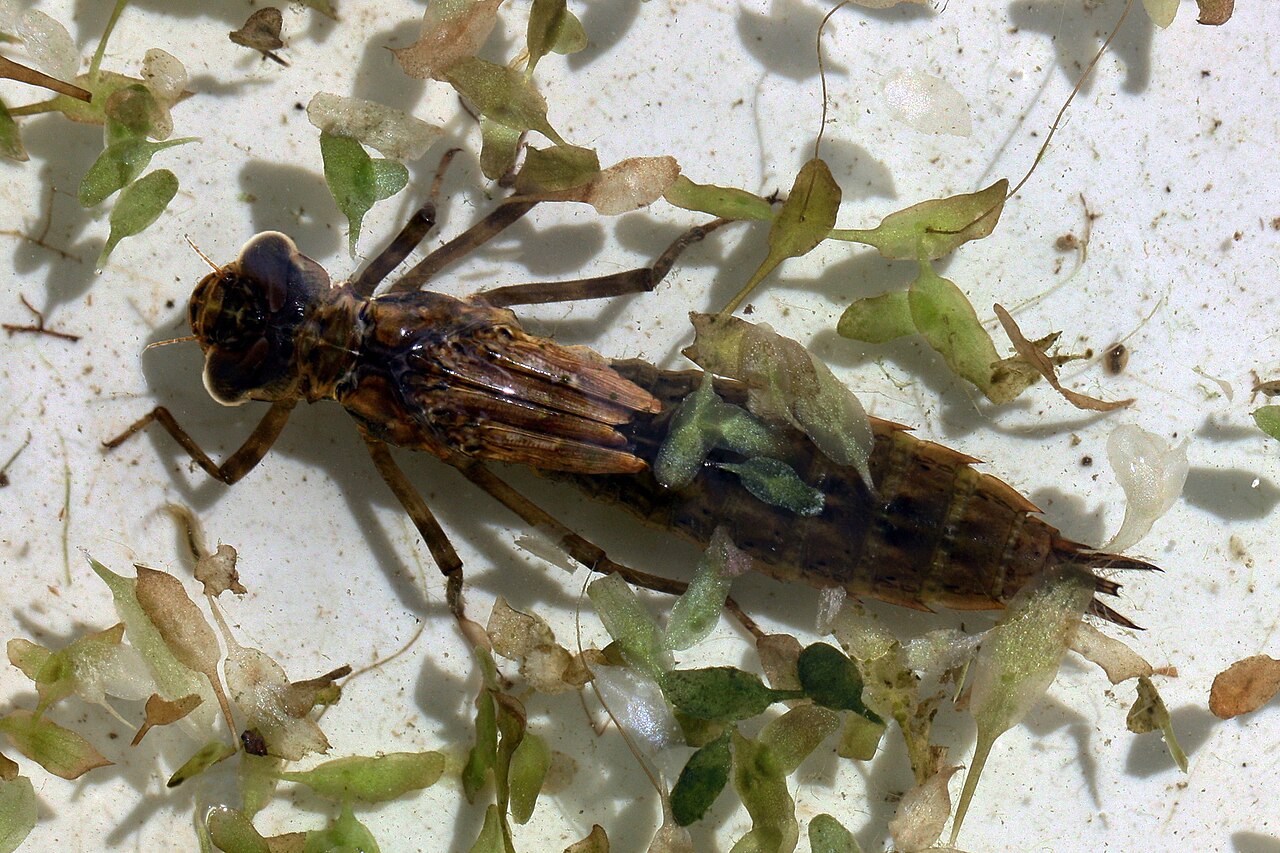
Nymphs are stocky and unglamorous, ranging from under 0.5 in in young stages to about 2 in when fully grown, in shades of brown, olive, and grey that match pond sediment. They are built for ambush rather than display.
The body plan is recognizably insect. Six legs, a large head with prominent eyes, a segmented abdomen, and, in later stages, obvious wing pads lying flat along the back like a folded jacket. Those wing pads are the clearest indicator that you are looking at a dragonfly nymph rather than some other aquatic larva.
Other pond invertebrates get confused with them too, including the larvae covered in our guide to the black caterpillar, which occasionally fall into water and are mistaken for aquatic species. Damselfly nymphs are the more common confusion and are easy to separate. They are slender rather than stocky and carry three leaf-shaped external gills at the tip of the abdomen that look like tail fins. Dragonfly nymphs have no such appendages, because their gills are internal.
The Jaw That Fires Like a Harpoon
The nymph’s hunting apparatus is one of the more remarkable pieces of anatomy in fresh water. The lower lip, called the labium, is modified into a hinged extendable arm tipped with grasping hooks, folded beneath the head at rest like a mask covering the face.
When prey comes within range the labium shoots forward, seizes the animal, and retracts, all in a fraction of a second. High-speed studies put the strike in the range of tens of milliseconds, far too fast to follow by eye, and the mechanism is at least partly hydraulic, driven by a rapid increase in internal body pressure rather than by muscle alone.
The reach is substantial, extending well beyond the head, which lets a motionless nymph take prey that never came close enough to sense danger. Combined with camouflage and near-total stillness, it makes dragonfly nymphs among the most effective invertebrate predators in a pond. Adults are equally formidable hunters with a documented catch rate above 90 percent on pursued prey, so the ability runs through the whole life cycle.
Jet Propulsion and Rectal Gills
Dragonfly nymphs breathe through gills lining the inside of the rectum, drawing water in through the anus and expelling it again. It is an unusual arrangement and it produces an unexpected secondary ability.
By contracting the abdominal muscles sharply, a nymph can expel that water in a jet and shoot forward several body lengths in an instant. It is genuine jet propulsion, used to escape predators and occasionally to close on prey, and it is the fastest movement in the animal’s underwater repertoire.
Ordinary movement is slow and deliberate by contrast. Nymphs walk across the bottom and through vegetation on six legs, and many species burrow into silt or cling motionless to stems for long periods, which is what makes the sudden jet so startling to watch.
What Baby Dragonflies Eat
Dragonfly nymphs are strict carnivores from the moment they hatch. Early stages take water fleas, copepods, and other tiny invertebrates, and prey size increases with each molt.
Mature nymphs are formidable. Mosquito larvae make up a substantial share of the diet in many ponds, along with mayfly and caddisfly larvae, worms, snails, small crustaceans, and tadpoles. Large nymphs of the biggest species regularly take small fish and are documented eating young amphibians well beyond the size you would expect.
Cannibalism is routine. Dragonfly nymphs eat other dragonfly nymphs, including their own species, and in a crowded pond this is a significant source of mortality. That appetite makes them genuine mosquito control in a garden pond, and it also means they interact heavily with the amphibians in our guide to what tadpoles eat, which share the same water and often end up on the menu.
How Long They Stay Underwater
This is the part that reframes the whole species. Depending on species, water temperature, and food supply, the nymphal stage lasts anywhere from a few months to five years, with two to three years typical for many temperate species and some northern populations taking longer still.
Development proceeds through roughly 8 to 17 molts. There is no fixed number, and individuals in the same pond can vary depending on how well they have fed. Warm productive water speeds development, and cold nutrient-poor water slows it dramatically.
Nymphs overwinter in the water rather than dying off. In climates where ponds freeze, they remain active but slow beneath the ice, feeding little and growing slowly until spring. That is why a pond can hold a substantial nymph population year-round even when no adult dragonflies have been seen for months.
Emergence: Leaving the Water
Emergence is the most vulnerable event in a dragonfly’s life. When ready, the nymph climbs out of the water up a reed stem, rock, or dock post, usually at night or in the early morning, and grips tightly.
The skin then splits along the back of the thorax and the adult pulls itself out head first, hangs while its abdomen extends, and pumps hemolymph into the crumpled wings to expand them. The whole process takes one to several hours, and the newly emerged adult, called a teneral, is soft, pale, and almost defenseless throughout.
Failure at this stage is common. Wings that do not expand fully, an adult that falls into the water, or a bird arriving mid-emergence all end the animal after years of underwater development. Those who succeed leave behind the exuvia still gripping the stem, and counting exuviae along a pond edge is a standard survey method because each one represents exactly one dragonfly that made it.
How Long Adults Actually Live
Most adult dragonflies live a few weeks. Some species manage a couple of months, and migratory species such as the wandering glider can live longer while covering extraordinary distances, but the winged stage is short in every case.
That inverts the intuition most people have. A dragonfly patrolling a pond in July may have spent three years as a nymph in that same water and will be dead within a month. The adult stage exists to disperse, mate, and lay eggs, and everything else was accomplished underwater.
Females lay eggs in or near water, either inserting them into plant tissue with a blade-like ovipositor or dropping them directly onto the surface while flying, and the cycle restarts. The adults share their hunting airspace with the insects in our guides to the hummingbird moth and the jumping spider, both of which are prey rather than competitors.
Dragonfly Nymphs in a Garden Pond
If you want dragonflies, build for the nymphs rather than the adults. A pond needs to hold water year-round, since a pond that dries out kills a multi-year nymph population outright, and it needs submerged and emergent vegetation for hunting cover and for the stems nymphs climb at emergence.
Fish are the central trade-off. Goldfish and koi eat dragonfly nymphs efficiently, and a stocked ornamental pond will support far fewer than an unstocked one. A pond without fish, with varied depth and plenty of plants, is what produces the dense nymph populations that in turn produce clouds of adults.
The mosquito payoff is real but worth stating honestly. Nymphs eat large numbers of mosquito larvae and adults catch mosquitoes on the wing, but no single predator eliminates mosquitoes from a yard, and the marketing that presents dragonflies as a complete solution overstates it. What they do provide is meaningful ongoing suppression plus a striking insect to watch, and avoiding insecticides near the water matters more than any other single choice, since the same products that kill mosquito larvae kill the nymphs hunting them. Our guide to getting rid of gnats covers the indoor version of the same problem.
Related reading: Baby Praying Mantis.
Related reading: Baby Silverfish.
Related reading: Baby Earwig.
Related reading: Dragonfly Symbolism.
Frequently Asked Questions
What is a baby dragonfly called?
A nymph or naiad. Dragonflies undergo incomplete metamorphosis, so there is no pupa, cocoon, or chrysalis. The nymph molts repeatedly with wing pads growing larger each time until a final molt produces the winged adult.
How long do dragonflies stay underwater as nymphs?
Anywhere from a few months to five years depending on species, temperature, and food, with two to three years typical for many temperate species. They pass through roughly 8 to 17 molts and remain active beneath the ice through winter.
What do dragonfly nymphs eat?
They are strict carnivores, taking water fleas and copepods when small and progressing to mosquito larvae, mayfly and caddisfly larvae, worms, snails, tadpoles, and small fish. Cannibalism on other nymphs is routine.
How does a dragonfly nymph catch prey?
With a hinged extendable lower lip called the labium, folded beneath the head like a mask and tipped with grasping hooks. It fires forward in tens of milliseconds, driven partly by hydraulic pressure, and reaches well beyond the head.
Do dragonfly nymphs really use jet propulsion?
Yes. They breathe through gills inside the rectum, and by contracting the abdomen sharply they expel that water in a jet and shoot forward several body lengths. It is used mainly to escape predators.
What is the empty shell on the reed by my pond?
An exuvia, the shed skin from the final nymphal molt, left gripping the stem after the adult emerged. It is not a cocoon. Counting exuviae is a standard survey method, since each one represents one dragonfly that successfully emerged.
Do dragonflies control mosquitoes?
They provide meaningful suppression rather than elimination. Nymphs eat mosquito larvae in the water and adults catch mosquitoes in flight, but no single predator clears a yard. Avoiding insecticides near the pond matters most, since larvicides kill nymphs along with mosquito larvae.