Gray Tree Frog: Safe to Touch, and It Survives Being Frozen
The gray tree frog (Dryophytes versicolor, long known as Hyla versicolor) is a small, bark-colored climber that is safe to touch, common across the eastern United States, and able to survive being frozen solid through winter. It is heard far more often than it is seen: a short, birdlike trill from a tree or a gutter downspout on a humid evening is almost always this frog.
At 1.25 to 2 in (3 to 5 cm) it fits on a quarter, yet it spends most of its life 20 ft or more above the ground on trunks and branches. The species name versicolor refers to its best trick, a slow shift between gray, green and near-white that matches whatever it is sitting on.
Gray tree frogs are 1.25 to 2 in (3 to 5 cm) tree-dwelling frogs of the eastern US and Canada. They are not poisonous and are safe to touch with wet hands, though their skin secretions irritate eyes. They change color between gray and green, call with a short trill, and survive winter by freezing.
| Quick Facts | Gray Tree Frog |
|---|---|
| Scientific name | Dryophytes versicolor (formerly Hyla versicolor) |
| Size | 1.25 to 2 in (3 to 5 cm) |
| Range | Eastern US and southeastern Canada, west to Manitoba and Texas |
| Marks | White spot under the eye, orange to yellow hidden on inner thighs |
| Call | Short, flute-like trill, 15 to 35 pulses per second |
| Winter | Freeze tolerant, overwinters under leaf litter and bark |
| Lifespan | 5 to 9 years wild, over 10 in captivity |
Is It Safe to Touch a Gray Tree Frog?
Yes, it is safe to touch a gray tree frog, and the frog will usually stay put long enough for you to move it off a window screen. Its skin produces a mild secretion that can burn if it reaches your eyes, nose or an open cut, so the rule is simple: wet hands before, washed hands after, and no rubbing your face in between.
Can you pick up a grey tree frog? You can, and the safest method is to let it walk onto a damp palm rather than pinching it. The adhesive toe pads grip skin well, which means a frog that feels secure rarely leaps. Children should handle them only with supervision, mostly because amphibians can carry Salmonella.
Keep contact under a minute. Dry hands pull moisture and protective mucus off the animal, and a stressed tree frog will empty its bladder, which is harmless but tells you the visit has gone on too long.
Is the Gray Treefrog Poisonous?
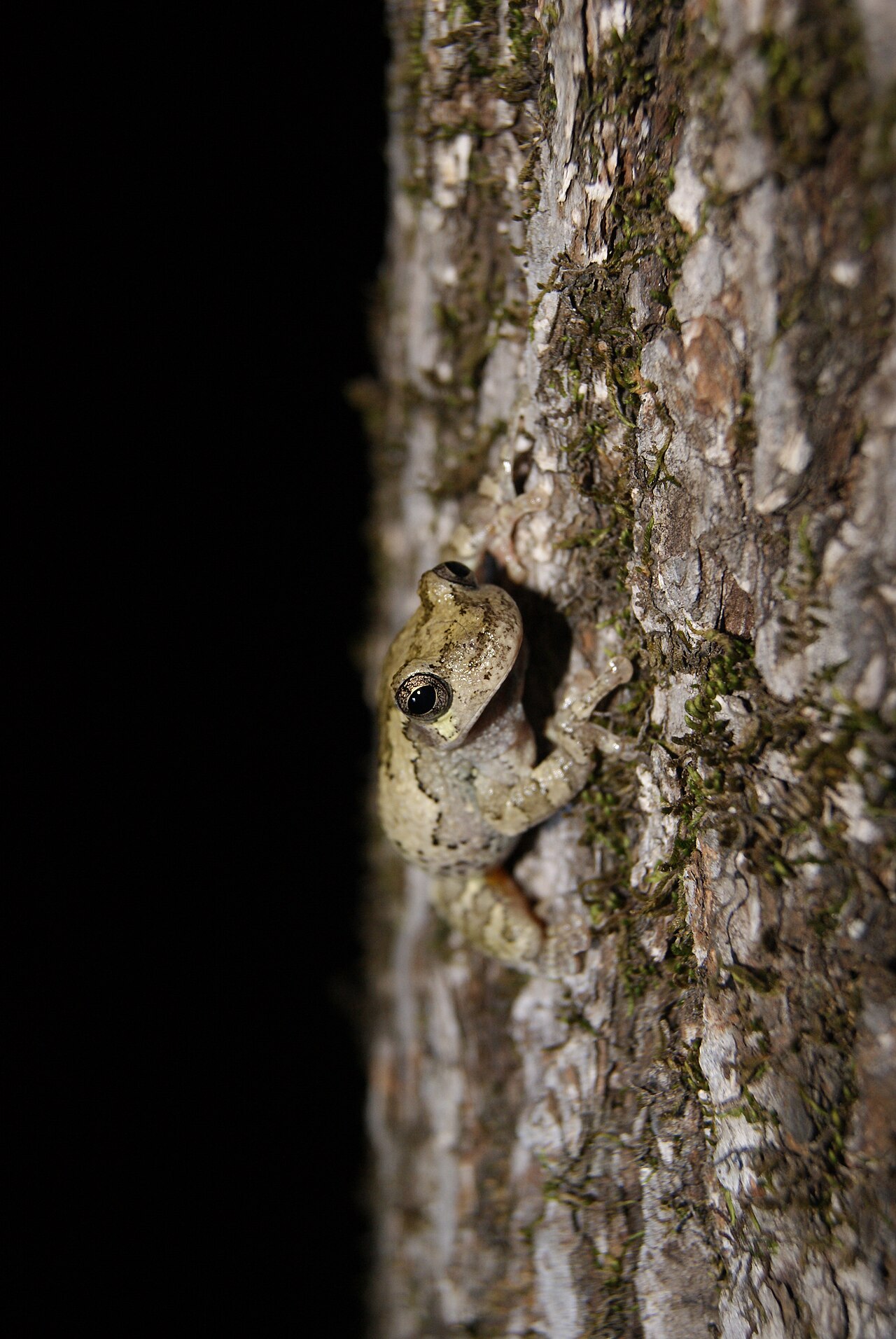
The gray treefrog is not poisonous to people, pets or predators in the way a dart frog is. It has no concentrated toxin glands and no defensive alkaloids, and snakes, birds and raccoons eat it routinely. What it does have are granular skin glands producing peptides that deter bacteria and taste unpleasant, enough to make a curious dog drop it and drool rather than swallow.
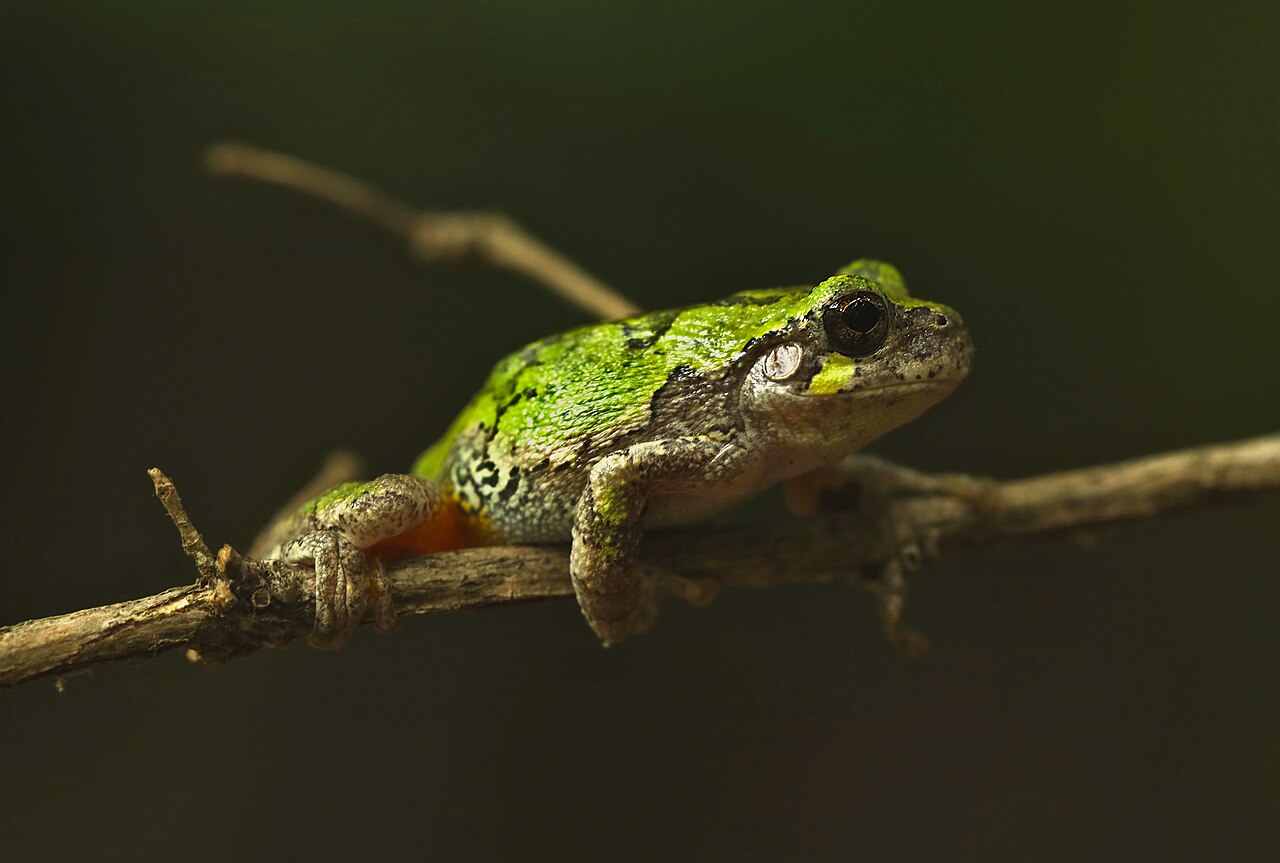
Its real defense is invisibility. The mottled gray back matched against lichen-covered bark is one of the better camouflage jobs in North American wildlife, and the frog sits motionless with its legs tucked so the outline disappears. When a predator does commit, the frog flashes the bright orange on its inner thighs while jumping, a startle trick shared with the red-eyed tree frog.
How to Identify a Gray Tree Frog
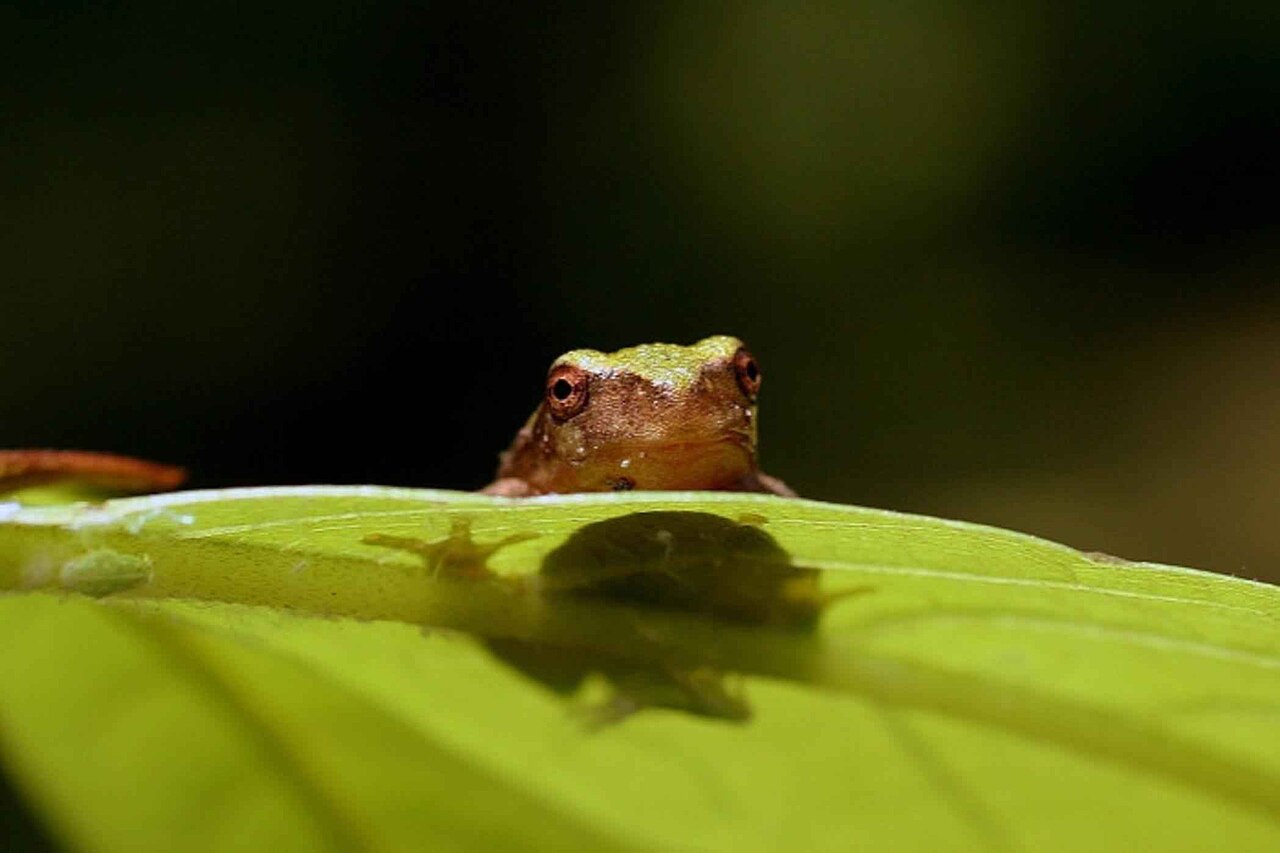
Look for warty gray skin with a dark, irregular star or blotch on the back, a crisp white spot directly beneath each eye, and large round toe pads. The hidden surfaces of the hind legs carry orange to golden yellow, visible only when the frog stretches or jumps. The belly is white and slightly granular.
Color is not a reliable field mark on its own, because a single individual shifts from pale gray to bright green within half an hour depending on temperature, humidity and background. That is also why green individuals get mistaken for the American green tree frog, which is a smooth, uniformly bright green frog with a clean white side stripe. For a broader overview of the family, see our guide to the tree frog group.
Gray Treefrog vs Cope’s Gray Treefrog
These two are nearly impossible to separate by sight and easy to separate by ear. Cope’s gray treefrog (Dryophytes chrysoscelis) gives a faster, harsher, higher-pitched trill, roughly twice the pulse rate of the gray treefrog at the same air temperature, which sounds buzzy rather than musical. The gray treefrog is a tetraploid species with twice the chromosome count of Cope’s, a genuinely unusual situation among vertebrates.
Ranges overlap broadly across the Midwest and Southeast, and the two often call from the same pond on the same night. Cope’s tends to have slightly less warty skin and a somewhat greener cast, but no one identifies them reliably that way. Recording the call and comparing the pulse rate is the only field method that holds up.
Where Gray Tree Frogs Live
Gray tree frogs live in wooded and partly wooded land from Maine and Ontario south to the Gulf and west to eastern Texas and Manitoba. Adults spend the non-breeding season high in deciduous trees, on trunks, in cavities and under loose bark, and come down only for spring and early summer breeding in shallow, fishless water: woodland pools, flooded ruts, cattle tanks, swimming pool covers and backyard water features.
They are also comfortable around houses. Porch lights concentrate moths, so the frogs gather on siding, window frames and patio umbrellas, and that is where most people first notice them. Suburban populations hold up well as long as there is standing water in spring and unsprayed trees within a few hundred feet, unlike the more water-bound southern leopard frog.
What a Gray Tree Frog Sounds Like
The call is a short musical trill lasting half a second to two seconds, repeated every few seconds, often described as birdlike or as a slow flute. Males call from tree branches and pond edges from April into July, and the chorus rises sharply on warm, humid nights before rain, which is the origin of the folk name rain frog.
Temperature changes the sound. In cool air the trill slows and drops in pitch, which is exactly why pulse rate comparisons with Cope’s gray treefrog must be made against a thermometer. A single frog calling from a downspout at close range is loud enough to carry through a closed window.
How Gray Tree Frogs Survive Winter
Gray tree frogs survive northern winters by letting themselves freeze. In autumn they move under leaf litter, into root cavities or beneath loose bark, and their liver converts stored glycogen into glycerol and glucose that flood the blood and tissues. Ice forms in the body cavity and under the skin while these cryoprotectants keep the cells themselves from rupturing, and up to a third or more of the frog’s body water can turn solid.
Breathing and heartbeat stop entirely for weeks. When spring warmth returns the frog thaws from the inside out, the heart restarts, and within a day or two it is calling. Most amphibians instead retreat below the frost line or to the bottom of ponds, a strategy covered in our look at frog hibernation.
What Gray Tree Frogs Eat and How They Are Kept
Wild gray tree frogs eat moths, beetles, crickets, flies, spiders, plant lice and snails, hunting at night by sitting still and ambushing anything that comes within a body length. Tadpoles graze algae and detritus for 45 to 65 days before transforming, and the froglets that leave the water are barely half an inch long.
Can I keep a grey tree frog as a pet? Yes, and captive-bred individuals are among the easier amphibians to house: a tall 10 to 20 gallon enclosure with branches and live plants, 68 to 78 F (20 to 26 C), a shallow water dish, and dusted crickets two or three times a week. They are display animals, not handling animals, much like the squirrel tree frog. Check state law before taking any native frog from the wild.
Frequently Asked Questions
How rare is a gray tree frog?
Gray tree frogs are common and listed as Least Concern, with stable populations across most of their eastern range. They seem rare only because they are nocturnal, well camouflaged and usually high in trees. In good habitat a spring chorus can include dozens of calling males within earshot of one spot.
Which frog is safe to touch?
Most North American frogs and toads, including gray tree frogs, leopard frogs and American toads, are safe to touch with clean wet hands. The exceptions are poison dart frogs and their relatives in the tropics, plus toads with large parotoid glands that can sicken a dog. Wash your hands afterward in every case.
What is the deadliest frog on Earth?
The golden poison frog (Phyllobates terribilis) of coastal Colombia carries enough batrachotoxin in its skin to be lethal to an adult human, making it the most toxic frog known. Its poison comes from its wild diet, so captive-bred individuals lose it. No North American frog approaches that level.
How long do gray tree frogs live?
Wild gray tree frogs generally live 5 to 9 years, which is long for a frog of that size, and captives have exceeded 10. Their freeze tolerance and arboreal habits keep them away from many ground predators. Most mortality happens in the tadpole and froglet stages rather than in adulthood.
What happens if a human touches a poison dart frog?
Touching most dart frogs briefly with intact skin causes nothing worse than mild irritation, since the toxins must enter the bloodstream to act. Wild Phyllobates species are the serious exception, and a cut or mucous membrane contact can be dangerous. Captive-bred dart frogs sold in the pet trade are effectively non-toxic.
Detailed species accounts, call recordings and range maps for both gray treefrogs are available from the Smithsonian’s National Zoo and Conservation Biology Institute.