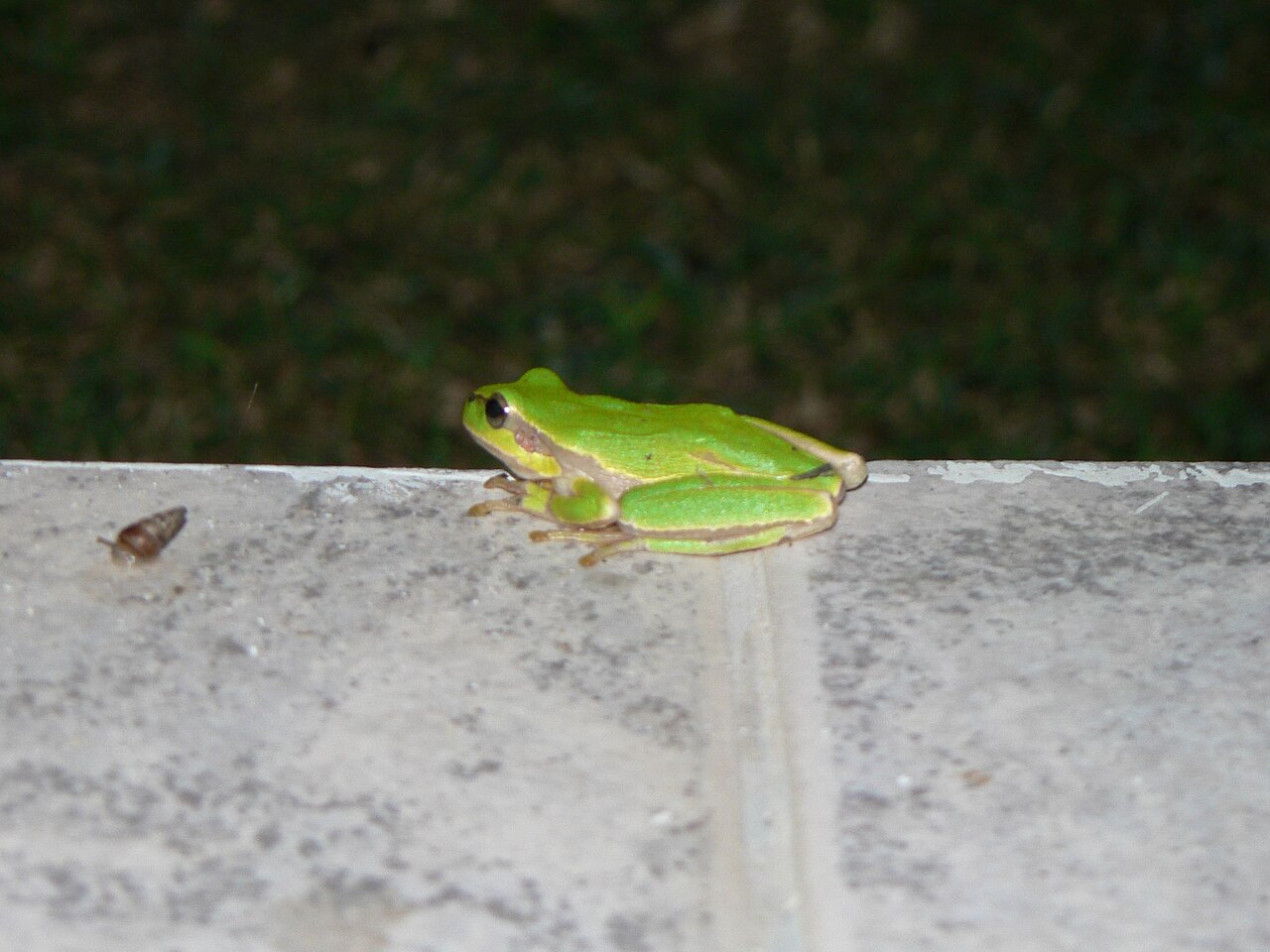
Squirrel Tree Frog: ID, Call, Range and Care in 5 Minutes
The squirrel tree frog (Hyla squirella) is a small, color changing treefrog of the southeastern United States, rarely longer than 1.5 in (3.8 cm) and named for a raspy call that sounds like a scolding squirrel. It is one of the most frequently encountered frogs on porches and window screens from Virginia to Texas, and one of the most frequently misidentified.
Most of that confusion comes from a single neighbor. Squirrel tree frogs shift between green, brown, and yellowish within minutes, which means a green individual gets mistaken for the American green treefrog and a brown one gets mistaken for a different species entirely. The side stripe settles the question in seconds once you know what to look for.
Squirrel tree frogs are small treefrogs, 0.9 to 1.6 in (2.3 to 4.1 cm) long, found across the southeastern United States. They change color between green, brown, and yellow, lack the crisp white side stripe of the green treefrog, and call with a raspy chatter before rain. They are harmless to humans and live 2 to 5 years in the wild.
| Trait | Squirrel tree frog |
|---|---|
| Scientific name | Hyla squirella, also listed as Dryophytes squirellus |
| Adult size | 0.9 to 1.6 in (2.3 to 4.1 cm) |
| Color | Green, brown, or yellowish, changes within minutes |
| Range | Southeastern Virginia to the Florida Keys, west to east Texas |
| Call | Raspy, duck like chatter, often before rain |
| Lifespan | 2 to 5 years wild, up to 8 in captivity |
| Danger to people | None, not venomous or poisonous |
What Is a Squirrel Tree Frog?
The squirrel tree frog is a small hylid treefrog native to the coastal plain of the southeastern United States. Adults are slender with smooth to slightly granular skin, large toe pads, and a body that is highly variable in color. Some individuals are plain, others carry faint blotches or a light bar between the eyes.
Taxonomists have moved the species between genus names in recent years, so field guides list it as either Hyla squirella or Dryophytes squirellus. Both refer to the same animal. Most state wildlife agencies still use the older name, which is worth knowing when you are cross checking references.
It is nocturnal and strongly associated with human structures. Porch lights attract insects, insects attract squirrel tree frogs, and a single lit window in coastal Florida can hold half a dozen on a humid night. For the wider family, see our overview of the tree frog group.
Why Are They Called Squirrel Tree Frogs?
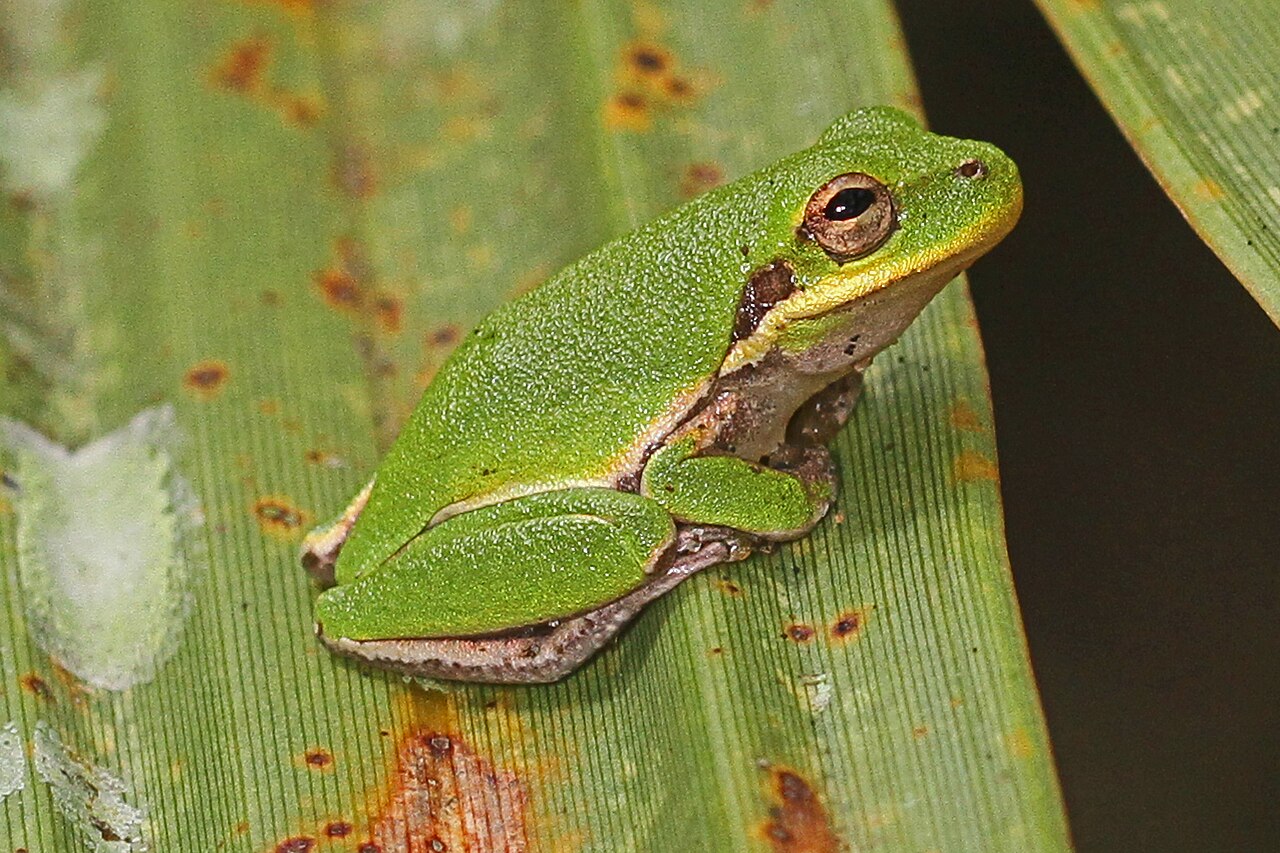
They are named for their call, a harsh raspy chatter that resembles the scolding bark of a gray squirrel. The sound is delivered in rapid bursts and carries surprisingly far for a frog this small, particularly when dozens call together after a summer storm.
The species has a second call that gets its own nickname. Males produce a shorter, drier version from trees and shrubs ahead of approaching rain, which earned the animal the folk name rain frog across much of the South. The behavior is real enough that older farming communities treated it as a weather sign.
The name has nothing to do with diet, habits, or appearance. It is purely acoustic, which trips up people who expect a frog named for a squirrel to look or behave like one.
How Big Do Squirrel Tree Frogs Get?

Adult squirrel tree frogs reach 0.9 to 1.6 in (2.3 to 4.1 cm) in snout to vent length, with most individuals near 1.25 in (3.2 cm). Females run slightly larger than males. That puts the species firmly at the small end of North American treefrogs, roughly the size of a US quarter with the legs folded.
Recently metamorphosed froglets leave the water at about 0.4 in (1 cm) and reach adult size within their first year. Size alone is a useful first filter in the field: anything noticeably larger than a quarter in the Southeast is more likely a green treefrog, a barking tree frog, or an introduced Cuban treefrog.
Squirrel Tree Frog vs Green Tree Frog
The difference is the side stripe. The American green treefrog (Hyla cinerea) carries a sharp, unbroken white or cream stripe running from the jaw along each flank, with a crisp dark border. Squirrel tree frogs either lack this stripe entirely or show a short, blurry, incomplete version that fades out behind the shoulder.
Size is the second check. Green treefrogs reach 1.25 to 2.5 in (3.2 to 6.4 cm) and look noticeably longer and more angular. Squirrel tree frogs are shorter, rounder, and stockier in proportion. Green treefrogs also stay green almost all the time, while squirrel tree frogs turn brown regularly.
Skin texture helps when the other marks are ambiguous. Green treefrogs are smooth and often speckled with tiny gold flecks; squirrel tree frogs have a faintly granular surface. Our profile of the American green tree frog covers the comparison from the other side, and the invasive Cuban tree frog is the third species worth ruling out in Florida.
Where Squirrel Tree Frogs Live
Squirrel tree frogs occupy the Atlantic and Gulf coastal plain from southeastern Virginia through the Florida Keys and west into eastern Texas, with scattered populations inland in Alabama and Georgia. They are common wherever moist lowland habitat meets vegetation, including cypress swamps, pine flatwoods, and suburban yards.
Breeding happens in shallow, fish free water: roadside ditches, flooded fields, temporary ponds, and cattle tanks. Females lay several hundred eggs in small packets, and tadpoles complete metamorphosis in roughly 40 to 50 days, fast enough to beat the drying of a seasonal pool.
Outside the breeding season the frogs disperse into shrubs, tree hollows, banana plants, and gutter downspouts. Detailed range and natural history notes for Florida populations are maintained by the Florida Museum of Natural History.
Can I Keep a Squirrel Tree Frog as a Pet?
Yes, squirrel tree frogs make undemanding captives, and captive bred animals are occasionally available. A single adult does well in a 10 gallon vertical enclosure with live or artificial plants, a shallow water dish, and a substrate that holds humidity. Two or three can share a 20 gallon tall setup.
Keep the enclosure at 72 to 82 F (22 to 28 C) with humidity between 50 and 70 percent, misted daily. Low output UVB is not strictly required but does improve long term health. Handling should be minimal and always with clean, wet hands, since amphibian skin absorbs oils and residues directly.
Collecting a wild frog is a different question. Several states regulate the take of native amphibians, and a wild caught animal is more likely to carry parasites. Keepers who want a hardier beginner species often choose White’s tree frog instead.
What to Feed a Squirrel Tree Frog
Feed appropriately sized live insects: quarter inch crickets, fruit flies, small waxworms, and gut loaded roach nymphs. An adult eats 3 to 6 insects every other day, and juveniles eat smaller prey daily. Nothing wider than the frog’s head should go in the enclosure.
Dust feeders with a calcium and vitamin D3 supplement at most feedings and a multivitamin once a week. Deficiency shows up as weak hind limbs and a soft jaw, and it is the most common avoidable problem in captive treefrogs. In the wild the diet is beetles, moths, flies, and small spiders taken at night.
Frequently Asked Questions
Are squirrel tree frogs poisonous?
No. Squirrel tree frogs are neither venomous nor poisonous to people or pets. Like all amphibians they secrete mild skin compounds that can irritate eyes or broken skin, and they can carry salmonella, so wash your hands after any contact. There is no bite risk.
What is the average lifespan of a squirrel treefrog?
Wild squirrel tree frogs typically live 2 to 5 years, with predation and seasonal drying taking most of the population early. In captivity, with steady humidity, a supplemented diet, and no predators, individuals commonly reach 6 years and occasionally 8.
What is the difference between a squirrel tree frog and a green tree frog?
Green treefrogs have a sharp, unbroken white side stripe and grow to 2.5 in (6.4 cm). Squirrel tree frogs are smaller at 1.6 in (4.1 cm) maximum, lack that crisp stripe or show only a blurred partial one, and change between green and brown regularly.
Why do squirrel tree frogs call before rain?
Falling barometric pressure and rising humidity trigger calling, because the temporary pools these frogs breed in only fill after storms. The behavior is reliable enough that the species is widely known as a rain frog across the southeastern United States.
Can I keep a tree frog I found as a pet?
Legally it depends on your state, and several regulate collecting native amphibians. Practically, wild caught frogs carry parasites more often and adjust to captivity poorly. If the frog came from your yard, the better outcome is usually releasing it where you found it and buying a captive bred animal instead.