Tree Frog Guide: How to Identify One and Whether It Is Safe to Touch
A tree frog is any frog built for climbing, and the giveaway is the feet: round sticky discs on every toe, wide enough to see without picking the animal up. North America has around 30 species in the family Hylidae, from the gray treefrog on a porch light to the spring peeper that fills wetlands with sound in March.
Most questions about them are safety questions. Tree frogs are not venomous, their skin secretions are mild, and the only real rule is to wash your hands and keep them off your face.
Tree frogs are small climbing frogs with sticky toe pads, typically 1 to 2.5 in (2.5 to 6 cm) long. They are not venomous and are safe to be around, though their skin secretions can irritate eyes and mouths. They eat insects, are harmless to gardens, and a yard full of them is a sign of healthy habitat.
| Quick fact | Tree frogs (Hylidae) |
|---|---|
| Typical size | 1 to 2.5 in (2.5 to 6 cm) |
| Key feature | Sticky adhesive discs on all toes |
| Diet | Flies, moths, crickets, spiders, ants |
| Lifespan | 3 to 6 years wild, over 10 in captivity |
| Active | Mostly at night, loudest in spring |
| Danger to people | None, mild skin irritant only |
How can you tell if a frog is a tree frog?
Look at the toes. Tree frogs have expanded, circular pads at the tip of each finger and toe that work by wet adhesion, letting the frog hold onto glass, siding and leaves. No true toad or leopard frog has them, and the difference is obvious at arm’s length.
The rest of the build follows the same job: a slim body, long legs and a light weight of well under an ounce. Many species also change color between gray, green and brown within an hour, which is why the same gray treefrog can look like bark one evening and moss the next.
Is a tree frog poisonous or venomous?

Neither, in any way that matters. Venom has to be injected, and no frog can do that. Tree frogs do produce mild toxins and antimicrobial compounds in their skin, which defend against bacteria and make them taste bad to predators, but the amounts are far too low to harm a person.
The species people actually worry about live elsewhere. A poison dart frog is genuinely poisonous, and even there the toxicity comes from the wild diet and disappears in captive animals. North American tree frogs carry nothing comparable.
Is it bad to touch a tree frog?
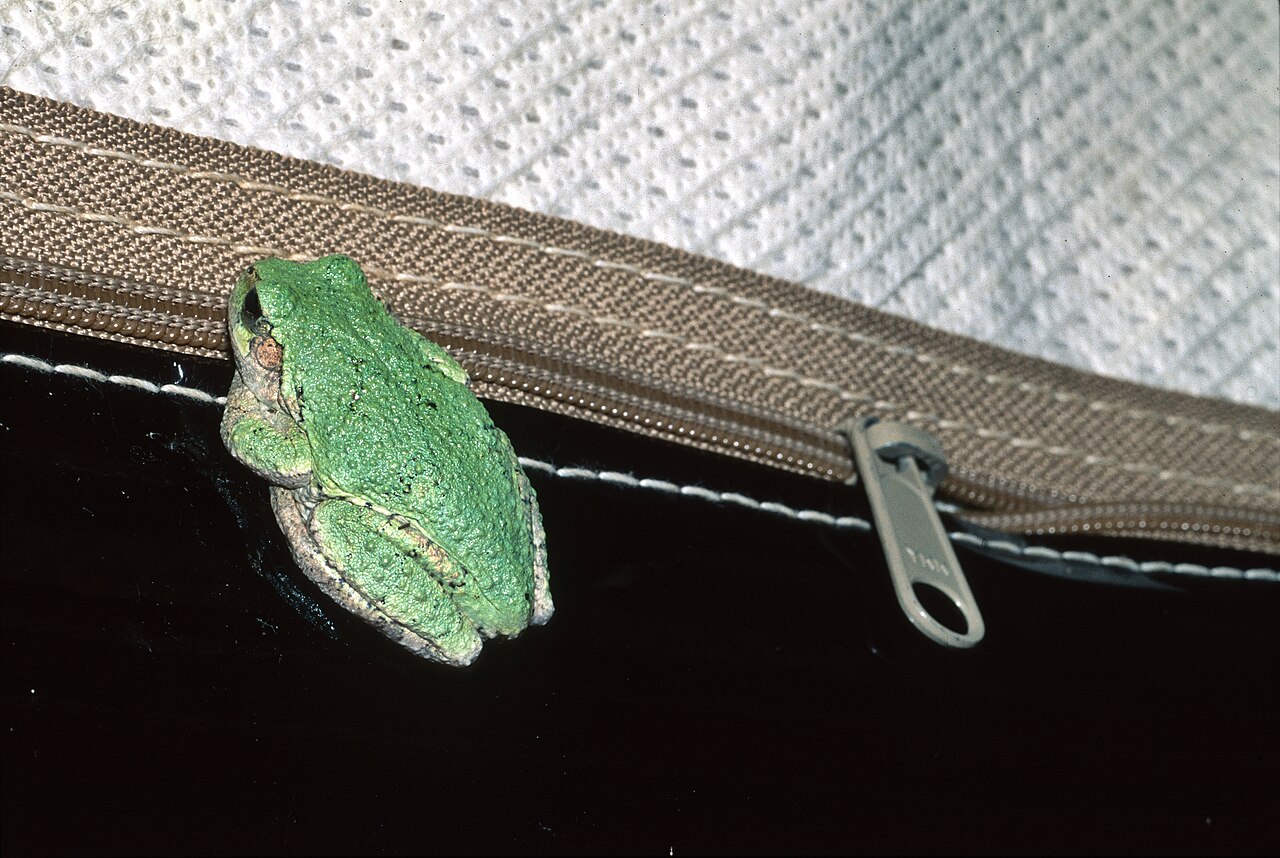
Handle them as little as possible, and more for the frog’s sake than yours. Amphibian skin absorbs water and chemicals directly, so sunscreen, insect repellent, soap residue and salt from hands all pass straight through it. Dry hands also strip the protective mucus layer.
If you must move one, wet your hands with clean water first and keep the contact short. Afterward wash thoroughly, because tree frogs can carry Salmonella and their skin secretions sting badly in the eyes. The frogs that are truly safest to touch are the ones nobody touches.
Is it good to have tree frogs in your yard?
Yes. A resident population eats a steady volume of mosquitoes, moths, flies and beetles every night, it damages nothing, and amphibians only persist where water is relatively clean and pesticide use is low. Their presence is a reasonable indicator that the yard is in decent shape.
Encouraging them is simple: leave a shallow water feature without fish, keep a patch of leaf litter and brush, skip broad spectrum insecticides, and accept the noise in spring. That noise is the breeding chorus, and our guide to tree frog calls covers how to tell the species apart by ear.
One exception is worth knowing. The invasive Cuban tree frog in Florida and along the Gulf coast eats native frogs, clogs plumbing and outcompetes local species, so a large, warty tree frog in that region is not the welcome guest the others are.
Can I keep a tree frog as a pet?
Captive bred tree frogs make reasonable low maintenance pets, and wild caught native ones do not. Many states protect native amphibians, and a wild frog brought indoors arrives with parasites and loses the seasonal cues it needs.
The usual starter species is the White’s tree frog, which is hardy, slow moving and long lived. The red eyed tree frog is the one everyone wants from photographs and is considerably more demanding, needing high humidity, live plants and stable warmth. Either way the setup is a vertical tank, live insects several times a week and no handling.
Frequently Asked Questions
What do tree frogs eat?
Adults eat live insects and other small invertebrates: flies, moths, crickets, beetles, ants and spiders, taken at night with a sticky tongue. They only respond to moving prey. Tadpoles are different, grazing on algae and decaying plant material until they complete metamorphosis.
Where do tree frogs go in winter?
Northern species shelter under logs, leaf litter and loose bark and enter dormancy. Gray treefrogs and spring peepers tolerate their body fluids partially freezing, using glycerol and glucose as a natural antifreeze, and thaw out in spring. Southern species simply become inactive during cold snaps.
Why do tree frogs scream?
A sharp, high distress call is a predator response, produced with the mouth open when a frog is grabbed by a snake, bird or cat. It can startle the attacker into letting go. It is completely different from the rhythmic breeding chorus heard in spring.
Are all tree frogs green?
No. Color varies by species and changes within individuals, covering gray, brown, tan and green. The barking tree frog is spotted, and gray treefrogs shift shade with temperature and background. Color alone never identifies a tree frog, but the toe pads always do.
For species lists and seasonal calling charts by state, the US Geological Survey amphibian monitoring program is the most reliable public source.