Siberian Flying Squirrel: Size, Range, Lifespan and Pet Laws
The Siberian flying squirrel (Pteromys volans) is a small nocturnal gliding rodent that lives in old conifer and mixed forests from Finland and the Baltic states across Russia to Japan. It weighs about as much as a deck of cards, glides up to 165 ft (50 m) between trunks, and spends almost its entire life above ground in tree cavities.
It is also the only flying squirrel native to Europe, which gives it a political weight no other squirrel has: logging plans in Finland are routinely redrawn because a survey crew found its droppings under a spruce. Most of what people search for, whether it is real, how big it gets, whether it can be kept as a pet, comes down to confusing it with two other animals, and that is worth clearing up first.
The Siberian flying squirrel is a real species, Pteromys volans, about 5 to 8 in (13 to 20 cm) long with a 4 to 5 in (10 to 13 cm) tail and a weight of 3 to 6 oz (95 to 170 g). It glides rather than flies, is strictly nocturnal, lives 3 to 5 years in the wild, and is protected across the European Union.
| Quick fact | Detail |
|---|---|
| Scientific name | Pteromys volans |
| Family | Sciuridae, tribe Pteromyini |
| Head and body length | 5 to 8 in (13 to 20 cm) |
| Tail length | 4 to 5 in (10 to 13 cm) |
| Weight | 3 to 6 oz (95 to 170 g) |
| Glide distance | Typically 15 to 65 ft (5 to 20 m), up to 165 ft (50 m) |
| Lifespan | 3 to 5 years wild, up to 10 or more in captivity |
| IUCN status | Least Concern globally, strictly protected in the EU |
Is the Siberian Flying Squirrel Real?
Yes. It is a described species with a continuous fossil and survey record, not a viral hoax, and it has been formally protected in Finland since 1989. The reason the question comes up so often is that the photos in circulation are usually of the Japanese dwarf flying squirrel (Pteromys momonga) or of the Hokkaido subspecies Pteromys volans orii, sometimes called the Ezo momonga, which has a rounder face and reads as a cartoon animal at first glance.
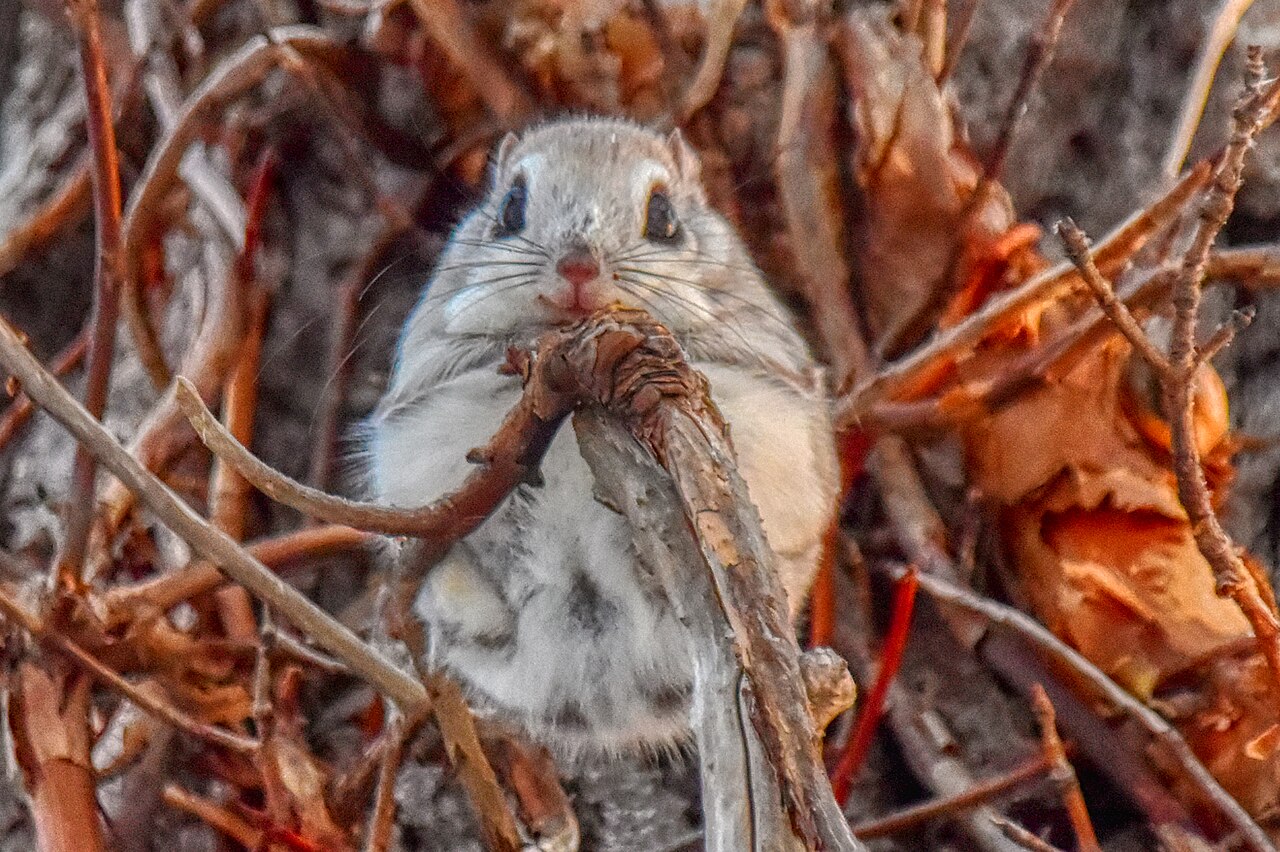
Those wide eyed portraits are heavily filtered, usually taken at zoos, and they exaggerate the head. A wild Siberian flying squirrel on a spruce trunk at night looks like a gray squirrel that has been flattened slightly and fitted with an oversized tail. The eyes are genuinely large, but the rest of the animal is unremarkable, which is why so few people who live inside its range have ever seen one.
Siberian Flying Squirrel Size and Appearance

Adults measure 5 to 8 in (13 to 20 cm) in head and body length with a flat, broad tail of 4 to 5 in (10 to 13 cm), and weigh 3 to 6 oz (95 to 170 g). Females average slightly larger than males. That puts the species close to a southern flying squirrel in size and well below the eastern gray squirrels most American readers picture.
The coat is silvery gray in winter and browner in summer, with a sharply defined white belly and a dark eye ring. The defining feature is the patagium, a furred membrane running from wrist to ankle that folds away invisibly when the animal is climbing. A small cartilaginous rod at the wrist, unique to gliding squirrels, holds the leading edge taut in flight.
How the Glide Actually Works

The squirrel climbs high, scans, then launches and spreads all four limbs so the patagium becomes a rectangular wing. Most glides cover 15 to 65 ft (5 to 20 m) with a loss of height of roughly one foot for every two to three feet traveled, and a downhill start can stretch a single glide to 165 ft (50 m).
Steering happens through the limbs and tail. Tightening one side of the membrane banks the animal, and the flattened tail works as both a rudder and an air brake in the final moment, when it pitches up and lands feet first on the trunk. Landing is followed immediately by a scramble around to the far side of the tree, which is the standard evasive move against an owl that tracked the glide.
Where Siberian Flying Squirrels Live

The range runs from Finland, Estonia, and Latvia east through the Russian taiga to the Pacific coast, north into Mongolia and northeastern China, and onto Hokkaido in Japan. It is a boreal animal, tied to mature spruce dominated forest mixed with aspen, birch, and alder, and it will not settle in a young plantation.
The hard requirement is cavity supply. The species nests in old woodpecker holes, mainly those cut by black woodpeckers, in natural hollows, and readily in nest boxes. Because those cavities only appear in stands that have been left alone for decades, habitat maps for this squirrel are effectively maps of old growth, and that link explains almost all of the conservation conflict around it.
What Siberian Flying Squirrels Eat

The diet is mostly leaves, and that is unusual for a squirrel. Through spring and summer it eats alder and birch leaves, buds, and shoots, plus some seeds, berries, and occasionally bird eggs. The gut is adapted to bulk plant material, with a large caecum that handles fiber the way a rabbit’s does.
Winter shifts the menu to catkins. Alder and birch catkins are harvested in autumn and stored in cavities and forks, and this cache carries the animal through the dark months. Feeding activity leaves distinctive yellow orange droppings under nest trees, and unlike ordinary squirrel droppings, these bright pellets are what Finnish surveyors search for to confirm occupancy.
Are They Nocturnal?
Strictly so. Siberian flying squirrels leave the cavity after full dark, feed in two or three bouts, and are back inside before first light, with females on nursing duty making shorter and more frequent trips. During the shortest days of the northern winter this compresses activity into a long night, and on the longest summer days it nearly eliminates it.
Night activity explains both the huge eyes and the near invisibility of the species. Ordinary tree squirrels are awake in daylight, and anyone comparing the two should read up on when squirrels are actually active before assuming a daytime sighting was a flying squirrel. It also does not hibernate, and like the North American species covered in our guide to squirrel winter behavior, it simply stays in the nest through the worst weather.
Breeding and Young
Breeding starts in late winter, with most litters born between April and June and a second litter possible in a good year. Gestation runs about five weeks, and a litter is usually 2 to 3 young, occasionally up to 6. The kits are born blind and hairless in a cavity lined with moss, lichen, and shredded bark.
Eyes open near four weeks, and first glides follow at about six to eight weeks, after a period of practice jumps inside the home tree. Females use several cavities and will move a litter if disturbed, carrying each kit by the skin. Young disperse in late summer, often more than a mile, and that dispersal stage is when most of them are killed.
How Long Do Siberian Flying Squirrels Live?
In the wild, 3 to 5 years is typical, and few animals reach the upper end. Mortality is heaviest in the first year, when inexperienced young are crossing open ground between forest patches. Radio tracking in Finland has repeatedly shown that juveniles disappear within weeks of dispersal.
Captive animals do considerably better. Zoo records show individuals past 10 years, and some reports put the ceiling higher, which follows the usual pattern for small rodents removed from predation. That gap between 4 years outside and 10 inside is a measure of predator pressure, not of the species being fragile.
Predators and Threats
The main enemy is the Ural owl, along with the tawny owl, the eagle owl, and by day the pine marten, which is the only predator able to follow the squirrel into a cavity. A squirrel’s worst enemy in this range is therefore an owl in the air and a marten in the tree, and the species defends itself entirely by evasion, since it has no other option at 5 oz.
Human pressure works differently. Clear cutting removes the cavity trees, and even selective logging can isolate a patch so thoroughly that dispersing young cannot reach it. Fragmentation, not direct killing, is the reason the Finnish population has been in long term decline, and it is why protected corridors of standing timber are the core of every management plan.
Conservation Status and the Finnish Conflict
The IUCN lists the species as Least Concern globally, because the Russian range is vast and the total population is large. That global figure hides the European situation: Estonia lists it as critically endangered with a population in the low hundreds, and Finland has recorded steady declines for decades. The current assessment is published by the IUCN Red List.
Under Annex IV of the EU Habitats Directive, damaging a breeding or resting site is illegal, so a confirmed occurrence can stop or redraw a logging operation, a road, or a housing development. That has made the species a recurring subject of Finnish court cases and a genuine flashpoint between forestry and conservation, an unusual role for an animal almost nobody ever sees.
Siberian Flying Squirrel vs Sugar Glider vs Japanese Flying Squirrel
The sugar glider (Petaurus breviceps) is not a squirrel at all. It is an Australian marsupial that carries young in a pouch, has a membrane running wrist to ankle like the squirrel but a fully furred round tail, and belongs to a completely separate branch of mammals. The resemblance is convergent evolution, not relationship.
The Japanese dwarf flying squirrel (Pteromys momonga) is a genuine close relative, smaller at 2 to 3 oz (60 to 90 g) and restricted to Honshu, Kyushu, and Shikoku. Most of the viral photographs labeled as Siberian flying squirrels are either this species or the Hokkaido subspecies of the Siberian. American readers looking for the local equivalent should start with the North American flying squirrels, which fill the same niche here.
Can You Have a Siberian Flying Squirrel as a Pet?
Realistically, no. In the European Union the species is strictly protected, so capture, possession, and trade are illegal. Outside that range there is no established captive breeding supply, meaning any animal offered for sale is either mislabeled or wild caught. Listings advertising a Siberian flying squirrel for sale are almost always sugar gliders or southern flying squirrels under another name.
Even without the legal problem, the species is a poor fit for a household. It is nocturnal, needs vertical space measured in feet rather than inches, eats a bulky leaf and catkin diet that is hard to replicate, and is easily stressed. Anyone set on a gliding pet should read the realities of keeping a flying squirrel first and check state law, since even native species are prohibited in much of the United States.
Frequently Asked Questions
Can you have a Siberian flying squirrel as a pet?
No. The species is strictly protected across the European Union, there is no legitimate captive bred supply elsewhere, and animals advertised for sale under that name are normally sugar gliders or North American flying squirrels. Keeping one would also mean meeting a nocturnal, leaf based, highly arboreal set of needs that a home cage cannot provide.
How long do siberian flying squirrels live?
Most wild individuals live 3 to 5 years, with the heaviest losses in the first year during dispersal. In captivity, where owls and pine martens are absent and food is constant, they have exceeded 10 years. The difference reflects predation pressure rather than any inherent weakness in the species.
What is the prettiest squirrel?
Judged on looks alone, the Indian giant squirrel with its maroon and cream coat and the Prevost’s squirrel with its black, white, and chestnut bands usually take the title. The Siberian flying squirrel wins on face rather than color, thanks to the oversized dark eyes that make photographs of it so shareable.
Do Siberian flying squirrels actually fly?
No, they glide. Flight requires powered, flapping wings, which no squirrel has. The patagium turns a fall into a controlled descent, so every glide ends lower than it started unless the animal climbs again. Bats are the only mammals capable of true flight.
What sounds do they make?
They are quiet compared with tree squirrels, using soft chirps and low whistles near the nest and between females and young. There is no loud territorial scolding of the kind you hear from a red squirrel, and readers comparing calls will find the range covered in our guide to squirrel vocalizations.
Do they live in groups?
Adults are largely solitary and hold overlapping home ranges, with males covering far more ground than females. Several animals may share a cavity during severe cold, which is the only time they aggregate outside of a mother with young. The collective term still applies, and a group of squirrels is called a scurry or a dray.