Japanese Flying Squirrel: Momonga Facts, Size, Diet, and Pet Laws
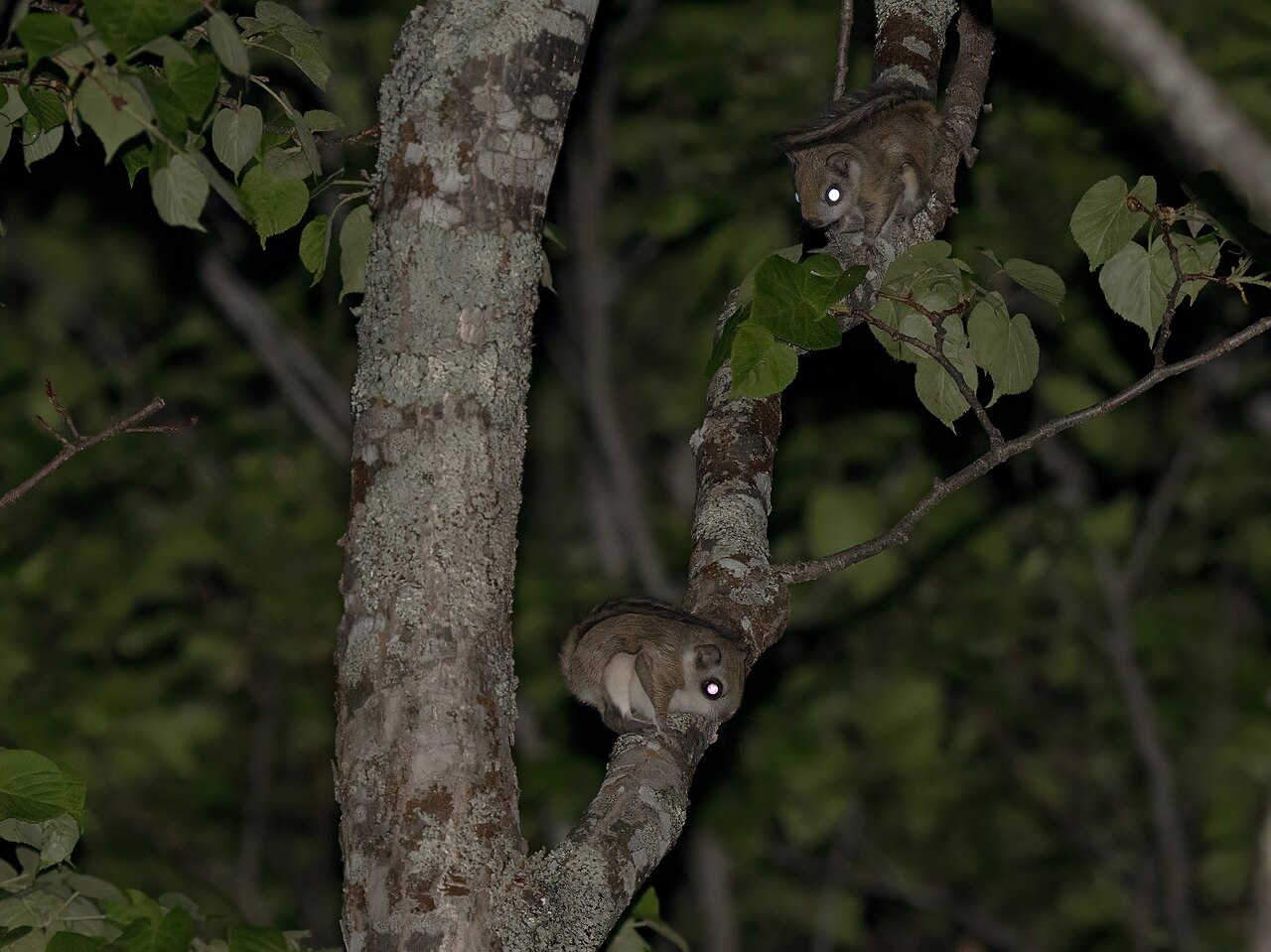
The Japanese flying squirrel is a real animal, and there are actually two of them. The palm sized Japanese dwarf flying squirrel (Pteromys momonga) weighs about as much as a deck of cards, while the Japanese giant flying squirrel (Petaurista leucogenys) is roughly the size of a house cat once you include the tail. Neither one flies. Both glide on a membrane of skin stretched between wrist and ankle, and both are strictly nocturnal residents of Japanese forest.
Most of what circulates online about the Japanese flying squirrel comes from a handful of viral photographs of the momonga peering out of a nest box, which makes the species look like a cartoon. The biology behind those photos is more interesting than the meme, and the question that brings most American readers here, whether you can keep one, has a short and unwelcome answer.
The Japanese flying squirrel is a nocturnal gliding rodent found only in Japan. The dwarf species, called momonga, is 5 to 8 in (13 to 20 cm) long and weighs 5 to 7 oz (150 to 200 g). It glides up to 160 ft (50 m) between trees, eats leaves, buds, seeds, and bark, and lives 4 to 5 years in the wild.
| Feature | Japanese dwarf (momonga) | Japanese giant (musasabi) |
|---|---|---|
| Species | Pteromys momonga | Petaurista leucogenys |
| Head and body length | 5 to 8 in (13 to 20 cm) | 11 to 20 in (28 to 50 cm) |
| Weight | 5 to 7 oz (150 to 200 g) | 1.8 to 3.3 lb (800 to 1,500 g) |
| Typical glide | 50 to 160 ft (15 to 50 m) | up to 525 ft (160 m) |
| Main food | Buds, leaves, seeds, bark | Leaves, bark, nuts, fruit |
| Active hours | Dusk to dawn | Dusk to dawn |
| Range | Honshu, Kyushu | Honshu, Shikoku, Kyushu |
What Is the Japanese Flying Squirrel?
The name covers two separate species in two separate genera, and confusing them is the single most common error in English language coverage. Pteromys momonga, the Japanese dwarf flying squirrel, is the small one with the enormous dark eyes. Petaurista leucogenys, the Japanese giant flying squirrel, is a much heavier animal with grizzled brown fur and pale cheeks that Japanese naturalists call musasabi.
Both belong to the tribe Pteromyini, the gliding squirrels, which contains roughly 50 species spread across Asia, Europe, and North America. They are true squirrels in the family Sciuridae, not marsupials, which is why the comparison with the sugar glider breaks down quickly. A sugar glider is a possum relative from Australia and New Guinea that happens to have evolved the same solution to the same problem.
If you want the wider picture of how gliding evolved across the family, our overview of the flying squirrel and its gliding anatomy covers the North American species that most readers will actually encounter in their own backyard.
Japanese Dwarf Flying Squirrel vs Japanese Giant Flying Squirrel
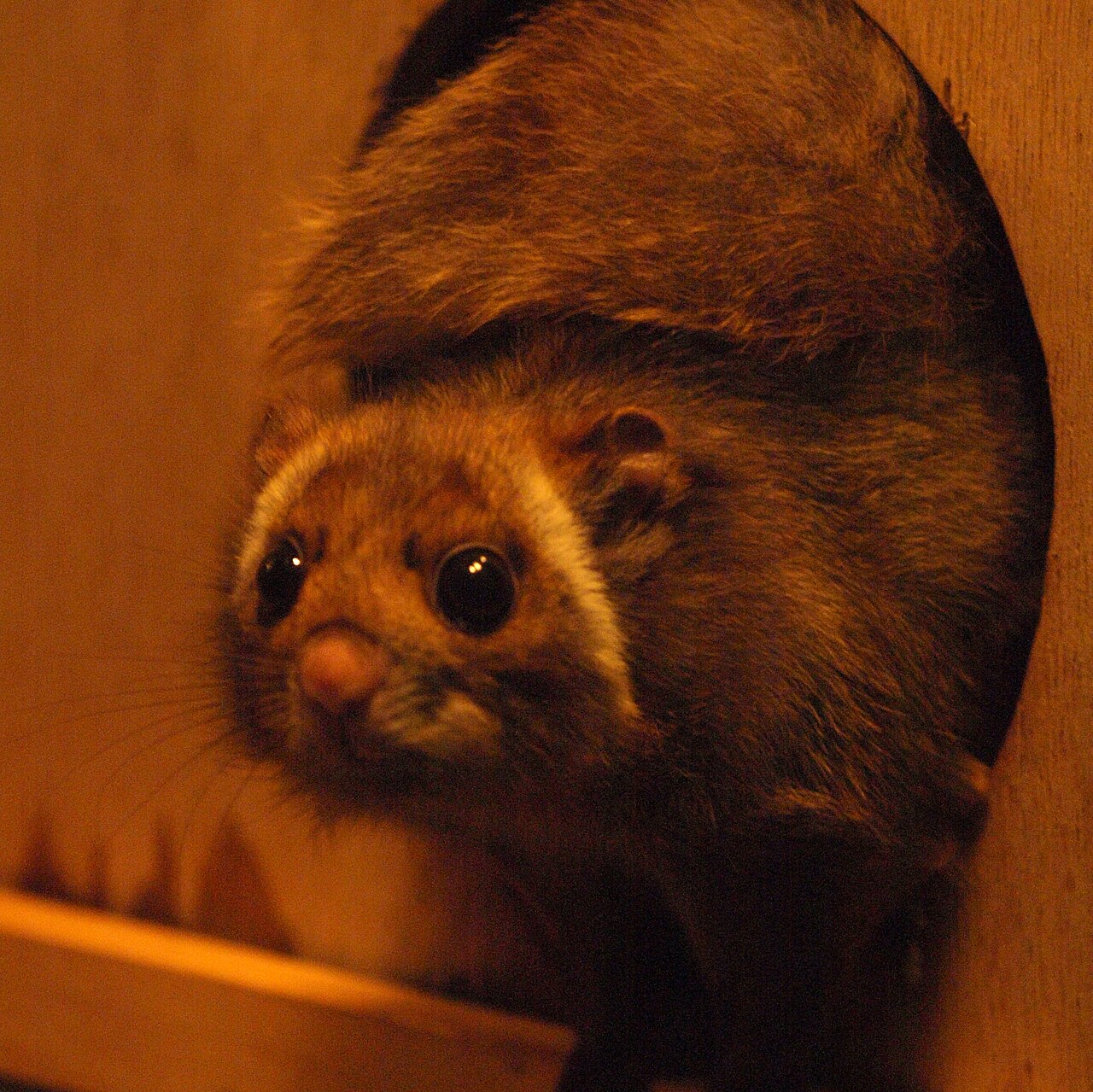
Size settles the identification instantly. A momonga fits in a cupped hand and weighs less than a can of soda. A musasabi is a solid armful, heavier than most pet rabbits, and when it launches from a shrine roof at dusk it reads as a gliding cat rather than a squirrel.
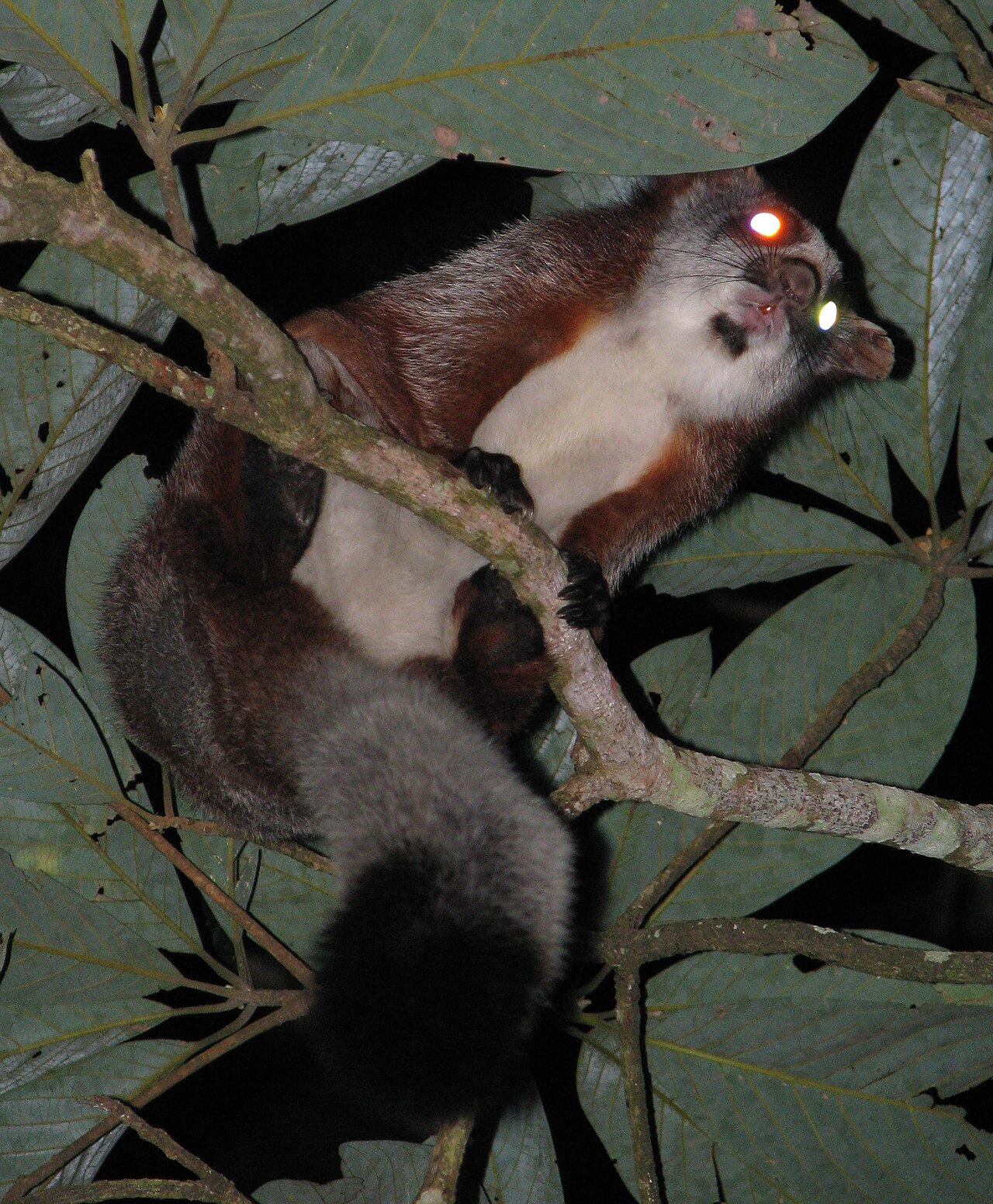
Coloration separates them too. The momonga is grey brown above with a clean white belly and a flattened, feather like tail. The musasabi is darker and browner with white flecking, a cylindrical bushy tail, and distinctive white patches on the cheeks and above the eyes. Only the momonga has the round, oversized eye that dominates the photographs.
Habitat overlaps but the two rarely compete directly. Momonga favor subalpine conifer and mixed forest at higher elevation, while musasabi are comfortable in lowland broadleaf forest and tolerate temple grounds, parks, and older neighborhoods with mature trees.
How Big Is a Japanese Flying Squirrel?
A Japanese dwarf flying squirrel measures 5 to 8 in (13 to 20 cm) in head and body length, with a tail adding another 4 to 5 in (10 to 13 cm), and weighs 5 to 7 oz (150 to 200 g). That places it at roughly half the weight of an American red squirrel and about the same mass as the Siberian flying squirrel, its closest relative in the genus Pteromys.
The Japanese giant flying squirrel runs 11 to 20 in (28 to 50 cm) in body length with a tail of similar length, and weighs 1.8 to 3.3 lb (800 to 1,500 g). Individual animals in the northern part of the range tend to sit at the top of that band.
Both species look considerably larger in flight than at rest, because the patagium, the gliding membrane, roughly doubles the outline of the body. A momonga at rest is a small grey ball. The same animal mid glide is a flat square the width of a paperback.
How the Momonga Glides
The patagium runs from wrist to ankle on each side, supported at the front by a small rod of cartilage extending from the wrist that the animal can swing forward to tension the leading edge. That cartilage spur is the anatomical signature of gliding squirrels and is absent in sugar gliders, which use an elongated fifth finger instead.
A glide starts with a vertical bob of the head, which gives the animal a parallax reading of the distance to the landing tree. It then launches, spreads all four limbs, and descends at roughly a three to one glide ratio, covering about three feet forward for every foot dropped. Momonga glides of 160 ft (50 m) have been recorded, and musasabi have been tracked past 500 ft (160 m).
Landing is the dangerous part. The squirrel pitches up sharply just before impact to bleed off speed, hits the trunk with all four feet, then immediately scoots to the far side of the tree, a reflex that defeats owls following the glide path.
What Japanese Flying Squirrels Eat
Momonga are largely folivorous, which is unusual for a squirrel. Leaves and buds make up the bulk of the diet, supplemented with conifer seeds, bark, flowers, and occasional insects. Deciduous buds carry them through late winter, and in spring they strip young leaves from cherry, birch, and maple.
Musasabi lean even harder on leaves and bark and are known to feed heavily on evergreen oak and cedar. Both species cache very little compared with ground foraging squirrels, a consequence of eating material that is available year round rather than seasonally abundant nuts.
That diet is also why neither animal transplants well to a cage. A folivore needs a rotating supply of fresh browse, not a seed mix, and the fiber load it requires is difficult to reproduce outside its native forest.
Where Japanese Flying Squirrels Live
Both species are endemic to Japan. The momonga occurs on Honshu and Kyushu, with the densest populations in montane forest between roughly 2,600 and 6,600 ft (800 to 2,000 m). The musasabi covers Honshu, Shikoku, and Kyushu across a wider elevation band and is the one most likely to be seen gliding over a temple courtyard at dusk.
Neither occurs on Hokkaido, where the resident glider is Pteromys volans orii, a subspecies of the Siberian flying squirrel often marketed online as the Ezo momonga. Many photographs labelled Japanese dwarf flying squirrel actually show this Hokkaido animal.
Nest sites are tree cavities, usually old woodpecker holes, and both species readily accept nest boxes. Momonga are social in winter and several animals will share one cavity, pressed together, which is the source of the widely shared photographs of four faces at a single hole. Like nearly all gliding squirrels, they are active only after dark.
What Is the Average Lifespan of a Japanese Dwarf Flying Squirrel?
Wild momonga typically live 4 to 5 years, with predation by owls, martens, and feral cats accounting for most deaths. Animals in captivity have reached 10 to 13 years, which is a long life for a rodent of that size and reflects how much of the wild mortality is predation rather than aging.
First year survival is the bottleneck. Females produce one or two litters per year of two to five young, and the young stay in the nest for about six weeks before their first glide. Juveniles that mistime a landing in their first month rarely get a second chance.
For comparison with the squirrels in your own yard, our breakdown of how long squirrels live covers the North American species and the same predation gap between wild and captive figures.
Can You Have a Japanese Flying Squirrel as a Pet?
In practice, no. Japan restricts the capture and trade of both native species, and there is no legitimate export pipeline for Pteromys momonga to the United States. Animals advertised online as Japanese dwarf flying squirrels are almost always either Siberian flying squirrels, American southern flying squirrels, or sugar gliders sold under a more appealing name.
Even where a gliding squirrel can be kept legally, the animal is a poor fit for a household. It is nocturnal, it needs a cage tall enough to glide in rather than wide, it urine marks its route, and a folivorous species needs fresh browse daily. Several US states ban private ownership of flying squirrels outright and others require a permit, so the rule that matters is your state wildlife code, not the seller’s assurance.
If you are set on the idea, read our honest assessment of the flying squirrel as a pet first, which covers legality by state, caging, and the care load people underestimate.
Are Flying Squirrels Aggressive?
Flying squirrels are not aggressive toward people. They are small prey animals whose entire defensive strategy is to be somewhere else, and a cornered one will bite only as a last resort. Bites are shallow but they break skin, and any wild rodent bite warrants a medical opinion.
Toward each other, the picture changes with the season. Momonga tolerate communal winter nests but males compete hard during the breeding period, and captive animals housed together outside winter will fight. Musasabi are more territorial year round and defend feeding trees against other adults.
The one genuine risk to humans is indirect. A colony that moves into an attic will chew insulation and wiring and leave a persistent scent, and exclusion after the fact is far more work than sealing the gaps beforehand. Detailed range and conservation data for both species is maintained by the Smithsonian Institution at si.edu.
Frequently Asked Questions
Is the Japanese flying squirrel real?
Yes. Two real species carry the name: the Japanese dwarf flying squirrel (Pteromys momonga) and the Japanese giant flying squirrel (Petaurista leucogenys). Both are documented wild mammals endemic to Japan. The viral photographs that make the momonga look computer generated are genuine, though the wide angle and the animal’s naturally oversized eyes exaggerate the effect.
Can I buy a Japanese dwarf flying squirrel?
Not legitimately in the United States. There is no legal export trade in Pteromys momonga, and listings using that name almost always describe a Siberian flying squirrel, an American southern flying squirrel, or a sugar glider. Before buying any gliding squirrel, check your state wildlife agency, since several states prohibit private ownership entirely.
What is the largest squirrel on Earth?
The Indian giant squirrel (Ratufa indica) is the largest, reaching 3 ft (91 cm) from nose to tail tip and over 4 lb (1.8 kg). Among gliders, the red giant flying squirrel (Petaurista petaurista) is the heavyweight at up to 6 lb (2.7 kg), well beyond the Japanese giant flying squirrel.
What’s the most aggressive squirrel?
The American red squirrel (Tamiasciurus hudsonicus) earns the title. It defends a food cache year round, chases off grey squirrels several times its weight, and raids the nests of other squirrels and birds. Flying squirrels sit at the opposite end of the scale and avoid confrontation almost entirely.
What is a king squirrel?
King squirrel is not a scientific term. It is used informally for the Indian giant squirrel, sometimes called the Malabar giant squirrel, whose size and multicolored coat give it a regal look. Occasionally the phrase also refers to a dominant individual holding the best feeding territory in a local population.
What is a group of squirrels called?
A group of squirrels is a scurry, and a family group sharing a nest is a dray. Both terms apply to flying squirrels, and a winter dray of Japanese dwarf flying squirrels can hold several adults packed into a single tree cavity for warmth.