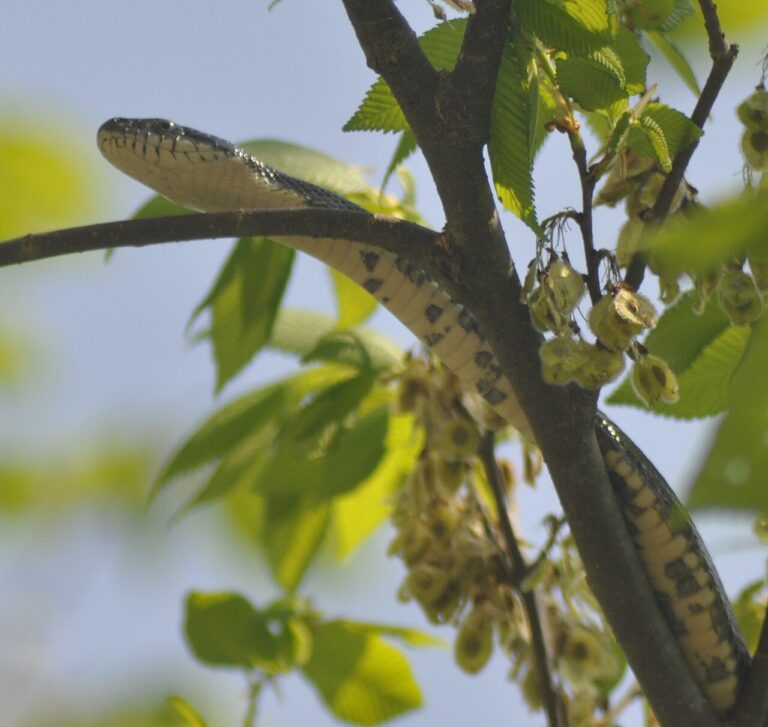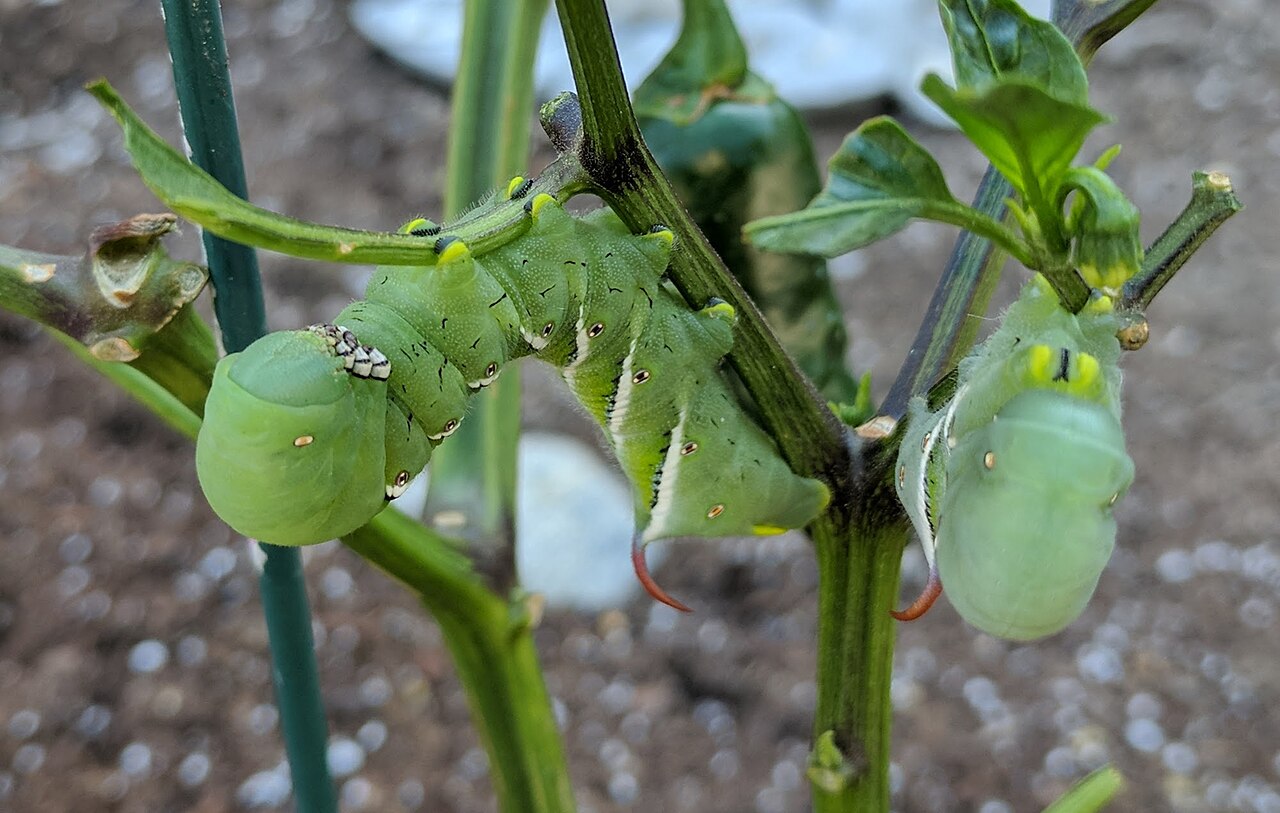
Green Caterpillar: Species Identification Guide
A green caterpillar on a tomato plant, a tree branch, or crawling across a windowsill is usually one of a small number of common species, and a few quick checks, a horn on the tail end, eyespots near the head, or dense spines, narrow the list fast. These caterpillars show up in nearly every US region, though which species you’re most likely to see shifts with what’s growing nearby and the time of year.
Most green caterpillars are completely harmless, but a couple of species covered here do sting, so knowing which is which matters more than just satisfying curiosity. This guide covers the green caterpillars most often found in US yards and gardens, what each becomes, and which ones to leave alone.
The most common green caterpillar in US gardens is the tomato or tobacco hornworm, identified by a curved horn on its rear end and diagonal white stripes. Most green caterpillars are harmless, but the io moth and saddleback caterpillars have stinging spines and should not be touched.
| Species | Key Feature |
|---|---|
| Tomato/Tobacco Hornworm | Curved horn on the tail, diagonal white stripes, found on tomato plants |
| Eastern Tiger Swallowtail Caterpillar | Green with large fake eyespots near the head |
| Luna Moth Caterpillar | Bright green, found on walnut and birch trees |
| Io Moth Caterpillar | Green with rows of stinging spines, do not touch |
| Saddleback Caterpillar | Green with a brown saddle marking, stinging spines |
| Cecropia Moth Caterpillar | Green with colorful blue and orange tubercles |
| Inchworms | Small, thin green loopers found indoors and on trees |
How to Identify a Green Caterpillar
Three features do most of the work: a horn or spike at the tail end, eyespots near the head, and whether the body is smooth or covered in raised bumps or spines. A horned tail almost always means a hornworm species, harmless despite the intimidating look. Fake eyespots near the head are a swallowtail signature, meant to make a small caterpillar look like a snake to a bird considering an easy meal. Texture is the safety-relevant check: any green caterpillar with dense, colorful tubercles or visible spine clusters deserves a closer look before handling, since that’s the general profile of the small number of species that do sting. Host plant narrows things further, since several of these species feed almost exclusively on one plant family, tomato-family plants for hornworms, hardwood trees for the giant silk moth caterpillars, and a wide range of shrubs for the stinging species. Size and time of year help too, small green loopers found year-round point toward inchworms, while a caterpillar approaching three or four inches in late summer is more likely one of the giant silk moth species nearing its final instar.
Tomato and Tobacco Hornworm
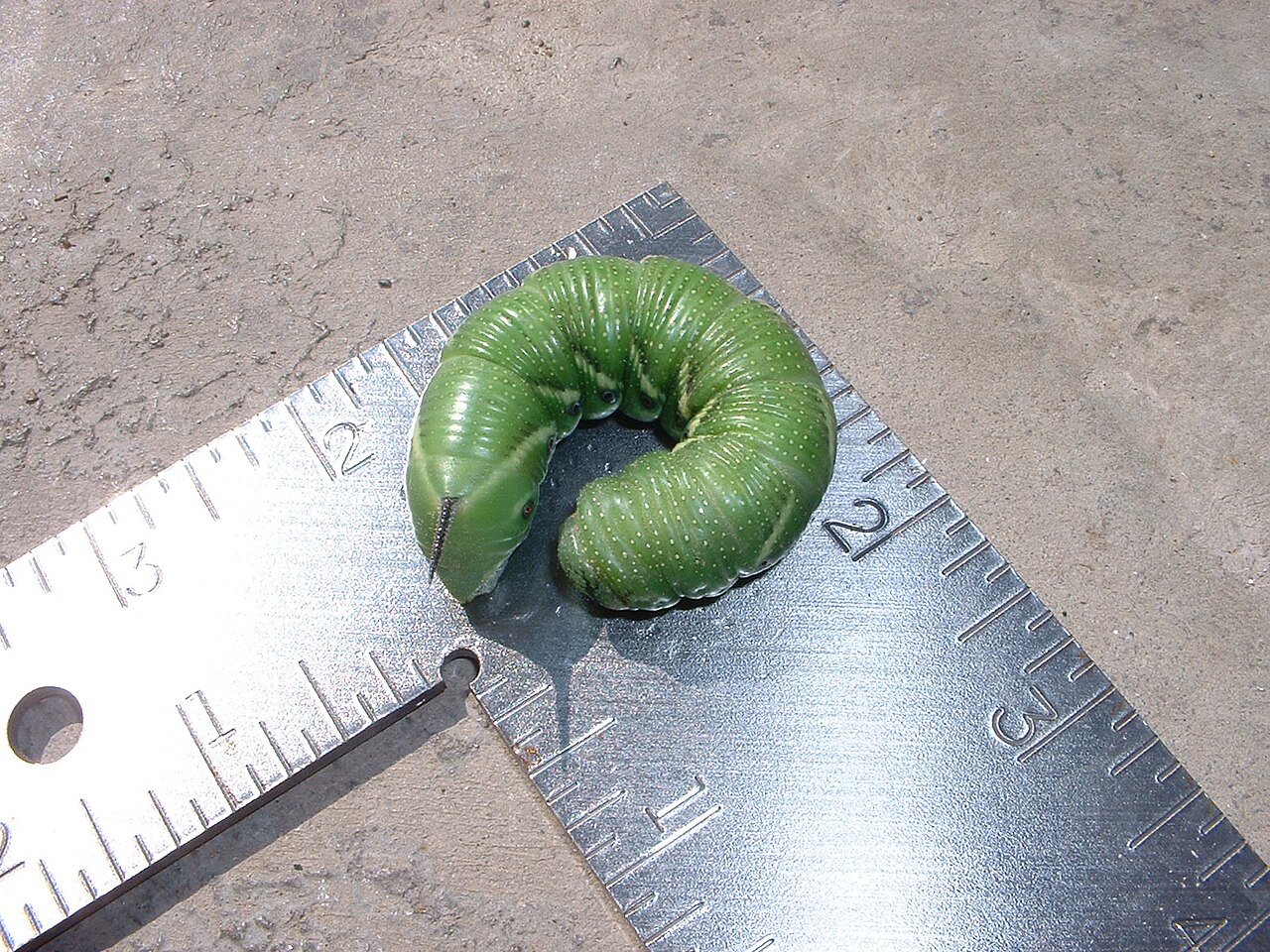
Hornworms are the green caterpillar most home gardeners encounter directly, since they feed heavily on tomato, pepper, and tobacco plants and can strip a plant’s foliage within days. Both the tomato and tobacco hornworm show diagonal white stripes and a curved horn projecting from the rear, and despite looking dramatic, the horn is entirely harmless and can’t sting or bite. The two species are nearly identical and distinguished mainly by horn color, tomato hornworms have a black horn while tobacco hornworms have a red one, along with subtle differences in the stripe pattern. Both eventually become large hawk moths, sometimes called sphinx moths, powerful nocturnal fliers that hover at flowers much like a hummingbird while feeding on nectar.
Eastern Tiger Swallowtail Caterpillar
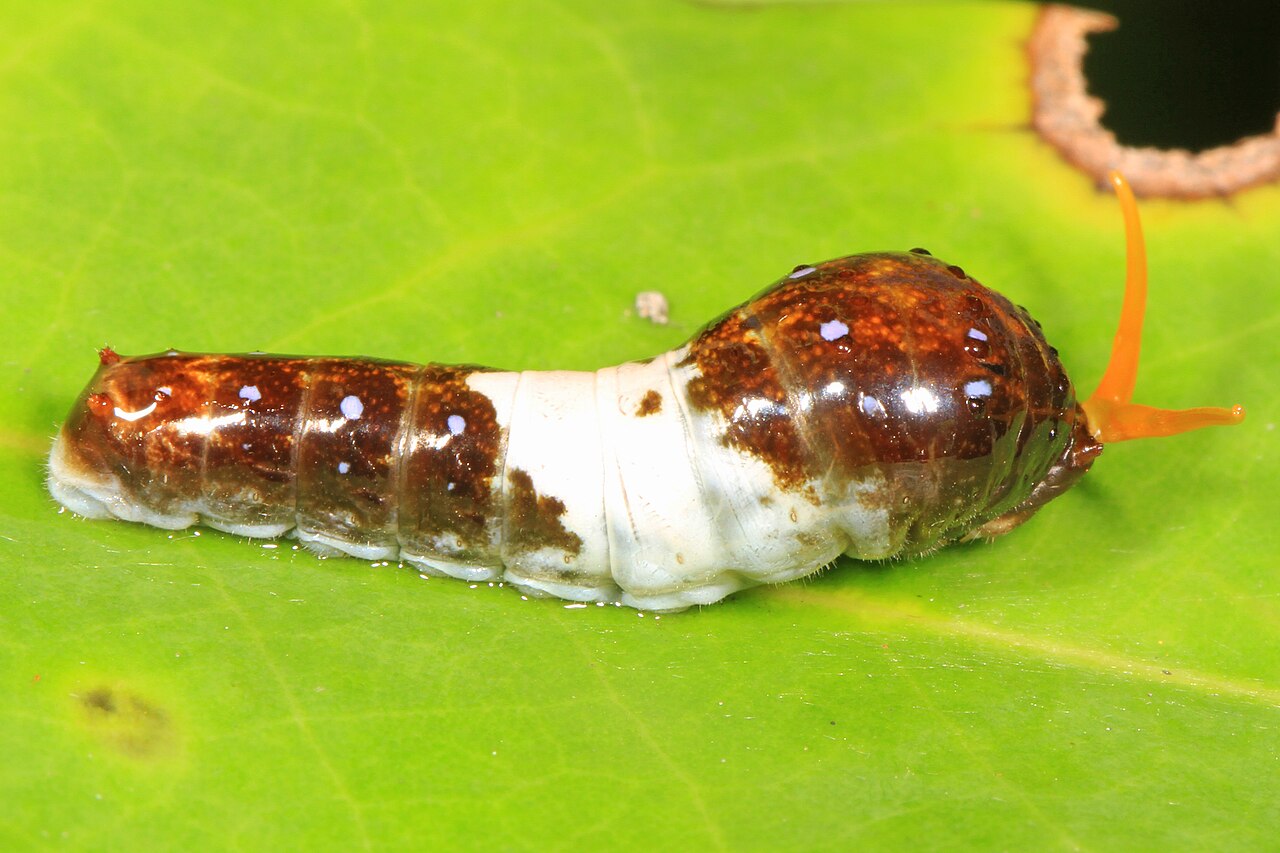
In its final instar, the eastern tiger swallowtail caterpillar turns bright green with a pair of large yellow-and-black false eyespots near the front of its body, a bluffing tactic meant to mimic a small snake and startle predators. It feeds on tree leaves rather than garden vegetables, favoring wild cherry, tulip tree, and ash, and it’s usually found folded inside a curled leaf shelter it constructs with silk during the day, only emerging to feed at night. Early instars look completely different, small and mottled brown-and-white to mimic bird droppings, before transitioning to the green, eyespot-bearing form in later stages. If disturbed, the caterpillar can also evert a forked orange gland called an osmeterium from just behind its head, releasing an odor that deters ants and other small predators without posing any risk to a curious person.
Luna Moth Caterpillar
The caterpillar that becomes a luna moth is a plump, pale green larva with small reddish tubercles along its sides, feeding on walnut, hickory, birch, and sweetgum trees. It’s a large caterpillar by the time it reaches its final instar, sometimes over three inches long, and it spins a papery brown cocoon wrapped in a leaf to overwinter before emerging as the pale green adult moth it’s named for. The National Wildlife Federation notes that luna moth populations have declined in parts of their range due to light pollution disrupting mating flights, making a caterpillar sighting a genuinely encouraging sign for local moth populations.
Io Moth Caterpillar
The io moth caterpillar is one of the two species on this page that genuinely stings, covered in branching green spines that deliver a painful, bee-sting-like reaction if brushed against skin. It feeds on a wide range of trees and shrubs and is often found in groups when young, spreading out to feed individually as it matures. The sting isn’t dangerous for most people, but it’s uncomfortable enough that this is one green caterpillar worth identifying correctly before reaching out to touch it. The adult io moth that eventually emerges looks nothing like the caterpillar, a yellow-brown moth with large, startling eyespots on its hindwings used to scare off predators.
Saddleback Caterpillar
The saddleback caterpillar is unmistakable once you know the pattern: a bright green body with a distinctive brown, saddle-shaped patch in the middle, bordered front and back by dense clusters of stinging spines. It’s one of the more painful stinging caterpillars in the US relative to its small size, and the sting can cause a reaction lasting longer than a typical bee sting, sometimes with a rash that spreads beyond the initial contact point. It’s most often found on a wide range of garden plants and shrubs rather than any single host, so location alone doesn’t rule it out the way it does for some other species, and its compact size makes it easy to miss until direct contact happens.
Cecropia Moth Caterpillar
The cecropia moth caterpillar is one of the most strikingly colored on this list, pale green with rows of coral-red and yellow tubercles along its back and blue tubercles along its sides. It’s the largest native moth caterpillar in North America, feeding on a range of trees including maple, cherry, and birch, and despite the bold coloring and bumpy texture, it does not sting and is safe to observe up close. Its size alone is often the giveaway, a mature cecropia caterpillar can reach nearly four inches long and thicker than a person’s thumb, dwarfing most other caterpillars found on the same tree.
Inchworms and Loopers
Inchworms are thin, small green caterpillars that move by looping their body forward, lacking the middle set of prolegs that gives most caterpillars a more even crawl. They’re common on trees and shrubs but also turn up indoors surprisingly often, usually after dropping from an overhanging branch on a strand of silk or being carried in on cut greenery, which explains why people sometimes find one on a windowsill or ceiling with no obvious outdoor connection. Birds hunting for caterpillars target inchworms heavily precisely because their exposed, slow-moving habit on leaf edges makes them an easy meal compared to better-camouflaged species.
Is It Safe to Touch a Green Caterpillar?
Most green caterpillars, including hornworms, tiger swallowtails, luna moths, and cecropia moths, are entirely safe to handle. The two species on this page that sting, io moth and saddleback, are both identifiable by their spine clusters, so checking texture before touching any unfamiliar green caterpillar is the simplest safety rule. If a sting does happen, tape applied and removed over the area can help pull out broken spines, and washing with soap and water afterward is usually enough to manage the reaction. Most reactions, even from the more painful saddleback sting, resolve within a day or two without any medical treatment, though anyone with a known allergy to insect stings should treat any caterpillar sting more cautiously and seek care if swelling spreads or breathing feels affected.
What Green Caterpillars Turn Into
Every species here becomes a moth or butterfly, though the group splits fairly evenly between the two. Hornworms become large sphinx moths, tiger swallowtails become the familiar yellow-and-black striped butterfly, and luna and cecropia caterpillars become two of North America’s largest and most recognizable native moths. Timing varies by species and climate, but most complete the transformation from final-instar caterpillar to emerged adult within two to four weeks in warm weather, longer if the species overwinters as a cocoon or chrysalis. Species that spend winter as a cocoon, like luna and cecropia moths, often complete only a single generation per year in cooler climates, while hornworms and tiger swallowtails can manage two or more generations further south.
Why You’re Finding Them in Your House
A green caterpillar indoors almost always arrived by accident rather than intentionally seeking shelter. Common routes include a caterpillar dropping from a tree branch overhanging a doorway, hitching a ride on cut flowers or produce, or crawling in through a gap while searching for a place to pupate, since some species leave their host plant entirely once ready to spin a cocoon. Finding a single caterpillar indoors is not a sign of an infestation and doesn’t require any pest control response, simply relocating it outside to a suitable plant is enough. A caterpillar found indoors in late summer or fall, when many species are actively wandering to find a pupation site, is especially unlikely to indicate anything beyond normal seasonal movement.
Frequently Asked Questions
What does it mean if you see a green caterpillar?
There’s no symbolic significance beyond the practical, a green caterpillar simply indicates a healthy population of moths or butterflies using the plants nearby as host material.
What does a green hornworm turn into?
It becomes a large sphinx moth, sometimes called a hawk moth, a fast-flying nocturnal moth with a wingspan that can exceed four inches in the largest species.
Is it okay to touch green caterpillars?
Most species are safe, but the io moth and saddleback caterpillars have stinging spines and should not be handled. Checking for dense spine clusters before touching any unfamiliar caterpillar is the safest approach, and when in doubt, observing from a short distance costs nothing.
What kind of caterpillars can you not touch?
Any caterpillar with visible spine clusters or dense bristly hairs, rather than a smooth body, should be treated with caution, since that texture is the general warning sign across most stinging species in the US.
Why am I finding green caterpillars in my house?
Most indoor sightings happen when a caterpillar drops from an overhanging tree branch, hitches a ride on cut plants, or wanders in while searching for a pupation site, not because of any infestation.
What kills caterpillars instantly if they’re damaging my garden?
Handpicking is the most immediate option for a small garden, while biological insecticides containing Bacillus thuringiensis target caterpillars specifically without harming most other garden visitors, though neither is truly instant, and repeated checks over several days usually work better than a single treatment.