Brown Caterpillar: Identification, Safety, and Tree Damage Risk
A brown caterpillar in a US yard is most often the eastern tent caterpillar, the forest tent caterpillar, or the brown and black banded form of the woolly bear. Each species has a different look up close, and the difference matters because one builds visible silk tents in trees while the others do not.
The fastest way to tell them apart is to look for a tent-like silk structure in a nearby tree fork and check whether the caterpillar has continuous fuzzy bands or a mix of colors along its body. This guide covers all three common brown caterpillars, whether any of them are dangerous to touch, and what a sighting typically means for the tree or garden it was found in.
Most brown caterpillars in US yards are eastern tent caterpillars, forest tent caterpillars, or the brown-and-black banded woolly bear. None are venomous, though a few can cause mild skin irritation. Tent-building species can defoliate branches but rarely kill an established tree.
| Species | Markings | Silk Tent? | Host Trees | Handling Risk |
|---|---|---|---|---|
| Eastern tent caterpillar | Brown with a white stripe, blue spots | Yes, in branch forks | Cherry, apple, crabapple | Low |
| Forest tent caterpillar | Brown with keyhole-shaped spots | No, silk mats only | Oak, maple, aspen | Low |
| Woolly bear (brown morph) | Brown and black bands | No | Low weeds and grasses | Low, mild itch possible |
| Black fuzzy caterpillar | Mostly black, dense hair | No | Varies | Low to moderate |
What Is a Brown Caterpillar?
A brown caterpillar is most commonly one of three species in the US: the eastern tent caterpillar, the forest tent caterpillar, or the brown and black form of the woolly bear. Each belongs to a different family and produces a completely different adult moth, so color alone only narrows the search partway.
The presence or absence of a silk tent is the single most useful clue. Tent caterpillars build visible nests in tree branch forks, while the woolly bear and most other brown caterpillars are solitary wanderers with no silk structure at all.
None of the common brown caterpillars found in US yards are venomous in a medically significant sense, though a few carry hairs that can cause mild skin irritation on contact.
Eastern Tent Caterpillar (Malacosoma americanum)
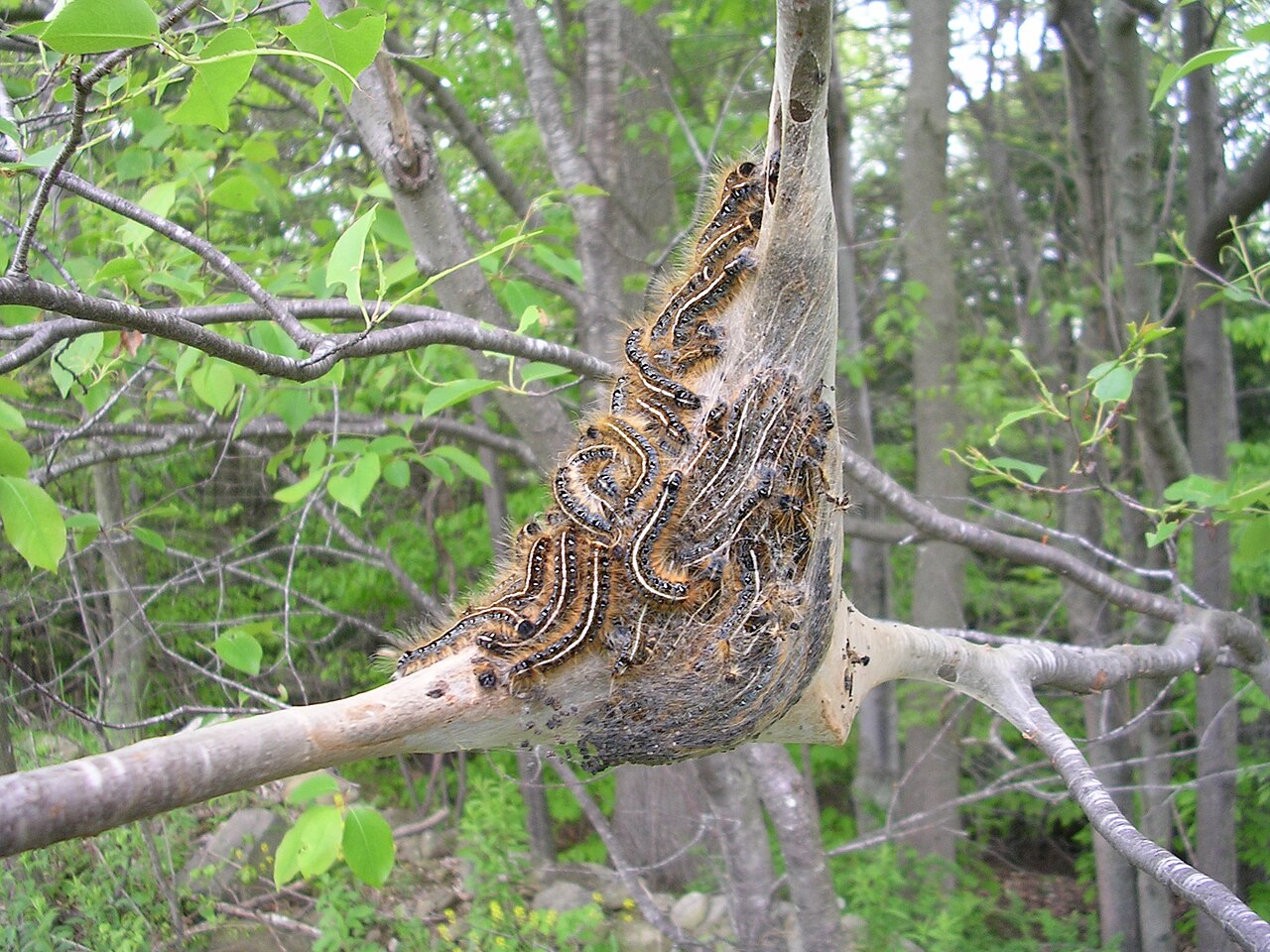
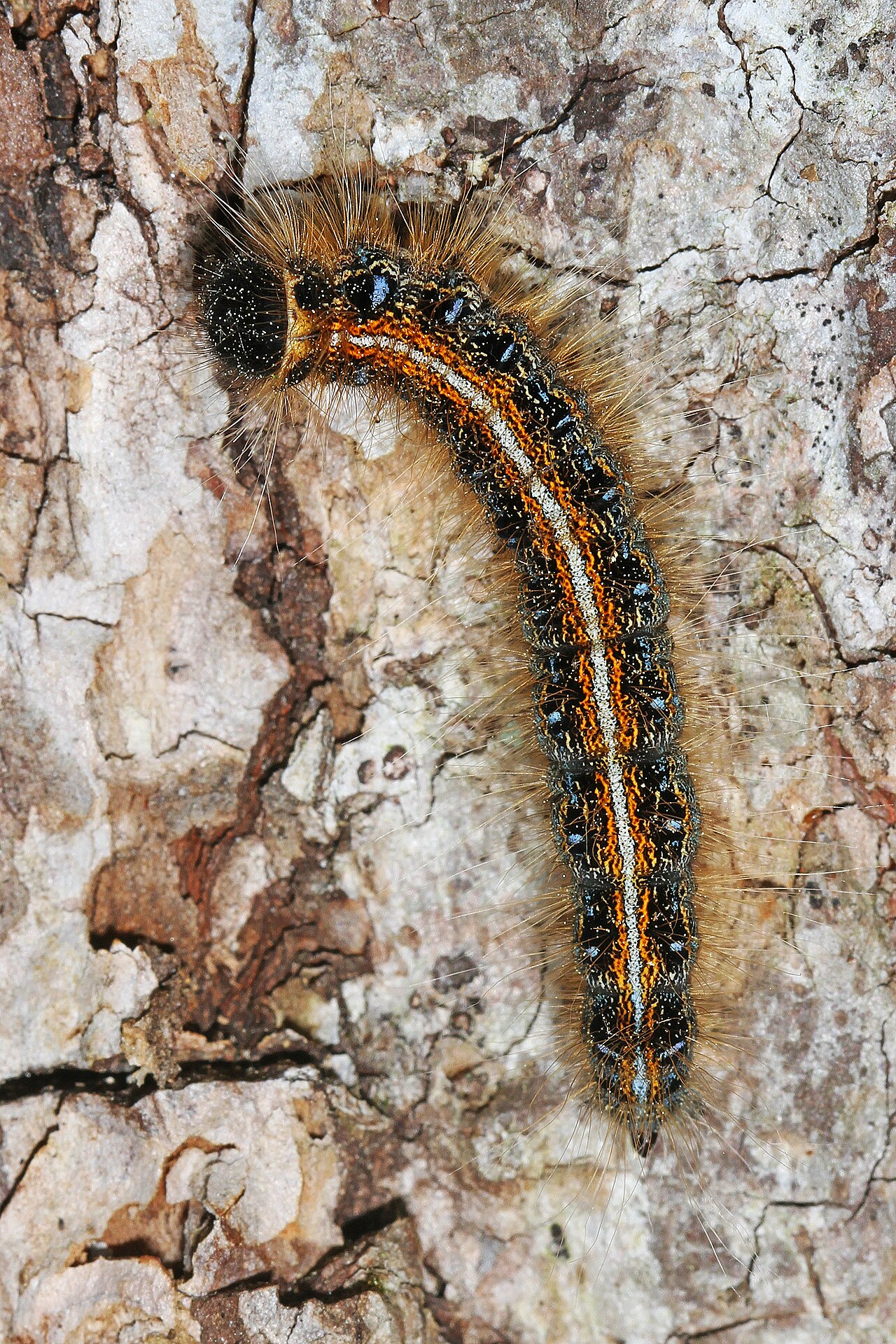
The eastern tent caterpillar is a brown, hairy caterpillar marked by a continuous white stripe down its back and a row of pale blue spots along each side. It is best known for the dense white silk tent it builds in the forks of cherry, apple, and crabapple trees each spring.
The caterpillars live communally inside the tent, expanding it as they grow and venturing out to feed on nearby leaves during the day before returning to the tent at night. A single tent can house dozens of caterpillars from one egg mass.
Heavy feeding can strip branches bare in a bad year, but healthy established trees typically produce a new flush of leaves and recover fully. The species completes its feeding cycle by early summer, after which the tents are abandoned.
Forest Tent Caterpillar (Malacosoma disstria)
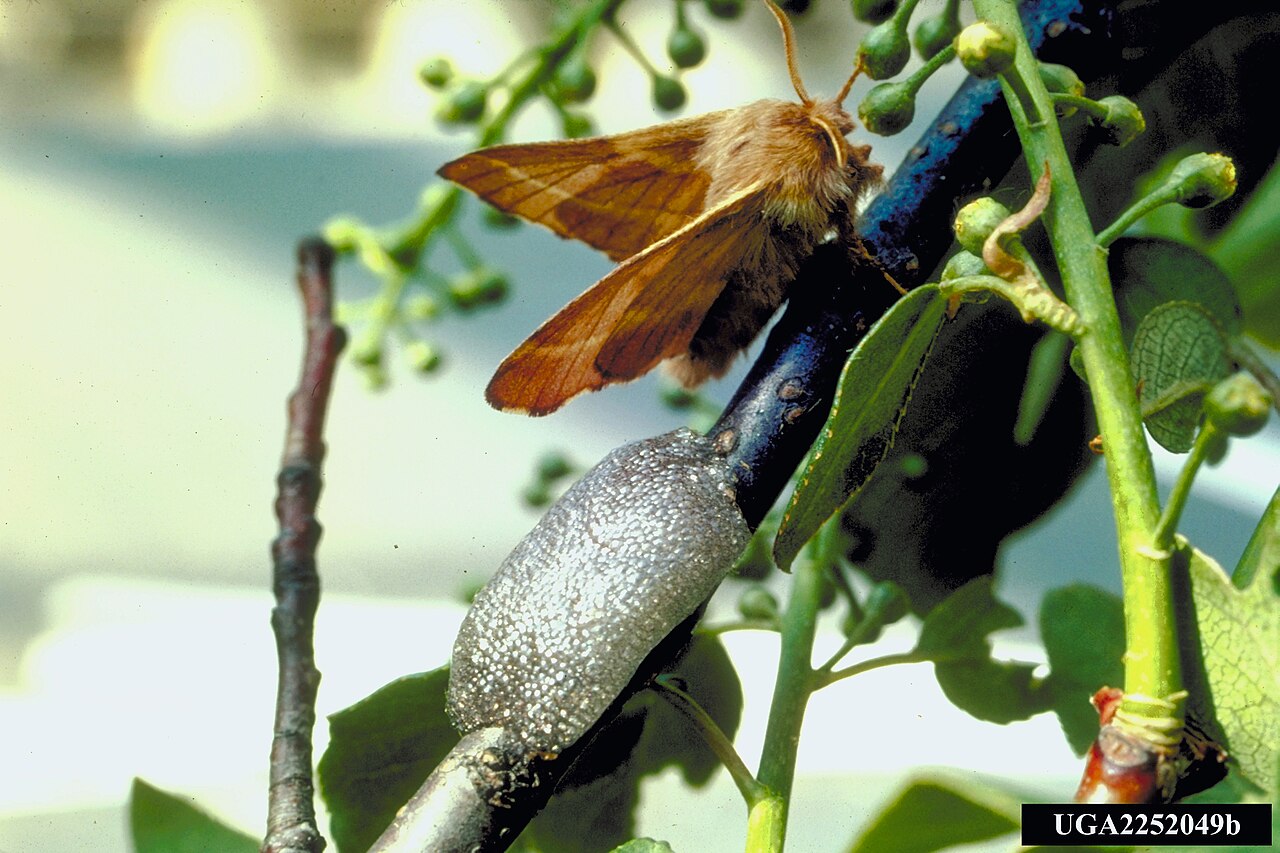
The forest tent caterpillar is a close relative of the eastern tent caterpillar, brown in color with a row of pale, keyhole-shaped spots running down its back instead of a solid stripe. Despite the name, this species does not build an enclosed tent.
Instead, it spins a silk mat on tree trunks or branches where the group rests between feeding bouts, which can look like a patch of webbing rather than a true tent. It prefers oak, maple, and aspen over the fruit trees favored by its eastern relative.
Population levels for this species swing widely from year to year, with occasional outbreak years producing visible defoliation across whole stands of trees before natural predators and disease bring numbers back down.
Banded Woolly Bear (Brown and Black Morph)
The banded woolly bear is a fuzzy caterpillar with alternating bands of brown and black hair, most often seen crossing sidewalks and roads in autumn. The width of the brown band varies between individuals and is not a reliable predictor of winter weather, despite the long-running folk belief.
This species does not build a tent or feed communally, instead wandering alone across a wide range of low plants, weeds, and grasses. Its autumn wandering behavior is actually a search for a sheltered spot to spend the winter, not feeding activity.
Woolly bears survive freezing temperatures by producing a natural antifreeze compound in their tissues, allowing them to overwinter as caterpillars rather than pupating before the cold arrives.
Are Brown Caterpillars Venomous?
No brown caterpillar commonly found in US yards is venomous in a medically serious sense. Eastern and forest tent caterpillars have fine hairs that rarely cause more than mild, temporary skin irritation in sensitive individuals.
The banded woolly bear’s hairs can occasionally trigger a mild itch similar to contact with fiberglass insulation, but this is a mechanical irritation rather than a venom reaction. Washing the area removes any remaining hairs and typically resolves discomfort quickly.
None of these species should be confused with genuinely stinging caterpillars such as the saddleback or puss moth caterpillar, which carry hollow spines connected to venom glands and are not brown in color.
What Do Brown Woolly Caterpillars Turn Into?
A banded woolly bear caterpillar becomes an Isabella tiger moth, a medium-sized moth with pale yellow-orange wings and small black spots. The caterpillar overwinters in its fuzzy form and pupates the following spring once temperatures rise consistently.
Eastern and forest tent caterpillars both become plain tan to brown moths with a wingspan of roughly one to one and a half inches, neither of which resembles the conspicuous tent-building larvae they started as.
In all three cases, the adult moth is far less noticeable than the caterpillar stage, which is why most people never realize they have already seen the adult form of a caterpillar they found earlier in the season.
Is It Safe to Pick Up a Woolly Bear Caterpillar?
Picking up a banded woolly bear caterpillar is generally safe, and it is one of the more commonly handled caterpillars thanks to its popularity with children in early fall. Most people experience no reaction at all from brief contact.
A small percentage of people develop a mild, short-lived itch from the caterpillar’s bristly hairs, particularly if the caterpillar is rubbed against the skin rather than allowed to walk across an open palm. This reaction resolves on its own without treatment.
Washing hands after handling any hairy caterpillar is a reasonable habit, both to remove loose hairs and to avoid transferring them to the eyes or face.
Is It Rare to See a Polyphemus Moth?
Polyphemus moths are not considered rare, but their large brown-winged adults are seen far less often than their caterpillars, since the adults are active mainly at night and live for only about a week. The caterpillar stage of this species is bright green, not brown, so it is not one of the caterpillars covered elsewhere in this guide.
People typically encounter this species as an adult moth resting on a wall or porch near outdoor lighting, where its large size and prominent eyespots make it stand out immediately. A daytime sighting of the resting adult is the most common way people notice this species at all.
Because the caterpillar and adult look nothing alike and rarely appear in the same season for the same observer, most people never connect the two life stages without specifically researching the species.
What Does It Mean If You Find a Caterpillar in Your House?
A caterpillar indoors almost always arrived by accident while searching for a pupation site or was carried in on clothing, firewood, or an open window rather than by intentionally moving in. None of the brown caterpillars covered here reproduce or feed inside a home.
Tent caterpillars and woolly bears are both outdoor species tied to specific plants or trees, so an indoor environment offers nothing they need to survive long term. A single indoor sighting is best resolved by gently relocating the caterpillar back outside to an appropriate host plant.
Repeated indoor sightings are unusual and more likely point to an open entry point near a tree or garden bed than to any kind of infestation risk.
Are Tent Caterpillars Bad for My Trees?
Tent caterpillars can strip significant foliage from an infested tree during an outbreak year, but established, healthy trees typically regrow leaves within weeks and survive without lasting harm. Repeated defoliation over several consecutive years is more likely to weaken a tree than a single bad season.
According to general guidance from university extension resources such as Penn State Extension, small tents can be pruned out by hand in early spring before populations grow large enough to cause noticeable damage. Chemical treatment is rarely necessary for typical backyard infestations.
Natural predators, parasitic wasps, and periodic disease outbreaks usually bring tent caterpillar populations back down within a year or two, even without any intervention from a homeowner.
What Does It Mean When a Caterpillar Visits You?
Various folk traditions treat an unexpected caterpillar sighting as a symbol of transformation or upcoming change, drawing on the caterpillar’s eventual metamorphosis into a moth or butterfly. These interpretations are cultural rather than scientific.
Biologically, a caterpillar’s presence simply indicates a suitable host plant nearby and says nothing about the person who happened to notice it. The timing of a sighting is driven entirely by the caterpillar’s feeding and growth schedule.
Whatever symbolic weight a person gives the encounter, it has no effect on the caterpillar’s actual behavior, which remains focused entirely on feeding and eventually finding a place to pupate.
Telling Tent Caterpillar Species Apart at a Glance
The fastest field check between the two tent-building species is the back stripe pattern rather than the tent itself, since both species build silk structures that can look similar from a distance. Eastern tent caterpillars show one continuous white line running the full length of the back, while forest tent caterpillars show a row of separate pale, keyhole-shaped marks instead of a single line.
Timing also helps narrow it down. Eastern tent caterpillars appear earlier in spring and finish feeding by early summer, while forest tent caterpillars tend to peak slightly later and are more likely to be seen wandering across driveways and sidewalks in large numbers during outbreak years.
Host tree is a useful secondary clue when the caterpillars themselves are hard to inspect closely. A tent in a cherry or crabapple tree points strongly toward the eastern species, while heavy caterpillar activity on oak or aspen points toward the forest species instead.
Frequently Asked Questions
What does it mean when you see an all brown caterpillar?
Practically, it usually means you have spotted an eastern tent caterpillar, forest tent caterpillar, or the brown form of a woolly bear. Any deeper symbolic meaning is a matter of personal or cultural belief rather than biology.
Are brown caterpillars venomous?
No common brown caterpillar in the US is venomous in a medically serious way. A few species can cause mild skin irritation from their hairs, but none inject venom the way true stinging caterpillars do.
Is it rare to see a polyphemus moth?
It is not rare, but the large brown adult moth is seen far less often than its bright green caterpillar, mainly because the adult is active at night and short-lived.
What do brown woolly caterpillars turn into?
A banded woolly bear caterpillar becomes an Isabella tiger moth, a pale yellow-orange moth with small black spots, after overwintering and pupating the following spring.
Is it safe to pick up a woolly bear caterpillar?
Yes, it is generally safe to handle, though a small number of people experience a mild, temporary itch from its bristly hairs.
What does the Bible say about caterpillars?
Caterpillars appear in a small number of biblical passages, most often grouped with locusts and other insects as agents of crop damage. These references are agricultural in context rather than a broader statement about caterpillars as a whole.
Related reading: the woolly bear caterpillar, black fuzzy caterpillars, birds that eat caterpillars, fuzzy caterpillars, black caterpillars, and green caterpillars.