Black and White Wasp: Identifying the Bald-Faced Hornet
A black and white wasp seen in the US is almost always the bald-faced hornet, a large, boldly patterned insect known for building football-sized paper nests. Despite the common name, it is technically a type of yellowjacket rather than a true hornet, and its markings are one of the most recognizable in the wasp world.
This species gets noticed more for its nest than for the insect itself, since the nest is often the first sign of a colony nearby. The sections below cover identification, sting severity, and safe options for dealing with a nest close to a home.
A black and white wasp is almost always the bald-faced hornet, a large yellowjacket relative with bold white facial and abdominal markings. It builds large aerial paper nests and defends them aggressively, making its sting one of the more painful common wasp stings in the US.
| Feature | Bald-Faced Hornet | Typical Yellowjacket | Paper Wasp |
|---|---|---|---|
| Color | Black with white face and tail markings | Black and yellow | Brown with yellow or red marks |
| Nest Shape | Large enclosed paper football | Underground or wall void | Open umbrella comb |
| Aggression | High near nest | Moderate to high | Low to moderate |
| Nest Size | Up to 14 in, hundreds of workers | Varies, can be large underground | Small, dozens of cells |
What Is a Black and White Wasp?
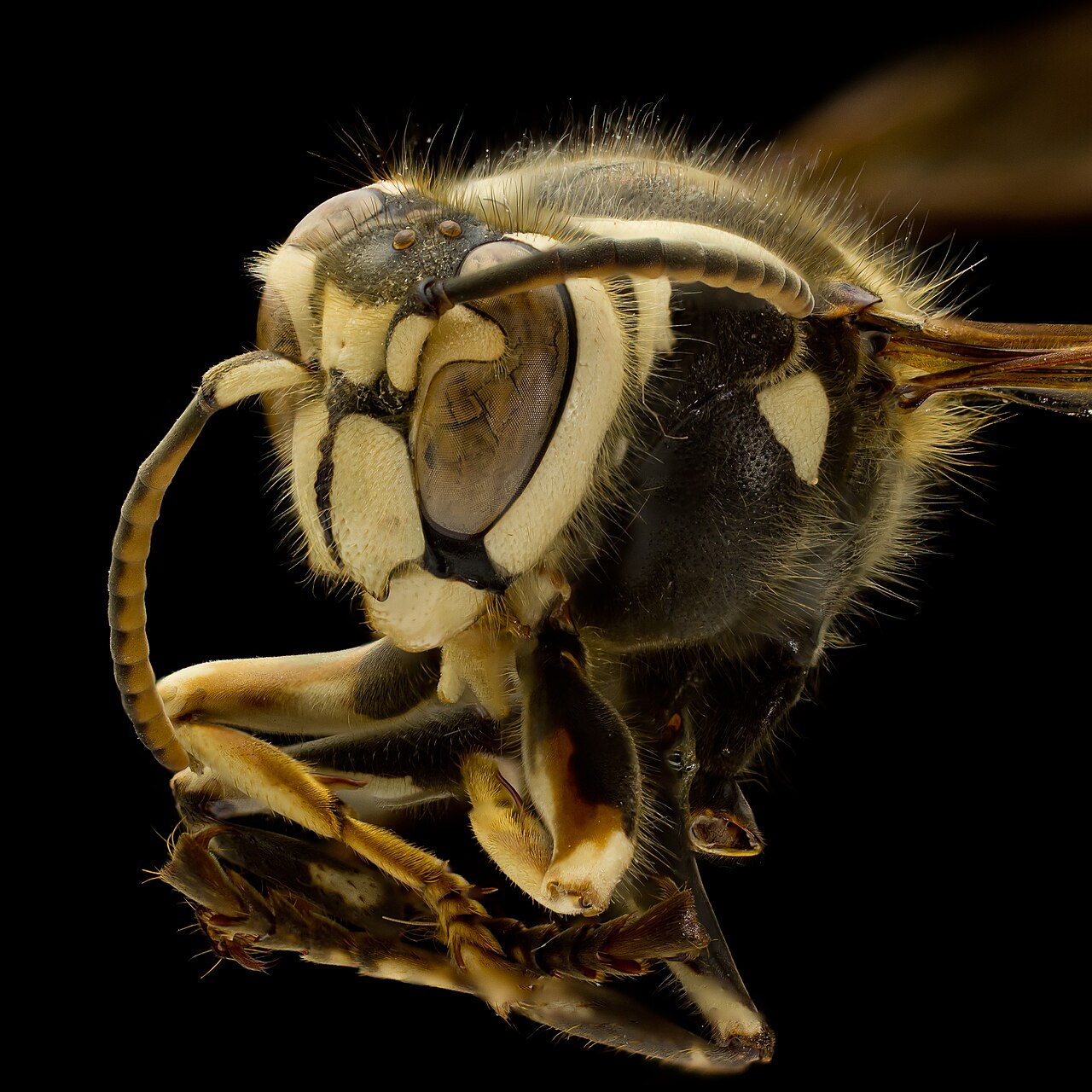
A black and white wasp seen in the US is almost always the bald-faced hornet, identified by a mostly black body with ivory white markings on the face and the tip of the abdomen. It is one of the largest common wasps encountered in North American yards.
Despite its name, this species is genetically a yellowjacket rather than a true hornet, a classification detail that has little practical impact on how the insect behaves or how a sighting should be handled. It is a social species that lives in large colonies rather than alone.
Confirming this species is straightforward once the distinctive white facial pattern and large aerial nest are visible, since no other common US wasp shares both features together.
Bald-Faced Hornet (Dolichovespula maculata) Identification
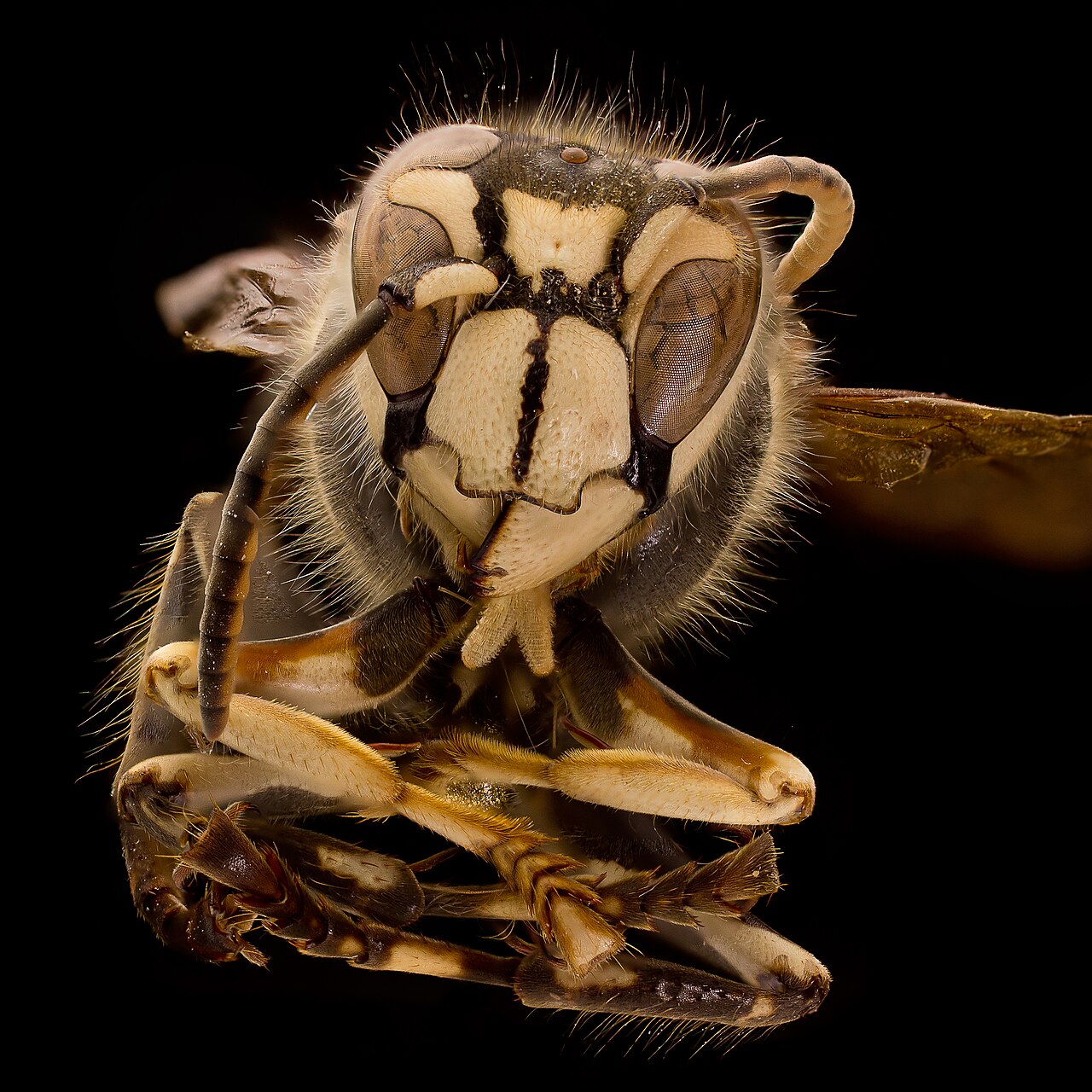
The bald-faced hornet has a black body roughly three-quarters of an inch long, with a mostly white face and three pale white bands near the tip of the abdomen. Workers, queens, and males all share this basic pattern, with queens being noticeably larger.
Colonies are founded each spring by a single overwintered queen, who builds a small initial nest and raises the first generation of workers before the colony grows rapidly through summer. By late summer, a mature colony can include several hundred workers.
This species is most active during the day and forages for insects, nectar, and sugary substances, making it a frequent visitor to outdoor food and drinks in late summer.
Bald-Faced Hornet Nest: What It Looks Like
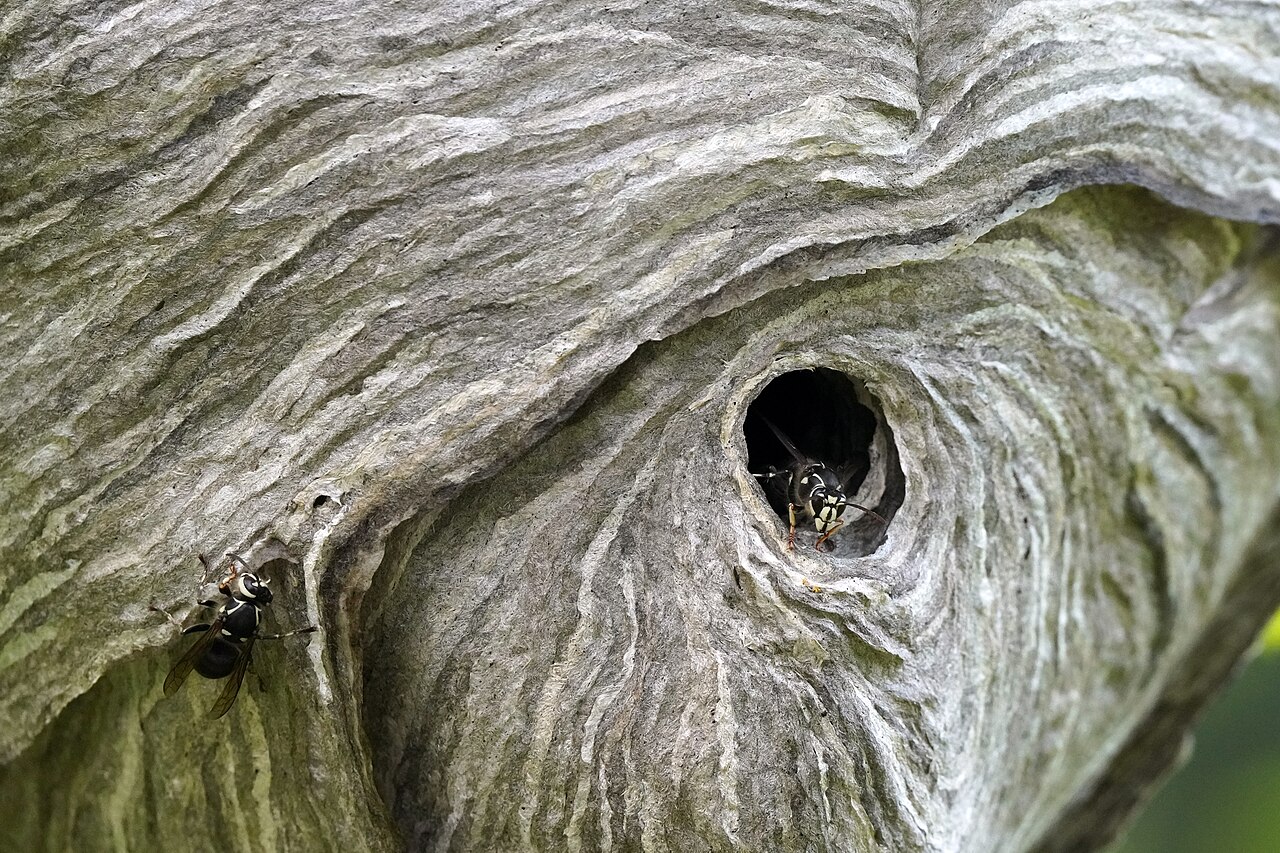
A bald-faced hornet nest is a large, gray, football-shaped paper structure typically built high in a tree, on a building eave, or against a wall, and can reach over a foot in length by late summer. The outer layer is made of chewed wood fiber mixed with saliva, giving it a distinctive papery texture.
Unlike an open paper wasp nest, the bald-faced hornet nest is fully enclosed, with a single entrance near the bottom that workers use to enter and exit. Multiple layers of comb are stacked inside, protected by the outer paper envelope.
Nests are rebuilt from scratch every year, since colonies do not survive winter, meaning an old empty nest found in late fall or winter poses no active threat regardless of its size.
Are Black and White Wasps Aggressive?
Bald-faced hornets are considered one of the more defensive common wasp species, particularly near their nest, where workers respond quickly and in numbers to any perceived threat. Away from the nest, individual foragers are far less likely to sting unprovoked.
Unlike honeybees, this species can sting multiple times, since its stinger is not barbed and is not lost after use. A disturbed nest can result in several workers stinging the same person in quick succession.
Vibration, sudden movement, and carbon dioxide from breathing near the nest entrance are all known triggers for a defensive response, which is why lawn equipment and foot traffic near an active nest often provoke stings.
What Happens If You Get Stung by a Bald-Faced Hornet?
A bald-faced hornet sting typically causes immediate sharp pain, localized redness, and swelling that peaks within a few hours and fades over one to two days for most people. The venom is potent enough that this species is often ranked among the more painful common US stinging insects.
Multiple stings in a short period, whether from one hornet or several, increase the total venom dose and can intensify swelling and discomfort beyond a single sting. Applying a cold compress and taking an over-the-counter antihistamine or pain reliever addresses most uncomplicated stings.
A small percentage of people experience a true allergic reaction, which can include widespread hives, difficulty breathing, or swelling away from the sting site, and this requires immediate emergency medical attention rather than home treatment.
What’s the Worst Wasp to Get Stung By?
Among common US wasps, the bald-faced hornet and various yellowjacket species are generally reported as producing the most painful stings, followed by paper wasps, which tend to be somewhat milder. Pain intensity is subjective and varies significantly between individuals.
The Schmidt sting pain index, a reference scale used by entomologists, ranks many US wasps and hornets as moderately to highly painful compared to bees, though none of them approach the extreme end of the scale occupied by certain tropical ant and wasp species.
For most people, the practical difference between these common wasp species comes down to how many stings occur at once and whether an allergic reaction develops, rather than which specific species delivered the sting.
Prior sting history also plays a role in how a new sting is experienced, since some people develop a stronger localized reaction to repeated stings over time even without a true allergy. This is different from anaphylaxis, which involves a broader immune response beyond the sting site.
Should I Destroy a Bald-Faced Hornet Nest?
A nest built well away from foot traffic, doorways, or windows can often be left alone, since bald-faced hornets are beneficial predators of flies, caterpillars, and other insects during the season. Removal becomes more reasonable when a nest is close to an entrance or high-traffic area.
Colonies naturally die off after the first hard frost, with only next year’s queens surviving the winter elsewhere, so a nest discovered in fall may not need any intervention at all before it becomes inactive on its own.
When removal is genuinely necessary, treating it as a task for professional pest control or done at night with proper protective clothing reduces the risk of multiple stings compared to a daytime attempt.
How to Get Rid of Black and White Wasps Safely
The safest approach to removing a bald-faced hornet nest involves treating it after dark, when the colony is least active, using a wasp-specific aerosol spray designed to reach the nest entrance from several feet away. Protective clothing covering skin fully is strongly recommended even at night.
Avoid using a flashlight directly on the nest entrance during treatment, since white light can trigger a defensive response; a red-filtered light is less likely to alert the colony. Waiting at least a day after treatment before removing the nest allows time to confirm the colony is no longer active.
For nests larger than a basketball, built high off the ground, or located near a structure’s interior, hiring a licensed pest control professional is generally the safer choice over DIY removal.
What Kills Wasps Instantly?
Commercial aerosol wasp and hornet sprays labeled for that purpose are formulated to knock down and kill wasps within seconds of direct contact, which is why they are the standard recommendation over homemade alternatives. These products are also designed to spray several feet, keeping the user at a safer distance than most improvised methods.
Homemade remedies circulating online vary widely in actual effectiveness and are frequently slower or less reliable than a purpose-made insecticide, increasing the chance of provoking a defensive swarm before the colony is fully controlled. Reliable results depend more on treating the nest at the right time of day than on which product is used.
Regardless of the method chosen, treating an active nest always carries some sting risk, and full protective clothing is a reasonable precaution even with a fast-acting product.
Does WD-40 Work on Wasps?
WD-40 is a popular home remedy claimed to kill wasps on contact, but it is not a registered insecticide and its effectiveness against an established nest is inconsistent compared to a purpose-made wasp spray. It is also flammable, which makes it a poor choice to use anywhere near open flame or a heat source.
Reports of WD-40 working against individual wasps in the open exist, but treating a full nest with a non-insecticide product is far less reliable than a labeled aerosol spray designed specifically for that purpose. According to general guidance from university extension resources such as University of Minnesota Extension, registered wasp and hornet products remain the standard recommendation for nest treatment.
For anyone dealing with an active nest, a product labeled specifically for wasps and hornets remains the more predictable and safer option over household substitutes.
Bald-Faced Hornet vs Paper Wasp
The clearest difference between these two species is color and nest shape rather than size alone. Bald-faced hornets are black with white markings and build a fully enclosed paper nest, while paper wasps are typically brown with yellow or reddish markings and build an open, umbrella-shaped comb with no outer covering.
Paper wasps also tend to form smaller colonies, often numbering in the dozens rather than the hundreds seen in a mature bald-faced hornet nest by late summer. This smaller colony size generally translates to a less intense defensive response if the nest is disturbed.
Both species are beneficial predators of caterpillars and other garden pests during the season, and neither should automatically be treated as a threat simply for being present in a yard away from high-traffic areas.
Frequently Asked Questions
Are black and white wasps aggressive?
Bald-faced hornets are considered a more defensive species near their nest, though individual foragers away from the nest are much less likely to sting unprovoked.
What happens if you get stung by a bald-faced hornet?
Most people experience sharp pain, redness, and swelling that fades within one to two days. A small percentage develop a true allergic reaction that requires emergency care.
Should I destroy bald-faced hornets?
Not necessarily. A nest located away from doors and walkways can often be left alone, since the colony naturally dies off after the first hard frost.
What’s the worst wasp to get stung by?
Bald-faced hornets and various yellowjackets are commonly reported as among the more painful common US stings, though individual pain tolerance varies widely.
What kills wasps instantly?
Commercial aerosol sprays labeled for wasps and hornets are formulated to kill on contact within seconds and are the standard recommendation over homemade alternatives.
What does WD-40 do to wasps?
It is a popular but unreliable home remedy that is not a registered insecticide and is less consistent against a full nest than a purpose-made wasp spray. It is also flammable and should be kept away from heat sources.
Related reading: black wasps, blue wasps, hornet nests vs wasp nests, hornets vs wasps, red wasps, and birds that eat wasps.