Rat Tracks in Snow: Size, Tail Drag and Lookalike Prints
Rat tracks are small, hand like prints in groups of four, with four toes on the front foot and five on the back, almost always joined by a thin tail drag line running down the middle of the trail. That tail line is the detail that settles most identifications. In fresh snow a Norway rat (Rattus norvegicus) leaves a trail about 1.75 to 2.5 in (4.5 to 6.5 cm) wide that hugs a wall, a fence line or a pipe run rather than crossing open ground.
Winter is the best time to read them, because snow holds detail that dust and gravel never will, and because rats move closer to buildings as temperatures fall.
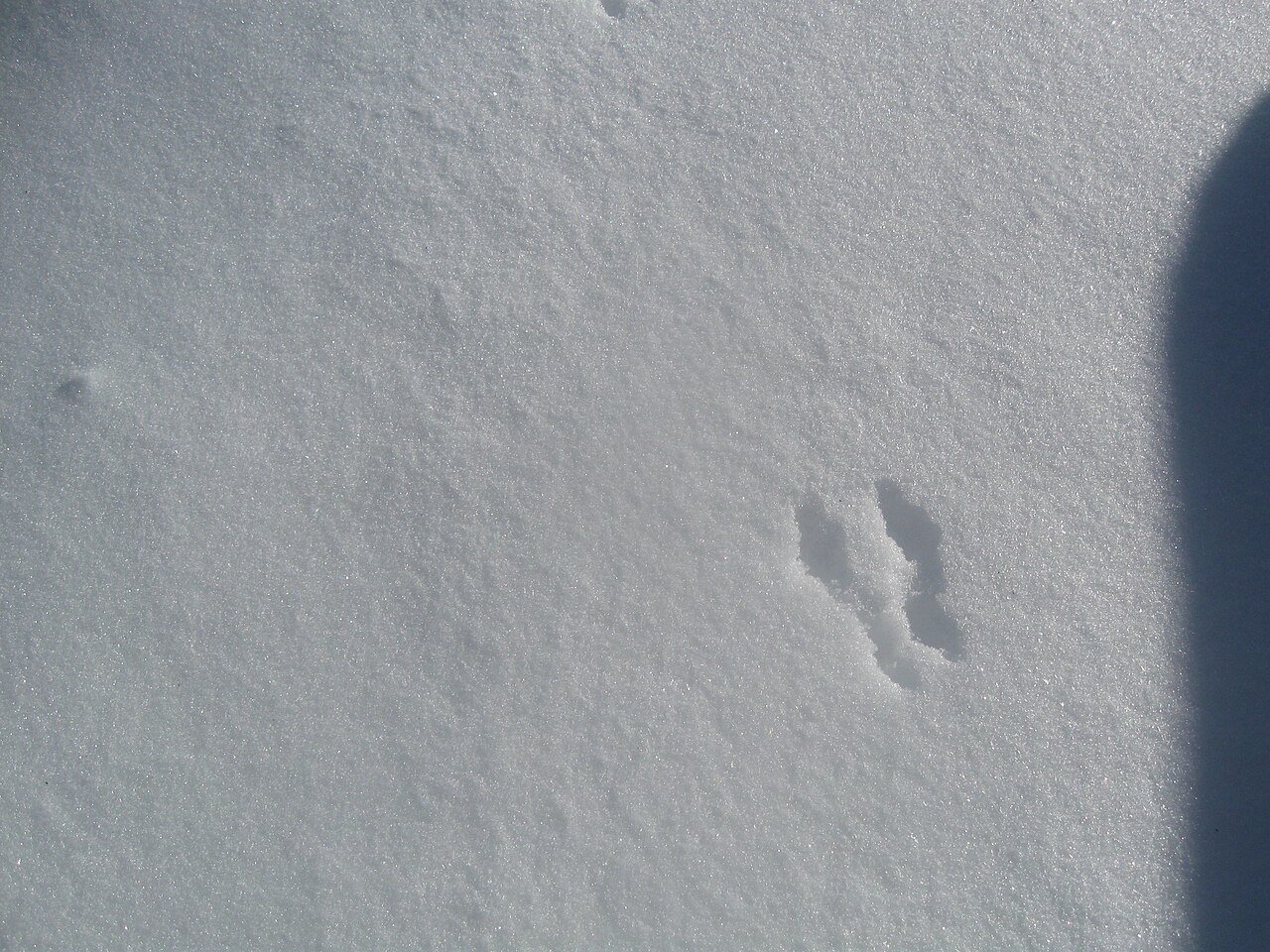
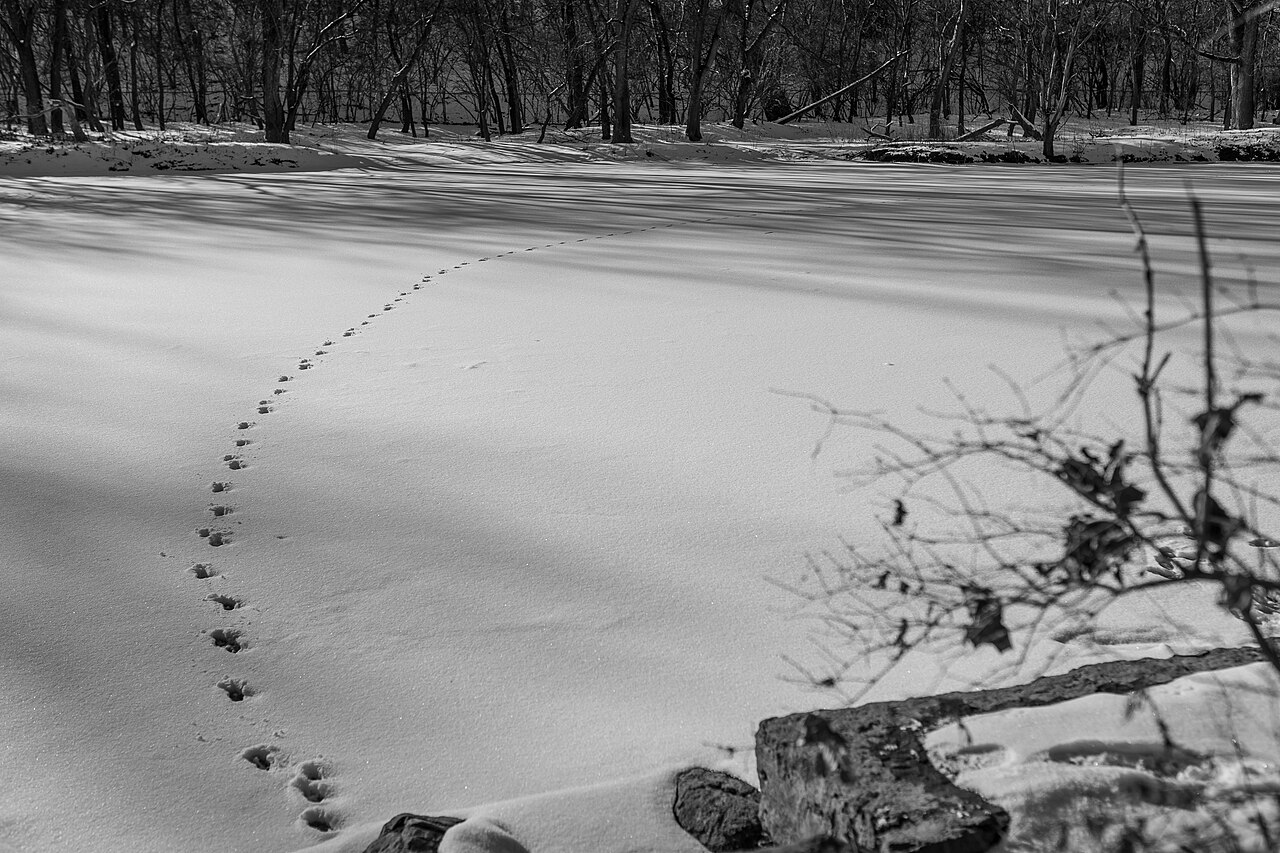
A rat track shows four toes on the front foot, print 0.5 to 0.75 in (1.3 to 1.9 cm) wide, and five toes on the hind foot, print 0.75 to 1.25 in (1.9 to 3.2 cm) long, with claw marks usually visible. Prints appear in bounding groups of four with a 1.75 to 2.5 in (4.5 to 6.5 cm) trail width and a continuous tail drag.
| Feature | Norway rat | Roof rat | House mouse | Gray squirrel |
|---|---|---|---|---|
| Front toes | 4 | 4 | 4 | 4 |
| Hind toes | 5 | 5 | 5 | 5 |
| Hind print length | 0.75 to 1.25 in (1.9 to 3.2 cm) | 0.6 to 1 in (1.5 to 2.5 cm) | 0.3 to 0.5 in (0.8 to 1.3 cm) | 1.5 to 2.5 in (4 to 6.5 cm) |
| Trail width | 1.75 to 2.5 in (4.5 to 6.5 cm) | 1.5 to 2 in (4 to 5 cm) | 1 to 1.5 in (2.5 to 4 cm) | 3 to 4.5 in (8 to 11.5 cm) |
| Stride, bounding | 3 to 12 in (8 to 30 cm) | 3 to 12 in (8 to 30 cm) | 1.5 to 6 in (4 to 15 cm) | 8 to 30 in (20 to 76 cm) |
| Tail drag | Usually present | Often present | Often present | Rare |
| Route | Along walls and edges | Along pipes and branches | Along walls | Tree to tree, open ground |
What Rat Tracks Look Like: Toes, Claws and Size
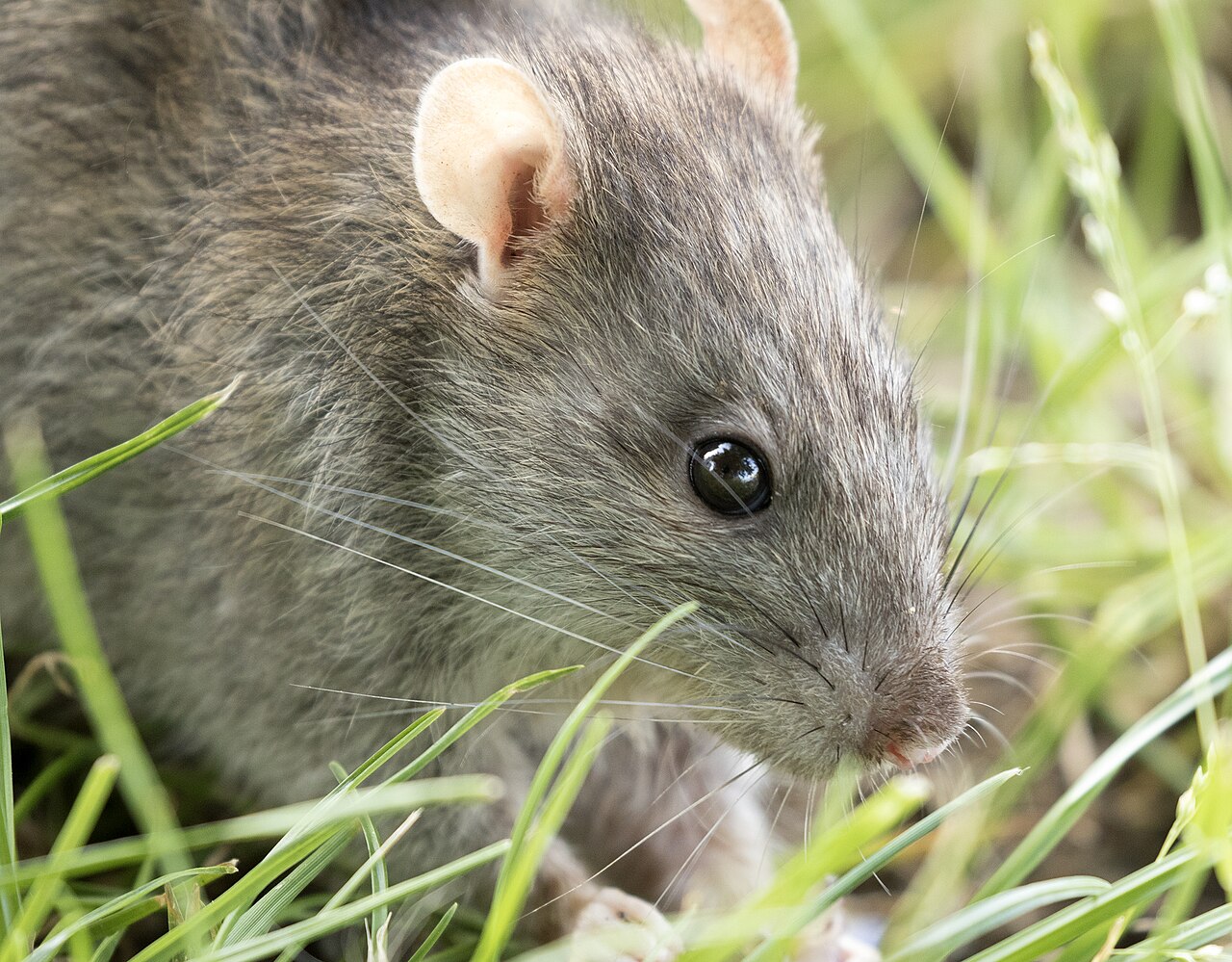
Count the toes first. A rat’s front foot registers four toes spread in a star around a small palm pad, because the inner digit is reduced and does not print. The hind foot registers five toes, is distinctly longer than wide, and shows a narrow heel that often fails to print on hard surfaces. Claws appear as fine pinpricks just beyond each toe tip in snow and soft mud.
Size does the species work. A Norway rat hind print runs 0.75 to 1.25 in (1.9 to 3.2 cm) long, front print 0.5 to 0.75 in (1.3 to 1.9 cm) wide. Roof rats (Rattus rattus) are 10 to 20 percent smaller in every measurement, and because they climb, their prints turn up on beams, pipe tops and flat roofs rather than at ground level.
Rat Tracks in Snow
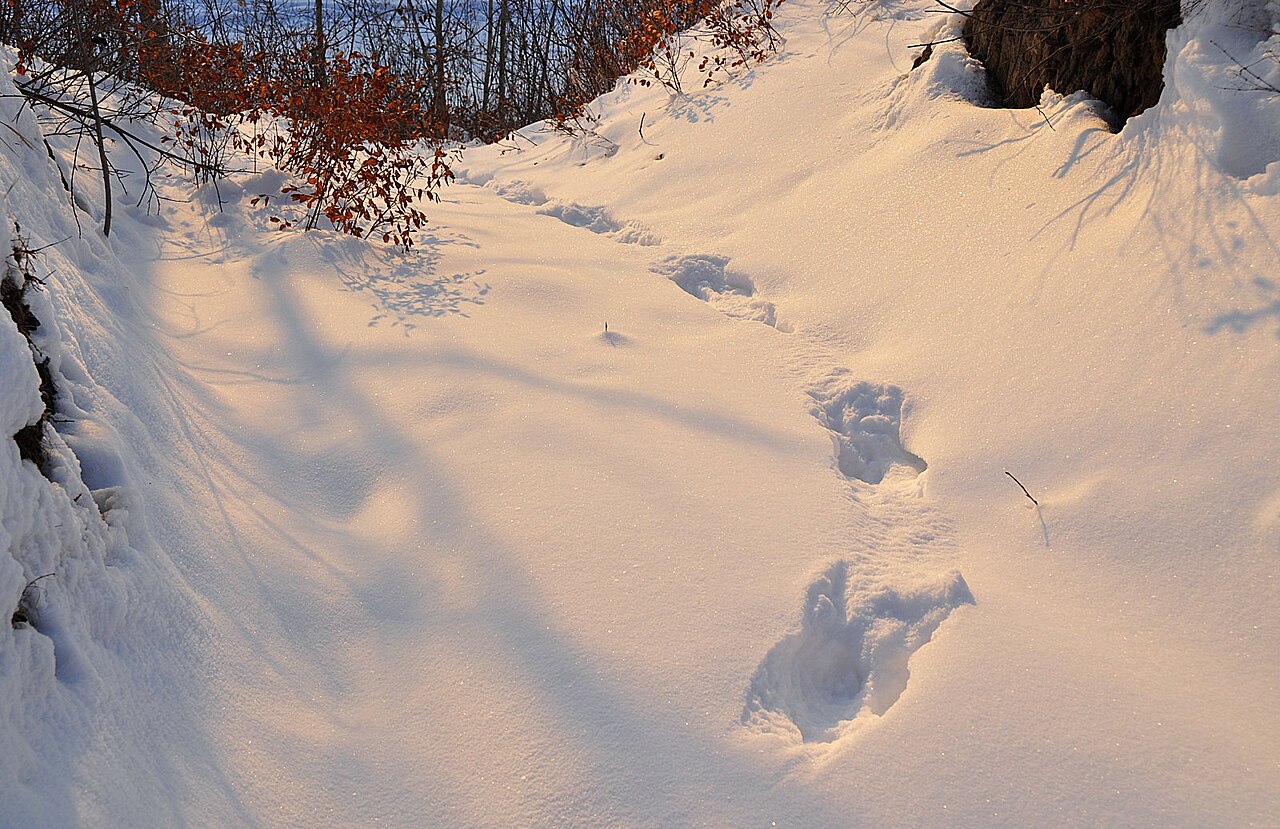
Snow is the ideal substrate, and the best window is the morning after an overnight dusting of 0.5 to 1 in (1.3 to 2.5 cm) on frozen ground. Deeper powder collapses around the foot and erases toes, leaving only holes. In that thin layer you get toe pads, claw points, the heel of the hind foot and a crisp tail line, all in one trail.
Rats in snow behave predictably. They follow the cleared edge of a path, the base of a foundation wall, the gap under a deck, or the lee side of a woodpile, and they rarely cross more than 3 to 10 ft (0.9 to 3 m) of open snow at once. Trails that run arrow straight across a lawn are almost never rats. Look instead for a worn groove between two points of shelter, often with the snow pressed down to a trench by repeated use.
Rats stay active through winter, so tracks appear on nights well below freezing. For the neat paired prints of a climber in the same yard, see squirrel tracks in snow.
Rat Tracks in Mud
Mud records the best detail of all when it is at the tacky stage, firm enough to hold an edge and wet enough to deform. Drainage ditches, the margins of a pond, the bare strip beside a dumpster and the mud under an outdoor tap are the productive spots. Here the vestigial inner digit on the front foot sometimes prints as a faint dot, and the palm pads separate cleanly.
Rat Tracks in Sand and Dust
Dry sand will not hold toes. What it keeps is the overall shape and the trail pattern, so in sand you identify a rat by cluster size, trail width and tail drag rather than by anatomy. Beach access paths, sandy crawl spaces and the dry soil of a greenhouse all work this way.
Dust is the version that matters indoors, and it can be made deliberately. A light dusting of unscented talc or plain flour laid 0.1 in (2.5 mm) deep across a suspected runway, in a strip 12 in (30 cm) long, prints every rodent that crosses it overnight. This is the standard tracking patch method used by pest professionals and it answers two questions at once: whether the runway is active, and how big the animal is.
Tail Drag: The Mark That Confirms a Rat
A Norway rat’s tail is 6 to 8 in (15 to 20 cm) long and heavy enough to touch down on most surfaces. In snow and dust it leaves a continuous thin line, sometimes wavering from side to side, running between the print groups. No native North American rodent of comparable size leaves that line as consistently.
Two cautions apply. A rat moving fast can carry its tail clear, so an absent drag does not rule a rat out. And mice drag their tails too, on a narrower trail, which is why the tail line confirms the family rather than the species. Pair the trail with droppings for certainty: rat droppings are blunt ended capsules 0.5 to 0.75 in (1.3 to 1.9 cm) long, and the comparison with mouse droppings takes a few seconds.
Stride, Gait and Trail Width
Rats bound. The hind feet land ahead of or beside the front feet, producing groups of four prints with a clear gap before the next group, and that group pattern is the first thing to look for at a distance. Stride between groups runs 3 to 12 in (8 to 30 cm) depending on speed, compressing to a shuffling walk along a wall and stretching when the animal is crossing exposed ground.
Trail width is more reliable because it does not change with speed. Measure across the outside edges of the widest group: a Norway rat gives 1.75 to 2.5 in (4.5 to 6.5 cm). Under 1.5 in (4 cm) is a mouse or vole, over 3 in (8 cm) a squirrel or larger.
Rat Tracks vs Mouse Tracks
Mouse trails look like rat trails at one third scale. What mice trails look like in practice: print groups about 1 to 1.5 in (2.5 to 4 cm) wide, hind prints 0.3 to 0.5 in (0.8 to 1.3 cm) long, stride 1.5 to 6 in (4 to 15 cm), and a fine tail line. Both species show four front toes and five hind toes, so toe count never separates them.
Behavior adds a second check. Mice stay within 10 to 30 ft (3 to 9 m) of the nest and tangle their trails into a small area, while rats range 50 to 150 ft (15 to 45 m) in purposeful runs. If you hear them too, mouse sounds and what each one means settle it.
Rat Tracks vs Squirrel Tracks
Squirrels register their front feet side by side, as a matched pair, and the hind feet land together behind or outside them, giving a square cluster 3 to 4.5 in (8 to 11.5 cm) wide. Front prints look like small hands with long, splayed fingers, longer and narrower than a rat’s. There is usually no tail drag.
The route is diagnostic. Squirrel trails cross open snow without hesitation and end at a tree trunk, where the tracks stop dead. Rat trails run along edges and end at a hole, a gap under siding or a drain. A trail that vanishes at a 2 in (5 cm) opening in a foundation is a rat; one that vanishes at a bark covered trunk is not.
Rat Tracks vs Vole and Rabbit Tracks
Voles leave the smallest trails of the three, roughly 1 to 1.5 in (2.5 to 4 cm) wide, and they travel in surface runways: shallow troughs pressed through grass and snow, often roofed over, with short connecting tunnels. Where a rat crosses a lawn on top of the snow, a vole prefers to stay under it, and the giveaway in spring is a maze of chewed grass channels.
Rabbits are not a real confusion once seen, but they get reported as large rodents. Rabbit tracks show two long hind prints landing ahead of two offset front prints, with trail widths of 4 to 5 in (10 to 13 cm) and no toe detail because the feet are furred. For the predators working the same snow, coyote tracks and bobcat tracks are the two canid and feline patterns worth learning alongside rodent sign.
Where to Look for Tracks Around a House
Work the edges. The most productive strips are the first 6 in (15 cm) beside a foundation, the gap behind a garbage enclosure, the route between a compost bin and the nearest cover, the mud beneath a crawl space vent, and the top of a boundary fence for roof rats. Rats are creatures of habit and reuse the same runway nightly, which is what makes a tracking patch so effective.
Read the other sign in the same places: greasy brown smears where fur rubs timber, 0.5 in (1.3 cm) gnaw marks with parallel tooth grooves, and burrow entrances 2 to 4 in (5 to 10 cm) across. The U.S. Fish and Wildlife Service publishes snow tracking guides for the larger species sharing the same ground.
How Many Rats the Tracks Indicate
Tracks alone cannot count animals, but trail density gives a usable estimate. A single clean trail with one route in and out suggests one or two animals passing through. Three or more distinct routes converging on one entry point, overlapping print groups of different sizes, and a runway worn to bare ground indicate an established group, which for Norway rats typically means a colony sharing a burrow system.
Juvenile prints mixed with adult prints are the real warning, because they mean breeding on site: a female produces four to six litters a year of six to twelve young. Tracking patches at three or four points for two nights map the routes well enough to place traps where the animals already travel.
Frequently Asked Questions
Can rats survive in the cold?
Yes. Norway rats do not hibernate and stay active all winter, which is why their tracks appear in fresh snow. They cope by moving into buildings, sewers and burrow systems below the frost line, and by nesting communally. Cold drives them closer to people rather than reducing numbers.
What is a rat’s biggest enemy?
Owls take more rats than any other wild predator in North America, with barn owls and great horned owls leading. Foxes, coyotes, snakes, hawks and domestic cats all take rats too, though cats are better at killing mice. No predator controls an urban rat population on its own.
What animal keeps rats away?
None reliably. Resident barn owls, foxes and snakes reduce pressure in rural settings, and a working farm cat suppresses new arrivals. In towns, food availability sets the population, so removing bins, pet food and fallen fruit does more than any animal.
What kills rats quickly?
Correctly set snap traps are the fastest humane method and they kill in under a second. Place them in an active runway, perpendicular to the wall, baited with peanut butter or bacon. Anticoagulant poisons take several days and carry a real risk of poisoning pets and the owls that hunt the rats.
What US city has the worst rat problem?
New York, Chicago and Los Angeles trade the top spot in annual pest control rankings, with Chicago named most frequently in the last decade. Older sewer systems, dense restaurant blocks and alley waste collection are the shared drivers, not climate.
How old are tracks in snow?
Fresh prints have sharp edges, visible claw points and loose crystals inside. After a few hours of sun or wind the rims soften and the claw marks blur. A print with a glazed, refrozen surface is at least one night old, and one with a melted rim is older than the last warm spell.