Texas Rat Snake: Identification, Size, and Behavior
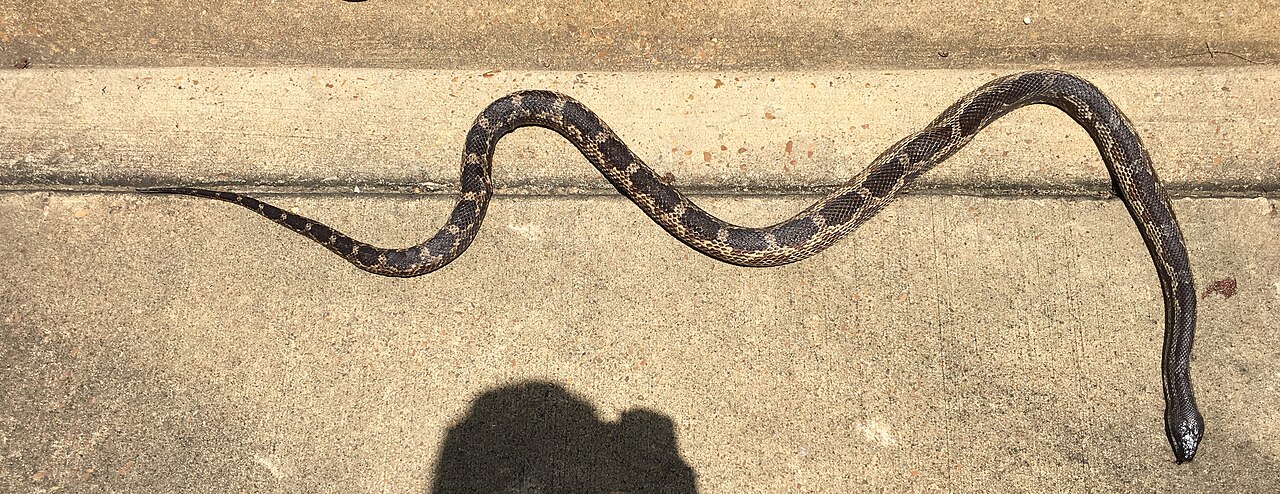
The Texas rat snake is a large, non-venomous constrictor found across most of Texas and into neighboring states, and it is one of the most frequently encountered snakes in the state. Adults typically reach 4 to 5 ft, with exceptional individuals passing 6 ft, and they are recognized by a blotchy pattern of dark brown or black markings over a tan to yellowish background, often with a gray head that contrasts with the body.
It is harmless to people, it kills rodents in large numbers, and it is the snake most often blamed for raiding chicken coops, which is where the common name chicken snake comes from. This guide covers identification, how to separate it from a copperhead or cottonmouth, the striking leucistic form, size and lifespan, behavior when cornered, what it eats, and how to handle one in your yard or attic.
| Quick Facts | Texas Rat Snake |
|---|---|
| Scientific name | Pantherophis obsoletus lindheimeri |
| Adult length | 4 to 5 ft, occasionally over 6 ft |
| Venomous | No, kills prey by constriction |
| Pattern | Dark blotches on tan to yellow, gray head |
| Diet | Rodents, birds, eggs, lizards, frogs |
| Lifespan | 10 to 15 years wild, over 20 in captivity |
How to Identify a Texas Rat Snake
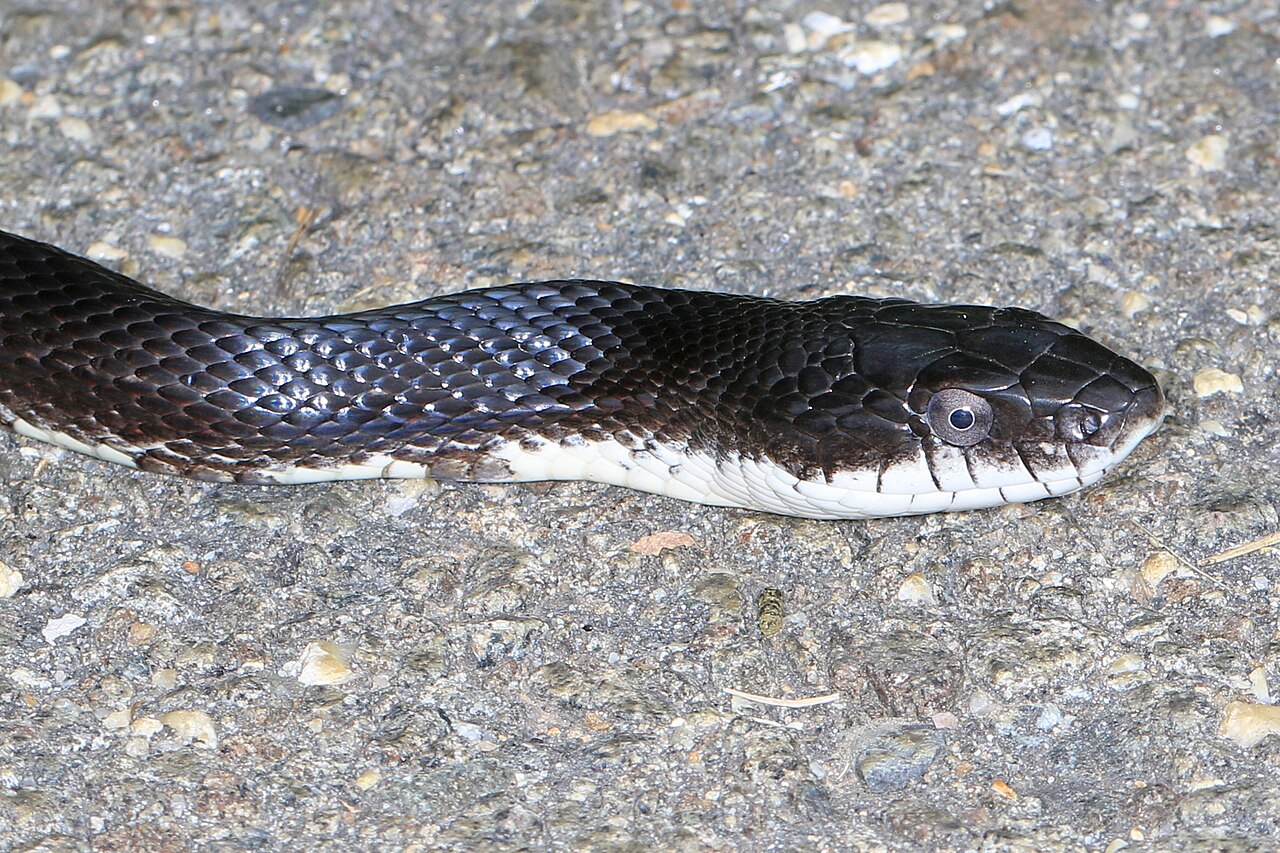
The Texas rat snake is a subspecies of the western rat snake, and its appearance is more variable than most field guides suggest. The typical adult carries irregular dark brown to black blotches down the back over a background that ranges from tan and yellowish to olive or gray, with the blotches becoming less distinct toward the tail. The head is often noticeably grayer than the body, a useful detail at a distance.
The body shape helps as much as the color. Rat snakes have a somewhat squared-off cross section rather than a rounded one, giving them a loaf-of-bread profile that becomes obvious once you know to look for it. The scales are weakly keeled, meaning each has a slight ridge, so the snake looks matte rather than glossy, and the belly is pale with a checkerboard of dark markings.
Regional variation is substantial. Snakes from east Texas tend to be darker, sometimes nearly black, while those from central and west Texas run lighter and yellower with sharper contrast. Juveniles look quite different from adults, with strong gray and brown blotching that leads people to mistake them for young rattlesnakes or copperheads. Our general guide to the rat snake covers the wider group across North America.
Is the Texas Rat Snake Venomous?
No. The Texas rat snake has no venom, no fangs, and no venom glands. It is a constrictor, meaning it seizes prey in its jaws and coils around the body, tightening with each exhalation until circulation stops. Nothing about that mechanism poses a danger to a person.
It will bite defensively if grabbed or cornered, and a large adult can produce a bite that draws blood, since the teeth are numerous and needle-like even though they are not fangs. The wound is a mechanical injury rather than an envenomation, and it should be washed thoroughly with soap and water and monitored for ordinary bacterial infection. Bites almost always come from handling attempts rather than from snakes approaching people.
The species is protected from the worst misconception by its own usefulness. A single adult rat snake removes a substantial number of rats and mice from a property each year, and killing one typically means more rodents, which in turn attracts venomous snakes that also hunt rodents. Texas Parks and Wildlife encourages leaving non-venomous snakes alone for exactly that reason.
Texas Rat Snake vs Copperhead and Cottonmouth
Misidentification as a copperhead is the most common and most consequential error. Copperheads carry distinct hourglass or Hershey’s Kiss shaped crossbands that are widest along the sides and pinch narrow across the spine, and the body color is a warm copper to pinkish tan. Rat snake blotches are irregular rectangles that are widest across the back, and the background is duller.
Head shape gets cited constantly and is less reliable than people think, because a frightened rat snake flattens its head into a broad triangle that mimics a viper convincingly. Better markers are the eyes and the facial pits. Copperheads and cottonmouths have vertical cat-like pupils and a heat-sensing pit between the eye and nostril, while rat snakes have round pupils and no pit. These are close-range features and should never be checked by approaching an unidentified snake.
Cottonmouths are heavier bodied, darker, usually near water, and they gape to show a white mouth lining when threatened. A rat snake in a tree or a barn is almost never a cottonmouth, since cottonmouths rarely climb. The safest rule for anyone unsure is distance, because every venomous snake in Texas will leave if given an exit, and identification can be done from a photograph afterward. Our guides to the hognose snake and the milk snake cover two more species that get killed regularly on mistaken identity.
The Leucistic Texas Rat Snake
The leucistic Texas rat snake is one of the most sought-after color forms in North American herpetoculture, and it accounts for a surprising share of search interest in the species. These animals are pure white or ivory with blue or dark eyes, and they occur in the wild rarely, arising from a recessive genetic condition that suppresses pigment deposition in the skin.
Leucism differs from albinism in a specific way. Albino animals lack melanin entirely and show pink or red eyes because blood vessels are visible through the unpigmented iris. Leucistic animals retain normal eye pigment while losing pigment in the body, which is why a leucistic rat snake looks like porcelain with dark eyes rather than a washed-out pink snake.
Wild leucistic individuals face real disadvantages, since a white snake on brown leaf litter is visible to every hawk and coyote in the area. Most of the ones people see are captive bred, and the line is well established in the pet trade. Albino and other color morphs including hypomelanistic forms also exist, and breeders have produced combinations of them.
Size, Growth, and Lifespan
Adults typically measure 4 to 5 ft, and the species is one of the larger snakes in Texas. Records exist above 6 ft, and animals in that range are usually old females in productive habitat. Hatchlings emerge at about 11 to 13 in and grow quickly on a rodent diet, reaching sexual maturity at around 2 to 3 years.
Growth is continuous but slows with age, and shedding frequency tracks it. A fast-growing juvenile may shed every 4 to 6 weeks while an adult sheds only two or three times a year. A snake preparing to shed develops cloudy blue-gray eyes for several days, becomes defensive because its vision is impaired, and is best left alone during that window.
Wild lifespan runs 10 to 15 years, limited by predation from hawks, owls, coyotes, and other snakes, plus vehicle strikes and human persecution. In captivity with consistent food and no predators, Texas rat snakes regularly pass 20 years, which is worth knowing for anyone considering one as a pet since it is a two-decade commitment.
Behavior: Why Texas Rat Snakes Seem Aggressive
Texas rat snakes have a reputation for being the most defensive of the rat snakes, and it is largely deserved. A cornered individual will coil, vibrate its tail rapidly against leaf litter to produce a rattling buzz, flatten its head, hiss loudly, and strike repeatedly. It is a convincing performance from an animal with no venom.
The tail vibration causes most of the trouble. Against dry leaves or grass it sounds enough like a rattlesnake that people react to it as one, and that reaction is often fatal for the snake. Several non-venomous species use the same bluff, and it works precisely because it is expensive to ignore.
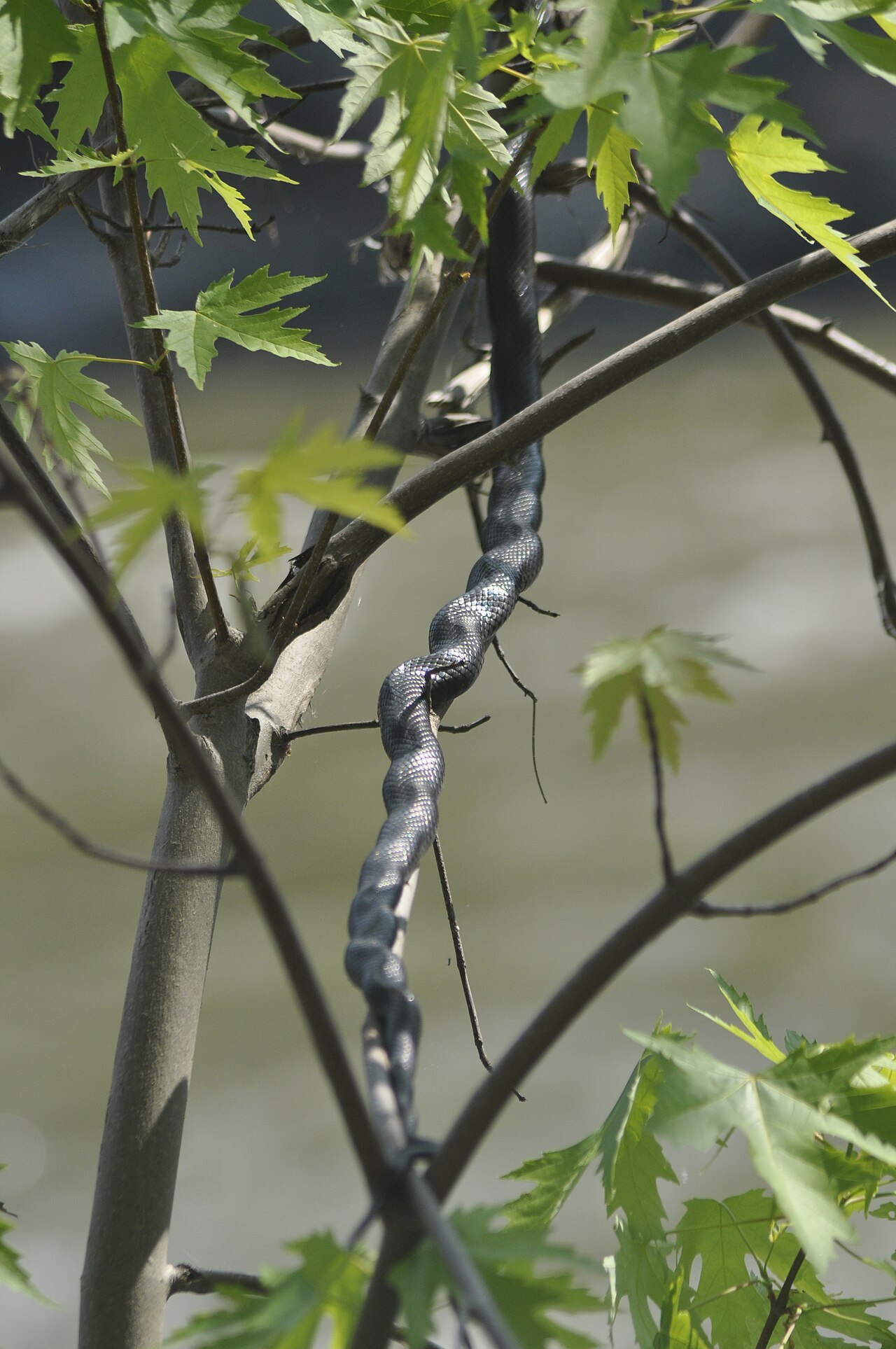
Given an escape route, the snake takes it every time. They are excellent climbers that ascend trees, brick walls, and downspouts in search of bird nests, and they are strong swimmers. Musking is the last resort, a foul-smelling discharge from glands near the vent that the snake smears on whatever is holding it, and it is far more effective at ending an encounter than the bite.
What Texas Rat Snakes Eat
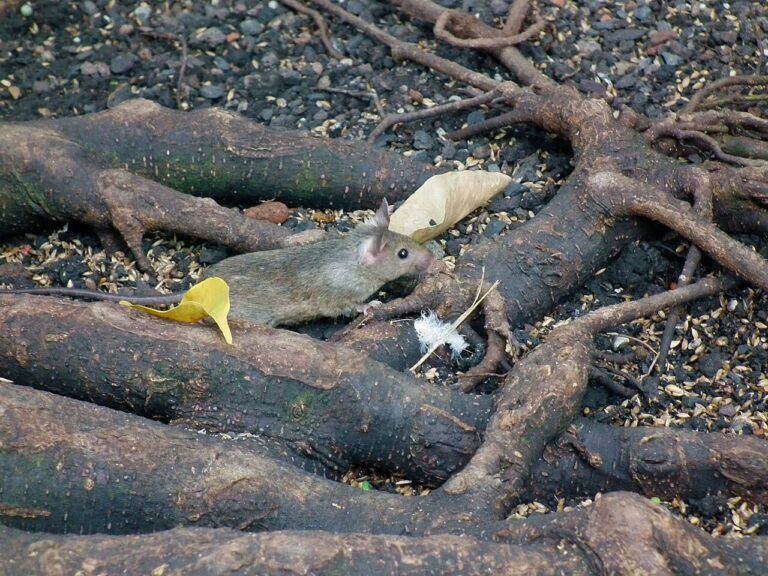
Rodents dominate the diet, which is where the name comes from. Rats, mice, voles, and young rabbits make up the bulk of what an adult eats, and a snake living in a barn or grain store can remove a remarkable number of them over a season. Prey is killed by constriction and swallowed whole, head first.
Birds and eggs are the second major category and the reason for the chicken snake nickname. Texas rat snakes climb readily to reach nests, and they will take eggs and nestlings from wild birds and from poultry coops with equal enthusiasm. A snake that finds a coop will return, which makes exclusion the only durable solution.
Juveniles start on smaller prey. Hatchlings and young snakes eat lizards, small frogs, and baby mice before graduating to full-size rodents as they grow. This shift matters for anyone keeping one, since a hatchling will not take an adult mouse. The rodents at the base of that food chain are covered in our guide to what mice eat.
Texas Rat Snakes in Chicken Coops and Attics
A rat snake in a coop is a predictable problem with a mechanical fix. Cover every opening larger than about 0.25 in with hardware cloth rather than chicken wire, which snakes pass through easily, and pay attention to gaps at the roofline, around vents, and where wire meets framing. Collect eggs daily so there is nothing to find.
Attics and wall voids attract them for the same reason houses attract rodents. A snake in an attic is following mice, and removing the snake without addressing the rodents simply creates a vacancy. Seal entry points at the roofline, trim tree branches back from the house, and deal with the rodent population, and the snake will move on.
If you need to remove one, contact a wildlife removal service or your local extension office rather than handling it yourself. Snake repellents sold in garden centers have repeatedly failed independent testing, and glue traps cause prolonged suffering and frequently catch non-target animals. Removing shelter is what actually works: clear brush piles, stack firewood off the ground and away from the house, mow tall grass, and eliminate the rodent food sources that started the chain. Where a snake has been, its droppings often follow, and our guide to snake droppings explains how to recognize them.
Related reading: Hognose Snake Playing Dead.
Frequently Asked Questions
Is the Texas rat snake venomous?
No. It has no venom, no fangs, and no venom glands, and it kills prey by constriction. A defensive bite from a large adult can draw blood because the teeth are needle-like, but it is a mechanical wound that needs only cleaning and normal infection monitoring.
How big do Texas rat snakes get?
Most adults reach 4 to 5 ft, with exceptional individuals passing 6 ft. Hatchlings emerge at 11 to 13 in and grow quickly on rodents, reaching maturity at 2 to 3 years. Wild lifespan is 10 to 15 years, and over 20 years in captivity.
How do I tell a Texas rat snake from a copperhead?
Copperheads have hourglass crossbands that are widest along the sides and pinch narrow over the spine, plus vertical pupils and a heat-sensing facial pit. Rat snakes have irregular rectangular blotches widest across the back, round pupils, and no pit. Check from a distance or from a photograph, never up close.
What is a leucistic Texas rat snake?
A leucistic Texas rat snake is a recessive color form that is pure white or ivory with normal dark or blue eyes. It differs from an albino, which lacks melanin entirely and has pink or red eyes. Wild leucistic individuals are rare and highly visible to predators, so most seen are captive bred.
Why is it called a chicken snake?
Because it climbs into poultry coops to take eggs and young chicks. Texas rat snakes are excellent climbers and readily ascend trees, walls, and downspouts to reach bird nests. Hardware cloth over every opening larger than 0.25 in and daily egg collection stop the raids.
Do Texas rat snakes rattle their tails?
They vibrate their tails rapidly, and against dry leaves or grass the sound closely mimics a rattlesnake. It is a bluff used by several non-venomous species, along with head flattening, loud hissing, and repeated strikes. Given an escape route the snake will leave rather than fight.
Should I remove a rat snake from my property?
Generally no. A single adult removes large numbers of rats and mice, and killing one usually means more rodents and, in turn, more venomous snakes hunting them. If removal is necessary, call a wildlife removal service or your extension office rather than using repellents or glue traps, which do not work or cause needless suffering.