Milk Snake
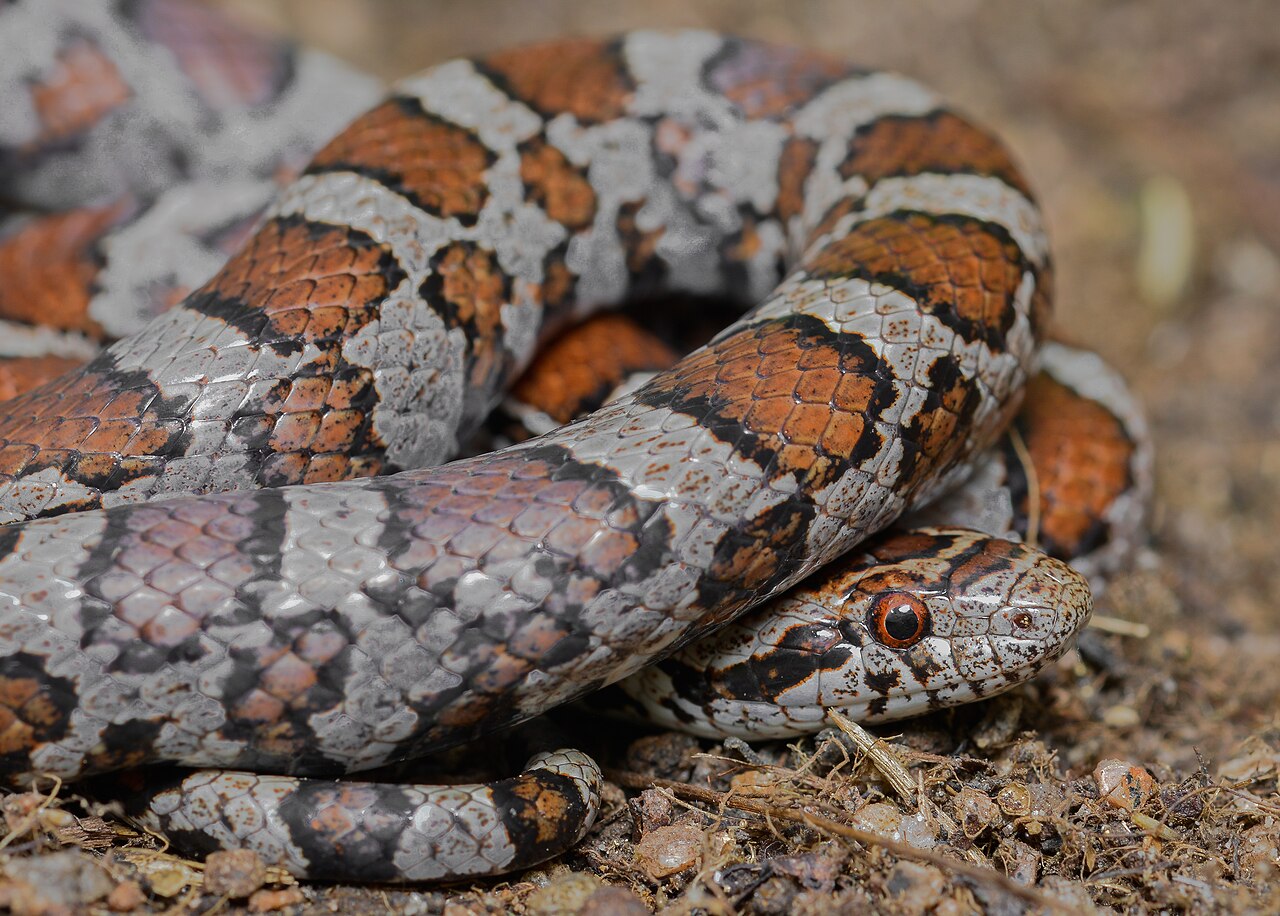
A milk snake is a harmless, non-venomous constrictor best known for its bold red, black, and white or yellow banding, a striking pattern that mimics the venomous coral snake closely enough to fool most predators. Scientifically known as Lampropeltis triangulum, it belongs to the kingsnake genus and is found across an enormous range stretching from southeastern Canada down through the United States, Mexico, and into Central and South America.
Despite the alarming coloring, a milk snake is completely safe to encounter, and its name has nothing to do with venom at all; it comes from a long-debunked old wives’ tale about the snake drinking milk from cows.
| Quick Reference | Detail |
|---|---|
| Scientific Name | Lampropeltis triangulum |
| Genus | Kingsnake (Lampropeltis) |
| Size | 2 to 5 feet, depending on subspecies |
| Coloring | Banded red, black, and white or yellow |
| Venom | None; completely non-venomous |
| Diet | Rodents, lizards, birds, eggs, and other snakes |
| Range | Southeastern Canada to South America |
What Is a Milk Snake?
The milk snake, Lampropeltis triangulum, is a member of the kingsnake genus, a group whose scientific name translates roughly to “shiny shield,” a fitting nod to their glossy, smooth scales. More than twenty recognized subspecies exist, each with its own regional color pattern, ranging from the boldly banded Honduran and Sinaloan milk snakes popular in the pet trade to the duller, saddle-patterned Eastern milk snake found across much of North America.
Most milk snakes show a pale Y- or V-shaped marking on the back of the neck along with a dark stripe running from each eye toward the jaw, subtle field marks that help confirm identification beyond the banded body pattern alone. Juveniles tend to show especially vivid, high-contrast coloring that gradually softens and widens as the snake matures into an adult, with the red bands typically becoming a bit duller and the black borders slightly less crisp by the time a snake reaches full size.
Adult length varies considerably by subspecies, from smaller regional forms that stay under three feet to the notably larger Honduran milk snake, which can reach four to five feet in exceptional cases, making overall size alone an unreliable way to guess which subspecies you might be looking at without also checking the color and banding pattern.
Milk Snake vs. Coral Snake: How to Tell Them Apart
The classic identification rhyme, “red touches black, friend of Jack; red touches yellow, kills a fellow,” refers to the order of colored bands and remains a genuinely useful starting point in parts of the country where both snakes occur, since a milk snake’s red bands border black, while a venomous coral snake’s red bands border yellow. This resemblance is a textbook example of Batesian mimicry, where a harmless species evolves to copy the warning coloration of a dangerous one, gaining protection without possessing any of the real risk.
Geography offers another useful clue: coral snakes have a fairly limited range in the southeastern United States, from North Carolina through Texas, with a separate population in the desert Southwest, while milk snakes range far more broadly across nearly the entire country and beyond. Outside of documented coral snake territory, a red-black-yellow banded snake is almost certainly a harmless mimic like the milk snake rather than the genuine venomous article, though the color rhyme itself can vary somewhat by subspecies and should never be treated as a substitute for knowing your local range.
Where Did the Name “Milk Snake” Come From?
According to the Smithsonian’s National Zoo, the name traces back to an old myth among farmers who found these snakes frequently in barns and wrongly concluded they were sneaking into stalls at night to drink milk directly from cows’ udders. In reality, milk snakes were drawn to barns for an entirely different, far more mundane reason: barns tend to be full of the rodents that make up a large share of an adult milk snake’s actual diet.
Snakes have no physical ability to suckle and, as strict carnivores, could not digest milk even if they somehow managed to consume it, which makes the old barn myth entirely biologically impossible. The name has stuck regardless, even though it describes a behavior the species has never actually shown.
Are Milk Snakes Dangerous to Humans?
Milk snakes are completely non-venomous and pose no real danger to people. A milk snake may bite defensively if it feels cornered and escape is not an option, but the bite typically does not even break the skin and requires nothing beyond basic cleaning similar to any minor scrape.
Regular, gentle handling tends to help a pet milk snake grow accustomed to people, reducing the odds of defensive biting over time, since most bites happen when a snake feels startled or trapped rather than out of genuine aggression. Wild milk snakes encountered outdoors are typically far more interested in escaping than confronting a person, and simply backing away calmly is usually all it takes to end the encounter without incident.
What Do Milk Snakes Eat?
Adult milk snakes are opportunistic carnivores whose diet leans heavily toward small mammals, particularly mice, rats, and voles, which explains why they are so often found near barns, sheds, and other rodent-friendly structures. They also regularly take lizards, especially skinks, along with birds, bird eggs, and reptile eggs when the opportunity arises, and will occasionally climb into low shrubs or trees specifically to raid a bird nest.
Notably, milk snakes are ophiophagous, meaning they actively hunt and eat other snakes, including venomous species such as small rattlesnakes and copperheads, a trait shared across the wider kingsnake genus and aided by a partial resistance to pit viper venom. Juvenile milk snakes start life on a very different menu, feeding mainly on slow-moving invertebrates like earthworms, slugs, and crickets before gradually shifting toward the vertebrate-heavy diet of an adult as they grow larger and more capable hunters, not unlike the size-driven diet shift a young rat snake goes through as it matures. This dietary flexibility across every life stage is a big part of why milk snakes have managed to thrive in such a wide range of habitats and climates.
How Milk Snakes Defend Themselves
Beyond their coral snake mimicry, milk snakes have a second layer of defensive bluffing: when threatened by a predator such as a fox or coyote, a milk snake will vibrate its tail rapidly against dry leaves or grass, producing a buzzing sound reminiscent of a rattlesnake’s warning rattle despite having no rattle of its own. If cornered further, it may also release a foul-smelling musk from its cloaca, a last-resort deterrent similar in spirit to the defensive tactics used by a hognose snake.
These bluffing behaviors work because so many predators have learned, through experience or instinct, to avoid animals that display the warning signs of a genuinely dangerous species, whether that warning sign is a rattling tail sound or a rattlesnake-adjacent color pattern.
Milk Snake Habitat and Range
Milk snakes occupy one of the broadest geographic ranges of any snake native to the Americas, found from southeastern Canada through virtually the entire continental United States and down through Mexico, Central America, and into parts of South America. Within that huge range, individual subspecies favor different habitats, from rocky hillsides and open woodlands to farmland, grassland, and even semi-desert terrain.
They are largely nocturnal or crepuscular, most active around dusk and after dark, and spend daylight hours hidden under logs, rocks, loose bark, or inside old rodent burrows and rocky crevices, sometimes turning up in the same kind of quiet, undisturbed spot favored by a blue-tailed skink. In cooler climates, milk snakes retreat to communal underground dens to survive the winter, sometimes denning alongside other snake species entirely, before emerging again as temperatures warm in spring.
Keeping a Milk Snake as a Pet
Milk snakes are one of the most popular pet snake choices for intermediate keepers, prized for their vivid coloring, manageable adult size of roughly two to five feet depending on subspecies, and generally docile temperament once accustomed to regular handling. Honduran and Pueblan milk snakes are two of the most commonly kept subspecies, valued for their especially bold, saturated banding.
Captive care is straightforward: milk snakes are typically fed appropriately sized, thawed frozen rodents rather than live prey, offered in the evening to match their naturally nocturnal feeding schedule. As close relatives of true kingsnakes, milk snakes retain a strong cannibalistic streak toward other snakes, including their own species, so like ball pythons and other solitary captive snakes, they should always be housed individually rather than in shared enclosures. A secure, well-ventilated enclosure with a temperature gradient, a hide box on both the warm and cool ends, and a shallow water dish covers the basics of a healthy setup, and with attentive care a pet milk snake can live well over a decade, a similar commitment to keeping a rattlesnake or any other long-lived captive reptile.
Related reading: Albino Corn Snake.
Related reading: Hognose Snake Playing Dead.
Frequently Asked Questions
Are milk snakes venomous?
No, milk snakes are completely non-venomous constrictors. Their bright banding mimics the venomous coral snake, but the milk snake itself poses no venom risk to people.
How can you tell a milk snake from a coral snake?
The classic rhyme “red touches black, friend of Jack; red touches yellow, kills a fellow” describes the band order, and geographic range also helps, since coral snakes occupy a much smaller area than the widespread milk snake.
Do milk snakes really drink milk from cows?
No, this is a debunked old myth. Milk snakes were simply drawn to barns by the abundant rodents living there, not by any interest in cow’s milk, which they cannot physically consume or digest.
What do milk snakes eat?
Adults primarily eat rodents, lizards, birds, and eggs, and are also known to eat other snakes, including venomous species. Juveniles start out eating small invertebrates like earthworms and slugs.
Are milk snakes good pets for beginners?
They are considered a solid intermediate choice, docile and manageable in size, though many hobbyists start with an even easier species before moving on to a milk snake.
Do milk snakes eat other snakes?
Yes, milk snakes are ophiophagous and will eat other snakes, including venomous species like small rattlesnakes, aided by a partial resistance to pit viper venom.
How big do milk snakes get?
Most milk snakes reach roughly two to five feet in length as adults, depending on the subspecies, with Honduran milk snakes running toward the larger end of that range and some smaller regional subspecies staying under three feet even as full-grown adults.