Spicebush Swallowtail Butterfly: ID and the Snake Caterpillar
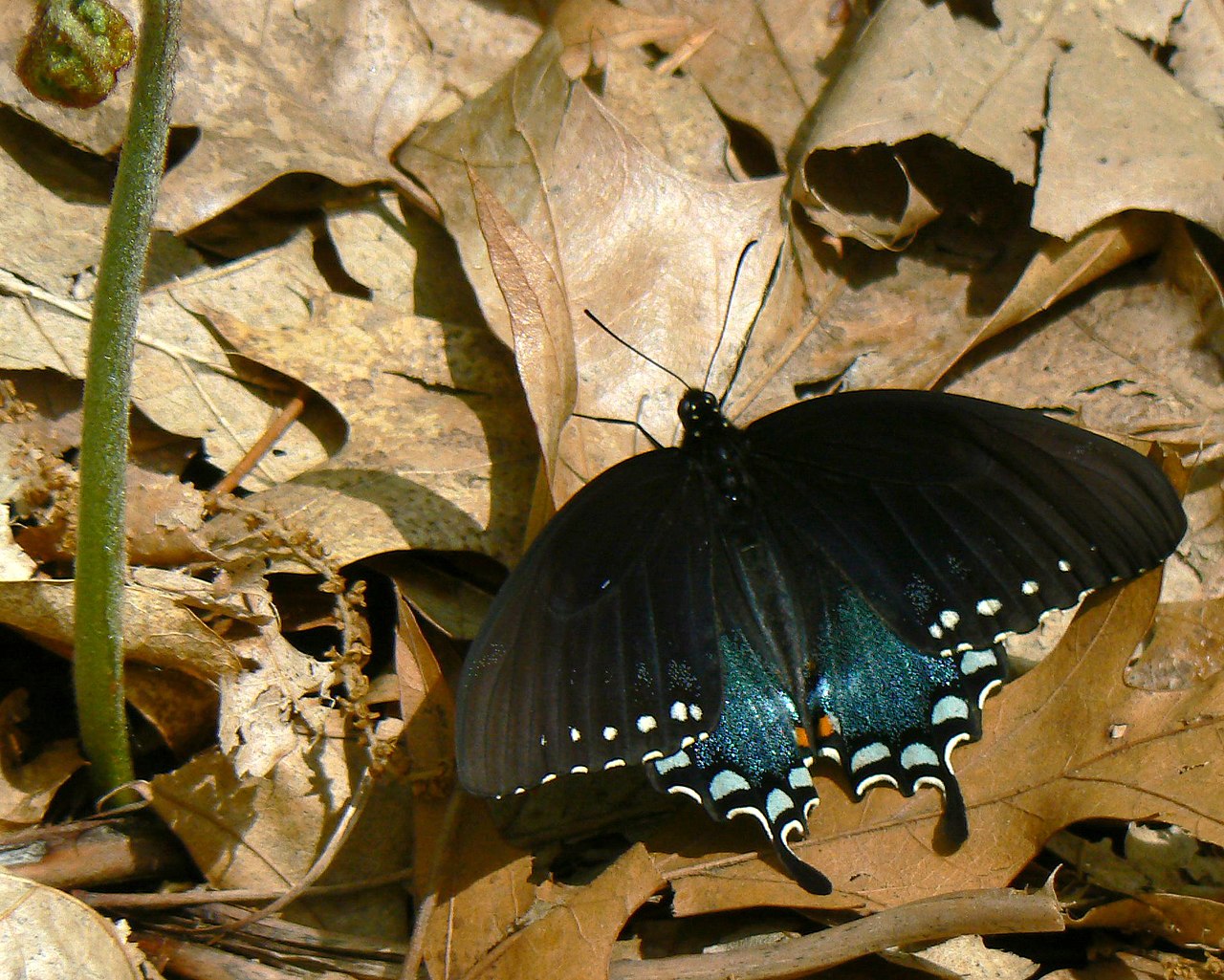
The spicebush swallowtail is a large black butterfly of the eastern United States with a broad blue-green sheen across the hindwings, a row of pale spots along the wing margins, and short tails. Males show a blue-green wash, females a deeper blue, and the underside carries two rows of orange spots on each hindwing with a gap in the inner row that separates it from every look-alike.
The caterpillar is the reason most people know the species. It is green with two enormous false eyespots on a swollen thorax, and it rests in a folded leaf shelter looking convincingly like a small snake, which is one of the most effective and best-studied cases of mimicry in North American insects. This guide covers identification, host plants, the caterpillar, mimicry, symbolism, and how to attract them.
The spicebush swallowtail is a large black butterfly with a blue-green hindwing sheen and pale marginal spots, found across the eastern United States. Caterpillars feed on spicebush and sassafras and mimic snakes with large false eyespots. The adults mimic the toxic pipevine swallowtail, which is why they are black rather than yellow.
| Feature | Spicebush Swallowtail |
|---|---|
| Scientific name | Papilio troilus |
| Wingspan | 3 to 4 in |
| Male | Blue-green hindwing sheen |
| Female | Deeper blue hindwing sheen |
| Host plants | Spicebush, sassafras, occasionally bay |
| Caterpillar | Green with large false eyespots |
| Overwinters | As a chrysalis |
What Does a Spicebush Swallowtail Look Like?
A large black butterfly, three to four inches across, with a broad sheen across the outer half of each hindwing and a row of cream or pale green crescents along the wing margins. Males carry a blue-green sheen; females a deeper, more purple-blue one, and the difference is visible in good light.
The underside is where identification is settled. Each hindwing carries two rows of orange spots, and in the inner row one spot is missing, leaving a distinct gap. That gap is the reliable field mark separating spicebush swallowtails from the black form of the tiger swallowtail and from the pipevine swallowtail.
Tails are short and spatulate rather than long and thin, and the body is black with pale spotting along the sides. Fresh individuals are strikingly iridescent; worn late-season ones lose most of the sheen and can be difficult. The swallowtail butterfly guide covers the family and the identification points across species.
What Is the Host Plant for Spicebush Swallowtails?
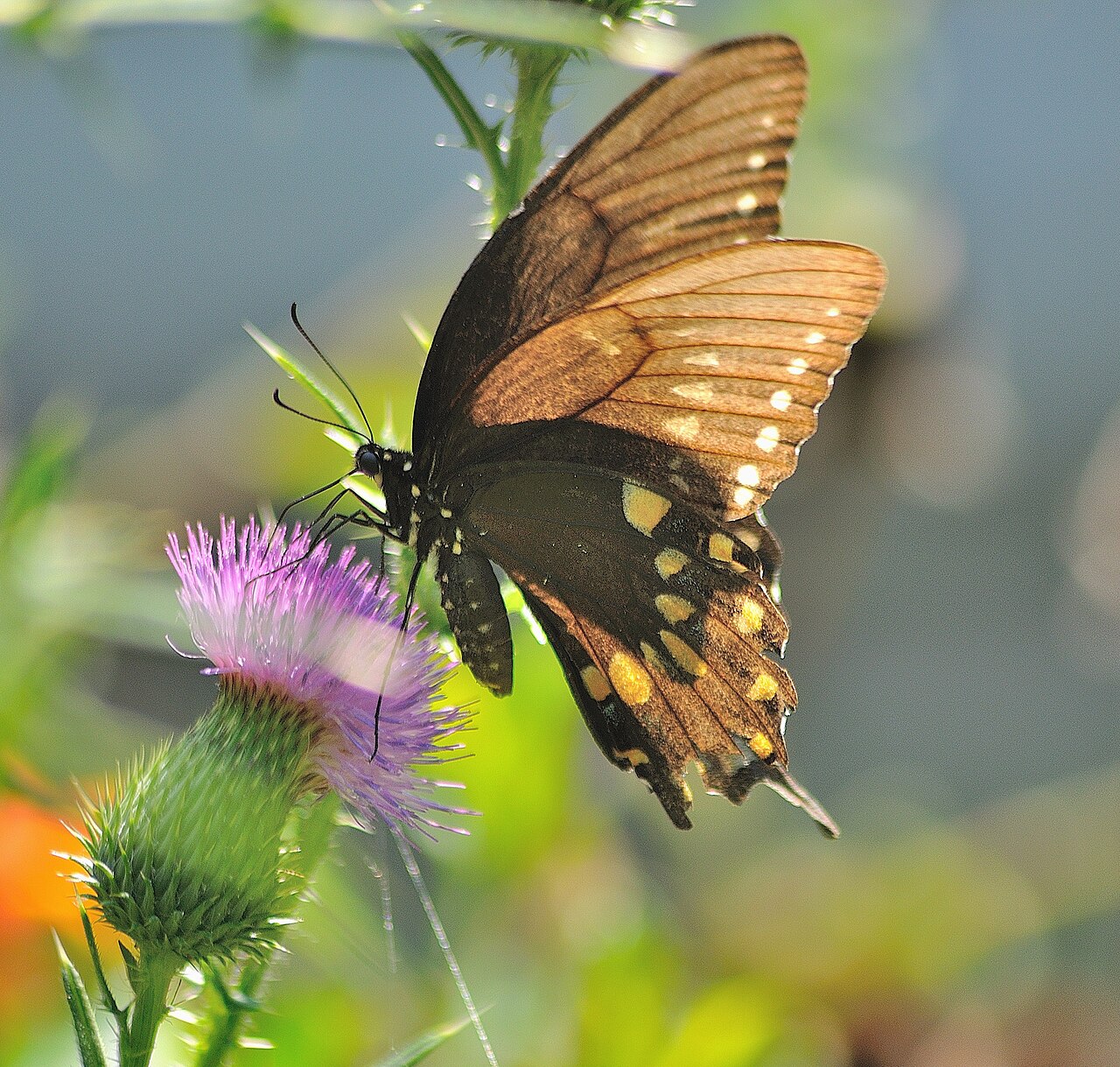
Spicebush and sassafras, both members of the laurel family, with spicebush the more important in most of the range and sassafras used heavily where it is common. Red bay, camphor tree, and a few other laurels are used occasionally in the south.
Females lay eggs singly on the underside of leaves, choosing young plants and fresh growth in partial shade at woodland edges rather than large mature shrubs in deep shade. Spicebush is an understorey shrub of moist woodland, and its distribution shapes where the butterfly occurs.
The relationship is tight enough that spicebush is worth planting specifically. It is an attractive native shrub with early yellow flowers, red autumn berries eaten by thrushes and catbirds, and good yellow autumn colour, and it supports the butterfly directly rather than only feeding adults. The zebra swallowtail guide covers another species tied to a single understorey tree.
What Does the Caterpillar Look Like?
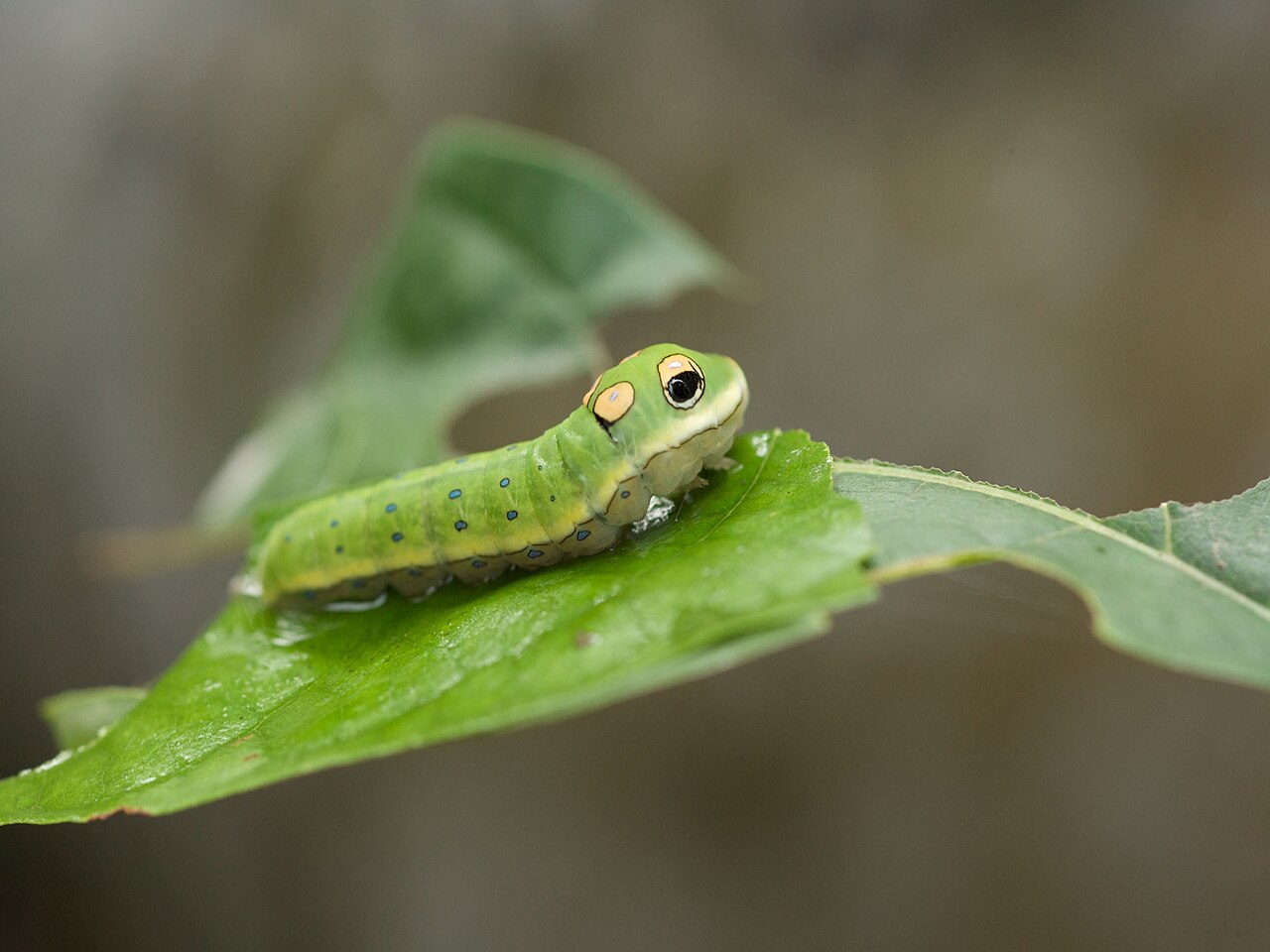
Like a small snake, and deliberately so. A late-instar spicebush swallowtail caterpillar is smooth and bright green with a swollen front end carrying two large black-and-yellow false eyespots complete with white highlights, plus a second smaller pair behind them. The effect at a glance is a reptile head.
The behaviour completes the illusion. The caterpillar folds a leaf over itself with silk and rests inside during the day, and when the shelter is opened the swollen thorax and eyespots face the intruder. Like all swallowtail larvae it can evert an osmeterium, a forked orange gland behind the head that looks like a flicking tongue and releases a sharp smell.
Earlier instars use a different disguise. Young caterpillars are brown and white and closely resemble a bird dropping, which works well at small size, and the switch to the snake mimic happens as they grow past the size where a dropping is plausible. Before pupation the caterpillar turns yellow or orange and leaves the plant. The black caterpillar guide covers other larvae found on the same plants.
Why Is the Adult Black?
Because it mimics the pipevine swallowtail, which is genuinely toxic. Pipevine swallowtail caterpillars feed on pipevine and store aristolochic acids, making both larvae and adults poisonous to birds, and the adult is black with an iridescent blue-green hindwing sheen.
The spicebush swallowtail is not toxic and gains protection purely by resemblance, which makes it a Batesian mimic. Several other species do the same thing: the black form of the female tiger swallowtail, the red-spotted purple, the female Diana fritillary, and the black swallowtail all converge on the same pattern, forming one of the best-documented mimicry complexes in North America.
The mimicry is geographically consistent with the model. Black-form female tiger swallowtails are common where pipevine swallowtails occur and scarce or absent where they do not, which is exactly what the theory predicts and is one of the standard textbook demonstrations of Batesian mimicry working in the wild. The black swallowtail guide covers another member of the complex.
Are Spicebush Swallowtails Rare?
No, but they are local and easy to miss. The species occurs across the eastern United States from southern New England and the Great Lakes to Florida and Texas, and it is common in woodland with spicebush or sassafras in the understorey. Where those plants are absent, so is the butterfly.
It is also less conspicuous than the yellow swallowtails. A dark butterfly moving through dappled woodland edge reads as a shadow, while a tiger swallowtail in the same place is visible at fifty yards, so spicebush swallowtails are consistently under-reported relative to their actual numbers.
Two to three broods run through the season, from April in the south and May further north into September, and the last generation overwinters as a chrysalis attached to a stem or leaf litter. Adults live about two weeks. Numbers vary between years with weather but the species is not of conservation concern.
What Attracts Spicebush Swallowtails?
Host plants first. Planting spicebush or sassafras is the difference between a butterfly passing through and a population breeding on the property, and spicebush in particular does well as an understorey shrub in partial shade with moist soil, which is a position most gardens have going spare.
For nectar, adults favour deep tubular flowers they can work while hovering: joe-pye weed, milkweed, thistle, honeysuckle, jewelweed, lantana, zinnia, and butterfly bush all draw them. They prefer larger flowers than the small blues and skippers use, and they tend to feed with wings fluttering rather than settling still.
Males puddle at damp ground, mud, and animal dung, sometimes in groups, so a damp patch or a shallow depression kept wet gives them somewhere to take minerals. Partial shade matters more than for most butterflies, since this is a woodland edge species rather than an open field one. The giant swallowtail guide covers a relative with entirely different habitat preferences.
What Does Seeing One Mean?
Spicebush swallowtails are read within general butterfly symbolism as transformation, renewal, and often as a message from someone who has died. The dark colouring adds readings about moving through a difficult period rather than about anything ominous, since dark butterflies are generally interpreted as endings and transitions rather than warnings.
There is no folklore specific to this species, and readings attached to it online are modern constructions built from general butterfly symbolism plus the colour. That is worth stating plainly rather than dressing up as tradition.
What a sighting reliably indicates is habitat: intact woodland edge with a laurel-family understorey and reasonable nectar nearby. As an ecological signal it is more informative than most butterflies, since the host plant requirement is narrow. The guide to a butterfly landing on you covers the wider symbolism.
What Is the Life Cycle?
Eggs hatch in about four to ten days, and the caterpillar passes through five instars over roughly three to four weeks, shifting from the bird-dropping disguise to the snake mimic partway through. Growth is fast in warm weather and slows markedly in the cooler ends of the season.
Pupation happens off the host plant. The mature caterpillar turns yellow or orange, leaves the shrub, and finds a stem, twig, or piece of debris where it attaches with a silk pad and a girdle around the middle, then forms a chrysalis coloured either green or brown depending on the surface it settled on. That colour matching is determined during the final larval stage.
The last generation of the year overwinters as a chrysalis, sometimes for six months or more, and emerges the following spring. This is why leaf litter and standing stems matter: a garden cleared bare in autumn removes the pupae along with the debris, and that loss is invisible because nobody is looking for a brown chrysalis on a stick.
How Do You Tell It From Similar Butterflies?
Check the underside hindwing spots. The spicebush swallowtail has two rows of orange spots with a gap in the inner row where one spot is missing. The pipevine swallowtail has a single row of large orange spots on a brilliant blue field. The black-form tiger swallowtail has a complete inner row with no gap, plus shadow stripes visible through the dark scaling.
Upper surface helps too. Spicebush swallowtails have a broad blue-green sheen filling much of the hindwing and pale green crescents along the margin; black swallowtails have two rows of yellow spots and a smaller blue patch confined to the middle of the hindwing.
Behaviour and habitat narrow it further. Spicebush swallowtails work woodland edges and shaded trails; black swallowtails prefer open fields, gardens, and roadsides; pipevine swallowtails flutter constantly even while feeding, which is distinctive once seen. Field guides from state extension programmes and university entomology departments such as the University of Florida (ufl.edu) publish regional keys to the complex.
Frequently Asked Questions
What does a spicebush swallowtail look like?
A large black butterfly three to four inches across with a blue-green hindwing sheen, pale crescents along the margins, and short spatulate tails. Females show a deeper blue than males.
What is the host plant for spicebush swallowtails?
Spicebush and sassafras, both laurel family, plus red bay and camphor in the south. Females lay singly on young leaves at woodland edges rather than on mature shrubs in deep shade.
Why does the caterpillar look like a snake?
It is snake mimicry. Late instars have a swollen thorax with large false eyespots and rest in folded leaf shelters, so an opened shelter presents what looks like a reptile head to a predator.
Why is the adult black instead of yellow?
It mimics the toxic pipevine swallowtail. The spicebush swallowtail is not poisonous itself and gains protection by resemblance, which makes it a Batesian mimic within a well-studied complex.
Are spicebush swallowtails rare?
No, but local. They are common where spicebush or sassafras grows in woodland understorey and absent where those plants are not, and being dark they are less noticed than yellow swallowtails.
What attracts spicebush swallowtails?
Spicebush or sassafras for breeding, deep tubular nectar flowers such as joe-pye weed, milkweed, and thistle for adults, and a damp patch where males can puddle for minerals.
How do you tell it from a black swallowtail?
Underside hindwing. Spicebush has two rows of orange spots with a gap in the inner row; black swallowtails have two rows of yellow spots above and a smaller blue patch on the hindwing.

Similar Posts
What Do Tadpoles Eat? Wild Diet and Feeding at Home
Tadpoles graze algae until their gut rebuilds itself into a carnivore’s. Here is what they eat at each stage and how to raise them without killing them.
Imperial Moth: ID, Caterpillar, and Underground Pupation
The imperial moth is a yellow giant that pupates underground instead of spinning a cocoon. Here is how to identify it and why it is vanishing up north.
Baby Otter: Development, Diet & What to Do
How river and sea otter pups develop, what they eat, and what to do if you encounter a baby otter alone.
Baby Snapping Turtle: Size, Diet, Care, and What to Do
Baby snapping turtles hatch at about an inch long and head straight for water. Here is how to identify one, what it eats, and what to do if you find one.
Gila Monster Bite: What Happens and What to Do
A Gila monster clamps and chews venom in, causing severe pain but almost never death. Here is the first aid, why bites are rare, and the diabetes drug link.
Baby Garter Snake: ID, Safety, and the Copperhead Test
A baby garter snake is 5 to 9 inches, harmless, and born live in litters of 10 to 40. Full identification, plus the one mark that separates it from a copperhead.