Monarch Caterpillar: ID, Milkweed, and the OE Problem
A monarch caterpillar is the striped yellow, black, and white larva found on milkweed, and milkweed is the only thing it can eat. Females lay exclusively on milkweed species, the caterpillars feed on nothing else, and the toxic compounds they absorb from those plants make both the larva and the adult butterfly poisonous to predators.
Getting to that meal requires solving a problem first. Milkweed defends itself with pressurized latex that can glue a caterpillar’s mouthparts shut, and monarch larvae respond by cutting a trench across the leaf to drain the flow before feeding inside it. This guide covers identification, the five growth stages, the latex-cutting behavior, the parasite that threatens monarch populations, and the tropical milkweed problem that well-intentioned gardeners created.
| Quick Facts | Monarch Caterpillar |
|---|---|
| Appearance | Yellow, black, and white bands, paired tentacles |
| Host plant | Milkweed species only |
| Growth stages | Five instars over 9 to 14 days |
| Final size | About 2 in |
| Growth in mass | Roughly 2,000 times from hatching |
| Toxic to predators | Yes, from milkweed cardenolides |
How to Identify a Monarch Caterpillar
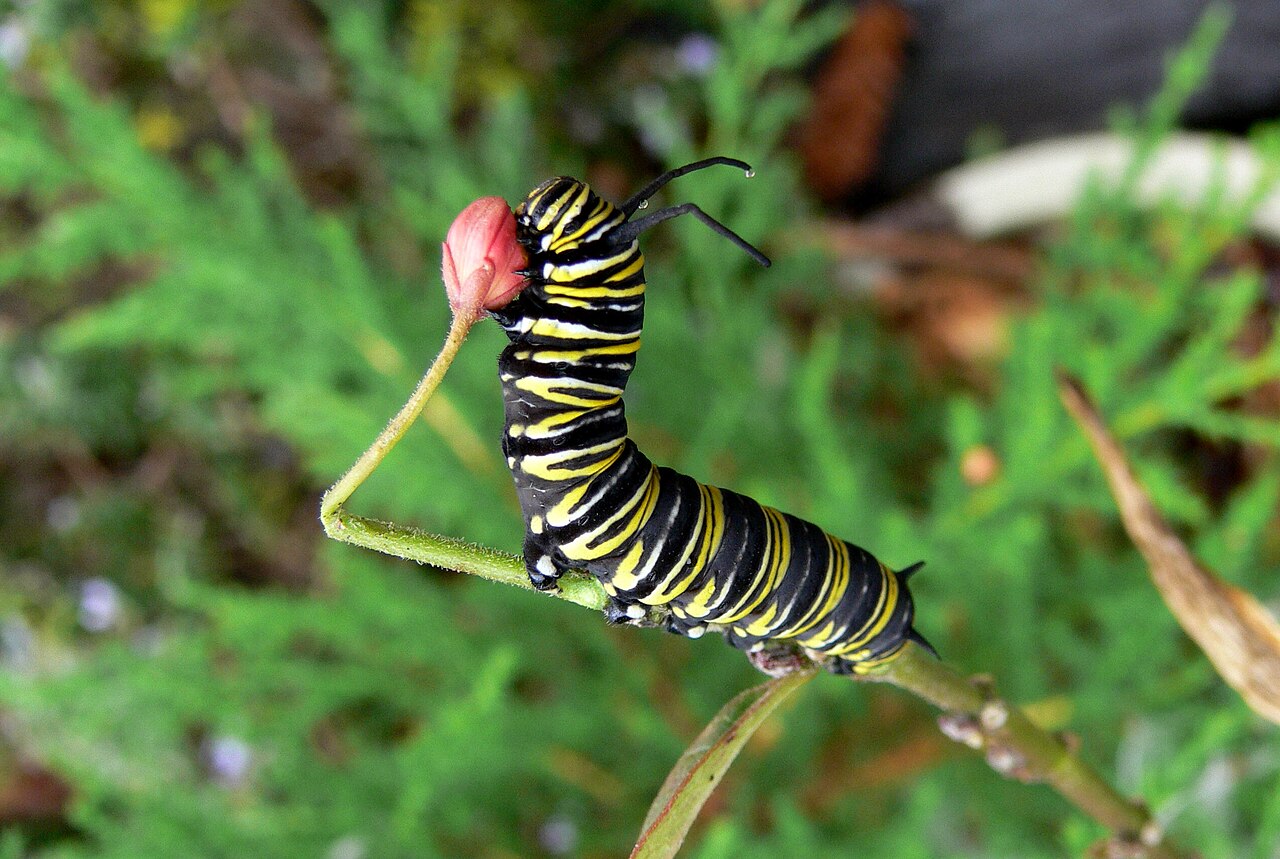
The banding is distinctive. Monarch larvae carry repeating bands of yellow, black, and white running around the body, giving a striped appearance quite unlike the blotched or hairy caterpillars people more often find.
The tentacles cause the most confusion. A monarch caterpillar has two pairs of black fleshy filaments, one pair behind the head and a shorter pair near the rear, and these are not antennae, stingers, or sensory organs in any meaningful sense. They wave when the caterpillar is disturbed and probably serve to startle predators and parasitic flies.
Two lookalikes exist and both feed on the same plants. Queen butterfly caterpillars have three pairs of filaments rather than two, and milkweed tussock moth caterpillars are hairy with tufts of black, orange, and white, looking nothing like a monarch once seen side by side. Our guides to the black caterpillar and the fuzzy caterpillar cover the wider identification problem.
Milkweed and Nothing Else
Monarchs are host plant specialists in the strictest sense. Females lay eggs only on milkweed in the genus Asclepias and closely related plants, and caterpillars die if placed on anything else, which is why milkweed availability rather than nectar availability determines monarch populations.
Around 100 milkweed species occur in North America and monarchs use many of them. Common milkweed, swamp milkweed, butterfly weed, showy milkweed, and whorled milkweed are among the most widely used, and different species dominate in different regions.
The specialization cuts both ways. It gives monarchs access to a plant most herbivores cannot touch, and it makes the entire species dependent on one plant genus, so the loss of milkweed from agricultural landscapes through herbicide-tolerant cropping is widely regarded as a principal driver of monarch decline. Nectar plants support adults, but only milkweed produces the next generation, a distinction our guide to the orange butterfly covers for the adult stage.
Cutting the Latex Trench
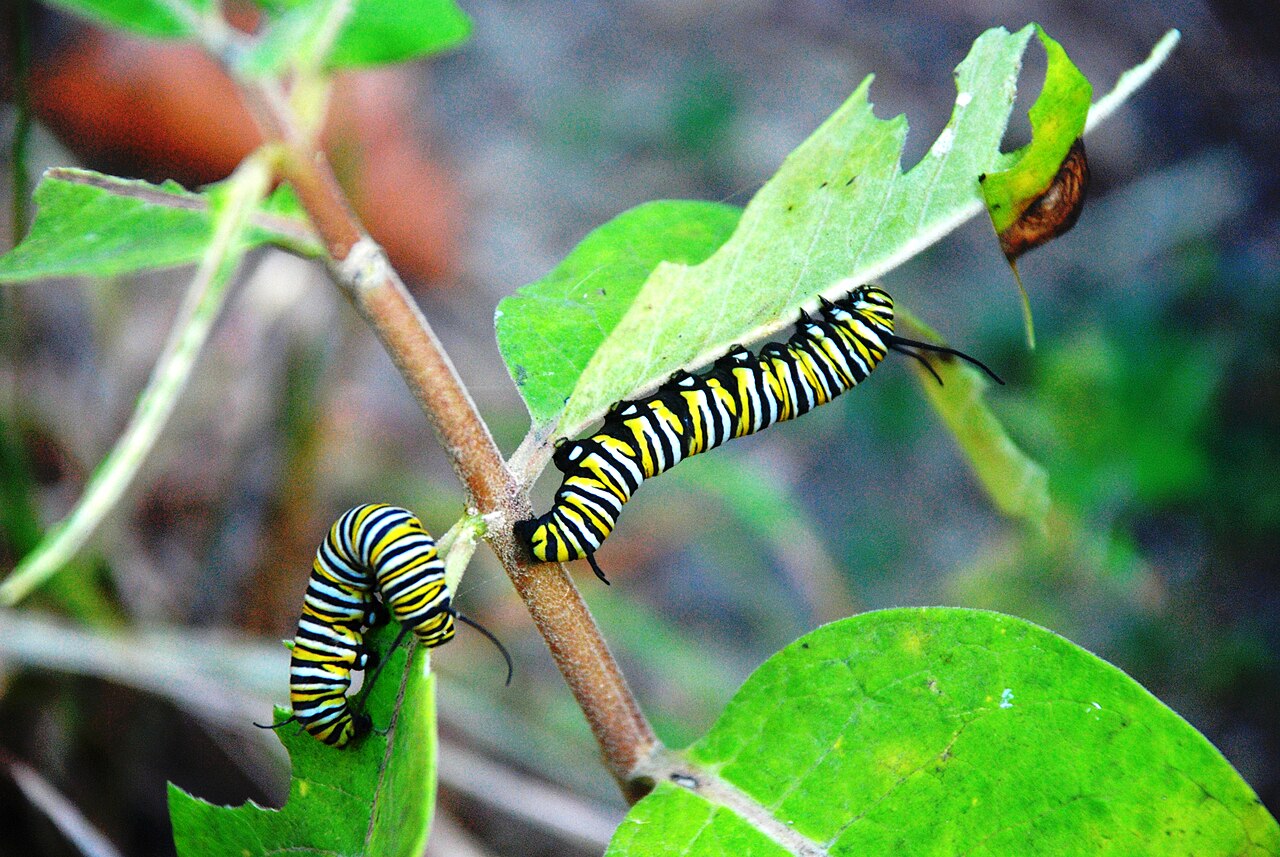
Milkweed is not a passive food source. The plant contains a network of pressurized canals filled with sticky white latex, and when a leaf is damaged the latex floods out, which can glue a small caterpillar’s mouthparts shut and kill it outright.
Monarch caterpillars defeat this with behavior rather than physiology. A larva chews a shallow trench or a semicircular cut across the leaf, severing the latex canals upstream, then waits while the latex drains and pressure drops before feeding on the isolated area beyond the cut.
Very young caterpillars use a smaller version of the same trick, chewing a tiny circle and feeding within it. The behavior is instinctive rather than learned, and it is one of the clearest examples of a herbivore evolving a behavioral answer to a plant’s chemical defense. Latex mortality remains significant despite it, and first instar larvae are the most vulnerable.
The Five Instars
Development runs through five stages separated by molts, and the whole larval period lasts only 9 to 14 days in warm conditions. The caterpillar grows roughly 2,000 times in mass across that span, one of the fastest growth rates of any insect larva.
The first instar is pale and translucent with a dark head, barely 0.08 in, and the banding is faint. By the second and third instars the yellow, black, and white pattern is clear and the tentacles are developing, and the caterpillar begins eating whole sections of leaf rather than just surface tissue.
Fourth and fifth instars do most of the eating. A fifth instar reaches about 2 in and consumes an enormous quantity of milkweed, often stripping a plant, and it is at this stage that most people notice them. Each molt leaves a shed skin that the caterpillar frequently eats, recovering the protein, and the head capsule is left behind as a small dark pellet.
What Comes Next
When fully fed, the fifth instar wanders away from the host plant, sometimes considerable distances, seeking a sheltered spot to pupate. This wandering phase is why caterpillars turn up on fences, walls, and furniture well away from any milkweed.
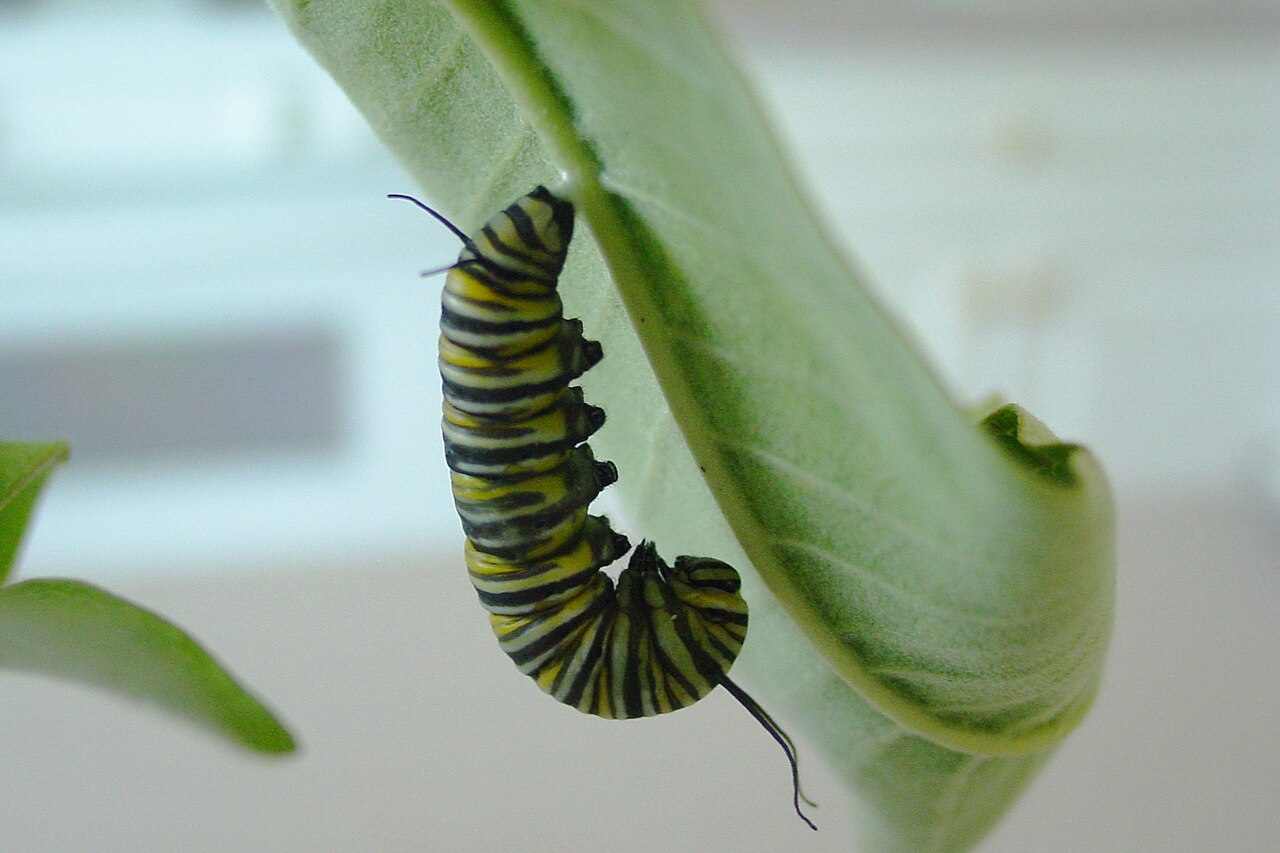
It then spins a silk pad, attaches by a structure called a cremaster, and hangs in a J shape for around 12 to 24 hours before the final molt reveals the chrysalis. The monarch chrysalis is jade green with a line of metallic gold dots, and it is among the most striking pupae in North America.
Metamorphosis takes 8 to 15 days depending on temperature. The chrysalis turns transparent in the final day, revealing the orange and black wings folded inside, and the adult emerges, expands its wings over a few hours, and flies. Late-season individuals enter reproductive diapause and become the migratory generation that flies to Mexico and lives eight months rather than a few weeks.
Toxins and Why Predators Avoid Them
Milkweed contains cardenolides, cardiac glycoside compounds that interfere with the sodium-potassium pump in animal cells and are genuinely toxic to vertebrates. Monarch caterpillars sequester these compounds in their tissues rather than excreting them.
The chemistry carries through metamorphosis, so the adult butterfly remains toxic, and the bright warning coloration of both stages advertises it. A bird that eats a monarch typically vomits and learns to avoid the pattern, which is the selective pressure behind the viceroy butterfly’s resemblance to it.
Monarchs are not immune by accident. They carry mutations in the sodium-potassium pump that make it resistant to cardenolide binding, and researchers have since introduced the same mutations into fruit flies and rendered them resistant to milkweed toxins as well. It is a well-documented case of a specific molecular adaptation enabling an entire ecological strategy. Handling caterpillars poses no risk to people, though washing hands afterward is sensible.
The OE Parasite
Ophryocystis elektroscirrha, usually shortened to OE, is a protozoan parasite specific to monarchs and queens, and it is a serious and growing problem. Spores on an adult butterfly’s body fall onto milkweed leaves as she lays, the caterpillar eats them, and the parasite multiplies inside it.
Heavily infected individuals often fail to emerge from the chrysalis, emerge deformed with crumpled wings, or emerge apparently normal but weakened, with reduced flight ability and shortened lifespan. Infected migratory monarchs are substantially less likely to complete the journey to Mexico, which itself acts as a filter that historically kept infection rates low in migratory populations.
Infection rates have risen sharply in some regions, and the leading explanation connects directly to garden practice. Where monarchs stop migrating and breed continuously in one place, spores accumulate on plants that never die back, and each generation infects the next more heavily than the last.
The Tropical Milkweed Problem
Tropical milkweed (Asclepias curassavica) is widely sold, easy to grow, and flowers spectacularly, and planting it in the southern United States has turned out to cause harm despite entirely good intentions.
The issue is that it does not die back. Native milkweeds senesce in autumn, breaking the OE cycle and signaling monarchs to migrate, while tropical milkweed persists through mild winters, so spores build up on the same leaves year after year and monarchs receive no cue to move on. Populations that stop migrating and breed continuously show dramatically higher OE infection rates.
The recommendation from monarch researchers is straightforward. Plant milkweed species native to your region wherever possible, and if you already grow tropical milkweed in a mild climate, cut it back hard to a few inches each autumn and again periodically through winter to mimic natural dieback. That single practice removes most of the harm.
Should You Raise Monarch Caterpillars?
This has become a genuinely contested question and the answer has shifted. Small-scale rearing of a few caterpillars remains a valuable educational experience, but the mass rearing that became popular through the 2010s is now viewed more critically by researchers.
Several concerns drive that. Crowded indoor rearing spreads OE and other pathogens efficiently, captive-reared monarchs have shown reduced flight and navigation ability in some studies, rearing removes the natural selection that would eliminate weak individuals, and commercially purchased monarchs can spread disease and inappropriate genetics between regions.
Current guidance from monarch conservation organizations, including the Xerces Society for Invertebrate Conservation, generally suggests rearing no more than about ten individuals per year, using locally collected eggs rather than purchased stock, keeping containers scrupulously clean, and releasing where collected. The larger contribution is habitat: planting native milkweed and nectar plants, avoiding pesticides entirely, and leaving stems and leaf litter over winter helps far more monarchs than any rearing project. Our guides to the green butterfly and the hummingbird moth describe the same host-plant-first approach for other species.
Frequently Asked Questions
What does a monarch caterpillar look like?
Banded in yellow, black, and white with two pairs of black fleshy tentacles, one behind the head and a shorter pair near the rear. It reaches about 2 in in the final instar. Queen caterpillars look similar but have three pairs of tentacles.
What do monarch caterpillars eat?
Milkweed and nothing else. Females lay only on Asclepias species and closely related plants, and caterpillars placed on any other plant will die. Around 100 milkweed species occur in North America and monarchs use many of them.
Why do monarch caterpillars cut the leaf before eating?
To drain the pressurized latex that milkweed releases when damaged, which can glue a small caterpillar’s mouthparts shut. The larva chews a trench severing the latex canals, waits for pressure to drop, then feeds beyond the cut. The behavior is instinctive.
Are monarch caterpillars poisonous to touch?
Not to people. They store cardenolide toxins from milkweed that make them poisonous to birds and other predators, and the toxicity carries into the adult butterfly, but handling poses no risk. Washing hands afterward is sensible.
How long does a monarch caterpillar take to pupate?
Nine to fourteen days through five instars in warm conditions, growing roughly 2,000 times in mass. It then wanders to find a pupation site, hangs in a J shape for 12 to 24 hours, and forms a jade green chrysalis, emerging as an adult 8 to 15 days later.
What is OE and why does it matter?
Ophryocystis elektroscirrha is a protozoan parasite specific to monarchs. Spores from adults fall on milkweed, caterpillars eat them, and heavily infected butterflies fail to emerge, emerge deformed, or fly poorly. Infection rates rise where monarchs breed continuously instead of migrating.
Should I plant tropical milkweed?
Not in mild southern climates, where it fails to die back, accumulates OE spores, and disrupts migration cues. Plant regionally native milkweed instead. If you already have tropical milkweed, cut it back hard each autumn and periodically through winter to mimic natural dieback.