Baby Gopher Snake: ID and the Rattlesnake Bluff
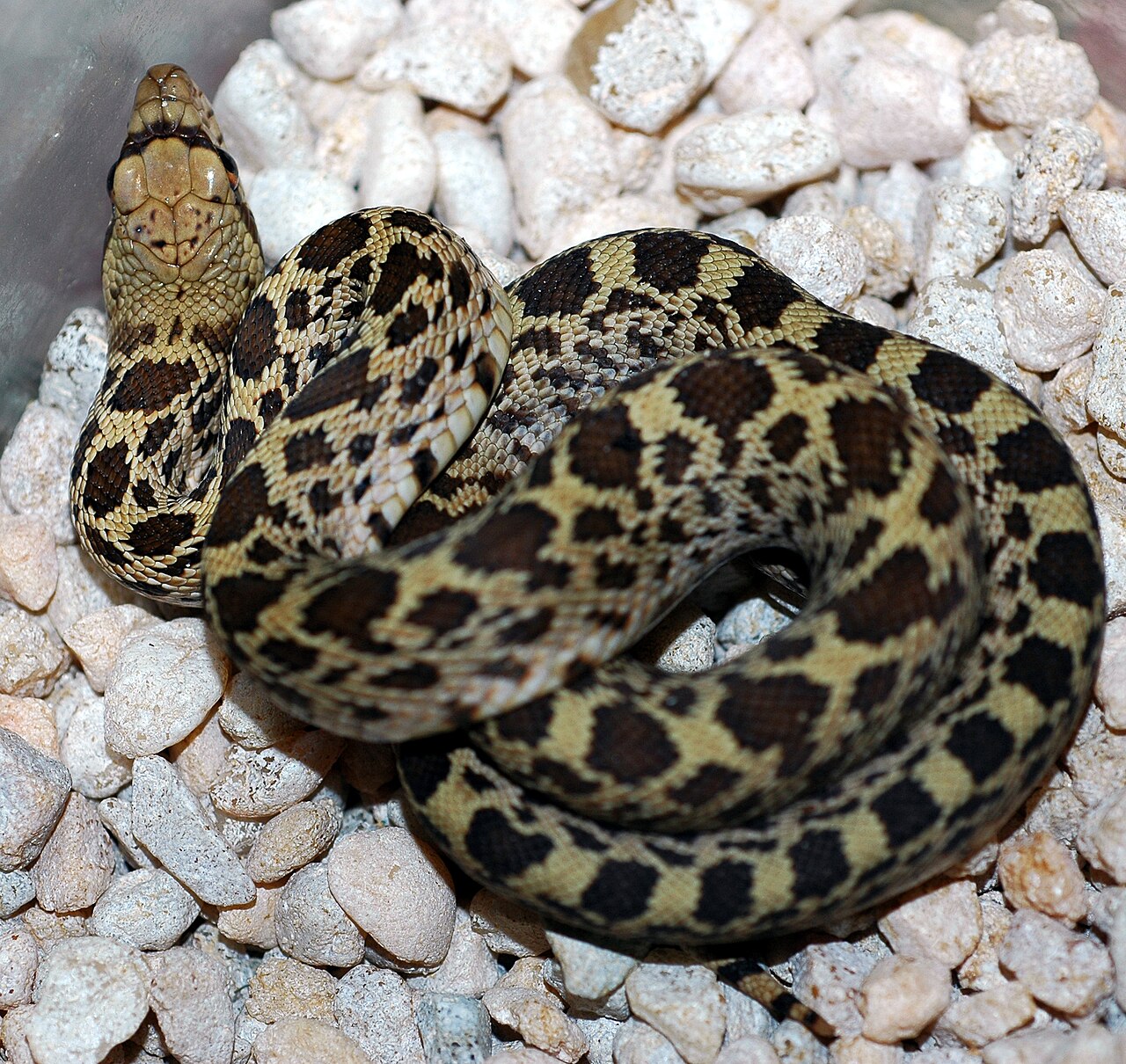
A baby gopher snake is a harmless, non-venomous hatchling about eight to eighteen inches long, patterned with dark brown or black blotches on a cream, tan, or yellowish body, with a narrow head barely wider than the neck and round pupils. It looks like a miniature adult from the moment it hatches, and it will hiss loudly, flatten its head into a triangle, and vibrate its tail if cornered.
That display is why baby gopher snakes are killed by mistake more often than almost any other North American snake. The behaviour is a deliberate rattlesnake impression, and it works well enough on people that a harmless snake ends up dead in a yard that would have benefited from having it. This guide covers identification, the differences from a baby rattlesnake, what to do if you find one, and why the species is worth keeping around.
A baby gopher snake is a non-venomous hatchling 8 to 18 inches long with dark blotches on a tan or cream body, a narrow head, and round pupils. It hisses, flattens its head, and vibrates its tail to mimic a rattlesnake, but it has no rattle, no facial pits, and a pointed rather than blunt tail tip.
| Feature | Baby Gopher Snake |
|---|---|
| Length at hatching | 8 to 18 in |
| Pattern | Dark blotches on cream, tan, or yellow |
| Head | Narrow, barely wider than neck |
| Pupils | Round |
| Tail | Pointed, no rattle or button |
| Venom | None; harmless to people |
| Hatching season | August to October |
What Does a Newborn Gopher Snake Look Like?
Hatchlings emerge at eight to eighteen inches, depending on subspecies and clutch, and are slender with proportionally large eyes. The ground colour ranges from cream and pale yellow to tan or light brown, overlaid with a row of squarish dark brown, reddish, or black blotches down the back and smaller blotches along the sides.
Pattern is often more contrasty in hatchlings than in adults, so a young gopher snake can look brighter and more boldly marked than the dusty adult it becomes. A dark line usually runs from the eye to the angle of the jaw, and the belly is cream or yellowish with dark spots along the edges.
The head is the key structure. It is narrow, elongated, and barely distinct from the neck, with a pointed snout and a slightly enlarged rostral scale used for burrowing. Round pupils, a narrow head, and a tapering pointed tail together rule out every pit viper in North America. The baby rat snake guide covers a similar-looking harmless hatchling from the eastern states.
How Do You Tell a Baby Gopher Snake From a Baby Rattlesnake?
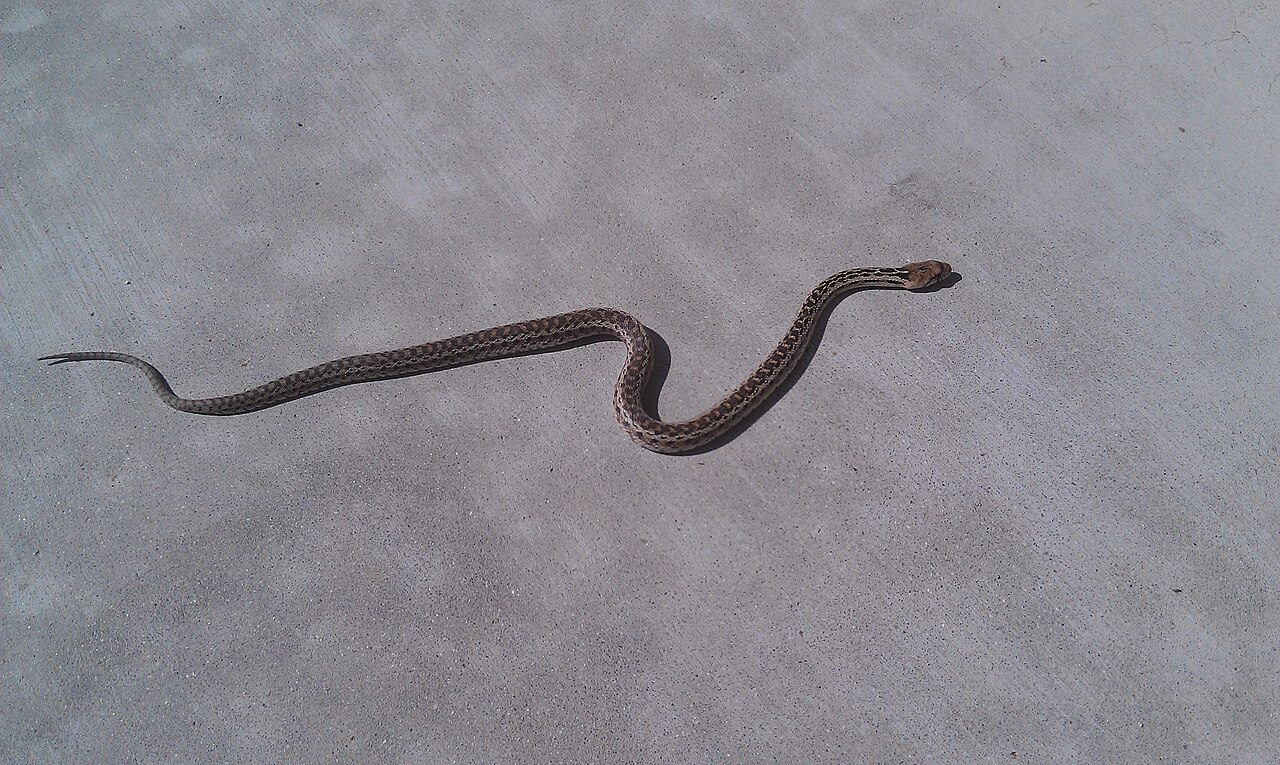
Look at the tail first, because it is the most reliable difference. A baby gopher snake has a smooth, pointed tail that tapers to a fine tip. A baby rattlesnake is born with a single hard segment called a button, a blunt rounded knob at the tail tip that produces no sound until further segments are added at each shed.
Head shape and eyes confirm it. Rattlesnakes have a broad triangular head clearly wider than the neck, vertical slit pupils like a cat’s, and a heat-sensing pit between the eye and the nostril. Gopher snakes have a narrow head, round pupils, and no pit. The head-flattening display makes a gopher snake’s head look triangular, which is exactly its purpose, but the neck stays thick rather than pinched.
Behaviour is a supporting clue rather than a diagnostic one. A gopher snake usually flees first and displays only when cornered, and its tail vibration against dry leaves produces a buzzing that sounds convincingly like a rattle. If you cannot see the tail and head clearly, treat any snake as venomous and leave it alone. The baby rattlesnake guide covers what the real thing looks like.
Are Baby Gopher Snakes Poisonous?
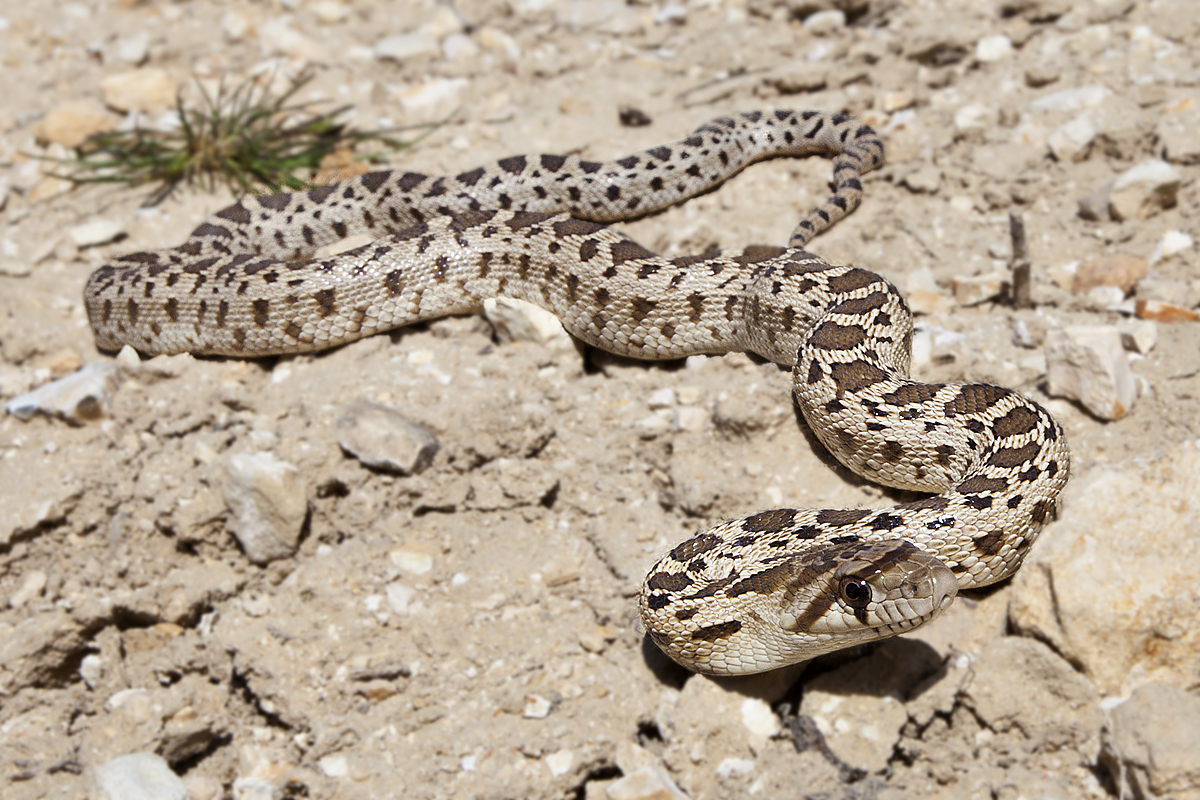
No. Gopher snakes are non-venomous at every age, and the widespread belief that baby snakes are more dangerous than adults because they cannot control their venom is false for venomous species and irrelevant here, since gopher snakes have no venom at all.
They are also not poisonous in the strict sense, which means toxic to eat or touch. Neither the snake nor its skin, saliva, or droppings carry anything harmful beyond the general risk of Salmonella that applies to all reptiles, which is managed by washing hands after handling.
A bite from a gopher snake is possible if the animal is grabbed or restrained, and it produces a set of shallow scratches that bleed a little and need cleaning. Gopher snakes are constrictors, killing prey by coiling, and their teeth are small and recurved for gripping rather than cutting. The baby snake guide covers general identification for hatchlings.
What Should You Do if You Find One?
Leave it alone and let it move on. A baby gopher snake in a yard, garage, or garden bed is hunting rodents and is doing exactly what you would want it to do. Most hatchlings found in late summer and autumn are simply dispersing from the nest and will not stay.
If it needs to be moved, the safest method is a broom and a bucket or a trash can laid on its side, sweeping the snake gently in and releasing it in cover a short distance away rather than transporting it far. Relocating a snake more than a few hundred yards significantly reduces its survival, since it loses access to known shelter and hunting ground.
Do not use glue traps. Snakes caught in them die slowly, and a snake stuck to a board is far harder to deal with than one moving freely. If a snake is already stuck, vegetable oil poured on the adhesive releases it. If identification is uncertain, photograph from a distance and ask a state wildlife agency or a local herpetological society rather than guessing.
Why Do Gopher Snakes Mimic Rattlesnakes?
Because it works. A gopher snake that is cornered draws its body into an S-coil, inflates its lungs and hisses loudly through a modified structure in the windpipe called an epiglottal keel, flattens its head into a triangle by spreading the jaw muscles, and vibrates its tail rapidly against leaf litter or gravel.
The hiss is genuinely loud, louder than in most snakes, and the epiglottal keel that produces it is an anatomical specialisation found in Pituophis and few other genera. Together with the head flattening and tail buzz, the effect is convincing to a coyote, a hawk, or a person, and the display costs the snake nothing but a few seconds of bluff.
This is Batesian mimicry, a harmless species imitating a dangerous one, and it is common among snakes: milk snakes copy coral snake colouring, hognose snakes flatten their necks like cobras. The unfortunate consequence for gopher snakes in human-dominated landscapes is that the display invites the response a rattlesnake would get. The baby hognose snake guide covers a different bluffing strategy.
Is It Good to Have Gopher Snakes in Your Yard?
Yes, and the case is straightforward. Gopher snakes are among the most effective rodent predators in western North America, eating pocket gophers, ground squirrels, voles, mice, and rats, and they pursue prey into burrows where cats and most other predators cannot follow. The name reflects the diet accurately.
They also displace rattlesnakes to some extent, competing for the same shelter sites and prey and occasionally eating smaller snakes. A property with a resident gopher snake is not automatically rattlesnake-free, but the two are in direct competition, and removing gopher snakes leaves more room rather than less.
Rodent control by other means often kills them indirectly. Anticoagulant rodenticides move up the food chain into snakes, hawks, owls, and foxes, and a snake that eats poisoned rodents dies with them. Removing food, water, and shelter for rodents and letting predators work is both cheaper and more durable. The guide to birds that eat mice covers the other half of that predator community.
Where Do Baby Gopher Snakes Come From?
Gopher snakes lay eggs rather than giving live birth, which separates them from rattlesnakes and garter snakes. Females deposit two to twenty-four eggs in early summer in loose soil, rodent burrows, rotting logs, or under rocks, and offer no parental care afterwards.
Incubation takes about 65 to 80 days, so hatching runs from August into October across most of the range. That timing is why late summer produces a sudden wave of small snakes in yards and on roads, and it is the period when most people encounter one for the first time.
Hatchlings are independent immediately, hunting small lizards, nestling rodents, and insects until they are large enough for adult prey. Mortality is high in the first year, taken by hawks, roadrunners, coyotes, foxes, cats, and larger snakes including kingsnakes, which eat other snakes routinely. Adults reach three to seven feet and can live over fifteen years in the wild.
Where Do Gopher Snakes Live?
Gopher snakes occupy most of the western and central United States, from the Pacific coast east to the Mississippi valley and from southern Canada into Mexico, in grassland, desert, scrub, farmland, open woodland, and suburban edges. Several subspecies are recognised, including the Pacific gopher snake, the Sonoran gopher snake, and the bullsnake of the Great Plains.
Bullsnakes are the same species under a different common name and are the largest form, occasionally exceeding eight feet, which makes them among the longest snakes in North America. Regional names vary enough that gopher snake, bullsnake, and pine snake all refer to closely related animals in the genus Pituophis.
Colour varies enough across that range to complicate identification. Pacific gopher snakes tend toward darker brown blotches on grey, Sonoran forms run paler and more yellowish to suit desert ground, and bullsnakes are often strongly yellow with reddish or black blotches and a heavily marked head. All show the same narrow head, round pupils, and pointed tail.
They are active by day in spring and autumn and shift to dawn, dusk, and night in summer heat, which is why encounters cluster at particular times of year rather than being spread evenly. State wildlife agencies such as California Department of Fish and Wildlife (wildlife.ca.gov) publish regional identification guides that distinguish the local subspecies from rattlesnakes. The baby corn snake guide covers the eastern equivalent among harmless blotched snakes.
Frequently Asked Questions
What does a baby gopher snake look like?
Eight to eighteen inches long, slender, with dark brown or black blotches on a cream, tan, or yellow body, a narrow head barely wider than the neck, round pupils, and a pointed tail.
How do you tell a baby gopher snake from a baby rattlesnake?
The tail. Gopher snakes taper to a fine point; baby rattlesnakes have a blunt button at the tip. Rattlesnakes also have vertical pupils, a triangular head, and a heat pit between eye and nostril.
Are baby gopher snakes poisonous?
No. Gopher snakes are non-venomous at every age and kill prey by constriction. The idea that baby snakes are more dangerous than adults is a myth and does not apply here at all.
Why does a gopher snake act like a rattlesnake?
It is deliberate mimicry. Cornered gopher snakes hiss loudly, flatten the head into a triangle, and vibrate the tail against leaf litter, which convincingly imitates a rattlesnake and deters predators.
Is it safe to pick up a gopher snake?
It is harmless but stressful for the animal, and a bite produces shallow scratches that need cleaning. Wash hands afterwards because of Salmonella. Moving one with a broom and a bucket is better than handling it.
Is it good to have gopher snakes in your yard?
Yes. They are among the most effective rodent predators in the west, following pocket gophers and ground squirrels into burrows, and they compete with rattlesnakes for the same shelter and prey.
When do baby gopher snakes hatch?
August through October, from clutches of two to twenty-four eggs laid in early summer in loose soil or rodent burrows. That timing explains the wave of small snakes seen in late summer.