Pipevine Swallowtail Butterfly: The Toxic Original
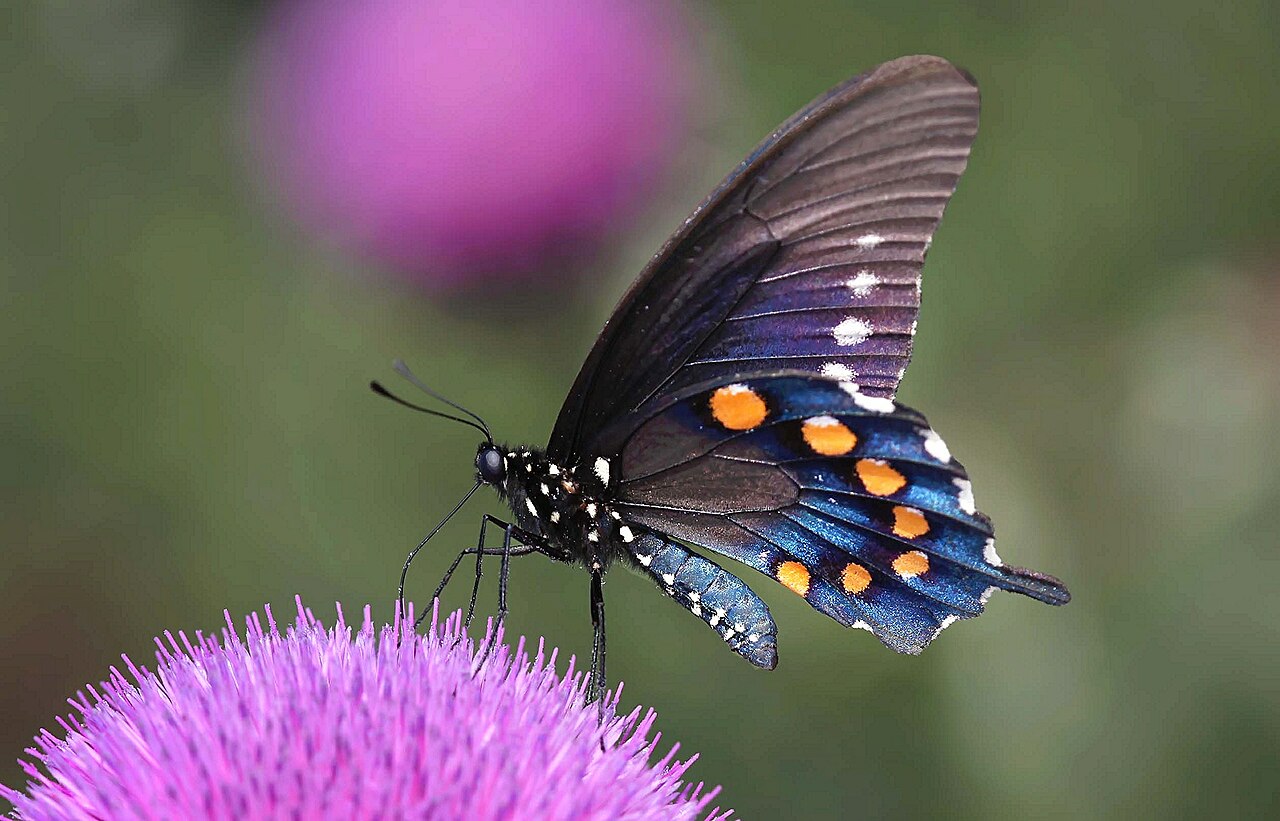
The pipevine swallowtail is a large black butterfly with a brilliant iridescent blue-green sheen across the hindwings and a single row of large orange spots on the hindwing underside. It is genuinely toxic, storing aristolochic acids from the pipevine its caterpillars eat, and it is the model that at least five other North American butterflies have evolved to imitate.
That makes it one of the most important insects in North American mimicry, and the reason black butterflies are so common in the east. The dark form of the female tiger swallowtail, the spicebush swallowtail, the black swallowtail, the red-spotted purple, and the female Diana fritillary all resemble it. This guide covers identification, the toxicity, the mimicry complex, host plants, and how to attract one.
The pipevine swallowtail is a large black butterfly with an iridescent blue-green hindwing sheen and a single row of large orange spots underneath. Its caterpillars eat only pipevine, storing aristolochic acids that make the butterfly toxic. At least five other North American butterflies mimic its appearance for protection.
| Feature | Pipevine Swallowtail |
|---|---|
| Scientific name | Battus philenor |
| Wingspan | 2.75 to 5 in |
| Male | Brilliant blue-green hindwing sheen |
| Female | Duller, more sooty; paler sheen |
| Underside | One row of large orange spots on blue |
| Host plants | Pipevine only (Aristolochia) |
| Toxicity | Aristolochic acids; genuinely poisonous |
How Do You Identify a Pipevine Swallowtail?
A large dark butterfly, roughly three to five inches across, black or very dark brown above with the outer half of each hindwing washed in an intense iridescent blue-green that flashes on and off as the angle changes. Males show it strongly; females are duller and more sooty with a weaker sheen.
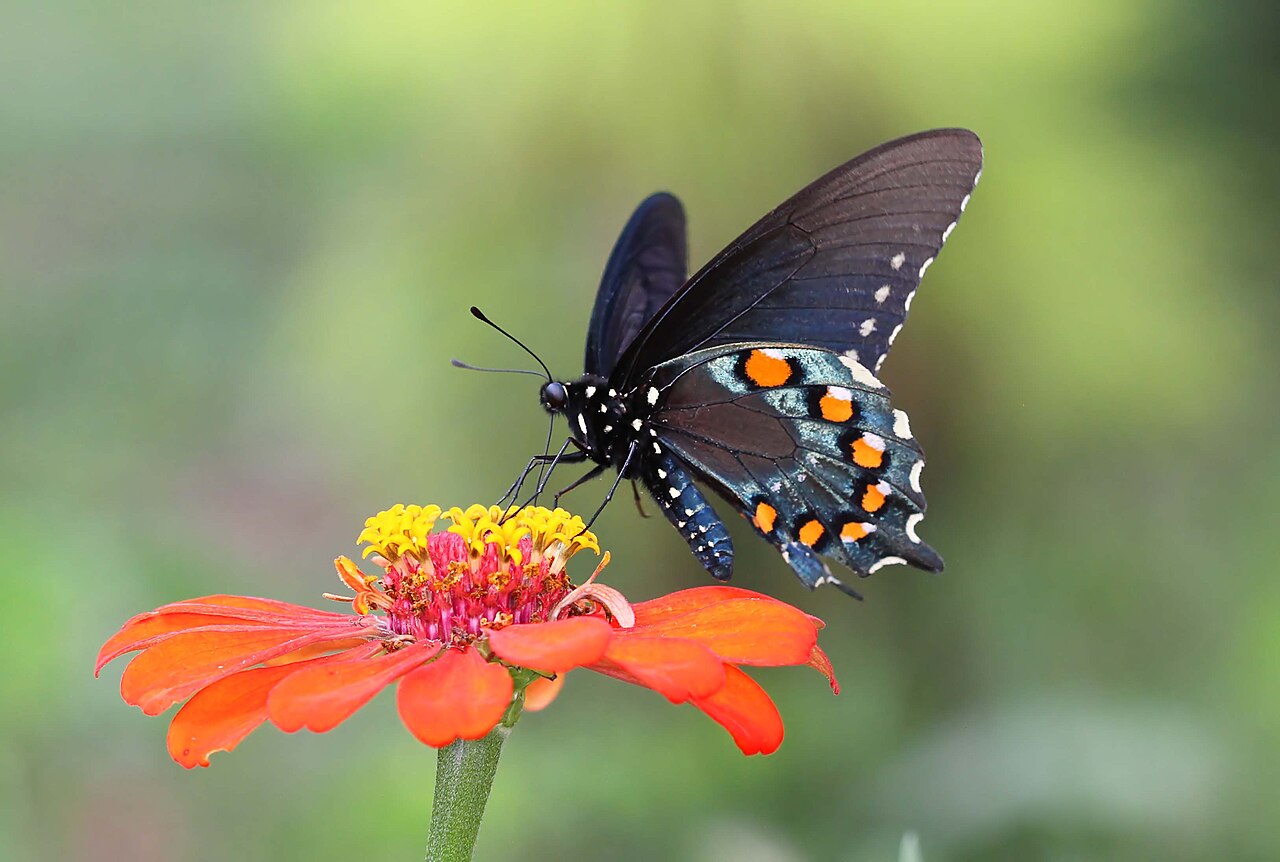
The underside is diagnostic. Each hindwing carries a single arc of seven large orange spots set on a brilliant iridescent blue field, and no other black swallowtail in North America has that combination. Spicebush swallowtails have two rows of smaller orange spots with a gap; black swallowtails have two rows of yellow spots above.
Behaviour helps at a distance. Pipevine swallowtails flutter their wings almost constantly even while feeding at a flower, which is unusual and distinctive, and their flight is quick and low. A dark swallowtail that never holds its wings still is almost certainly this species. The swallowtail butterfly guide covers the family.
Is the Pipevine Swallowtail Poisonous?
Yes, genuinely, and this is what makes the species matter ecologically. Caterpillars feed exclusively on pipevine, which contains aristolochic acids, and they sequester those compounds in their tissues, carrying them through the chrysalis into the adult. Both larvae and adults are toxic and taste foul to birds.
Aristolochic acids are potent. In vertebrates they are nephrotoxic and carcinogenic, and human poisoning cases from herbal preparations containing Aristolochia led to bans in many countries. A bird that eats a pipevine swallowtail vomits and learns to avoid the pattern permanently.
They are not dangerous to touch. The toxin matters only if the insect is eaten, and handling a butterfly or caterpillar poses no risk beyond the general advice not to handle wings. The bright red-orange tubercles on the black caterpillar are aposematic, advertising exactly this. The black caterpillar guide covers what the larva looks like.
What Butterflies Mimic It?
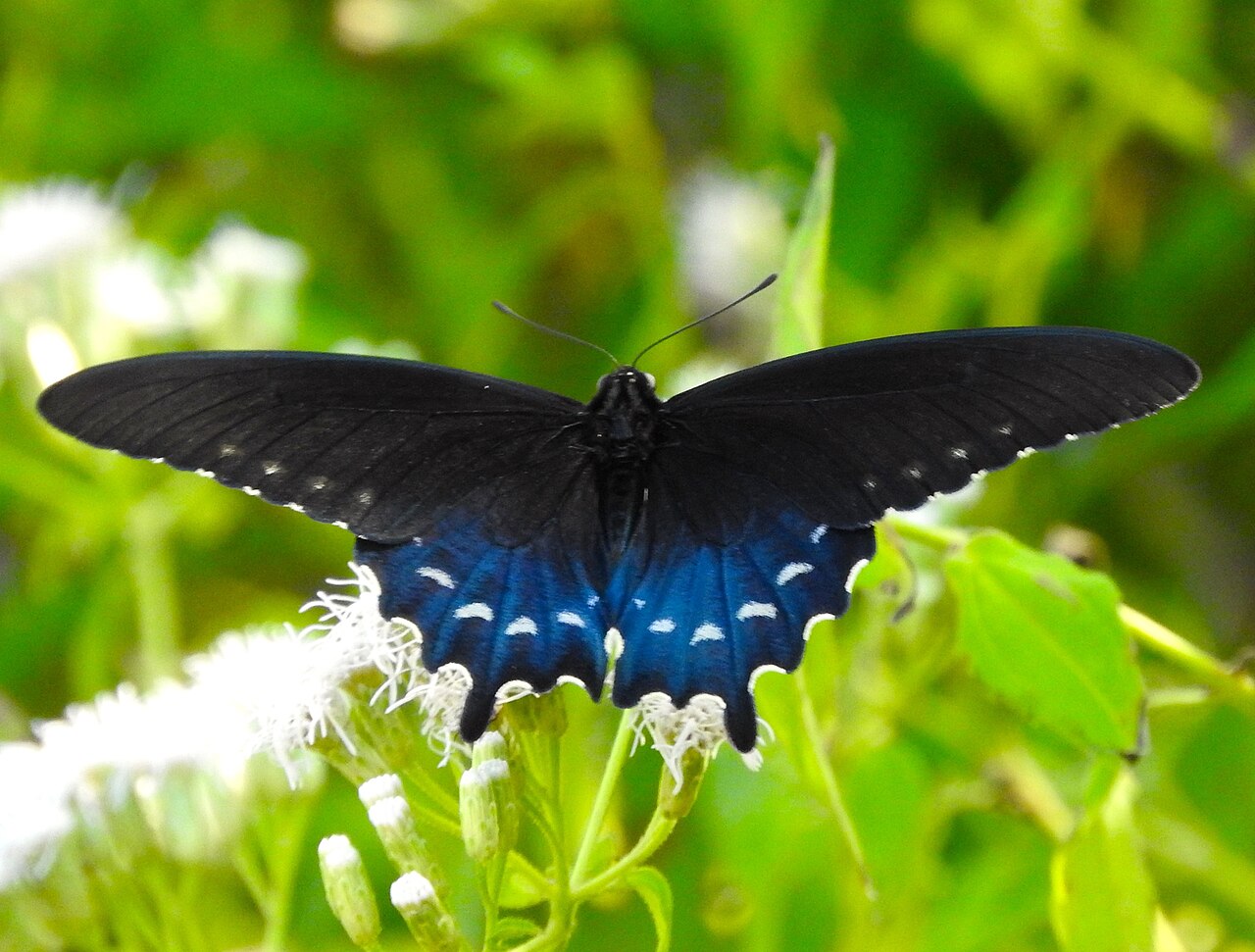
At least five, forming the best-known mimicry complex in North America. The dark form of the female eastern tiger swallowtail, the spicebush swallowtail, the black swallowtail, the red-spotted purple, and the female Diana fritillary all converge on the same dark ground colour with blue hindwing scaling.
Most of these are Batesian mimics, meaning they are harmless species copying a defended one and gaining protection without paying the cost of being toxic themselves. That only works while the mimics remain less common than the model, since a predator that keeps eating palatable copies stops avoiding the pattern.
The geography supports the theory neatly. Dark-form female tiger swallowtails are common where pipevine swallowtails occur and scarce or absent where they do not, which is one of the standard textbook demonstrations of Batesian mimicry operating in the wild rather than in a laboratory. The spicebush swallowtail guide covers one of the mimics in detail.
What Is the Host Plant?
Pipevine, and only pipevine. Caterpillars feed exclusively on plants in the genus Aristolochia, principally Virginia snakeroot and Dutchman’s pipe in the east, California pipevine in the west, and several other species regionally. Nothing else will support them.
The choice of species matters more than most host-plant advice. Some ornamental tropical pipevines sold in the nursery trade, particularly Aristolochia gigantea and Aristolochia littoralis, are toxic to the caterpillars, which are attracted to lay on them and then die. Planting the wrong pipevine creates a trap rather than habitat.
Eggs are laid in small clusters of one to twenty on new growth, unlike most swallowtails which lay singly, and young caterpillars feed together before dispersing. Larvae are dark red-brown to black with rows of fleshy orange or red tubercles, and they look alarming but do not sting. The zebra swallowtail guide covers another single-host species.
Where Do They Live?
Across the southern and eastern United States, from Connecticut and the lower Great Lakes south to Florida and west through Texas to Arizona and California, plus Mexico and Central America. The species is most numerous in the southeast and in central California.
Distribution follows the host plant rather than habitat type. Pipevine grows in woodland edges, river bottoms, and canyon slopes, and where it is absent the butterfly is absent regardless of nectar availability. That makes the species local and patchy in the northern half of its range.
The California pipevine swallowtail is the western population, associated with California pipevine along streams and canyons in the Central Valley and foothills, and it has become a well-known case study in urban conservation after a deliberate effort to reestablish it in San Francisco through pipevine planting. The giant swallowtail guide covers a relative whose broad host range takes it almost everywhere instead.
How Rare Are They?
Locally common where pipevine grows and absent where it does not, which produces a strong impression of rarity for anyone outside a population’s range. In the southeast they can be abundant, gathering at mud puddles in numbers on warm mornings.
The species is not of conservation concern overall, but individual populations are fragile because they depend entirely on one plant genus that has itself declined with woodland clearance and river bottom development. Isolated populations do disappear when the pipevine goes.
Two to three broods run per year from spring into autumn depending on latitude, and the last generation overwinters as a chrysalis, attached to a stem, log, or wall and coloured brown or grey. Adults live about two weeks in summer.
What Is the Life Cycle?
Eggs are laid in clusters of one to twenty on new pipevine growth, which is unusual among swallowtails, and they are rust-orange and slightly bumpy. They hatch in four to ten days, and the young caterpillars feed together in a group before dispersing as they grow.
The larva passes through five instars over two to four weeks, changing from a gregarious small caterpillar to a solitary dark red-brown or black one with rows of fleshy tubercles, some of them long and curving forward from the head. Like all swallowtail larvae it can evert an orange osmeterium, though the chemical defence from the host plant matters far more.
Pupation happens off the plant, with the caterpillar wandering to a stem, wall, or log, attaching with a silk pad and girdle, and forming a chrysalis that is green in summer and brown or grey in the overwintering generation. Adults emerge after one to two weeks in summer, or the following spring for the last brood of the year.
How Do You Attract Them?
Plant the right pipevine, in the right place. Native pipevines are vigorous climbing vines that want a fence, trellis, or tree to grow up, tolerate partial shade, and take a few seasons to reach a size that can support caterpillars without being defoliated to nothing.
Nectar matters separately, because adults feed at flowers unrelated to the host. Pipevine swallowtails favour thistle, phlox, bee balm, lilac, azalea, verbena, butterfly bush, lantana, and milkweed, and they feed with wings fluttering, which makes them easy to recognise at a border.
Males puddle at damp ground, mud, and stream edges, sometimes in large groups, so a damp patch or a shallow sand depression kept wet is worth providing. Avoid insecticides on and near the pipevine, since even products marketed as natural kill the eggs and small caterpillars the planting was meant to support. The guide to a butterfly landing on you covers the encounter people report most.
What Is Special About Them?
Their ecological role. Most butterflies matter as pollinators or as prey; the pipevine swallowtail matters as a template. The existence of a toxic, conspicuously patterned, reasonably common butterfly created the selective pressure that produced dark forms in five other species, and removing it would eventually erode all of them.
The colour is worth noticing for its own sake. The blue-green sheen is structural rather than pigment, produced by microscopic layered scales that interfere with light, which is why it appears and vanishes with the viewing angle. That is the same mechanism behind morpho butterflies and hummingbird gorgets.
The species also has a long record in research. Its mimicry complex has been studied since the nineteenth century, and work on pipevine swallowtail toxicity, on female tiger swallowtail polymorphism, and on predator learning has shaped how mimicry is understood generally. University entomology programmes such as the University of Florida (ufl.edu) maintain species accounts covering the detail. The blue morpho guide covers the same optical trick at a larger scale.
Frequently Asked Questions
How do you identify a pipevine swallowtail?
A large black butterfly with an intense iridescent blue-green hindwing sheen and a single arc of seven large orange spots on the hindwing underside. It flutters its wings constantly, even while feeding.
Is the pipevine swallowtail poisonous?
Yes. Caterpillars store aristolochic acids from pipevine, and both larvae and adults are toxic to birds. They are harmless to touch, since the toxin only matters if the insect is eaten.
What is the host plant for pipevine swallowtails?
Pipevine only, in the genus Aristolochia. Some tropical species sold as Dutchman’s pipe are toxic to the caterpillars, so check the botanical name and plant the species native to your region.
What butterflies mimic the pipevine swallowtail?
The dark form of the female tiger swallowtail, spicebush swallowtail, black swallowtail, red-spotted purple, and female Diana fritillary. Most are harmless Batesian mimics gaining protection by resemblance.
Where can I find pipevine swallowtails?
Across the southern and eastern United States and in central California, always near pipevine in woodland edges, river bottoms, and canyon slopes. They are absent where the host plant is.
How rare are pipevine swallowtails?
Locally common where pipevine grows and absent where it does not. Individual populations are fragile because they depend entirely on one plant genus that has declined with woodland clearance.
What is special about pipevine swallowtails?
They are the toxic model for the largest mimicry complex in North America, and the reason so many eastern butterflies are black with blue hindwings rather than brightly coloured.

Similar Posts
Softshell Turtle: ID, Bite, and Handling
A flat leathery-shelled turtle with a snorkel snout and a neck that reaches halfway back along its own shell. Why there is no safe side grip, and whether you can keep one.
Cricket Poop: Identification and Cleanup
Cricket droppings are dark cylindrical pellets 1 to 2 mm long. How to tell them from mouse, roach and bed bug evidence, the allergy risk, and safe cleanup.
Asian Lady Beetle
Asian lady beetles look like ladybugs but bite, swarm homes in fall, and can irritate pets. Here is how to tell them apart and keep them out.
Baby Garter Snake: ID, Safety, and the Copperhead Test
A baby garter snake is 5 to 9 inches, harmless, and born live in litters of 10 to 40. Full identification, plus the one mark that separates it from a copperhead.
Opossum Sounds: Hisses, Clicks, and the Bluff Behind Them
Opossums hiss, growl, click, screech and sneeze, but the hiss is almost always bluff. What each sound means and why most night noise is not an opossum at all.
Clover Mite: Why They Appear and How to Stop Them
Tiny red mites that swarm sunny walls in spring and autumn, do not bite, and stain when crushed. Why vacuuming beats squashing and the one measure that actually works.