Yellow Lizard: 9 Species in the US and How to Tell Them Apart
A yellow lizard in the United States is almost always harmless. Yellow shows up on native fence lizards, whiptails, skinks and collared lizards, on two introduced geckos in Florida and the Gulf states, and on escaped pet leopard geckos, and none of those animals can hurt you beyond a pinch. Only one venomous lizard lives in this country, the Gila monster, and its bands read more orange and pink than yellow.
The hard part is not safety, it is naming the animal. A yellow lizard can mean a sandy spiny lizard baking on a rock in Nevada, a black juvenile skink with five cream to yellow stripes in a Georgia woodpile, or a pale gecko on a porch wall in Texas at night. This guide works through the yellow lizards people actually photograph in the US, sorted by where you are and what pattern you saw, and it also settles the yellow spotted lizard from the book Holes.
Yes, yellow lizards are real and common in the US. The most frequent ones are the yellow backed spiny lizard in the Southwest, striped juvenile five lined and broad headed skinks in the East, desert grassland whiptails with pale yellow stripes, and the pale Mediterranean house gecko on walls at night. None of them is venomous, and all are safe to handle.
Is a Yellow Lizard Poisonous or Dangerous?
No yellow lizard in the United States is poisonous, and only one US lizard is venomous at all. That animal is the Gila monster (Heloderma suspectum), a heavy, slow desert lizard of Arizona, Nevada, Utah, New Mexico and southwestern California, 18 to 22 in long (46 to 56 cm), with beaded black skin broken by bands of pink, orange or dull yellow. It delivers venom by chewing, not striking, and it bites only when picked up or stepped on. Bites are extremely rare and are treated as a medical emergency, but no modern death is documented.
Every other yellow lizard you are likely to meet is a small insect eater with no venom at all. A frightened skink or whiptail may nip, and the grip of a large collared lizard or spiny lizard can break skin, so wash the spot like any other scratch. The real hazard is Salmonella on the skin of any reptile, which is why handling should always be followed by soap and water.
Lizards are also not poisonous to eat or to lick, which matters to people whose dog caught one. Most lizards pass through a dog without trouble. The exception in the Southeast is parasite transfer from skinks, which can carry liver flukes in cats, so a cat that eats skinks regularly is worth a vet conversation.
| Species | Yellow pattern | Total length | US range | Risk |
|---|---|---|---|---|
| Yellow backed spiny lizard | Sandy yellow back, dark shoulder bar | 7 to 9 in (18 to 23 cm) | Great Basin, Mojave, CA to OR | Harmless |
| Desert grassland whiptail | 6 pale yellow stripes, blue tail when young | 6 to 9 in (15 to 24 cm) | AZ, NM, west TX | Harmless |
| Five lined skink | 5 yellow to cream stripes, blue tail when young | 5 to 8 in (13 to 21 cm) | East of the Plains | Harmless |
| Broad headed skink | Yellow stripes when young, orange head in males | 6 to 13 in (15 to 33 cm) | Southeast, lower Midwest | Harmless |
| Eastern collared lizard | Yellow to green body, yellow head in Texas | 8 to 15 in (20 to 38 cm) | Ozarks, Plains, Southwest | Firm bite only |
| Yellow headed gecko | Bright yellow head on a dark body | 3 to 4 in (8 to 10 cm) | Key West, Miami area | Harmless |
| Mediterranean house gecko | Pale yellow to pink, bumpy, translucent | 4 to 5 in (10 to 13 cm) | Southern US, Gulf states | Harmless |
Is There a Yellow Lizard, or Is That Just Lighting?
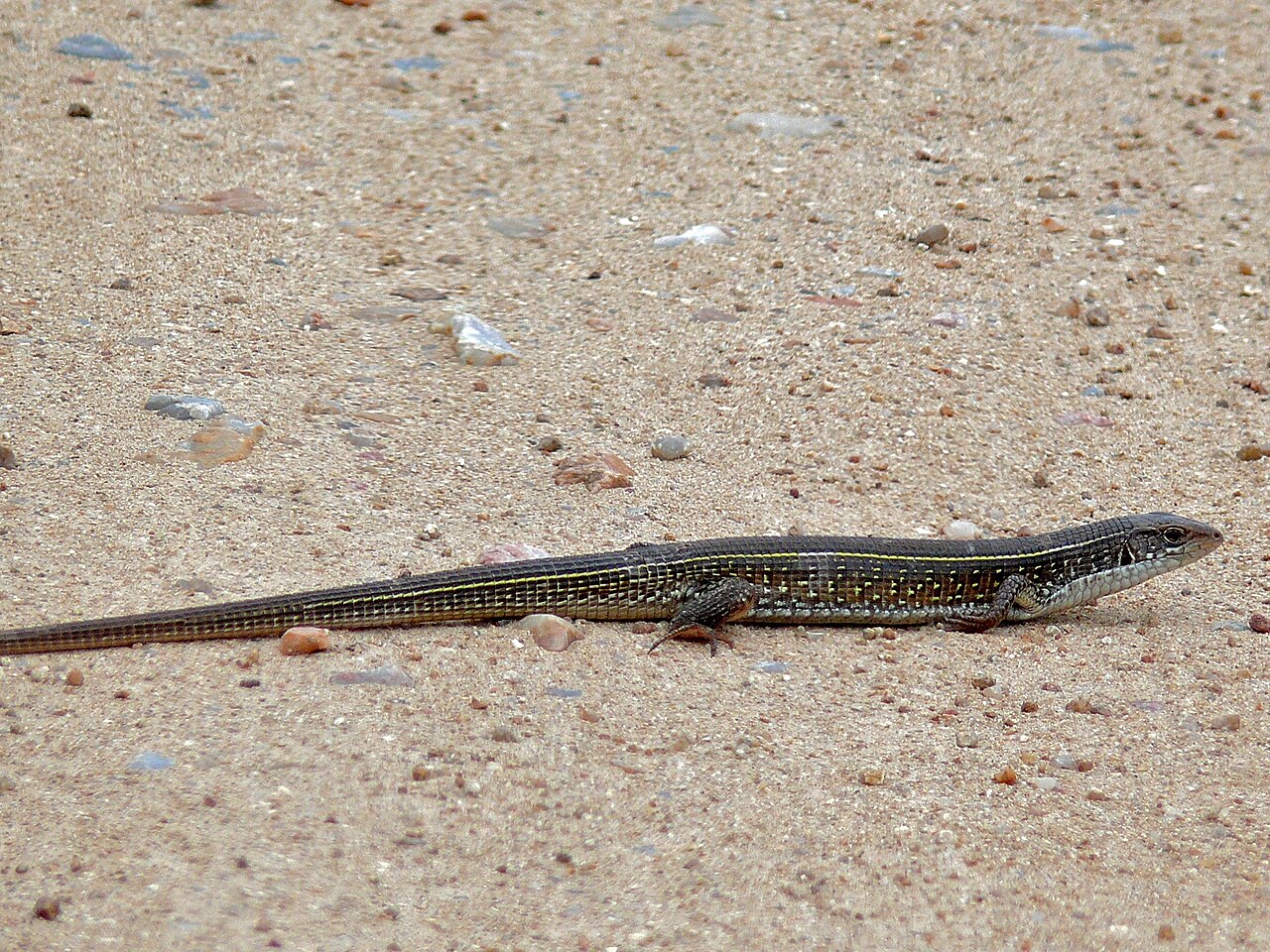
There is, and more than one. Pure canary yellow is uncommon in wild North American lizards, but sandy yellow, olive yellow, cream yellow and yellow striped patterns are everywhere once you look. Yellow in lizards comes from xanthophore cells in the skin, the same pigment class that colors yellow butterflies and the feathers of yellow birds.
Light does change what you see. A spiny lizard on hot pale granite at noon looks far yellower than the same animal in shade, and many lizards lighten their ground color when warm. Skinks are the opposite case: their yellow is a fixed stripe pattern that fades with age rather than with temperature.
Two other sources of yellow lizards in US yards are escapes and releases. Captive bred leopard geckos and bearded dragons in yellow morphs turn up in suburbs, especially in warm states, and they are tame, slow and obviously out of place.
Yellow Backed Spiny Lizard (Sceloporus uniformis)
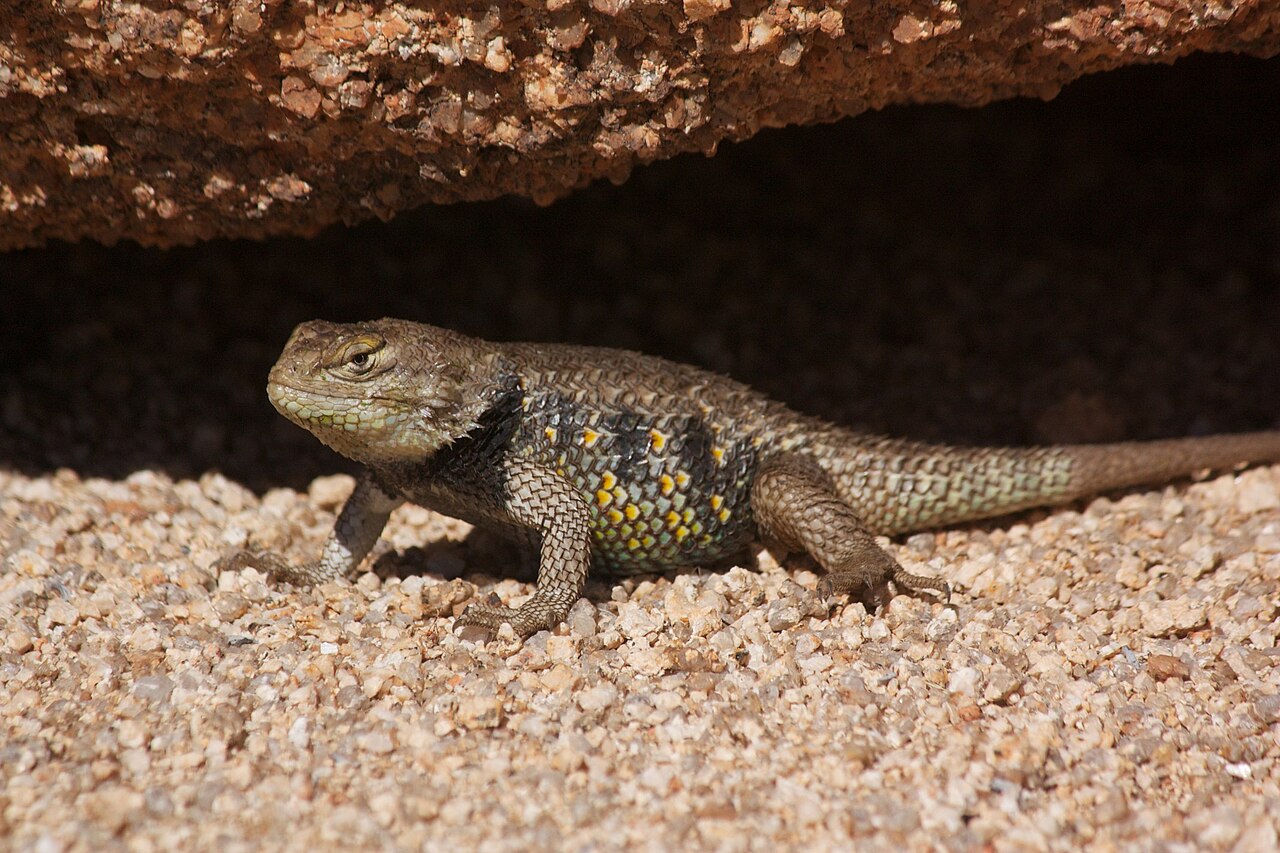
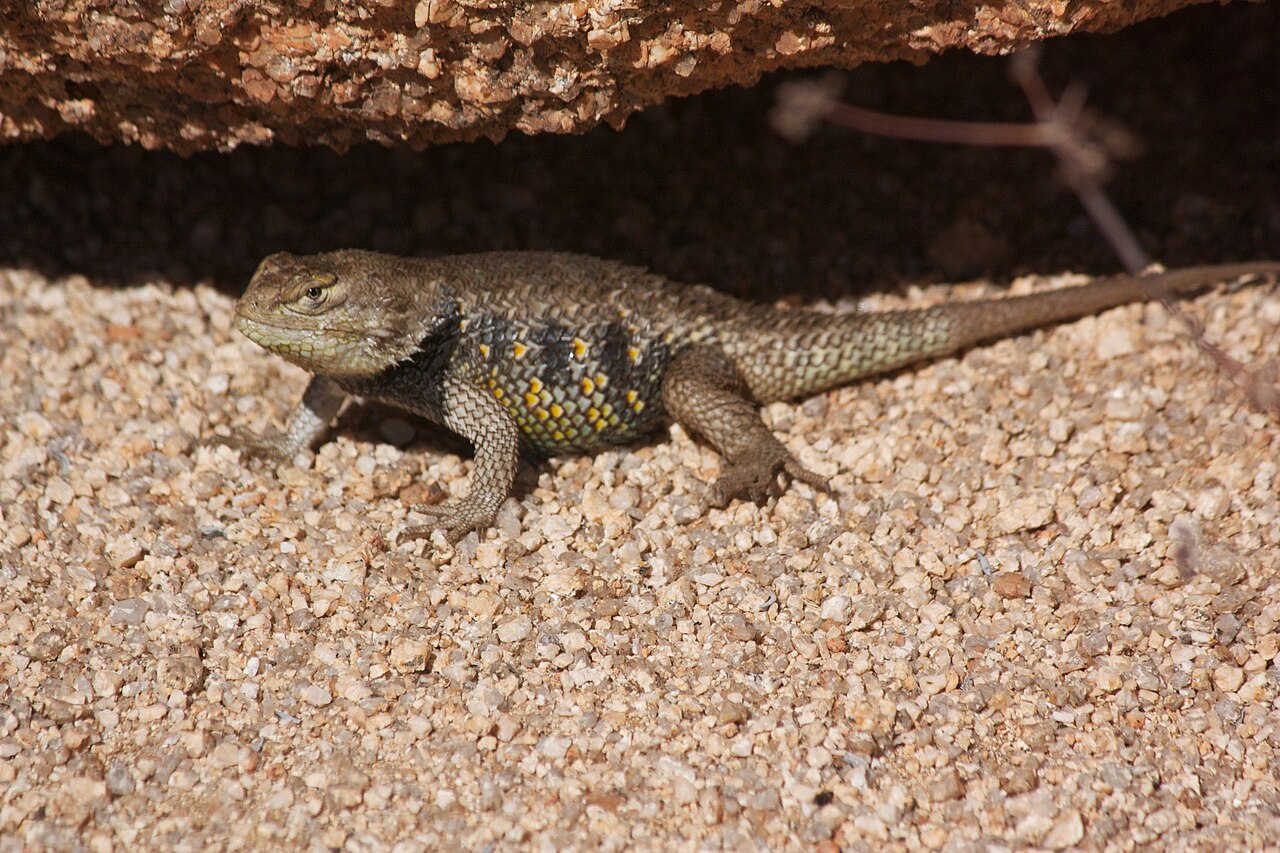
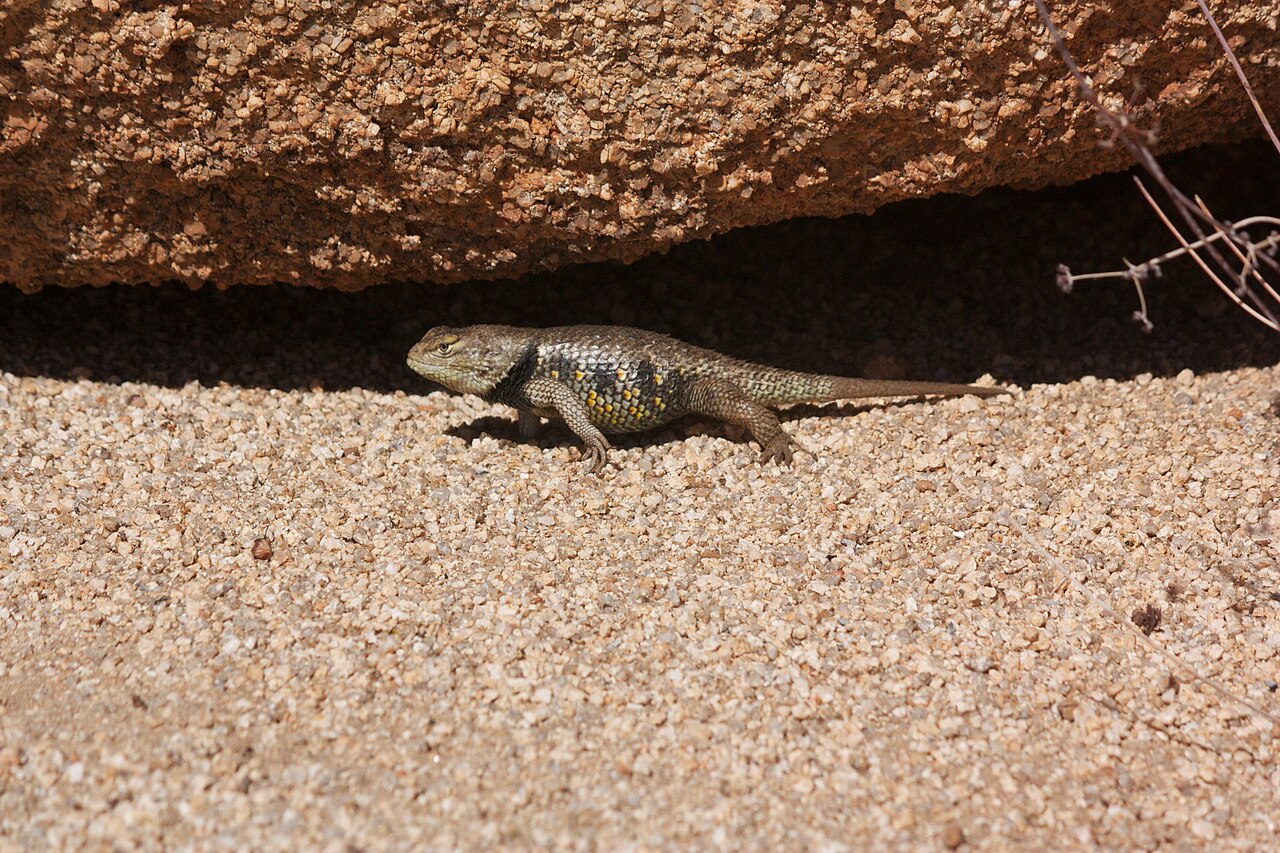
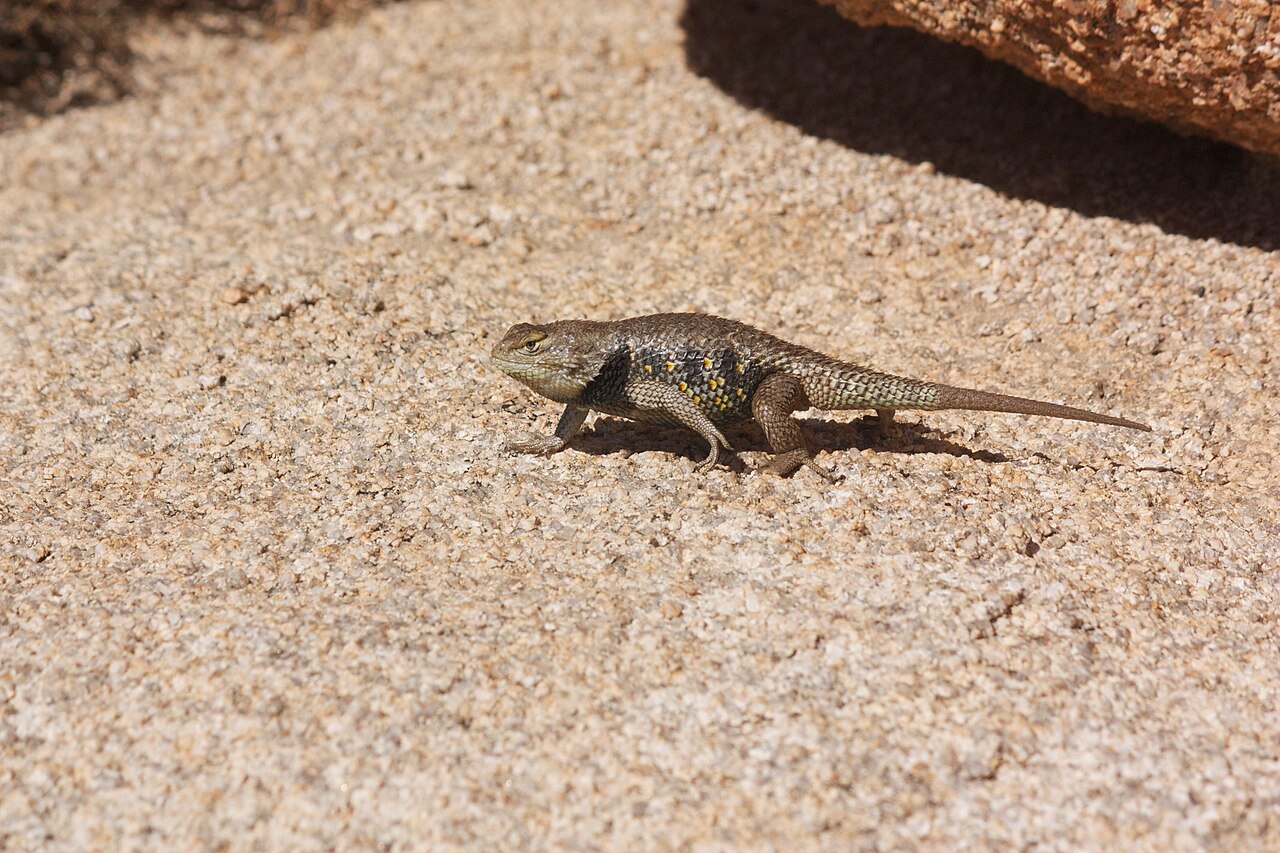
This is the closest thing the US has to a lizard named for being yellow. Adults run 7 to 9 in long (18 to 23 cm) with a sandy to mustard yellow back, keeled rough scales and a sharp black bar across each shoulder. Males show blue to violet belly patches that flash when they do push ups on a rock.
It lives in the Great Basin and the western Mojave, from southern Oregon and eastern California through Nevada into western Utah and Arizona, in sagebrush, juniper and rocky washes. You usually see it on a boulder or a fallen Joshua tree limb, head up, before it drops into a crevice.
It is completely harmless. The spiny scales look defensive and they are, but against snakes and birds, not hands. Picked up, it may gape and nip, and it will drop its tail if grabbed there.
Desert Grassland Whiptail (Aspidoscelis uniparens)
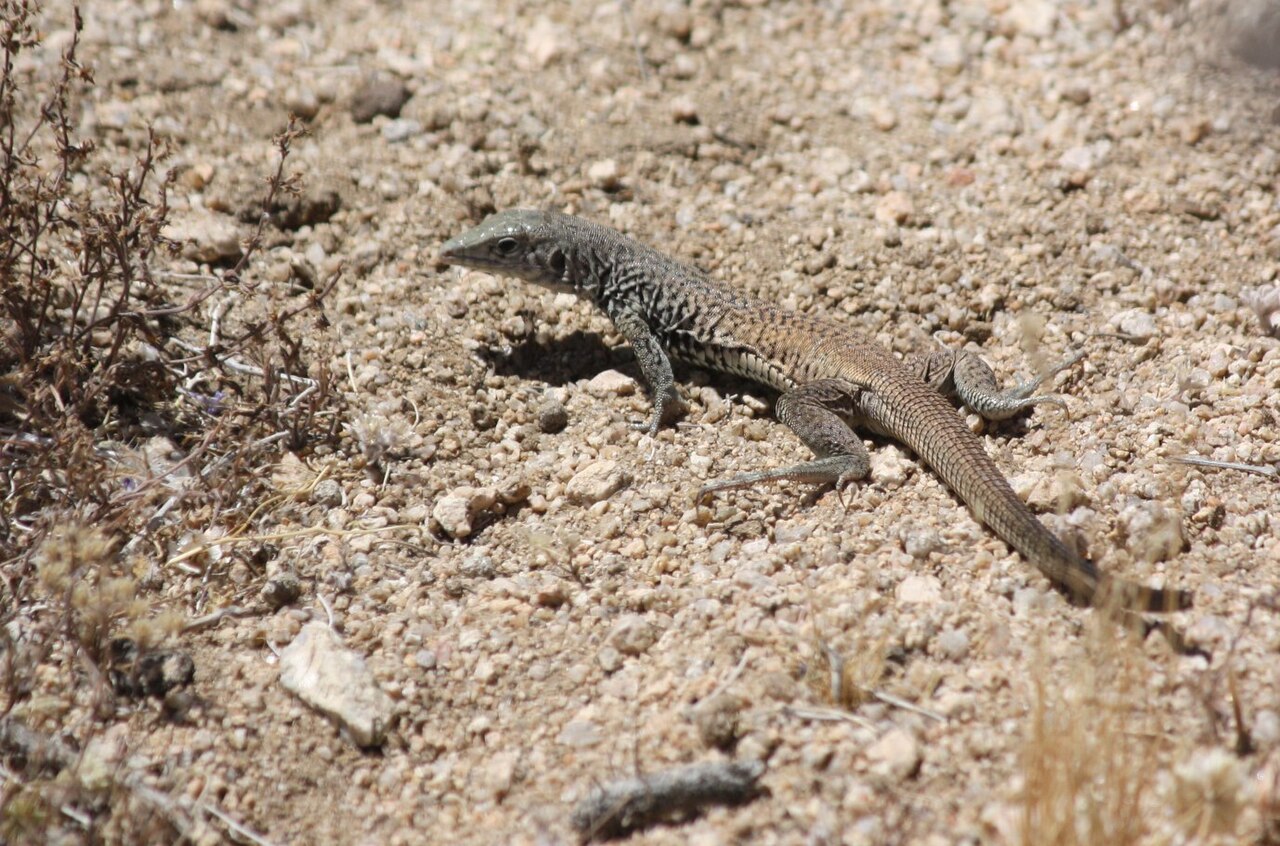
If your yellow lizard had stripes and would not stand still, this is the usual answer in Arizona, New Mexico and far west Texas. Six pale yellow stripes run down a dark brown to olive body, 6 to 9 in long (15 to 24 cm) including a whip thin tail, and juveniles carry a blue to green tail that fades with age.
Whiptails forage constantly, nosing under leaf litter in a jerky stop and start walk, and they are among the fastest lizards in the Southwest. This species is also all female: it reproduces by parthenogenesis, so every animal you see is a clone line and no males exist.
Whiptails are harmless and nearly impossible to catch. They dig shallow burrows for the night and emerge late in the morning, which is why desert yards see them at a predictable hour.
Five Lined Skink (Plestiodon fasciatus)
The most reported yellow striped lizard east of the Great Plains is a juvenile five lined skink: glossy black with five crisp yellow to cream stripes and an electric blue tail. Adults reach 5 to 8 in (13 to 21 cm), and the stripes dull to bronze while the blue drains out of the tail. Breeding males develop a red to orange jaw.
They live in moist woods, woodpiles, stone foundations and mulch beds from New England and Ontario south to Florida and west to Texas and Wisconsin. Skinks are the lizards most likely to be inside a garage or basement in the Southeast.
The blue tail triggers a steady myth that these skinks are venomous. They are not. The tail is a decoy that breaks off and keeps twitching while the lizard escapes, and it grows back shorter and gray.
Broad Headed Skink (Plestiodon laticeps)
The broad headed skink is the large southern cousin and the one that climbs. Young animals look almost identical to five lined skinks, striped yellow on black with a blue tail, but adults reach 6 to 13 in (15 to 33 cm) and lose the pattern entirely. Breeding males turn olive brown with a swollen, bright orange red head.
Range covers the Southeast and lower Midwest, from Pennsylvania and Kansas south to Florida and Texas, with a strong preference for oak woods, tree cavities and outbuildings. It hunts up trunks and on roof edges, so sightings often come from a porch rather than the ground.
Counting the scale rows under the chin and on the lip separates it from five lined and southeastern five lined skinks, which is work for a photo rather than a glance. Neither species is dangerous, though a big male has real jaw strength.
Eastern Collared Lizard (Crotaphytus collaris)
This is the showiest yellow lizard in the country. Males run 8 to 15 in (20 to 38 cm), with a double black collar, a blue green to yellow green body and, in Texas and northern Mexico populations, a vivid yellow to orange head that gives them the name yellow headed collared lizard. Females are duller and show orange bars when gravid.
Collared lizards sit on exposed limestone and granite in the Ozarks, the southern Plains, Texas and the Southwest, and they sprint on their hind legs when flushed, tail up for balance. They are predators of other lizards and large insects, not just plant pickers.
They are not venomous, but they are the US lizard most likely to actually hurt when handled: the jaws are built for crunching beetles and a large male draws blood. Admire it from a few feet away.
Yellow Headed Gecko (Gonatodes albogularis)
In Key West and parts of Miami Dade County, a tiny lizard with a glowing yellow head and a slate blue body is an introduced yellow headed gecko. Males carry the yellow; females and juveniles are drab brown with a pale neck collar and are easy to overlook. Total length is only 3 to 4 in (8 to 10 cm).
Unlike most geckos in Florida, this one is active by day, usually on tree trunks, shaded walls and stacked lumber in the first hours after sunrise. It is native to Central America and northern South America and has held small populations in south Florida for decades.
It is harmless and too small to bite meaningfully. Because it needs humid shade, it does not spread into dry suburban yards the way the house geckos do.
Mediterranean House Gecko (Hemidactylus turcicus)
The pale yellow lizard on a porch wall at night, near a light, with sticky toe pads and big lidless eyes, is almost certainly this gecko. Color runs translucent pink to sandy yellow with darker speckles and raised bumps, and the body is 4 to 5 in (10 to 13 cm) with the tail.
Introduced from the Mediterranean basin, it now lives across the southern US from Florida to California and north into Kansas and Missouri, almost always on buildings. It eats the moths and caterpillars and small insects that lights attract, which makes it a useful tenant.
It squeaks when caught, drops its tail readily and cannot hurt you. The droppings are the common complaint: small dark pellets with a white urate cap, stacked below a favorite perch.
Leopard Gecko (Eublepharis macularius): The Yellow Lizard Most People Own
Search yellow lizard pet and this is the animal behind the question. The leopard gecko is bright yellow with black spots, 7 to 11 in long (18 to 28 cm), with movable eyelids, a thick tail and no toe pads, so it walks on the floor instead of up the glass. Captive morphs push the yellow to near orange.
It is native to dry rocky country in Afghanistan, Pakistan, northwest India and Iran, not to North America. A yellow spotted gecko found loose in a US yard, especially one that lets you pick it up, is a lost pet and should be contained and offered to a local reptile rescue.
As a first reptile it is genuinely easy: an insect diet, a warm floor, a humid hide and a decade or two of life. That is a different article, but it explains why most yellow lizard photos online are captive animals on paper towel.
The Yellow Spotted Lizard From Holes: Is It Real?
The lizard in Louis Sachar’s Holes is called the yellow spotted lizard, and the deadly version in the book is invented. Sachar gave it eleven yellow spots, black teeth, a milky white tongue and a bite with no cure, and set it in a Texas desert. No such animal exists, and nothing in Texas kills with a bite.
The name, though, belongs to a real species: the yellow spotted night lizard (Lepidophyma flavimaculatum). It looks the part up close, dark chocolate brown with rows of pale yellow spots along the flanks, a flat head, about 5 in of body (13 cm) plus tail. It is nocturnal, lives in rotting logs and leaf litter in rainforest from southern Mexico to Panama, eats insects, and in many populations is all female.
It is not venomous, it does not occur in the US, and it is secretive enough that most herpetologists in its range rarely see one. Predators are forest snakes, birds and small mammals, and its best defense is staying under wood.
Yellow Stripes, Yellow Spots or Yellow Belly: Sorting the Lookalikes
Three patterns cause almost all the confusion, and each points to a different group. Stripes down the back mean a skink or a whiptail. Spots or speckles on a dark ground mean a gecko or a captive animal. A yellow or orange wash on the throat and belly, with a plain back, usually means a side blotched or spiny lizard catching sun.
| Feature | Five lined skink | Desert grassland whiptail |
|---|---|---|
| Stripe count | 5, broad, on black | 6, narrow, on olive brown |
| Scales | Smooth, wet looking, glossy | Granular, velvety, never shiny |
| Tail | Thick base, bright blue when young | Very long whip, blue green when young |
| Movement | Short dashes, hides in wood | Constant jerky foraging in the open |
| Range | East of the Great Plains | AZ, NM, west TX grassland |
Warning colors matter here too. Yellow and black in insects usually signals a sting or bad taste, as with a black and yellow wasp or a black and yellow garden spider, and the same combination on a black and yellow snake can mean a venomous species. In lizards that logic does not transfer. Yellow on a US lizard is camouflage or courtship, never a venom warning. Verified range maps for every native species are published by the US Geological Survey.
Frequently Asked Questions
What kind of lizard has yellow stripes?
In the eastern US, a lizard with yellow stripes is nearly always a juvenile five lined, southeastern five lined or broad headed skink, all black with pale yellow lines and a blue tail. In the Southwest it is a whiptail, with six or seven narrower yellow stripes and a much longer tail.
How do yellow spotted lizards look in real life?
The real yellow spotted night lizard is small and plain: about 5 in of body (13 cm), dark brown, with two to four rows of dull yellow spots along each side, a flattened head and granular skin. It has no black teeth, no white tongue and none of the menace the book gives it.
What eats yellow spotted lizards?
Forest snakes take most of them, along with ground foraging birds, opossums and other small mammals that turn over rotting logs. Larger lizards and spiders eat hatchlings. Because the species stays under wood and is active at night, predation pressure is lower than for sun basking lizards.
What is the rarest lizard color?
True blue is the rarest, which is why blue tailed skinks and the blue iguanas of Grand Cayman draw so much attention. Yellow, green, brown and gray are all produced by common pigments and structural layers, while strong blue needs a specific light scattering structure that few species evolved.
What is the rarest lizard on Earth?
There is no settled answer, since counts change with each survey. The species named most often is the Jamaican iguana (Cyclura collei), believed extinct for decades until a rediscovery in 1990, with a wild population in the low hundreds. The Union Island gecko and several Madagascan species are comparable.
Where can I find yellow spotted lizards?
The real species lives only from southern Mexico through Central America to Panama, inside rotting logs and leaf litter in humid lowland forest. In the US, searching for one is pointless. The yellow lizards you can find here are the skinks, whiptails, spiny lizards and geckos listed above, and yellow birds are far easier to spot in the same habitats.