Black and Yellow Spider: What It Is and Whether It Is Dangerous
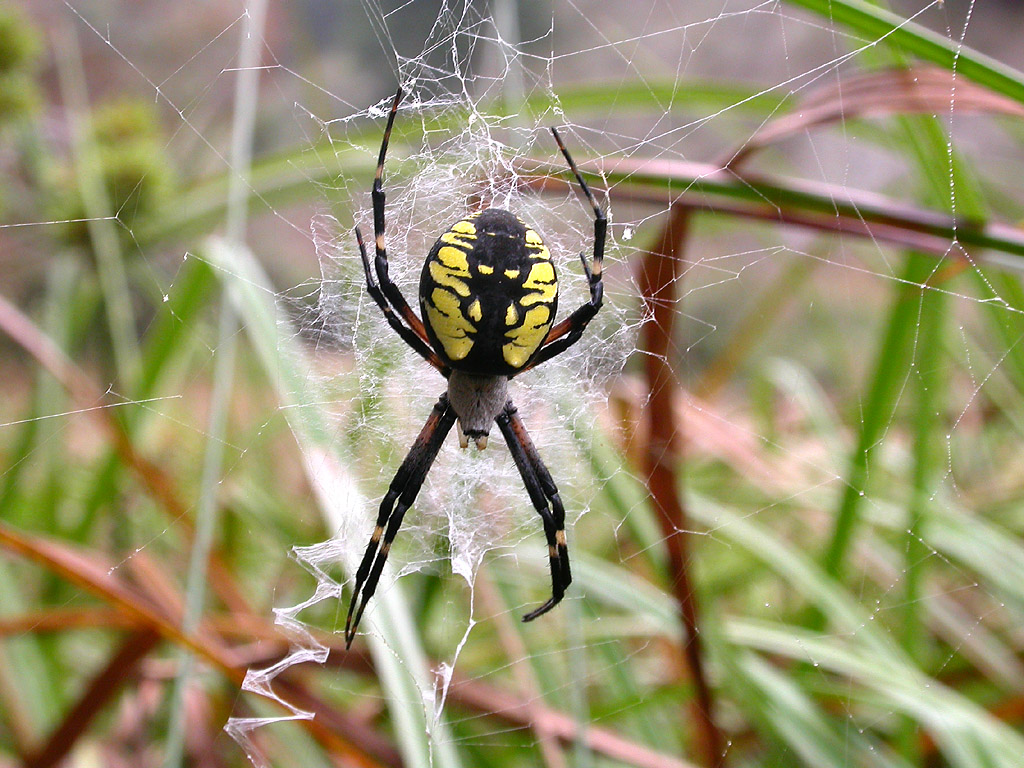
A black and yellow spider sitting in a large circular web in late summer is almost certainly a black and yellow garden spider, Argiope aurantia, and it is harmless to people. The species is unmistakable once you know the marks: a silver-haired head, a black abdomen splashed with bright yellow, and a heavy zigzag band of white silk running down the center of the web. Females reach 1.1 in in body length and hang head down at the hub all day.
The other common candidates are smaller and structured differently. Banded garden spiders carry horizontal stripes rather than blotches, bold jumping spiders have yellow-marked juveniles with no web at all, and yellow sac spiders are pale, fast, and found on walls indoors. Web shape separates them faster than color does.
The black and yellow spider found in gardens across North America is Argiope aurantia, the black and yellow garden spider. It is not dangerous to humans, builds a large orb web with a zigzag silk band, and reaches about 1.1 in in females. Bites are rare, defensive, and comparable to a bee sting at worst.
| Spider | Body Length | Web | Where You Find It |
|---|---|---|---|
| Black and yellow garden spider | 0.75 to 1.1 in | Large orb with zigzag band | Gardens, tall grass, shrubs |
| Banded garden spider | 0.6 to 0.9 in | Orb, weaker zigzag | Open fields, prairie |
| Yellow garden orbweaver juveniles | 0.2 to 0.4 in | Small orb | Same habitats, midsummer |
| Golden silk orbweaver | 1 to 2 in | Huge golden orb | Southeast woodlands |
| Spined micrathena | 0.3 in | Small tight orb at face height | Forest trails |
| Yellow sac spider | 0.2 to 0.4 in | No web, silk retreat only | Walls and ceilings indoors |
Is a Black and Yellow Spider Dangerous?
No black and yellow spider in North America is medically dangerous to humans. The garden spider that generates most of these questions has venom adapted to subdue insects and delivers it through fangs that struggle to break human skin at all. Documented bites are rare, occur only when a spider is squeezed or trapped against skin, and produce a brief sting with local redness.
The comparison people reach for is a bee sting, and that overstates it in most cases. There is no tissue damage, no systemic reaction in healthy adults, and no reported case requiring antivenom. Reactions requiring medical attention involve allergy to the venom rather than the venom itself.
The two North American spiders that warrant genuine caution, the black widow and the brown recluse, are neither black nor yellow. Widows are glossy black with a red hourglass underneath, and recluses are uniformly tan with a violin mark. If a spider is boldly patterned in yellow, it is not one of them, and the black widow question is a separate matter entirely.
Black and Yellow Garden Spider: The One You Are Seeing
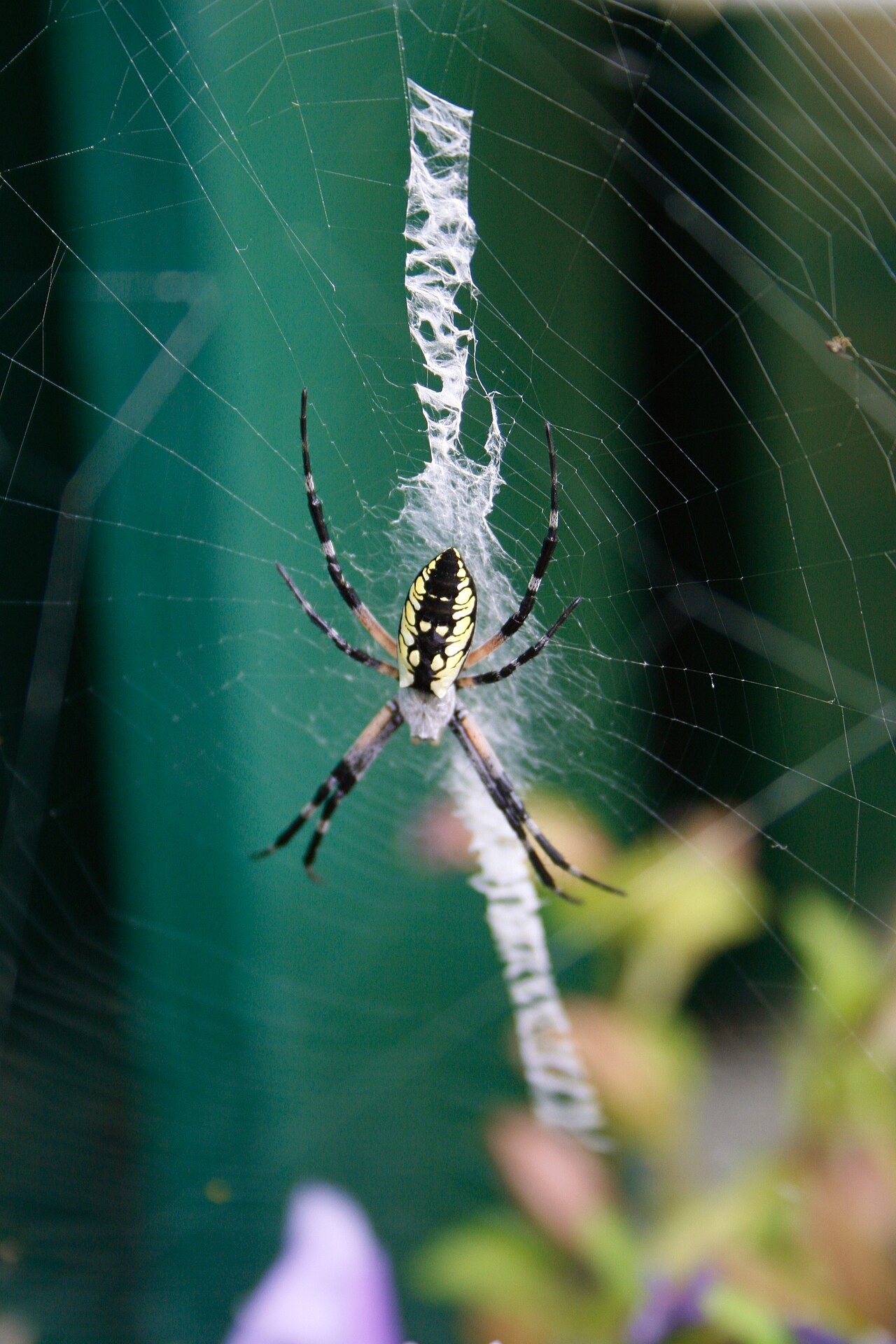
Argiope aurantia is the default answer across almost the whole continent. The abdomen is oval and boldly patterned in black with irregular yellow or orange blotches, the cephalothorax is covered in short silver hairs, and the legs are black with yellow or reddish bands at the base. Females are three to four times the size of males and are the only ones most people ever notice.
The web is the second identifier. It is a classic orb up to 2 ft across, positioned in sunny spots among tall vegetation, with a dense zigzag of white silk running vertically through the center. The spider sits head down at the hub with legs paired so that its eight legs look like four.
Range covers southern Canada through Mexico, with the species most abundant from July through the first hard frost. They favor gardens, meadow edges, hedgerows, and any tall plant that offers anchor points and insect traffic. Females rebuild the central portion of the web nightly, eating the old silk to recover the protein.
What the Zigzag in the Web Is For
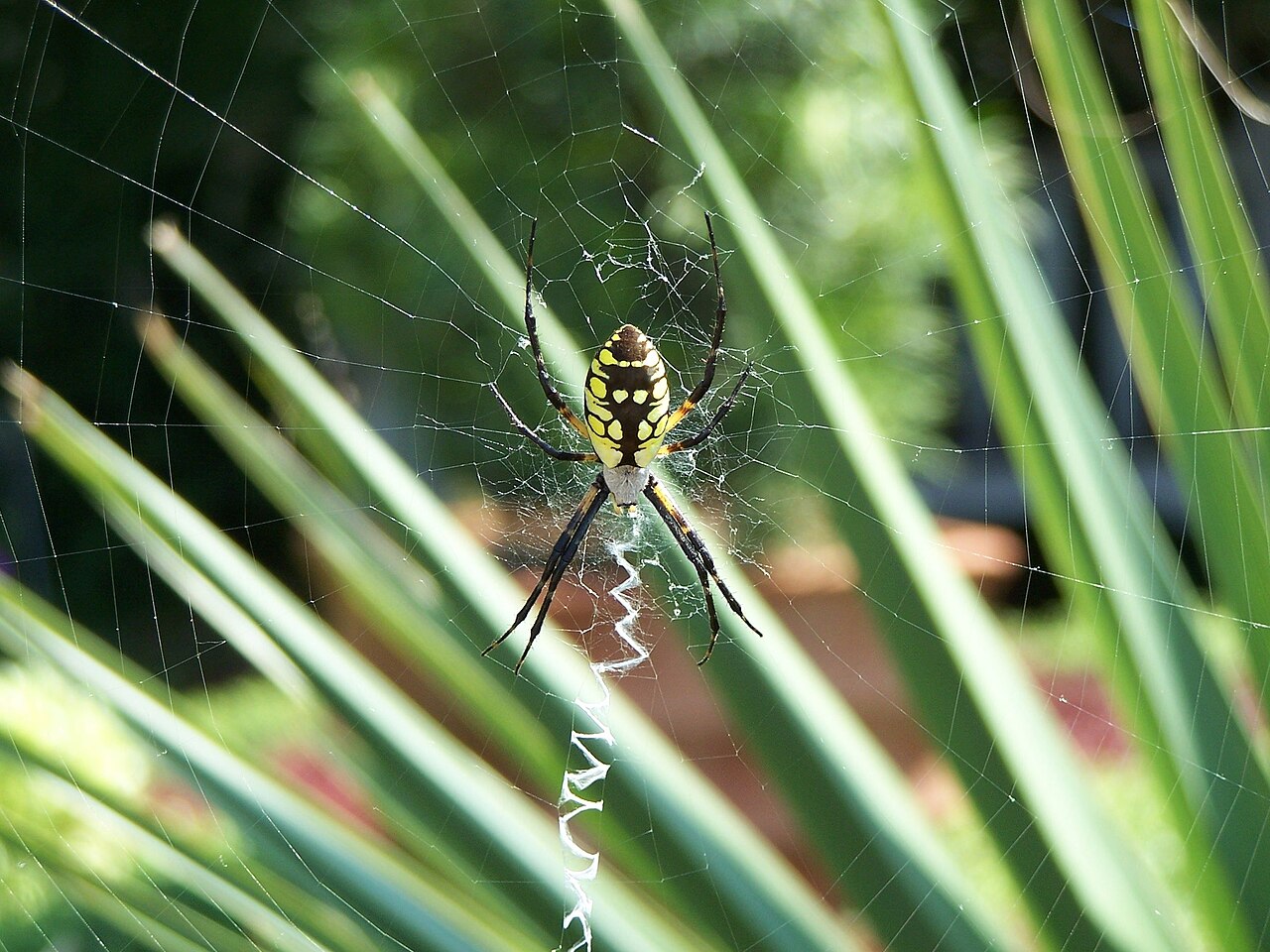
The heavy zigzag band is called a stabilimentum, and it is one of the more debated structures in spider biology. It is made of thick silk laid down in a vertical strip through the hub, sometimes as a simple line and sometimes as a full X across all four quadrants. Only some orbweaver genera build it, and Argiope is the most consistent.
Three explanations compete. It may act as a warning to birds, making the web visible enough to avoid so the spider does not have to rebuild after a collision. It may reflect ultraviolet light in a pattern that attracts flying insects, since many flowers signal in the same range. It may also break up the spider’s outline against predators.
Evidence supports parts of all three, and the function may vary by habitat and by predator pressure. What is clear is that the structure is not there to strengthen the web, since the silk is not load bearing. Its presence is a reliable field mark regardless of what it does.
Banded Garden Spider and Other Argiope Species
The banded garden spider, Argiope trifasciata, is the closest look-alike and the one most often confused with its more famous relative. It carries fine horizontal silver, yellow, and black bands running across the abdomen rather than the bold irregular blotches of Argiope aurantia. The overall impression is of a striped spider rather than a spotted one.
It prefers more open habitat, dominating in prairie, old fields, and coastal dunes where the garden spider is less common. Webs are built lower in the vegetation and the stabilimentum is often reduced to a short vertical line or absent entirely. Both species peak at the same time of year.
The silver argiope of the Southwest and Florida completes the group, with a shorter, more angular abdomen that has lobed edges. All three are harmless, all three build large orbs, and all three shed their webs and disperse after producing egg sacs in fall. None of them is aggressive.
Black and Yellow Jumping Spiders
Jumping spiders in the genus Phidippus include several species with yellow or orange markings, particularly in juveniles. Young bold jumpers are black with pale orange or yellow spots on the abdomen that turn white as the spider matures, which is why the same individual can be reported as a different species at different ages. They are compact, fuzzy, and hold themselves upright.
The key separator is that jumping spiders build no capture web at all. They hunt by stalking and pouncing, using excellent vision from a pair of enormous forward-facing eyes, and they trail a silk dragline as a safety tether. A yellow-marked spider running across a fence rail or window frame is a jumper, not an orbweaver.
They are also the group most people find tolerable, since they turn to look at an approaching hand and often appear curious rather than fleeing. Bites are extremely rare and produce nothing worse than a small red mark. Anyone wanting the full picture will find it in the jumping spider guide.
Yellow Sac Spiders and Indoor Yellow Spiders
Yellow sac spiders are the pale yellow to cream spiders found running on walls and ceilings at night, usually about 0.3 in with a slightly darker stripe down the abdomen. They build no web, instead constructing a small silk sleeping tube in a wall corner or where the ceiling meets the wall. That retreat is what gives the group its name.
They account for a meaningful share of indoor spider bites in North America, mostly because they wander over bedding at night and get pressed against skin. The bite produces a stinging sensation, a red welt, and occasional local swelling that resolves in a few days. Older claims that they cause necrotic wounds have not held up under review.
They are not black and yellow in the patterned sense, but they are frequently reported that way because the abdomen darkens after feeding. If a small pale yellow spider is moving fast on an interior wall with no web nearby, this is almost always what it is. Sealing gaps and reducing outdoor lighting near doors cuts indoor numbers substantially.
Golden Silk Orbweavers and the Southeast Species
The golden silk orbweaver, still widely called the banana spider, is the largest black and yellow spider in North America. Females reach 2 in in body length with a leg span the width of a hand, carrying an elongated cylindrical abdomen marked in yellow and white with tufts of black hair on the leg joints. The web silk is visibly golden in sunlight.
Webs are enormous, often 3 ft across with support lines spanning much further, and they persist for weeks rather than being rebuilt nightly. The species is restricted to the Southeast, common in Florida, coastal Georgia, and the Gulf states, where it strings webs across forest trails at exactly face height. Walking into one is memorable and completely harmless.
Despite the size, this spider is among the most reluctant to bite of any large orbweaver, typically dropping from the web or playing dead when disturbed. The venom is mild and the fangs rarely penetrate skin. The full account sits in the banana spider guide.
What Black and Yellow Garden Spiders Eat
Garden spiders take whatever flies into the web, which in a typical yard means flies, mosquitoes, moths, wasps, bees, grasshoppers, and small beetles. Large females routinely subdue prey heavier than themselves, including grasshoppers and cicadas, by wrapping first and biting second. Wrapping immobilizes the insect before it can damage the web.
Feeding is external. The spider injects digestive enzymes that liquefy the internal tissue, then draws the contents out, leaving an empty husk that is cut from the web and dropped. That is why the ground beneath an established web accumulates a small pile of insect shells.
Consumption rates are high enough to matter agriculturally. A mature female may take several hundred insects across a season, which is why garden spiders are counted as beneficial in vegetable plots and orchards. The broader picture of spider diets is covered in what spiders eat.
Garden Spiders as Pest Control
Orbweavers are counted as beneficial in almost every agricultural and horticultural assessment, and the black and yellow garden spider is among the most effective because of the size of the web and the size of the prey it can handle. A single web positioned in a vegetable plot intercepts cucumber beetles, squash bugs, grasshoppers, and moths whose larvae would otherwise feed on the crop.
The value is highest in gardens managed without broad insecticide applications, since those sprays remove spiders along with the target pests and leave the plot with fewer natural controls the following season. Spider populations recover more slowly than the pest populations they suppress, which is why sprayed plots often see worse outbreaks in year two.
Extension programs consistently recommend leaving orbweavers in place, and the guidance published by Penn State Extension treats garden spiders as beneficial species requiring no management. Structural placement matters more than numbers: webs at the edge of a bed intercept insects arriving from outside before they reach the plants.
Egg Sacs, Life Cycle, and Where They Go in Winter
Females produce one to four egg sacs in late summer and fall, each a brown papery sphere about 1 in across containing 300 to 1,400 eggs. The sacs are suspended near the web on a dense silk platform, and the female guards them until she dies at the first hard freeze. She does not survive the winter under any circumstances.
Spiderlings hatch inside the sac in fall, overwinter there in a dormant state, and emerge the following spring when temperatures rise. They disperse by ballooning, climbing to a high point, releasing a strand of silk, and letting air currents carry them, sometimes for miles. Survival at this stage is very low.
The species is annual throughout its range, which means the enormous spider present in September is a different individual from the one that was there the previous year. Removing an egg sac from a garden removes next year’s population. Leaving it attached to a stake or fence costs nothing.
How to Identify Black and Yellow Spiders Step by Step
Check for a web first, since presence or absence splits the field immediately. A large vertical orb with a zigzag band means a garden spider, a huge golden web at head height in the Southeast means a golden silk orbweaver, and no web at all means a jumping spider or sac spider.
Next look at body proportions. Orbweavers have large rounded or oval abdomens far bigger than the front section, while jumping spiders are compact with a boxy front section and large forward-facing eyes. Sac spiders are elongated and uniform with no strong pattern.
Finally note the pattern type. Irregular yellow blotches on black mean Argiope aurantia, fine horizontal bands mean Argiope trifasciata, and small paired spots on a dark body usually mean a juvenile jumper. Anyone working through a broader set should also check the grass spider, which is often mistaken for a young garden spider in lawns.
Frequently Asked Questions
Is a black and yellow spider poisonous?
The black and yellow garden spider is venomous in the sense that all spiders are, but it poses no danger to people. Its venom is adapted to insects, its fangs rarely penetrate human skin, and bites occur only when the spider is trapped against the body. The effect is comparable to a mild bee sting at worst.
What is the zigzag in a garden spider web for?
The zigzag band is a stabilimentum, and its function is still debated. Leading explanations are that it warns birds away so the web is not destroyed, that it reflects ultraviolet light in a way that attracts flying insects, and that it disguises the spider’s outline. It adds no structural strength to the web.
Should I remove a black and yellow spider from my garden?
There is no practical reason to. A mature female removes hundreds of pest insects across a season and dies at the first hard freeze without any intervention. Relocating her almost always kills her, since she cannot build a new web and reach breeding condition before cold weather arrives.
What attracts black and yellow garden spiders?
Tall vegetation with sturdy anchor points, full sun, and heavy flying insect traffic. Gardens with tomatoes, sunflowers, and ornamental grasses are ideal because the stems support a large web. Outdoor lighting nearby increases insect volume and often increases spider numbers with it.
Do black and yellow spiders come inside houses?
Garden spiders essentially never do, since they need open space and sun for a large orb web. A yellow spider found indoors is almost always a yellow sac spider, which builds no capture web and hunts on walls at night. Jumping spiders also wander inside occasionally through open windows.
How long do black and yellow garden spiders live?
Females live a single season, hatching in spring and dying at the first hard frost in fall, so the entire visible life cycle spans about six months. Males mature earlier and die shortly after mating, often within days. Spiderlings overwinter inside the egg sac and emerge the following spring.