Red and Black Beetle: What It Actually Is and How to Handle It
A red and black beetle is usually not a beetle at all. The insects that dominate this search are boxelder bugs and milkweed bugs, both of which are true bugs with flat backs, sucking mouthparts, and a completely different body plan from beetles. The genuine red and black beetles are the milkweed leaf beetle, the red milkweed longhorn, various ladybug species, and the fire-colored beetles, and none of them gathers on house siding by the hundreds.
That distinction decides everything about what to do next. Boxelder bugs cluster on warm walls in fall and get indoors through gaps, which is a building sealing problem. Actual beetles turn up individually on plants, cause no household nuisance, and mostly warrant leaving alone.
Most red and black insects reported as beetles are boxelder bugs or milkweed bugs, which are true bugs rather than beetles. Genuine red and black beetles include the milkweed leaf beetle, red milkweed beetle, fire-colored beetles, and several ladybugs. None of them is harmful to people, and none bites or stings.
| Insect | Actually a Beetle? | Size | Where You See It |
|---|---|---|---|
| Boxelder bug | No, a true bug | 0.5 in | Sunny walls, indoors in fall |
| Large milkweed bug | No, a true bug | 0.4 to 0.7 in | Milkweed seed pods |
| Milkweed leaf beetle | Yes | 0.3 to 0.5 in | Milkweed leaves |
| Red milkweed beetle | Yes, longhorn | 0.4 to 0.6 in | Milkweed stems, long antennae |
| Fire-colored beetle | Yes | 0.4 to 0.8 in | Dead wood, flowers |
| Two-spotted ladybug | Yes | 0.2 in | Aphid-infested plants |
Beetle or True Bug? The Test That Settles It
Look at the back. A beetle has a hard shell split by a straight line running down the middle, formed by two wing covers meeting edge to edge. A true bug has a triangular plate behind the head and wings that overlap at the rear, producing an X pattern rather than a straight seam.
Mouthparts confirm it. Beetles have chewing jaws that bite pieces out of leaves, leaving holes and notches. True bugs have a needle-like beak folded under the body that pierces plant tissue and draws sap, leaving stippled discoloration rather than holes.
Development differs as well. Beetles go through a complete transformation with a grub stage that looks nothing like the adult, while true bugs hatch as miniature versions of the adult and grow through a series of molts. That is why boxelder bug clusters contain bright red wingless juveniles alongside the adults, something no beetle colony would show.
Boxelder Bugs: The Most Common Red and Black Insect
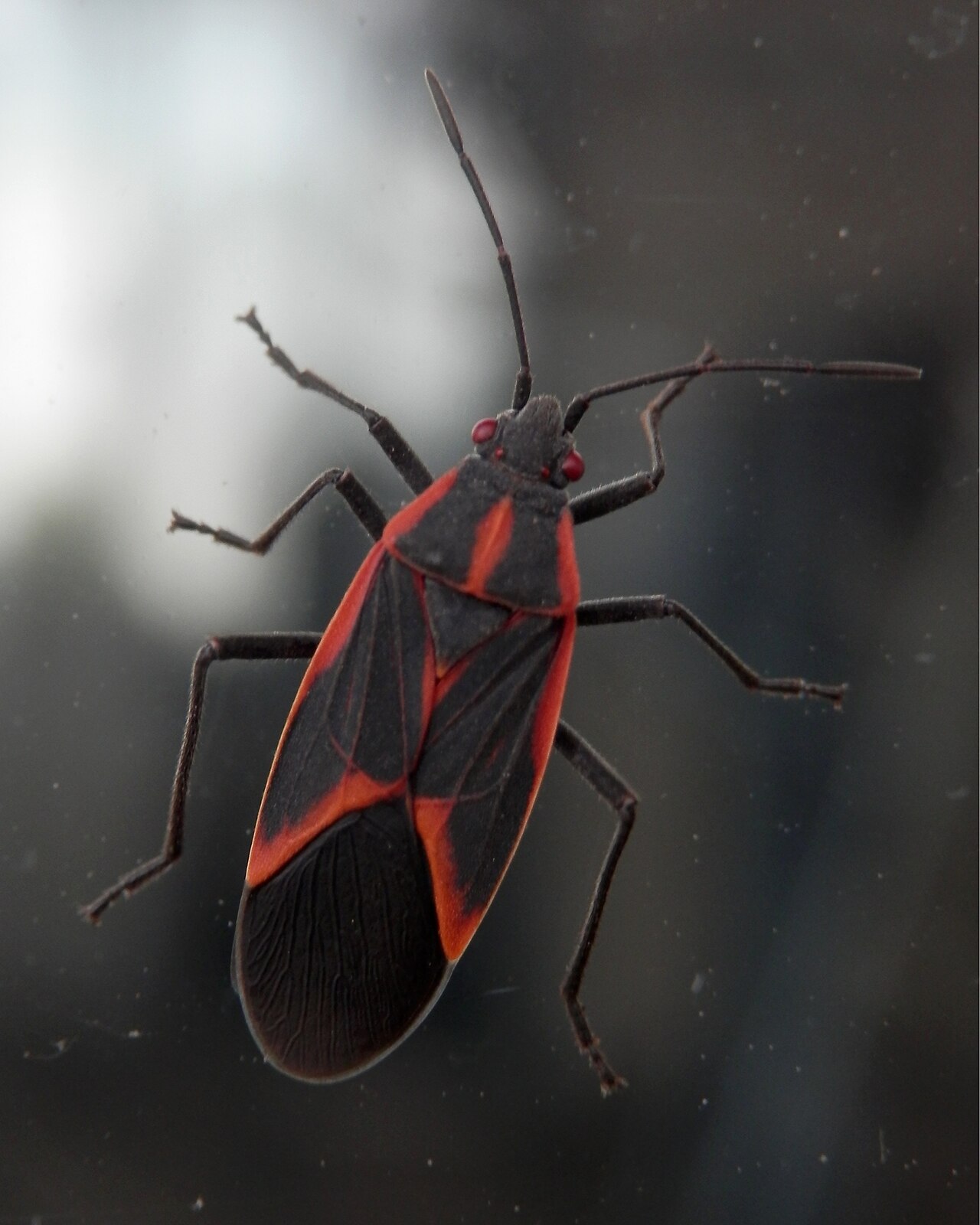
Boxelder bugs are flat, elongated, about 0.5 in long, black with three thin red lines on the plate behind the head and red edges outlining the wings. Juveniles are bright red with black legs and no wings, which is why a cluster looks like two different species mixed together. They feed on the seeds of boxelder, maple, and ash trees.
They become a household issue in fall, when they gather in enormous numbers on south and west facing walls to absorb heat before winter. From there they work into wall voids, attics, and window frames through gaps, and warm days in midwinter bring them out into living space. They do not feed, breed, or damage anything indoors.
Control is exclusion rather than spraying. Sealing gaps around windows, doors, siding joints, and utility penetrations before September removes the entry route, and a vacuum handles the ones already inside. Crushing them stains surfaces and releases a strong odor, so vacuuming is the better option.
Milkweed Bugs and the Warning Color System
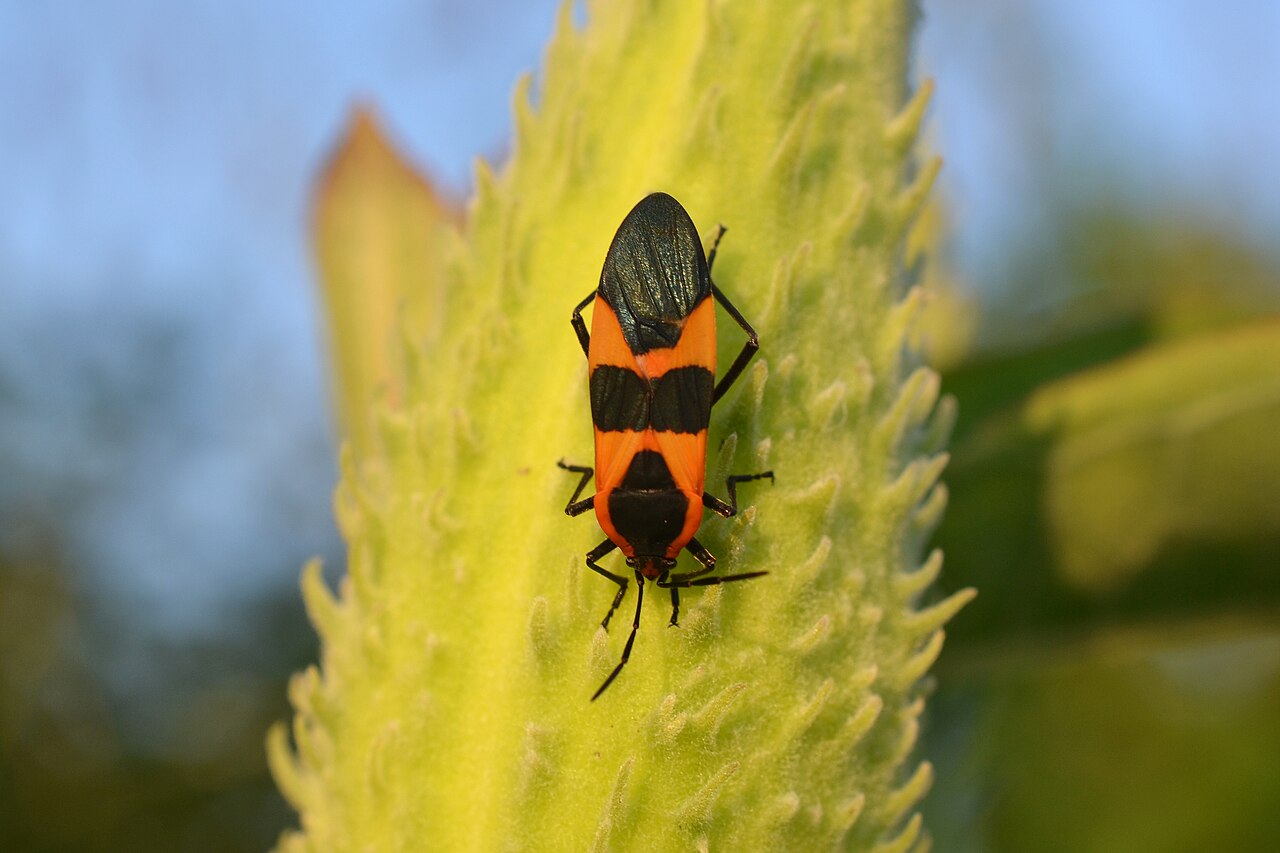
Large milkweed bugs are orange-red and black with a bold band pattern across the back, roughly 0.6 in long, and they cluster on milkweed seed pods in late summer. Small milkweed bugs are similar with an X-shaped black mark on the back. Both pierce seeds with a beak and drink the contents.
The color is aposematic, meaning it advertises toxicity rather than providing camouflage. Both species sequester cardiac glycosides from milkweed sap into their own tissue, which makes them unpalatable to birds and lizards. That is the same chemical defense monarch caterpillars use on the same plant.
The convergence across species is striking. Monarch butterflies, milkweed bugs, milkweed leaf beetles, and red milkweed beetles all feed on milkweed, all sequester the same toxins, and all advertise with the same red and black scheme. Predators that learn the lesson from one species avoid all of them, which is the point.
Milkweed Leaf Beetle: A Real Red and Black Beetle
The milkweed leaf beetle is a genuine beetle, rounded and domed like an oversized ladybug at 0.4 in, with an orange-red shell marked by irregular black blotches. The pattern varies enough between individuals that no two look identical, and some are almost entirely red while others are heavily marked. The straight seam down the back confirms the beetle identity.
It feeds exclusively on milkweed, chewing holes in the leaves rather than piercing them, and it deals with the plant’s sticky latex the same way monarch caterpillars do. The beetle cuts a leaf vein upstream of where it intends to feed, draining the pressure so the latex stops flowing. This behavior is called vein cutting and evolved independently in several milkweed specialists.
Populations are never large enough to damage a milkweed patch meaningfully. They overwinter as adults in leaf litter and emerge in spring alongside the first milkweed shoots. Gardeners growing milkweed for monarchs should leave them in place.
Red Milkweed Beetle and the Longhorn Group
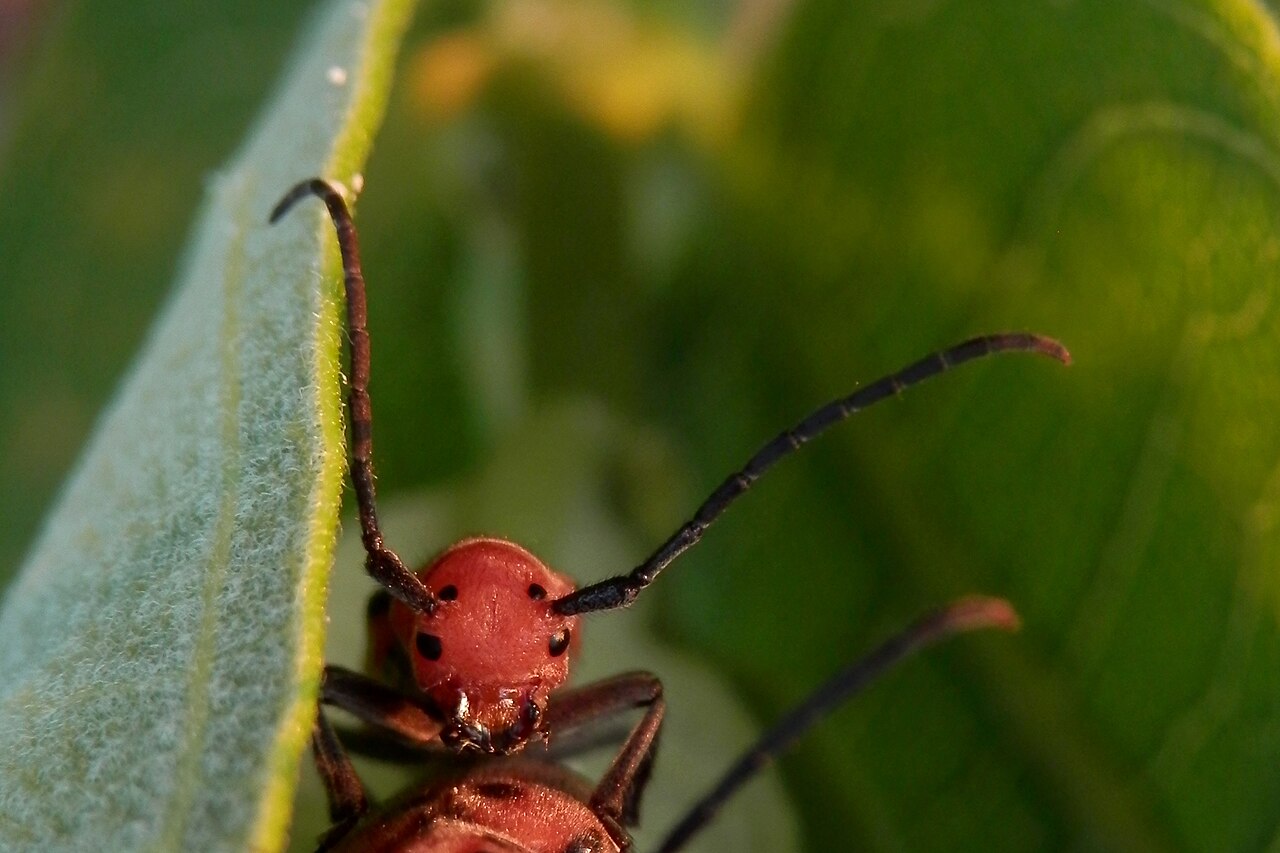
The red milkweed beetle is instantly recognizable by its antennae, which are as long as the body and set into the eyes in a way that splits each eye into two halves. The body is bright red-orange with four black spots on the wing covers and additional black marks on the head. Adults reach about 0.5 in.
The scientific name Tetraopes means four eyes, referring to that split. Adults feed on milkweed leaves and flowers while larvae bore into the roots, spending the winter underground before emerging as adults in early summer. Like everything else on milkweed, they carry the plant’s toxins.
Other longhorn beetles in the group show red and black patterns as well, including the locust borer, which mimics a yellowjacket in yellow and black rather than red. All longhorns are identifiable by antenna length, which exceeds half the body in every species. None of them bites people or damages structures.
Fire-colored Beetles and Net-winged Beetles
Fire-colored beetles are soft-bodied, elongated, and orange-red with a black head and dark wing covers in some species, reaching 0.8 in. Males have feathery comb-like antennae used to detect female pheromones. Larvae develop under the bark of decaying logs, which makes the group common in wooded areas with fallen timber.
Net-winged beetles take the pattern further, with broad flattened wing covers marked by a raised network of ridges and colored bright red-orange with black tips. They fly slowly and conspicuously, which only works because they are chemically defended. Several unrelated beetles mimic their appearance to borrow the protection.
Both groups are harmless and neither enters buildings in numbers. A red and black beetle found on a flower or on dead wood in a forest is far more likely to be one of these than any pest species. They are also good indicators of habitat quality, since both depend on standing and fallen dead wood.
Ladybugs With Red and Black Patterns
Ladybugs are the red and black beetles most people already recognize, though the pattern varies far more than the standard image suggests. The two-spotted ladybug is red with a single black spot on each wing cover, the seven-spotted is red with seven, and the convergent ladybug shows a variable number with two white marks behind the head.
The complication is the Asian lady beetle, an introduced species that ranges from pale yellow through orange to deep red with anywhere from zero to nineteen spots. It carries an M-shaped black mark on the white plate behind the head, which is the reliable separator. This is the species that gathers on walls and enters houses in fall.
Native ladybugs do not swarm buildings, so a red and black beetle clustering at a window in October is almost certainly the introduced species. The differences are worked through in the Asian lady beetle comparison, and the wider color range is covered in the ladybug look-alike guide.
Red and Black Beetle Larvae
Larvae in this group look nothing like the adults and are frequently reported as a separate infestation. Ladybug larvae are the most misidentified, elongated and spiky with a dark blue-gray body marked in orange, moving deliberately across leaves covered in aphids. They eat more aphids in the larval stage than they do as adults.
Milkweed leaf beetle larvae are soft, pale, and grublike, feeding on milkweed roots underground where they are almost never seen. Red milkweed beetle larvae do the same thing, boring into the root crown and overwintering there before pupating in spring. Neither causes noticeable damage to an established milkweed patch.
Boxelder bug juveniles are not larvae at all, since true bugs skip the grub stage entirely. They are bright red, wingless, and shaped like small adults, which is why a fall cluster contains individuals at several sizes and colors at once. The ladybug side of this is covered in the ladybug larvae guide.
Are Red and Black Beetles Harmful?
None of the insects in this group is dangerous to people. Boxelder bugs and milkweed bugs have piercing mouthparts built for plant tissue and do not bite humans in any meaningful way, though a boxelder bug held against skin can produce a brief prick. Neither transmits disease nor damages food, fabric, or structures.
Asian lady beetles are the one partial exception. They can deliver a weak nip that feels like a pinch, and the yellow defensive fluid they release stains light surfaces and triggers allergic rhinitis in sensitive people during heavy indoor infestations. Native ladybugs rarely cause either problem because they do not aggregate indoors.
Plant damage is minor across the board. Milkweed specialists feed on a plant that regrows readily, and boxelder bugs feeding on seeds do not affect tree health. University extension programs including University of Minnesota Extension classify boxelder bugs as a nuisance pest requiring exclusion rather than chemical treatment.
How to Get Rid of Red and Black Insects Indoors
Exclusion in late summer is the only approach that works long term. Seal cracks around window and door frames, repair damaged screens, caulk gaps where siding meets trim, and cover attic and soffit vents with fine mesh. Doing this in August, before the insects begin gathering, prevents the entire problem.
Exterior sprays applied to walls in fall give partial short-term reduction but need repeating and kill beneficial insects on the same surfaces. Indoor sprays accomplish nothing useful, since the insects entering living space are coming from wall voids that no surface treatment reaches. Vacuuming remains the practical indoor response.
Removing nearby female boxelder trees is sometimes suggested and rarely worth it. The insects fly considerable distances, so a neighbor’s tree supplies the same population, and mature shade trees have value that outweighs the nuisance. For a related indoor issue, the stink bug approach uses the same exclusion logic.
Identifying Red and Black Insects Step by Step
Start with the back seam. A straight line down the center means beetle, an X pattern from overlapping wings means true bug. This single check resolves the majority of cases and takes two seconds with a phone camera zoomed in.
Next check the setting. Hundreds clustered on a sunny wall in fall means boxelder bugs or Asian lady beetles, a handful on milkweed pods means milkweed bugs, and a single individual on a flower or dead log means a native beetle. Aggregation behavior is a strong signal on its own.
Finally check antennae and body shape. Antennae longer than the body mean a longhorn beetle, a domed round body means a leaf beetle or ladybug, and a flat elongated body means a true bug. Anyone comparing against darker species should also see the black beetle guide.
Related reading: small black beetle.
Frequently Asked Questions
What is the black beetle with red stripes on my house?
Almost certainly a boxelder bug, which is a true bug rather than a beetle. It is flat, about 0.5 in long, black with three thin red lines behind the head and red wing edges, and it gathers on sunny walls in fall. It causes no damage indoors and is handled by sealing gaps and vacuuming.
Are red and black beetles harmful to humans?
No. Boxelder bugs, milkweed bugs, and the native red and black beetles neither bite meaningfully, sting, transmit disease, nor damage food or fabric. Asian lady beetles can deliver a weak nip and release a staining fluid that triggers allergies in heavy indoor infestations, which is the only real concern in the group.
Why shouldn’t you squish a boxelder bug?
Crushed boxelder bugs leave a persistent orange stain on paint, curtains, and carpet and release a strong defensive odor that lingers. The stain is difficult to remove from porous surfaces. Vacuuming avoids both problems, and the bag should be emptied outdoors immediately.
What red and black bug lives on milkweed?
Four species share that plant and that color scheme: large and small milkweed bugs, which are true bugs feeding on seeds, and the milkweed leaf beetle and red milkweed beetle, which are genuine beetles chewing leaves and boring roots. All four sequester the plant’s toxins and advertise it with red and black.
How do I permanently get rid of boxelder bugs?
Seal the building before they gather, ideally in August. Caulk gaps around windows and doors, repair screens, close siding joints, and mesh attic and soffit vents. Exterior sprays give only temporary reduction, and indoor sprays do not reach the wall voids where the insects overwinter.
What is the difference between a beetle and a true bug?
Beetles have two hard wing covers meeting in a straight line down the back, chewing mouthparts, and a grub larval stage. True bugs have overlapping wings forming an X pattern, a triangular plate behind the head, a piercing beak, and juveniles that look like small wingless adults.