Asian Lady Beetle vs Ladybug: How to Tell Them Apart
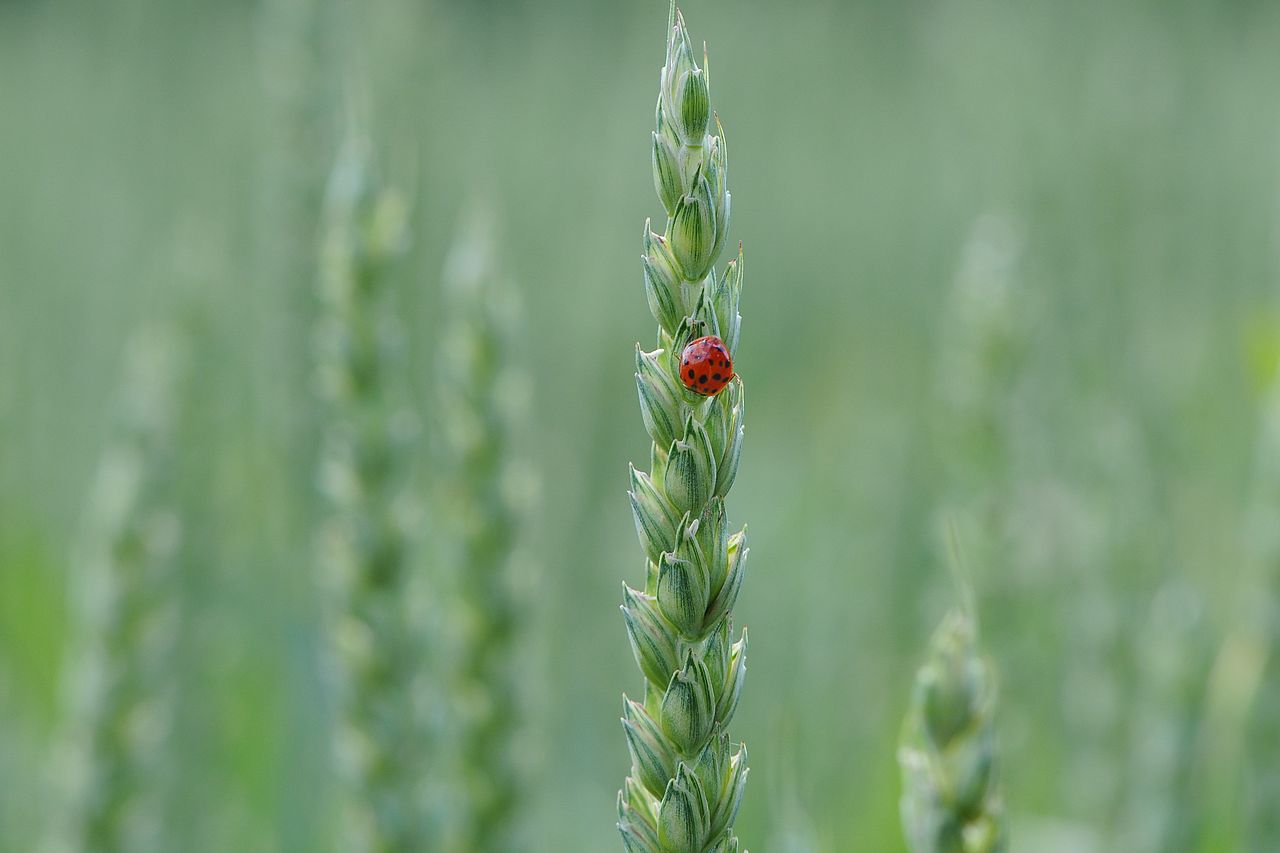
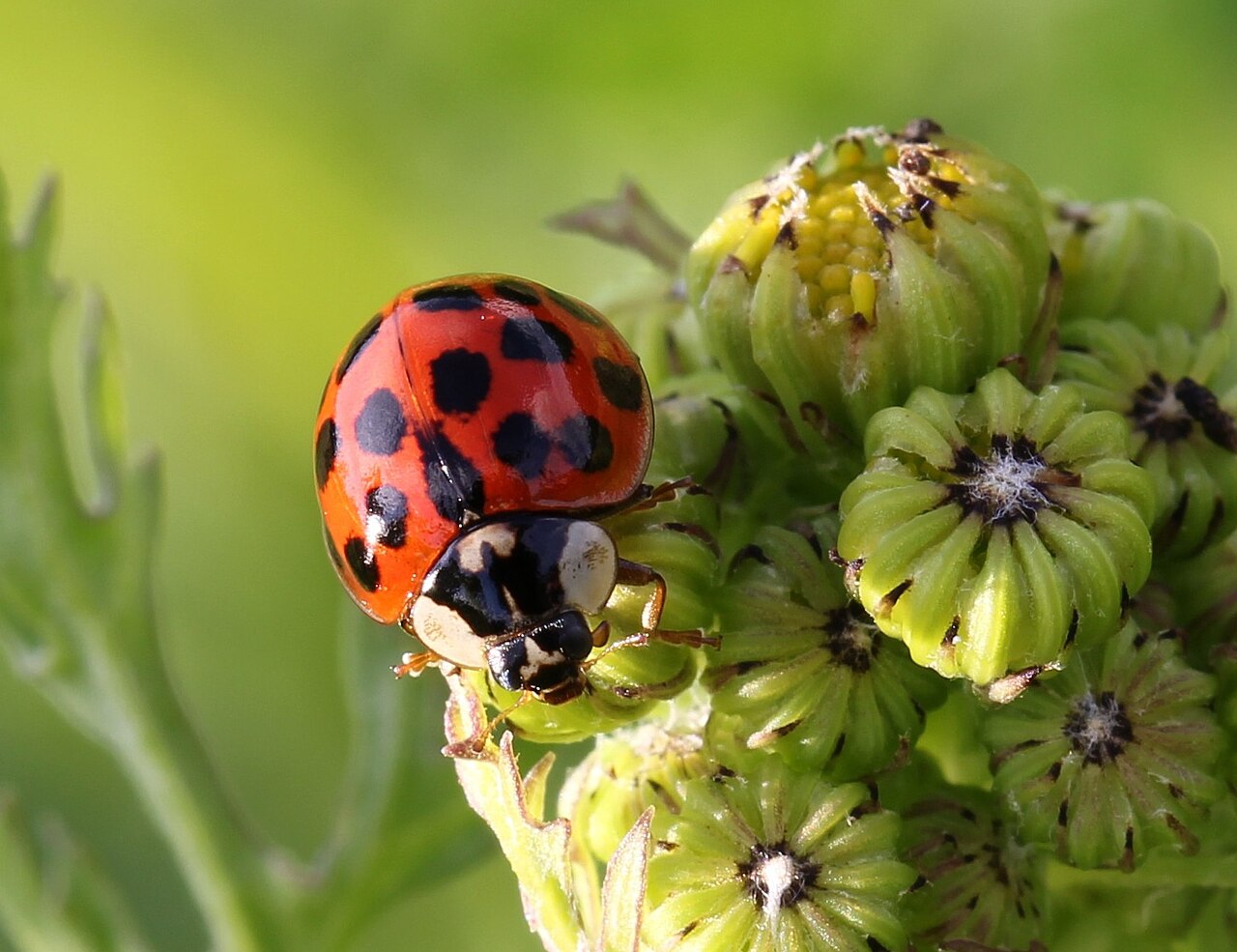
An Asian lady beetle and a native ladybug can look almost identical at first glance, but a few details separate them every time. The clearest tell is the black M or W shaped marking on the white area just behind an Asian lady beetle’s head, a mark native ladybugs never have. Asian lady beetles also range from pale yellow to deep red with anywhere from zero to nineteen spots, while native ladybugs are a uniform bright red with about seven neat, symmetrical spots. Behavior seals the identification: Asian lady beetles bite, swarm on sunny walls in fall, and invade homes for winter, while native ladybugs stay outdoors and never bite.
| Trait | Native Ladybug | Asian Lady Beetle |
| Head Marking | Black head, small white cheeks | Bold black M or W on white |
| Color Range | Uniform bright red or orange | Pale yellow to deep red |
| Spot Count | About 7, evenly spaced | 0 to 19, irregular |
| Bites Humans | No | Yes, occasionally |
| Enters Homes in Fall | No | Yes, in large numbers |
| Native to US | Yes, most species | No, introduced from Asia |
What Is a Native Ladybug?
Native ladybugs belong to the beetle family Coccinellidae, and North America is home to dozens of true native species. They are best known for their tidy, rounded shells in bright red or orange, topped with black spots that are usually symmetrical and number around seven per wing case. A ladybug’s head is mostly black with two small white patches that look almost like cheeks, and its body stays smooth, domed, and compact from every angle.
Gardeners welcome native ladybugs because a single adult can eat hundreds of aphids over its lifetime, along with mites, scale insects, and other soft bodied pests. They spend their entire lives outdoors, sheltering under bark, leaf litter, or garden debris rather than seeking out human structures. Because they evolved alongside local plants and prey, native ladybugs fill a balanced ecological role that keeps pest populations in check without becoming a nuisance themselves.
Unlike their Asian relatives, native ladybugs do not bite people and do not release a noticeable odor when handled. If you find a classic red beetle with neat black spots resting calmly on a leaf in your garden, it is almost certainly one of these beneficial natives, and the best response is simply to leave it undisturbed to keep hunting pests.
What Is an Asian Lady Beetle?
The Asian lady beetle (Harmonia axyridis) is a related but distinct species, native to eastern Asia and introduced to the United States in the early to mid 1900s specifically to control agricultural aphids. Early releases in several southern states, plus California, Pennsylvania, Connecticut, and Maryland, did not appear to take hold at first, but a wild population became established near New Orleans in the late 1980s and spread rapidly from there.
Today the Asian lady beetle, also called the multicolored Asian lady beetle, Japanese lady beetle, harlequin ladybird, or Halloween beetle, is found across nearly the entire continental United States and into parts of Canada. The Halloween beetle nickname comes from its habit of swarming onto warm, sun facing walls right around October, just as it searches for cracks and gaps to slip through before winter.
Because it was introduced deliberately as a pest control tool, the Asian lady beetle succeeded almost too well. It adapted quickly to North American climates and food sources, and its populations expanded far beyond the farmland it was originally meant to protect, eventually reaching backyards, garden centers, and homes nationwide.
Color and Spot Pattern Differences
Color is one of the fastest ways to start telling these two beetles apart, though it is not foolproof on its own. Native ladybugs keep a fairly consistent, bright red or orange tone across most individuals, with black spots that tend to be uniform in size and placed in a predictable, almost mirror image pattern on each wing cover.
Asian lady beetles are far more variable. Individuals can appear pale yellow, tan, orange, or deep red, sometimes all within the same local population, which is exactly why people often assume they are looking at several different species. This range even overlaps with the orange ladybug color variant, which adds another layer of confusion for anyone going by shell color alone. Spot count is just as inconsistent, ranging anywhere from zero spots at all up to nineteen, arranged with no real symmetry.
Because color and spot count vary so much in Asian lady beetles, relying on them alone can lead to misidentification. They are a helpful first clue, especially when you see a beetle that looks unusually pale or has an odd, uneven spot pattern, but the head marking described next is the detail that actually confirms the species.
The M or W Marking: The Fastest Way to Confirm ID
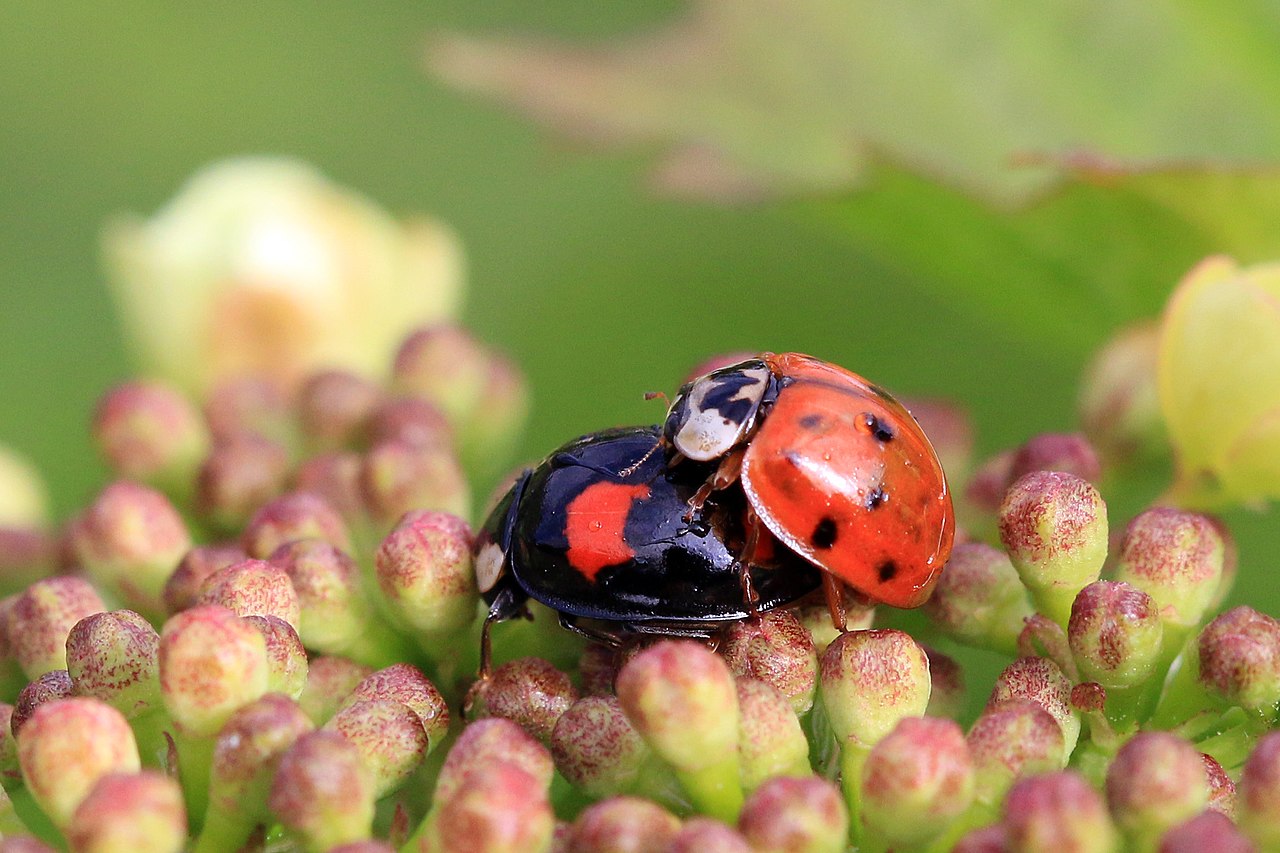
The single most reliable field mark is on the pronotum, the shield shaped plate just behind the head. Asian lady beetles show a bold, black M or W shaped marking (it reads either way depending on which end you view it from) set against a mostly white background. Native ladybugs simply do not have this marking; their pronotum is mostly black with only small white patches near the eyes.
This single feature works regardless of the beetle’s body color or spot count, which makes it far more dependable than color alone. Even a pale, nearly spotless Asian lady beetle will still carry that distinctive M or W, so a quick look at the head area is often all it takes to settle an identification on the spot.
If you want a fast field test, flip your attention away from the wing covers entirely and look only at that small white panel behind the head. A clean black head with tiny white cheek marks means native ladybug. A bold black M or W on white means Asian lady beetle, no matter how unusual the rest of its coloring looks.
Body Shape and Size Differences
Beyond color and markings, the two beetles differ subtly in shape. Native ladybugs are almost perfectly round and domed, giving them a compact, ball like profile from above. Asian lady beetles run slightly larger and more oval, with a body that looks a bit flattened and elongated by comparison.
Size differences are small but noticeable side by side. Native ladybugs typically measure around 5 to 7 millimeters in length, while Asian lady beetles usually run a touch longer, landing closer to 6 to 8.5 millimeters. On their own these size differences are hard to judge without a reference beetle nearby, so they work best as a supporting clue rather than a primary identification method.
The slightly flatter, more oval shape of the Asian lady beetle likely helps it squeeze into narrow cracks and gaps around window frames and siding, which ties directly into the home invading behavior covered next. A rounder, more domed body like the native ladybug’s is simply less suited to that kind of crevice hunting.
Behavior Differences: Biting, Swarming, and Home Invasion
Behavior is where the two species diverge most dramatically, and it is usually what prompts people to search for an identification in the first place. Native ladybugs do not bite, do not swarm in large numbers, and do not seek shelter inside homes. They spend the cold months tucked under bark or leaf litter outdoors and simply go unnoticed by most homeowners.
Asian lady beetles behave very differently. As outdoor temperatures drop in fall, they gather in large groups on warm, sun exposed walls, often on the south or west side of a house, searching for cracks around siding, window frames, and utility openings. Once inside wall voids or attics, they can emerge indoors throughout winter and again on warm days, sometimes in the hundreds.
They will also bite, usually a light pinch rather than a painful bite, and when threatened or crushed they release a yellowish defensive fluid with a strong, unpleasant odor that can trigger allergic reactions or asthma symptoms in sensitive people. Native ladybugs essentially never do either of these things, which makes bite reports and indoor swarms two of the most reliable behavioral signs that you are dealing with Asian lady beetles rather than true ladybugs.
Diet and Impact on Native Ladybug Populations
Both species eat much the same food, which is exactly why the Asian lady beetle was introduced in the first place. Aphids make up the bulk of the diet for both beetles, along with scale insects, mites, and other soft bodied plant pests, making each species genuinely useful in gardens and farm fields when their numbers stay reasonable.
The difference emerges in what else Asian lady beetles are willing to eat. Beyond aphids, they will prey on the eggs and larvae of other beetles, including native ladybug species, giving them a competitive edge in shared habitat. Researchers have linked the spread of Asian lady beetles to measurable declines in several native ladybug populations across North America over the past few decades.
This competitive pressure is one of the more overlooked costs of the original introduction. While Asian lady beetles do control aphids effectively, that benefit came paired with a longer term ecological trade off for native species that had no evolutionary experience with this particular competitor and predator. Homeowners doing a broader backyard bug inventory often find jumping spiders and house centipedes sharing the same garden beds, both of which are equally beneficial predators worth leaving undisturbed.
Larvae Differences
Both species pass through a larval stage that looks nothing like the familiar rounded, spotted adult, and this stage has its own set of identifying features. Native ladybug larvae have a smooth, grey body with a small spine and patches of red or orange, growing to roughly 1/25 to 3/8 of an inch before pupating, a process that takes about a month from hatching.
Asian lady beetle larvae are darker overall, ranging from dark grey to nearly black, with a noticeably longer spine and orange markings positioned both along the sides and down the middle of the body. They also grow larger than native ladybug larvae, reaching up to about 1/3 of an inch, and complete their larval stage faster, typically in 15 to 25 days.
Both larval forms molt four times before entering the pupal stage, and both are voracious aphid predators in their own right, often consuming more prey per day than the adults do. Recognizing the larval stage matters because these odd, spiky looking insects are frequently mistaken for pests and mistakenly removed from gardens where they are actually doing valuable pest control work.
Related reading: Yellow Ladybug.
Related reading: Ladybug Look Alike.
Related reading: Green Ladybug.
Related reading: Japanese Beetle vs Ladybug.
Frequently Asked Questions
Is an Asian lady beetle the same as a ladybug?
No. Both belong to the same beetle family, Coccinellidae, but the Asian lady beetle (Harmonia axyridis) is a distinct species introduced from Asia, while true ladybugs are native North American species with more consistent coloring and no head marking.
Do Asian lady beetles bite?
Yes, occasionally. Asian lady beetles can deliver a light pinching bite, especially when handled, though it rarely breaks skin. Native ladybugs essentially never bite people.
Why do Asian lady beetles invade homes in the fall?
They search for warm, sheltered spaces to survive winter and are drawn to sun facing walls where they can slip through small cracks around siding, windows, and utility openings before temperatures drop further.
Can you tell an Asian lady beetle from a ladybug by color alone?
Not reliably. Color varies widely in Asian lady beetles, from pale yellow to deep red, so the black M or W marking behind the head is a far more consistent identification feature.
Are Asian lady beetles harmful to gardens?
Not directly. They eat aphids and other pests like native ladybugs do, but their presence has been linked to declines in native ladybug populations due to competition and predation on native larvae and eggs.
What is the black M or W marking on lady beetles?
It is a marking on the pronotum, the plate just behind the head, unique to Asian lady beetles. Native ladybugs have a mostly black head with only small white cheek patches instead.
Are Asian lady beetles dangerous to pets?
They are not venomous or seriously dangerous, but the yellowish fluid they release when threatened can occasionally cause mouth irritation if a curious pet bites or chews on one.