What Do Jellyfish Eat? Diet, Stinging Cells, and Digestion
Jellyfish eat zooplankton, fish eggs, fish larvae, small crustaceans, and other jellyfish, catching prey with stinging cells on their tentacles and moving it to a single opening on the underside of the bell that serves as both mouth and anus. They have no brain, no heart, no blood, and no digestive tract in the usual sense.
Size scales the diet rather than changing it. A small moon jellyfish takes plankton; a lion’s mane jellyfish with tentacles running to a hundred feet takes fish and other jellyfish. What stays constant is the method, which is passive: jellyfish drift and pulse, and prey collides with the tentacles rather than being pursued. This guide covers the diet, the stinging cells, digestion, what eats them, and the bloom question.
Jellyfish eat zooplankton, fish eggs and larvae, small crustaceans, and other jellyfish, catching prey with stinging cells called nematocysts on the tentacles. A single opening on the underside serves as mouth and anus. They have no brain or heart, are around 95 percent water, and catch prey passively rather than hunting.
| Aspect | Jellyfish Feeding |
|---|---|
| Main diet | Zooplankton, fish eggs and larvae, crustaceans |
| Large species | Fish and other jellyfish |
| Capture | Nematocysts on tentacles; passive drift |
| Mouth | Single opening; also the anus |
| Body water content | About 95 percent |
| Brain and heart | Neither; a nerve net instead |
| Main predators | Sea turtles, ocean sunfish, seabirds, other jellyfish |
What Do Jellyfish Eat?
Whatever drifts into them at the right size. The core diet across most species is zooplankton, meaning copepods and other tiny crustaceans, along with fish eggs, newly hatched fish larvae, small molluscs, and the eggs and larvae of other invertebrates.
Larger species take larger prey. Lion’s mane jellyfish, among the largest in the world, take fish and other jellyfish, and several species are specialist jellyfish eaters, with the comb jelly and some true jellyfish consuming their own kind readily. Sea nettles are significant predators of fish eggs and larvae in some estuaries.
A few do something different. Upside-down jellyfish rest on the seabed with their bells down and tentacles up, hosting symbiotic algae in their tissues and getting a large share of their energy from photosynthesis, which is the same arrangement corals use. They still catch plankton but they are partly solar-powered. The sea turtle guide covers the animal that depends on them most.
How Do They Catch Prey Without a Brain?

With stinging cells that fire on contact. The tentacles are covered in nematocysts, capsules containing a coiled harpoon-like thread under enormous internal pressure, and when a trigger structure is touched the thread everts in microseconds, penetrating the prey and injecting venom.
The firing is not a decision. Each nematocyst operates independently, responding to a combination of chemical and mechanical cues from the prey, which means a jellyfish does not need a brain to hunt because the hunting happens at the cellular level. That is why a detached tentacle on a beach can still sting.
What the animal does have is a nerve net, a diffuse ring of neurons around the bell edge coordinating swimming and the transfer of captured prey to the mouth. Box jellyfish are the exception in complexity, with twenty-four eyes including some with lenses and retinas, and they actively swim and avoid obstacles rather than purely drifting.
Do Jellyfish Have a Mouth?
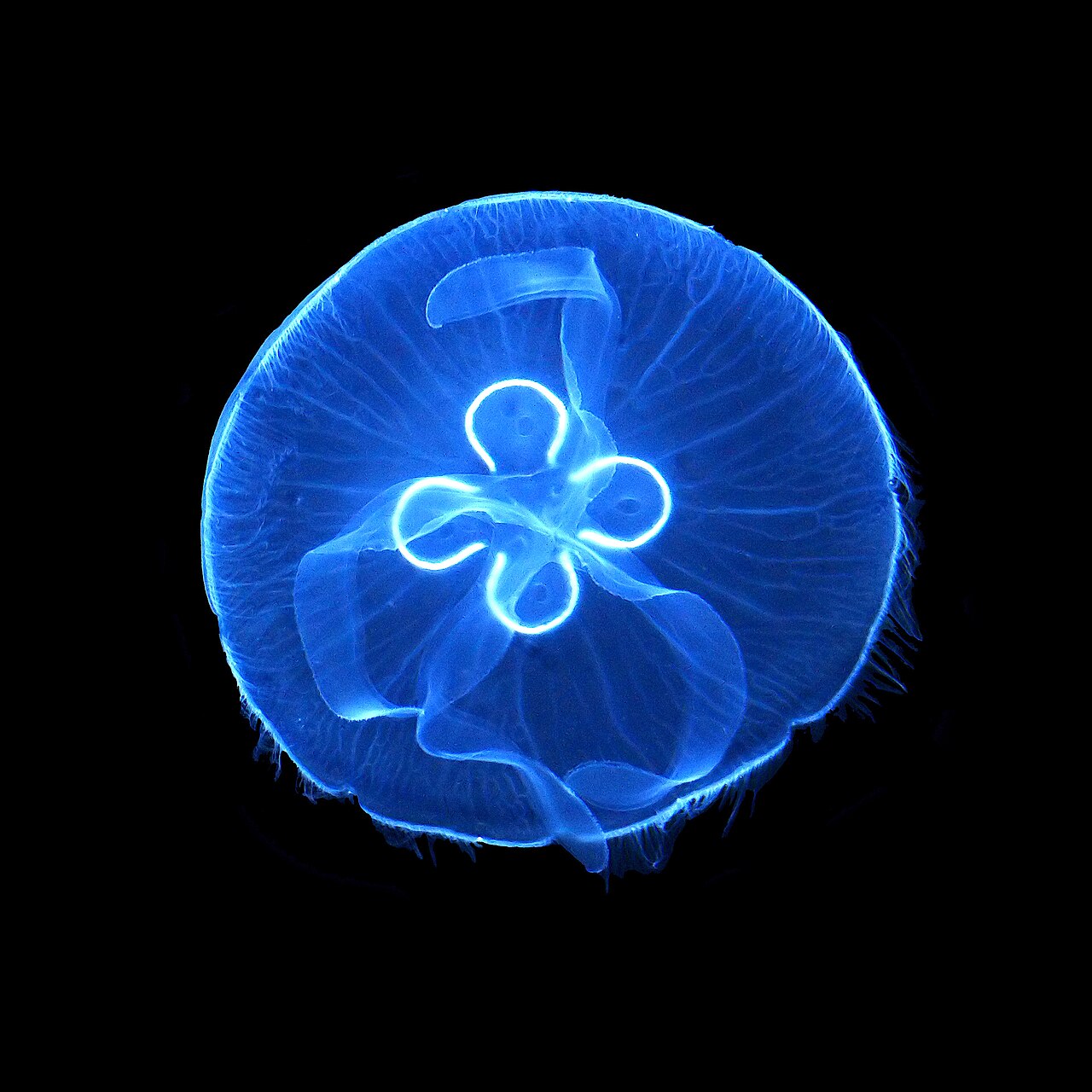
One opening, doing both jobs. Food enters through a mouth on the underside of the bell into a simple gastrovascular cavity where enzymes break it down, nutrients are absorbed, and waste is expelled back out through the same opening.
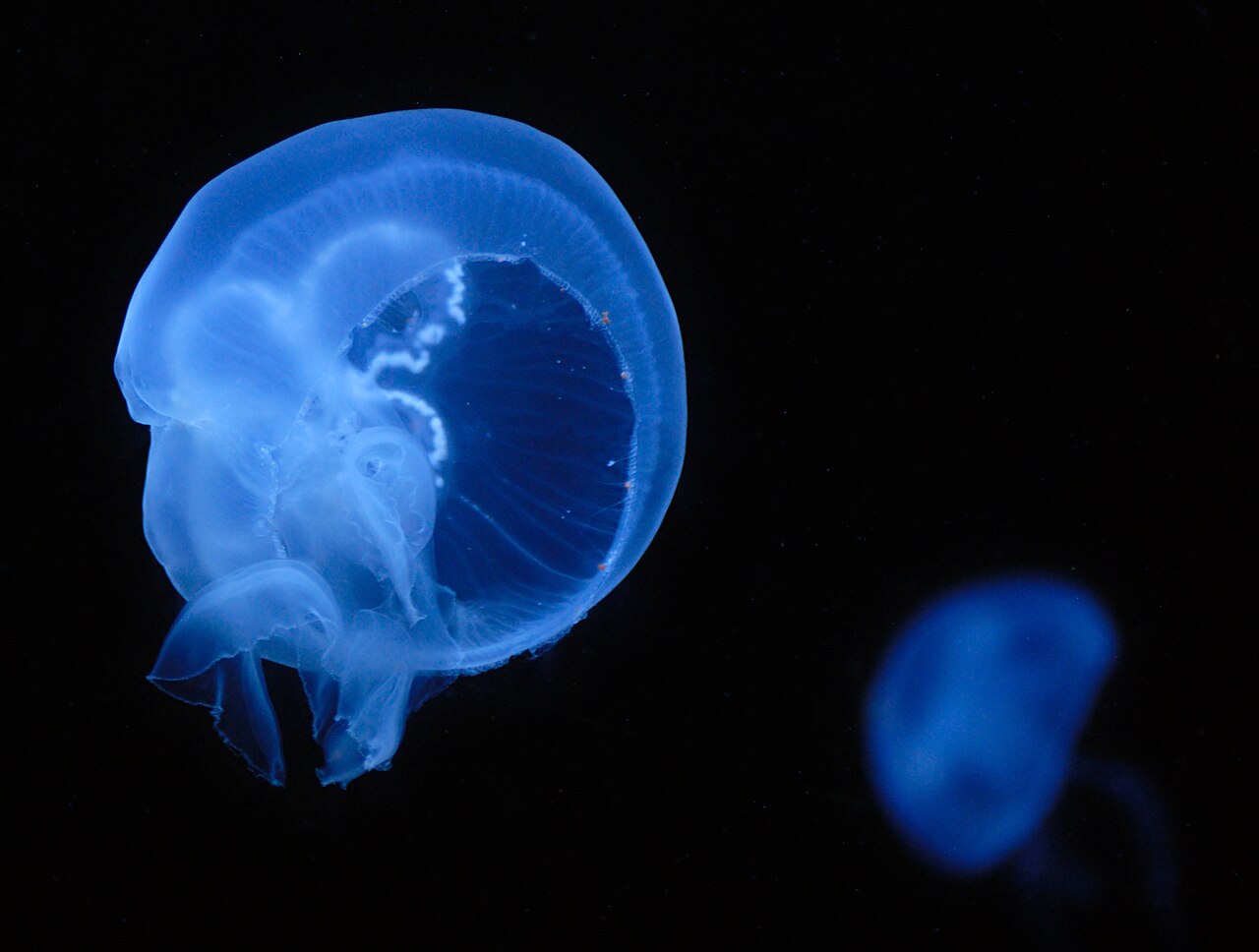
Oral arms do the handling. The frilly structures hanging below the bell are not tentacles but oral arms, and they move captured prey from the stinging tentacles to the mouth, in some species also catching plankton directly on mucus-covered surfaces.
Digestion is fast, and it has to be. A jellyfish cannot swim efficiently while heavy with food, so a meal is processed in a few hours, and this is why washed-up jellyfish deflate so quickly and why a jellyfish that has fed heavily hangs lower in the water. The guide to birds that eat fish covers the seabirds that take them at the surface.
How Often Do They Eat?
Continuously, in effect. A drifting jellyfish is fishing the entire time it is in the water column, and it feeds opportunistically as prey encounters the tentacles rather than in discrete meals.
Feeding rate scales with prey density, and in a rich plankton bloom a jellyfish can consume a remarkable proportion of its own body weight daily. That capacity is part of what makes jellyfish blooms ecologically significant: a dense aggregation can strip zooplankton and fish larvae from an area faster than the system replaces them.
They also tolerate starvation unusually well. A jellyfish deprived of food shrinks, reabsorbing its own tissue and reducing in size while staying alive, then grows again when food returns. That reversible shrinkage is unusual among animals and is one reason jellyfish persist through poor conditions that kill fish.
What Eats Jellyfish?
More than the low nutritional value suggests. Leatherback sea turtles are the specialists, feeding almost entirely on jellyfish and equipped with backward-pointing spines in the throat that prevent slippery prey escaping, and an adult leatherback eats hundreds of pounds of jellyfish a day.
Ocean sunfish are the other major consumer, along with several seabirds including fulmars and albatrosses, some sharks, tuna, swordfish, and various crabs. Other jellyfish are significant predators too, and some sea slugs eat cnidarians and store the stinging cells in their own tissues for defence, in the same way the monarch butterfly stores toxins from milkweed.
Small fish use them differently. Juveniles of many species shelter among the tentacles, unharmed by the stings through mucus adaptations or by careful positioning, using the jellyfish as mobile cover from predators and sometimes nibbling at it. That relationship is common enough to be a recognisable pattern in open water.
Are Jellyfish Mostly Water?
About 95 percent, which explains a great deal about them. A stranded jellyfish reduces to a thin film because there is almost nothing solid in it, and the low organic content is why they were long assumed to be a nutritional dead end in food webs.
That assumption has been revised. Research using camera traps on the seabed and stomach content analysis has found far more jellyfish predation than previously recorded, and the term jelly-falls describes the sinking of dead jellyfish blooms that deliver substantial carbon to deep-sea communities.
The structure is simple in proportion. Two cell layers separated by mesoglea, a jelly-like substance that is mostly water with a protein and collagen framework, no bones, no shell, no respiratory or circulatory system, with oxygen diffusing directly across the body surface.
Do Jellyfish Blooms Matter?
Yes, and increasingly. Large aggregations clog power station and desalination plant intakes, causing shutdowns, burst fishing nets, kill farmed salmon, and close beaches, and several high-profile incidents have taken large facilities offline for days.
The ecological effect is the bigger question. Blooms consume fish eggs and larvae in quantity, competing with fish for zooplankton at the same time, which can suppress recovery of fish stocks in a feedback loop. Overfishing removes both jellyfish predators and their competitors, warming water extends breeding seasons, and nutrient runoff creates low-oxygen zones that jellyfish tolerate better than fish.
Whether blooms are globally increasing is genuinely contested, with some researchers arguing the apparent rise reflects better observation and long natural cycles rather than a trend. What is not disputed is that regional increases have occurred and that the conditions favouring jellyfish are becoming more common.
What Is Their Life Cycle?
Two completely different body plans in one species. Fertilised eggs develop into a swimming larva that settles on the seabed and becomes a polyp, a small stalked animal resembling a tiny sea anemone, and the polyp can persist for years while budding off clones.
The familiar jellyfish is the second stage. Under the right conditions the polyp undergoes strobilation, stacking up like a pile of saucers and releasing tiny juvenile medusae one after another, which grow into the adult jellyfish. A single polyp can release dozens.
That explains sudden blooms. The polyp stage is invisible on the seabed, so a population that has been present for years can produce enormous numbers of medusae within weeks when temperature and food conditions trigger strobilation. Nothing arrived; the standing stock simply changed form. The alligator snapping turtle guide covers another aquatic animal with a slow, low-energy strategy.
Are Jellyfish Immortal?
One species comes close, and the claim gets applied far too broadly. Turritopsis dohrnii, a jellyfish a few millimetres across, can revert from the adult medusa stage back to the juvenile polyp stage under stress or injury, a process called transdifferentiation, and then develop into adults again.
That is biological immortality in the sense of no fixed lifespan from ageing, not invulnerability. The animal is still eaten, still killed by disease, and still dies in the vast majority of cases, and the reversal has been demonstrated in laboratory conditions rather than tracked in wild populations.
Ordinary jellyfish do not do this. Most species live a few months to a year as adults, with the polyp stage on the seabed persisting far longer and budding off new medusae, which is why a bloom can appear suddenly from a population that was invisible on the substrate. NOAA (noaa.gov) publishes species information and bloom monitoring for US waters, and the softshell turtle guide covers another aquatic species with an unusual body plan.
Frequently Asked Questions
What do jellyfish eat?
Zooplankton, fish eggs and larvae, small crustaceans, and other jellyfish. Larger species take fish, and upside-down jellyfish get much of their energy from symbiotic algae instead.
Do jellyfish have a mouth?
One opening on the underside of the bell serves as both mouth and anus, leading into a simple cavity where food is broken down and waste is expelled back out the same way.
How do jellyfish catch prey without a brain?
Stinging cells called nematocysts fire automatically on contact, driven by chemical and mechanical cues at the cellular level. A nerve net coordinates swimming and moving prey to the mouth.
What makes 95 percent of a jellyfish?
Water. The body is two cell layers separated by mesoglea, a jelly of water with a protein and collagen framework, with no bones, blood, heart, or respiratory system.
What eats jellyfish?
Leatherback sea turtles above all, plus ocean sunfish, several seabirds, some sharks, tuna, swordfish, crabs, and other jellyfish. Juvenile fish shelter among the tentacles without being stung.
Can a dead jellyfish still sting?
Yes. Nematocysts fire on contact rather than on command and remain functional in stranded animals and detached tentacles for hours or days. Never handle one on a beach.
Which jellyfish never dies?
Turritopsis dohrnii can revert from adult to juvenile polyp under stress and redevelop, so it has no fixed ageing lifespan. It is still eaten and still dies; most species live under a year.

Similar Posts
Bobcat Poop: Identification and How It Differs From Coyote
Bobcat poop is segmented with blunt ends and packed with fur. How to tell it from coyote, house cat and raccoon droppings, why bobcats leave it on rocks, and the toxoplasmosis risk.
Squirrel Poop: Identification and How It Differs From Rat
Squirrel droppings are rounded pellets about 0.375 inches long. Here is how to tell them from rat, mouse and chipmunk droppings, and how to clean them up.
Chipmunk Poop: Identification and Comparison Guide
Chipmunk droppings are small dark pellets you rarely see, because chipmunks use burrow latrines. Here is how to identify them and what they mean.
What Do Snails Eat? Complete Diet Guide by Type
A species-by-species breakdown of what snails eat in the wild, in aquariums, and as pets, plus calcium needs and unsafe foods.
Baby Hedgehog: Hoglet Facts, Growth, Diet, and Care
A baby hedgehog is called a hoglet. Here is how they develop, what they eat, why there are none in the wild in North America, and how care works.
Baby Jumping Spider: Spiderling Growth, Care, and Egg Sacs
A baby jumping spider is called a spiderling: pinhead-sized, fully independent, and hunting from day one. Growth, egg sacs, ballooning, and pet-keeper basics.