Clover Mite: Why They Appear and How to Stop Them
Clover mites are tiny bright red mites, smaller than a pinhead at about a fifth of a millimetre, that appear in large numbers on sunny walls, windowsills, and around windows in spring and autumn. They feed on grass and clover, do not bite, do not carry disease, and cannot survive indoors, but they leave a red stain when crushed.
That stain is what people notice and what makes them alarming. It is body pigment rather than blood, since clover mites feed on plants, but it marks curtains, carpets, and painted surfaces and is difficult to remove. Killing them by squashing therefore creates the problem it was meant to solve. This guide covers identification, why they appear, the confusion with chiggers and bed bugs, and how to deal with them.
Clover mites are bright red plant-feeding mites under a millimetre long that invade buildings in spring and autumn. They do not bite, do not carry disease, and die indoors within days. Crushing them leaves a red stain from body pigment, not blood, so vacuum rather than squash. Removing turf and plants right against the foundation is the durable fix.
| Feature | Clover Mite |
|---|---|
| Size | About 0.2 mm; smaller than a pinhead |
| Colour | Bright red to reddish-brown |
| Distinctive feature | Very long front legs, often mistaken for antennae |
| Bite | None; they feed on plants |
| Red stain | Body pigment, not blood |
| Peak | Spring and autumn; warm sunny walls |
| Indoors | Cannot feed or survive; die in days |
What Are Clover Mites?
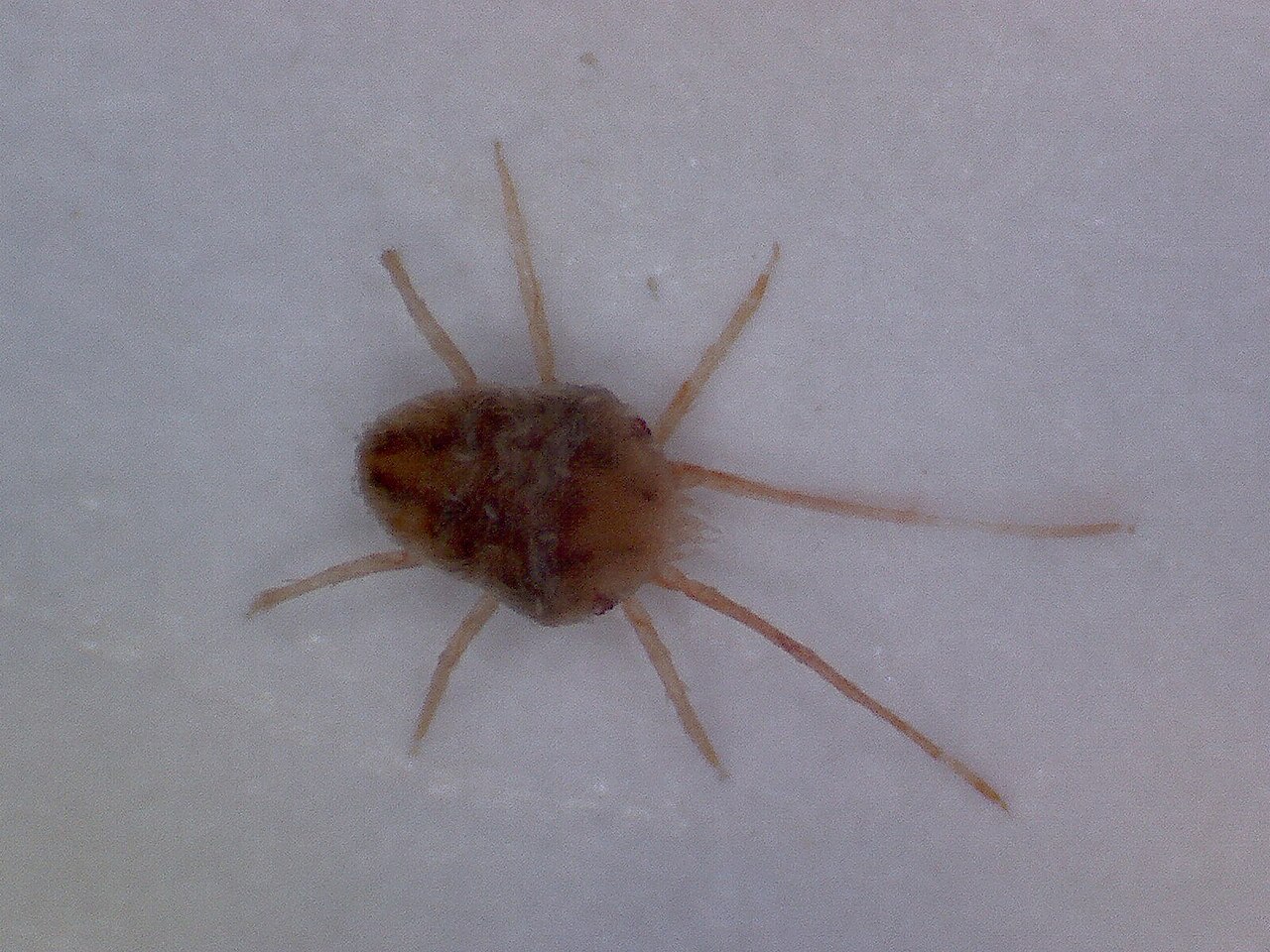
Plant-feeding mites in the same family as spider mites, and despite the name they feed on a wide range of grasses, clover, and other lawn and ornamental plants rather than clover alone. Adults are about a fifth of a millimetre long and bright red to reddish-brown.
The identifying feature is the front pair of legs, which are conspicuously longer than the others and are held forward, so they look like antennae. Mites have no antennae, and this is one of the few reliable ways to distinguish a clover mite from other small red arthropods at low magnification.
They are also all female. Clover mites reproduce by parthenogenesis, with no males known, and each female lays around seventy eggs, which is a large part of why populations build so quickly on a favourable lawn. Eggs are laid in cracks in foundations, bark, and paving and can lie dormant through unfavourable weather. The red house spider guide covers the other red arthropod people find indoors.
Do Clover Mites Bite?
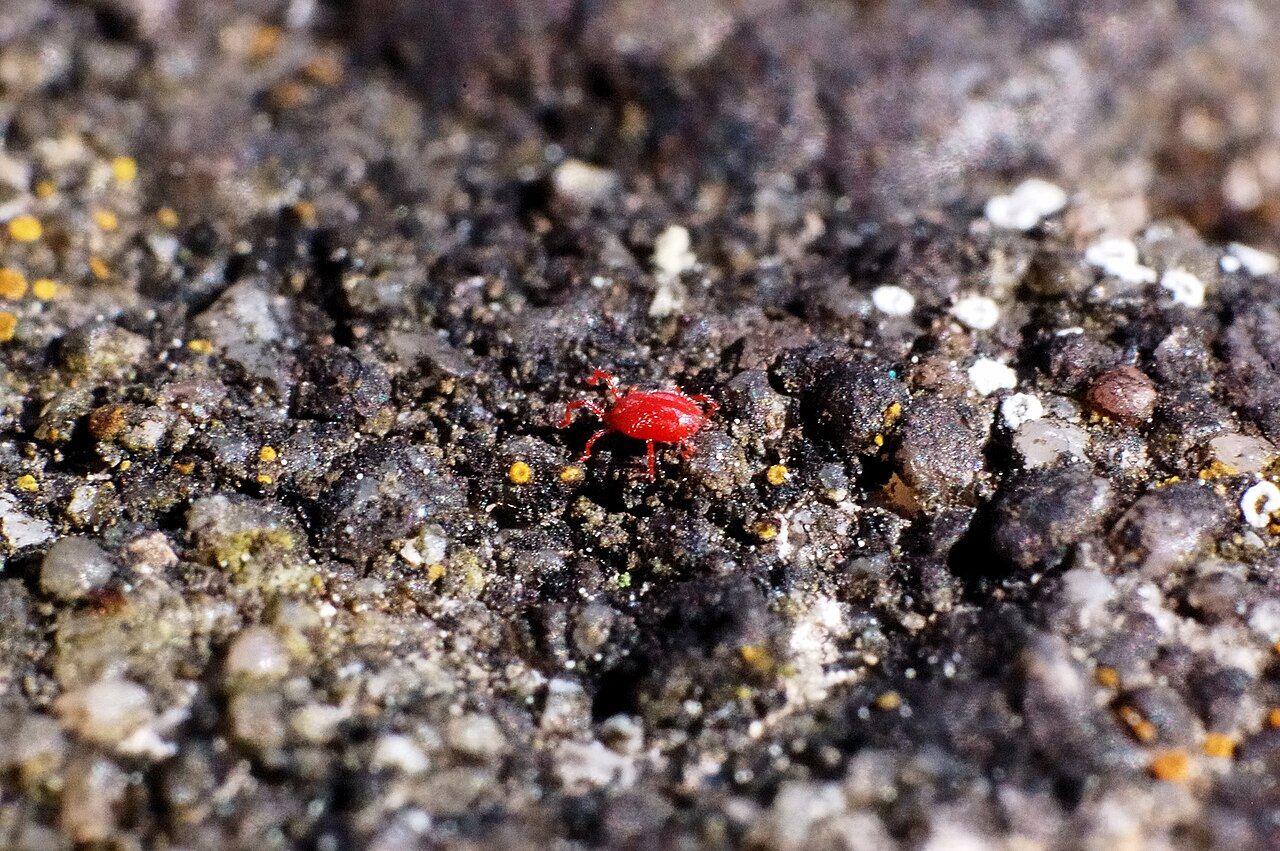
No. Clover mites have mouthparts built for piercing plant cells and sucking sap, and they cannot bite skin, do not feed on blood, and are not parasites in any sense. There is no medical significance to having them crawl on you.
The confusion with biting mites is understandable but wrong. Chiggers are larval mites that do attach to skin and cause intense itching, are orange-red, and are found in grass and vegetation outdoors in summer rather than swarming on walls. Bird and rodent mites bite people when a host nest is abandoned, and those are genuine causes of unexplained itching.
The reported itching from clover mites is generally either coincidental or a mild irritation from the sheer number of tiny legs on skin. If bites are genuinely occurring, the culprit is something else, and identifying it properly matters because the treatments differ completely. The chigger bites vs flea bites guide covers the actual biters.
Why Do They Come Inside?

Temperature and moisture, at both ends of the season. Clover mites are most active in cool weather and become abundant in spring and autumn, and they migrate off the lawn when conditions change, either as summer heat and drought dry out their food or as autumn cold sets in.
They orient toward warm sunlit surfaces, so south and west-facing walls take the worst of it, and they enter through the same tiny gaps that everything else uses: around window frames, under siding, through weep holes, and beneath door thresholds. A single mite needs almost no gap at all.
The pattern is strongly tied to lawn condition. Buildings with thick, well-fertilised turf and dense plantings running right up to the foundation get them badly, and heavily fertilised lawns in particular support very high mite populations, since nitrogen-rich grass is exactly what they feed on.
How Do You Get Rid of Them?
Vacuum, do not squash. A vacuum with a hose attachment removes them from windowsills, walls, and carpet without staining, and the contents should go straight outside afterwards. A damp cloth also works if wiped rather than rubbed.
Soapy water in a spray bottle kills them on contact for larger concentrations on a windowsill, and it does not stain the way crushing does. Indoor insecticide is unnecessary because the mites cannot survive indoors anyway and will die within a few days without plant material.
For an ongoing problem, an exterior barrier treatment applied to the foundation and lower wall by a professional in early spring or autumn reduces numbers, but it is a supplement to habitat modification rather than a substitute. The mites keep coming from the lawn as long as the lawn supports them. The guide to getting rid of stink bugs covers the same exclusion logic for a larger invader.
Why Do They Leave a Red Stain?
Because their body pigment is red. Clover mites feed on plants and have no blood in the vertebrate sense, so the mark left by a crushed mite is pigment from the body contents rather than anything ingested, which is worth knowing because the assumption that it is blood drives a lot of unnecessary alarm.
The stain matters practically. Crushed mites mark curtains, blinds, painted walls, carpet, and upholstery, and the pigment sets into porous surfaces, so a wall wiped after squashing a hundred mites can be permanently spotted.
That is the whole argument for vacuuming. Removing them intact avoids the stain entirely, and since they cannot reproduce or survive indoors there is no reason to kill them in place. If stains have already occurred, treat them as you would any protein stain: cold water and a mild detergent, blotting rather than rubbing.
Are They Harmful to Plants?
Occasionally, at high densities. Clover mites feed by piercing plant cells and draining the contents, which produces a silvery or stippled appearance on grass blades and can cause patchy discolouration in lawns, particularly on the sunny side of a building where they concentrate.
Damage is usually cosmetic and temporary. Grass recovers as mite numbers fall with the change of season, and the discolouration is often mistaken for drought stress or fertiliser burn. Serious lawn damage from clover mites is uncommon.
They also feed on ornamental plants, shrubs, and occasionally fruit trees without generally causing significant harm. The one management note is fertiliser, since heavily nitrogen-fertilised turf supports substantially larger populations, so easing back on feeding on the affected side of a house reduces the source.
What Else Looks Like Them?
Spider mites are the closest relatives and look similar but are usually found on plant foliage rather than on walls, often with fine webbing, and are more often greenish or yellowish than bright red. Red velvet mites are much larger, velvety, and are predators rather than plant feeders.
Chiggers are the important distinction because they genuinely bite. They are orange-red larval mites, occur in vegetation outdoors in summer, attach to skin at tight clothing lines, and cause intense itching that starts hours after exposure. They do not swarm on walls in spring.
Bird and rodent mites are the other genuine biters and are the diagnosis worth considering if itching is real and persistent. They appear after a bird or rodent nest in a roof or wall is abandoned, are grey or pale until fed, and the solution is removing the nest rather than treating the room. University extension programmes such as the University of Minnesota (umn.edu) publish identification keys for household mites.
Can They Get Into a Bed?
They can end up there but they do nothing once they arrive. Clover mites crawl across floors, walls, and furniture when they enter a room, so finding one on bedding is possible, particularly near a window, but they do not bite, do not feed on people, and do not colonise mattresses.
That distinction matters because the question usually comes from someone who thinks they are being bitten at night. Bed bugs leave dark reddish-brown smears on sheets and cluster in mattress seams; bird and rodent mites arrive from an abandoned nest in the roof or wall; scabies mites burrow and cause intense itching that is worse at night.
None of those are red specks on a windowsill in spring. If itching is genuine and persistent, the correct step is identifying the actual cause, because treating a room for clover mites when the problem is a starling nest in the soffit achieves nothing. The bed bug bites guide covers the diagnosis people most often reach for.
Will They Come Back?
Yes, seasonally, unless the habitat changes. Clover mites are on the lawn all year at some level, and they will migrate again in the next cool wet spring or the next autumn, so a single treatment resolves the current wave rather than the situation.
What breaks the cycle is the plant-free strip at the foundation combined with sealing gaps around windows and doors and easing off lawn fertiliser on the affected side. Those three together generally reduce a recurring problem to an occasional one.
Perspective helps as well. Clover mites are harmless, cannot establish indoors, damage nothing beyond cosmetic lawn stippling, and disappear within days once inside. They are a nuisance defined almost entirely by their numbers and by the stain, and treating them as a health threat leads to chemical use that is disproportionate to the actual problem. The carpet beetle larvae guide covers a household arthropod that does warrant more effort.
Frequently Asked Questions
Are clover mites harmful?
No. They do not bite, carry no disease, cannot survive indoors, and damage nothing except occasional cosmetic stippling on heavily infested lawns. The stain from crushing them is the real nuisance.
Do clover mites bite humans?
No. Their mouthparts pierce plant cells to drink sap and cannot penetrate skin. Genuine bites indicate something else, most often chiggers or bird and rodent mites from an abandoned nest.
How do you kill clover mites?
Vacuum them rather than squashing, or spray soapy water on concentrations. Indoor insecticide is unnecessary since they die within days without plants. Clear a plant-free strip at the foundation to stop the source.
Why do clover mites leave a red stain?
Their body pigment is red. They feed on plants and have no blood, so the mark is body contents rather than anything ingested, and it sets permanently into curtains, carpet, and paint.
Are clover mites the same as chiggers?
No. Chiggers are larval mites that attach to skin and cause intense itching, occur in outdoor vegetation in summer, and do not swarm on walls. Clover mites feed only on plants.
Why do I suddenly have clover mites?
They migrate off lawns in spring and autumn as conditions change, orienting to warm sunlit walls. Heavily fertilised turf running right up to the foundation supports the largest populations.
Will clover mites come back?
Seasonally, unless the habitat changes. A plant-free strip at the foundation, sealed gaps around windows, and less lawn fertiliser on the affected side reduce it to an occasional event.

Similar Posts
Black and Yellow Caterpillar: Species Identification Guide
Black swallowtail, monarch, cinnabar moth, and more. How to tell these common black-and-yellow caterpillars apart and which ones are safe to touch.
Snake Poop: Identification & What It Looks Like
How to identify snake droppings, why they have a white chalky cap, and how to tell them apart from bird and rodent droppings.
Baby Hedgehog: Hoglet Facts, Growth, Diet, and Care
A baby hedgehog is called a hoglet. Here is how they develop, what they eat, why there are none in the wild in North America, and how care works.
Frog Poop: What It Looks Like and How to Identify It
Frog poop is a dark cylindrical pellet with blunt ends, packed with insect parts. How to tell it from rat and mouse droppings, whether it is dangerous, and how to clean it up.
Spider Poop: What It Looks Like and How to Clean It
Spider poop is a small dark splatter that dries hard on walls below webs. How to tell it from mouse droppings and mold, whether it stains, and how to remove it safely.
What Do Crickets Eat? Wild Diet & Feeder Care Guide
What crickets eat in the wild, as pets, and as gut-loaded reptile feeders, plus safe hydration and what nymphs need.