How to Get Rid of Stink Bugs: What Actually Works
Sealing the building is the only method that reliably keeps stink bugs out, and everything else is cleanup. Brown marmorated stink bugs enter through gaps as small as a fifth of an inch around windows, doors, siding, vents, and utility penetrations in autumn, and once inside a wall void there is no spray that reaches them.
Indoors, the practical tools are a vacuum with a stocking rigged in the hose and a jar of soapy water, not insecticide. Squashing releases the defensive fluid that stains and smells, and crushing them near an entry point is worse than useless. This guide covers exclusion, removal, what genuinely kills them, the scents question, and why they come in such numbers.
Sealing gaps around windows, doors, siding, vents, and utility penetrations before autumn is the only reliable way to keep stink bugs out. Indoors, vacuum them with a stocking in the hose or drop them into soapy water, which kills on contact. Insecticides do not reach bugs in wall voids, and squashing releases a staining defensive fluid.
| Method | Effectiveness |
|---|---|
| Sealing gaps before autumn | The only reliable prevention |
| Soapy water | Kills on contact; best indoor removal |
| Vacuum with stocking in hose | Effective; avoids tainting the machine |
| Squashing | Avoid; stains and smells persistently |
| Indoor insecticide | Does not reach bugs in wall voids |
| Light traps | Modest help indoors in winter |
| Scent repellents | Little reliable evidence |
What Kills Stink Bugs Instantly?
Soapy water. A jar of water with a squirt of dish soap kills stink bugs on contact by breaking surface tension so the insect cannot stay afloat or breathe through its spiracles, and it works within seconds. Hold the jar beneath the bug and touch it, since stink bugs drop when disturbed and fall straight in.
That drop reflex is the whole technique. Trying to catch one from above makes it fly; approaching from below and letting it fall works nearly every time, and it avoids handling entirely. A wide-mouthed jar kept on a windowsill through autumn deals with most of them.
What does not work well is spraying inside the house. Contact aerosols kill the bug in front of you but do nothing about the hundreds in the wall void, they leave residue in living space, and dead insects accumulating inside walls attract carpet beetles and other secondary pests. The carpet beetle larvae guide covers that follow-on problem.
Why Should You Never Squish One?
Because the defensive glands release an oily aldehyde mixture that stains and lingers. The smell is sharp and persistent, often compared to coriander, and it clings to hands, fabric, carpet, and paint in a way that takes repeated cleaning to remove.
Staining is the underrated part. The fluid is yellow-orange and marks light-coloured walls, curtains, blinds, and upholstery permanently, so a squashed bug on a windowsill or a lampshade leaves a visible mark long after the smell has gone.
The claim that crushing one attracts more is weaker than commonly stated. Stink bugs do use aggregation pheromones to gather at overwintering sites, but the defensive secretion released by crushing is a different chemical set, and the evidence that it directly recruits others is thin. Either way, adding chemical signal to a wall you are trying to make unattractive is not helpful.
How Do You Keep Them Out?
Seal in late summer, before the autumn migration. Caulk gaps around window and door frames, siding joints, chimney flashing, and where pipes, cables, and vents pass through the wall, and repair or replace damaged screens on windows, doors, attic vents, and soffit vents.
Pay attention to the sunny walls. Brown marmorated stink bugs orient to tall, warm, sunlit surfaces, so south and west-facing walls take the brunt, and light-coloured houses on ridges and at woodland or field edges are hit hardest. Those walls are where sealing effort pays off most.
Small measures matter because the entry points are small. A stink bug can use a gap around a fifth of an inch, so door sweeps, weatherstripping, and screening over attic and gable vents with fine mesh close routes that look too narrow to matter. Exterior perimeter insecticide applied by a professional in early autumn adds some benefit but cannot substitute for sealing. The stink bug eggs guide covers the outdoor stage.
Why Do I Suddenly Have So Many?
Because they overwinter together and your house is the cliff face. In their native East Asian range, brown marmorated stink bugs shelter in rock outcrops and under bark for winter, and in North America and Europe buildings substitute, with aggregations of several thousand recorded on single walls.
Aggregation pheromones concentrate them, and the chemical marker persists between seasons, which is why a house that had them one autumn gets them the next. New arrivals orient to the residue as well as to the warm sunlit wall.
Once inside they go into wall voids, attics, crawl spaces, and behind trim, where they are dormant rather than active. They do not feed, breed, or damage anything indoors, and the reason they appear at windows through winter is that warm days rouse them and they head toward light. That is also why numbers seem to spike in February. The guide to what stink bugs eat covers the feeding damage they do outdoors.
What Scent Keeps Stink Bugs Away?
Nothing with strong evidence, though several are widely recommended. Mint oil, garlic spray, neem, dryer sheets, and vinegar all appear in home remedy lists, and the research supporting them for brown marmorated stink bug is thin to nonexistent.
Where there is some basis is with certain plant-derived compounds in laboratory settings, but laboratory repellency and keeping bugs off a house wall in autumn are different problems. A treatment that has to be reapplied constantly to a whole exterior is not a practical control even if it has a measurable effect.
Ultrasonic devices do nothing at all, as with every insect they are marketed against. The money is better spent on caulk, weatherstripping, and vent screening, all of which work permanently and also reduce heating costs, which is more than any repellent offers.
What Are Their Natural Enemies?
Parasitoid wasps do the most, and one in particular matters. The samurai wasp, Trissolcus japonicus, is the specialist egg parasitoid that controls brown marmorated stink bug in its native range, and it turned up in the United States on its own in 2014, spreading since without deliberate release in most areas.
Native predators help less than they might. Spiders, assassin bugs, damsel bugs, ground beetles, lacewing larvae, earwigs, and predatory stink bugs all take eggs and nymphs, and birds, bats, toads, and lizards take adults, but predation rates on the introduced species run well below those on native stink bugs because local predators have no evolutionary history with it.
That mismatch is the core reason it became a problem. A native stink bug arrives with its own parasitoids and predators; an introduced one arrives without them, and it takes decades for the balance to build. The guide to birds that eat stink bugs covers what the bird side contributes.
Do They Do Any Harm?
Not indoors and not to people. Stink bugs do not bite, sting, transmit disease, damage structures, or breed inside, and they do not chew fabric or infest food. The complaints are the smell, the numbers, and the mess of dead insects.
Allergy is the one health note. Heavy indoor infestations produce allergen from body parts and secretions, and reported reactions include rhinitis and asthma exacerbation in sensitive people, which is an argument for removing accumulations properly rather than leaving them in wall voids.
Outdoors is where the damage is. Brown marmorated stink bug feeds on more than 100 plant species, piercing fruit and vegetables and leaving corky depressions and distortion, and mid-Atlantic apple growers recorded tens of millions of dollars of losses in a single bad year. In a garden the damage is usually cosmetic and manageable with row covers on vulnerable crops, as the Japanese beetle guide covers for a similar pest.
How Do You Identify Them?
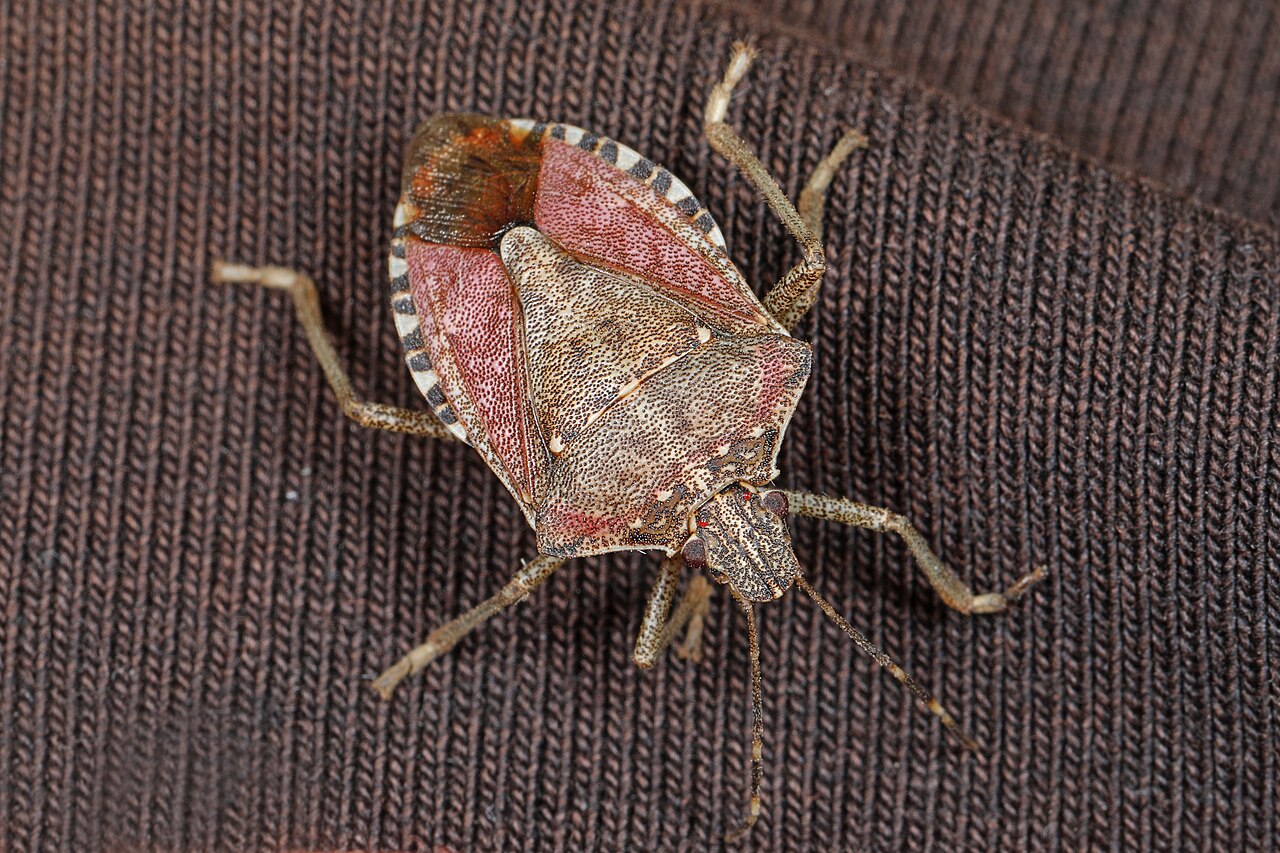
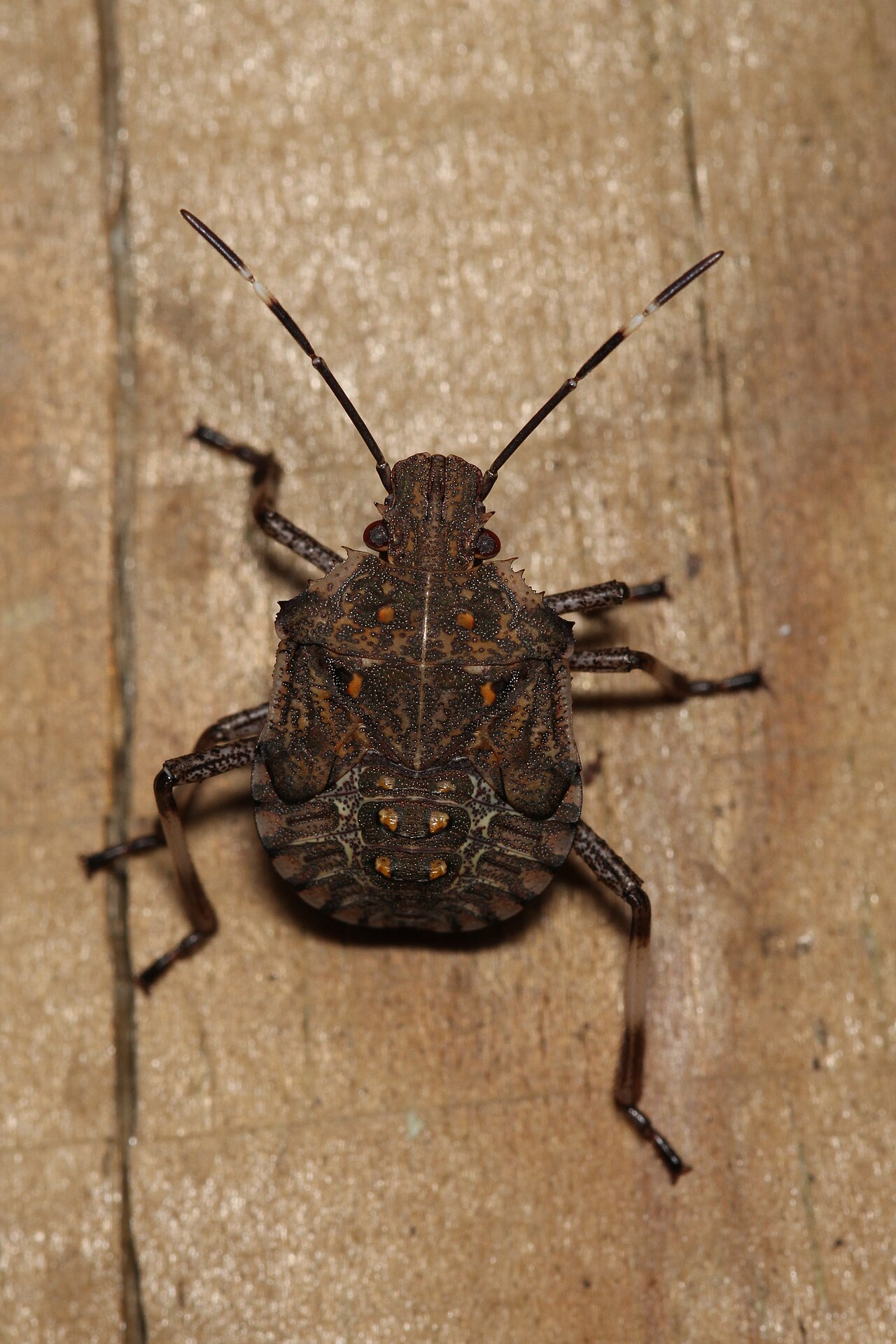
The brown marmorated stink bug is shield-shaped, about three quarters of an inch, mottled brown, with alternating light and dark bands on the last two antennal segments and along the exposed edge of the abdomen. Those banded antennae are the reliable mark.
Native stink bugs look similar and mostly are not the problem. The brown stink bug and the dusky stink bug are close matches but lack the antennal banding, and several native species are predatory rather than plant-feeding, including the spined soldier bug, which has sharp shoulder points and eats caterpillars and beetle larvae.
Where they overwinter separates them too. Native species shelter under bark, in leaf litter, and in ground cover, and a stink bug in a house in January is almost certainly the introduced species. Killing every shield-shaped bug on sight removes beneficial predators along with the pest.
What About the Ones Already Inside?
Remove them as they appear and accept that the wall void population will emerge gradually through winter. There is no way to treat a void effectively, and attempting it by dusting insecticide into wall cavities leaves dead insects that feed carpet beetles and dermestids.
Light traps help modestly. A simple homemade version using a desk lamp over a foil roasting pan of soapy water in a dark room overnight has been tested by university researchers and performs comparably to commercial traps, catching a useful proportion of the bugs active indoors.
Do not seal entry points in midwinter with bugs inside. Blocking the route they came in by means they push further into the living space instead of leaving, so sealing belongs in late summer before they arrive or in late spring after they have gone. Extension programmes such as Penn State (psu.edu), which has run the longest-standing research on the species, publish current management guidance.
Frequently Asked Questions
What kills stink bugs instantly?
Soapy water. Hold a jar beneath the bug and touch it, since they drop when disturbed. It kills within seconds and avoids the smell and staining that squashing causes.
Why should you never squish a stink bug?
The defensive fluid is oily, sharply scented, and yellow-orange, and it stains walls, fabric, and upholstery permanently as well as clinging to hands for hours.
How do you keep stink bugs out of a house?
Seal gaps around windows, doors, siding, vents, and utility penetrations in late summer, and screen attic and soffit vents. They enter through gaps as small as a fifth of an inch.
What causes so many stink bugs in my house?
They overwinter communally and use buildings as substitute rock outcrops, orienting to warm sunlit walls. Aggregation pheromone residue persists between seasons, so affected houses are hit repeatedly.
What scent keeps stink bugs away?
None with reliable evidence. Mint oil, garlic, dryer sheets, and vinegar are widely suggested and poorly supported, and ultrasonic devices do nothing. Sealing works permanently.
Do stink bugs lay eggs in houses?
No. They are dormant indoors and do not feed or breed. They lay eggs outdoors on plant leaves in spring and summer after leaving the building.
What is the natural enemy of a stink bug?
The samurai wasp, an egg parasitoid from the same native range, which arrived in the US on its own in 2014. Native spiders, beetles, and birds take some but far fewer than they take of native species.

Similar Posts
How to Get Rid of Ground Bees (And When Not To)
Most ground bees are harmless solitary pollinators that leave within weeks. Here is how to tell them from yellowjackets and what actually works.
Black House Spider: ID, Bite Risk, and Lookalikes
The black house spider is harmless and builds funnel webs in window frames. Here is how to identify it and which dark spiders actually warrant caution.
Mountain Lion Sounds: The Scream and Every Call Explained
Mountain lion sounds decoded: the famous breeding scream, growls, hisses, mother-kitten chirps, and how to tell a mountain lion from the bobcat and fox it’s confused with.
Frog Poop: What It Looks Like and How to Identify It
Frog poop is a dark cylindrical pellet with blunt ends, packed with insect parts. How to tell it from rat and mouse droppings, whether it is dangerous, and how to clean it up.
Monarch Butterfly Life Span: Weeks or Months?
Summer monarchs live weeks, the migratory generation lives eight to nine months. Why diapause changes everything, how long each stage takes, and what shortens their lives.
Groundhog Sounds: The Whistle and Every Other Call Explained
Groundhog sounds decoded: the alarm whistle behind the whistle pig nickname, teeth chattering, distress squeals, and why night noise is almost never a groundhog.