Purple Snake Identification: 7 Species That Look Purple
No snake in the United States is purple in the way a flower is purple. What people photograph and call a purple snake is almost always a black or dark blue snake throwing an iridescent violet sheen in direct sun, and the effect is strongest in the first days after a shed. Two southeastern species do this so reliably that purple is a fair description of them in the field.
Outside North America the answer changes. A small group of African burrowing snakes is named for the color, and the sunbeam snake of Southeast Asia is one of the most intensely iridescent reptiles alive. This guide separates the snakes that look purple from the ones that are, and starts with the question that matters first.
There are no truly purple snakes in the United States. The eastern mud snake and rainbow snake show a strong purple iridescence over glossy black scales, and both are harmless. Africa’s purple-glossed snakes are genuinely violet, mildly venomous to prey, and not dangerous to people.
Is a Purple Snake Venomous or Poisonous?
Every purple looking snake in the United States is nonvenomous. The mud snake, rainbow snake, racer, and rat snake have no venom and no fangs capable of injecting anything. None is poisonous either, which is a separate question: poison is swallowed, venom is injected, and no North American snake is toxic to touch or handle.
Africa’s purple-glossed snakes (Amblyodipsas) are rear fanged and mildly venomous, enough to subdue the burrowing lizards and small snakes they eat. Bites on people are rare and produce local swelling at worst. If you need to identify something dangerous instead, the genuinely venomous US species are patterned in red, yellow, and black or in brown hourglass bands, as covered in our coral snake and king snake comparison.
Are There Really Purple Snakes?
Yes, but not where most searches come from. The genus Amblyodipsas holds roughly nine species of purple-glossed snakes across sub-Saharan Africa, and the name is literal: the scales carry a deep violet to plum cast rather than a reflection. Everything else in the purple category is iridescence, which is a trick of surface structure rather than a pigment.
That distinction matters when you are trying to identify an animal from a photo. A pigmented snake looks the same color from every angle and in shade. An iridescent snake looks black in the hand, purple at a low sun angle, and green or bronze if you shift ten degrees. Nearly every purple snake photo taken in North America belongs to the second group.
Purple and Purple Looking Snakes at a Glance

| Species | Source of the color | Adult length | Range | Risk |
|---|---|---|---|---|
| Eastern mud snake | Iridescent sheen on blue black | 40 to 54 in (100 to 137 cm) | Southeast US | Harmless |
| Rainbow snake | Strong iridescence, red stripes | 36 to 48 in (90 to 120 cm) | Southeast US | Harmless |
| North American racer | Violet gloss after shedding | 20 to 60 in (50 to 152 cm) | Most of the US | Harmless, bites |
| Western rat snake | Faint purple wash on black | 42 to 72 in (107 to 183 cm) | Central US | Harmless |
| Purple-glossed snake | True violet pigment | 20 to 40 in (50 to 100 cm) | Sub-Saharan Africa | Mildly venomous |
| Sunbeam snake | Extreme iridescence | 36 to 48 in (90 to 120 cm) | Southeast Asia | Harmless |
| Lavender ball python | Captive bred color morph | 36 to 60 in (90 to 152 cm) | Pet trade only | Harmless |
Eastern Mud Snake (Farancia abacura)

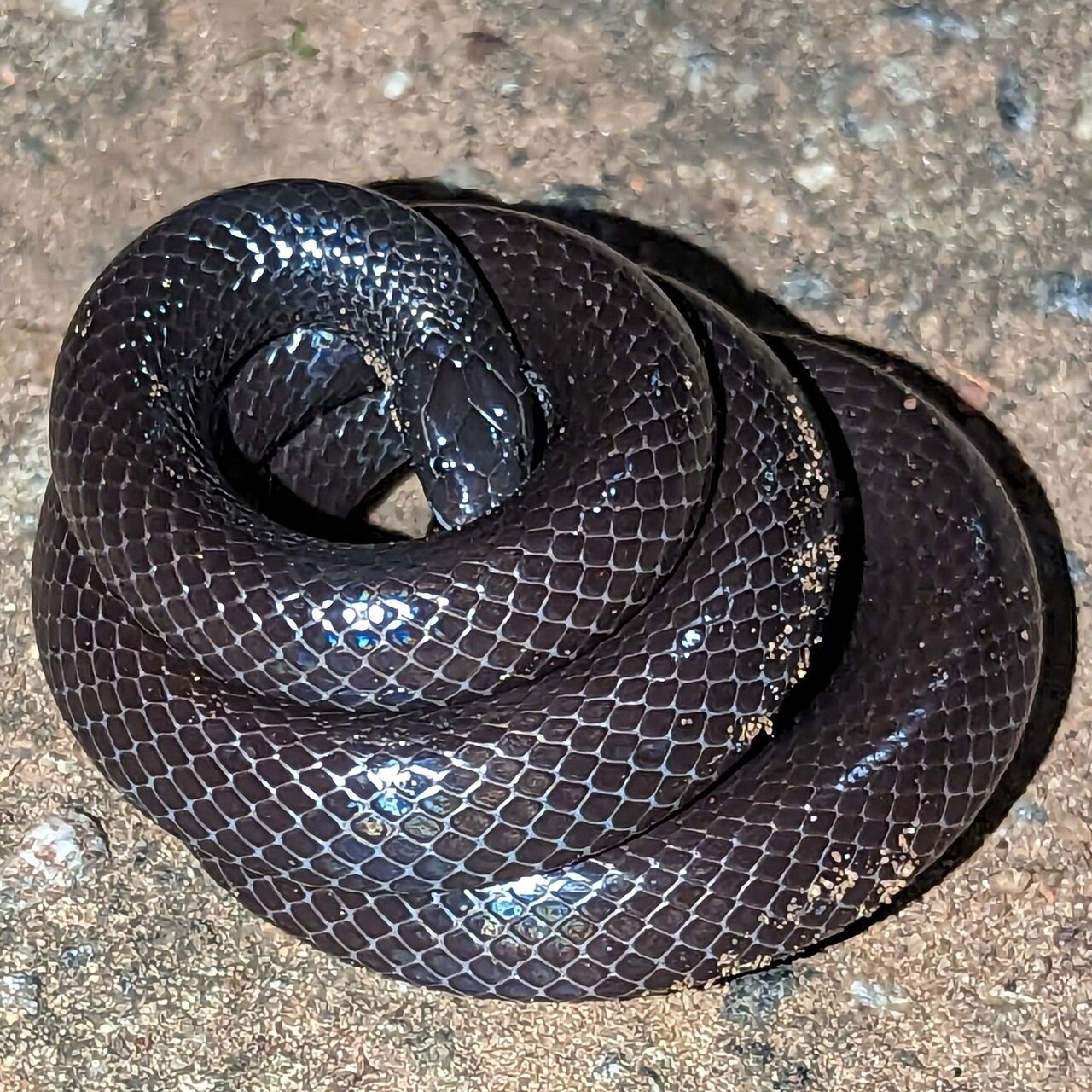
The best candidate for a purple snake in the United States. The back is smooth, glossy, and blue black, and in sunlight it throws a distinct violet to plum sheen across the whole body, while the belly and lower sides carry red or pink bars that push up between the scales. Adults run 40 to 54 inches (100 to 137 cm), with record animals past 80 inches (203 cm).
Mud snakes live in swamps, cypress sloughs, and slow blackwater across the southeastern coastal plain, and they are almost entirely aquatic. Their diet is unusual: mostly amphiumas and sirens, the big eel shaped salamanders of the same wetlands. They have a hard pointed tail tip that they press against a handler’s skin, which founded the hoop snake and stinging snake stories. It cannot break skin and carries no venom.
Rainbow Snake (Farancia erytrogramma)
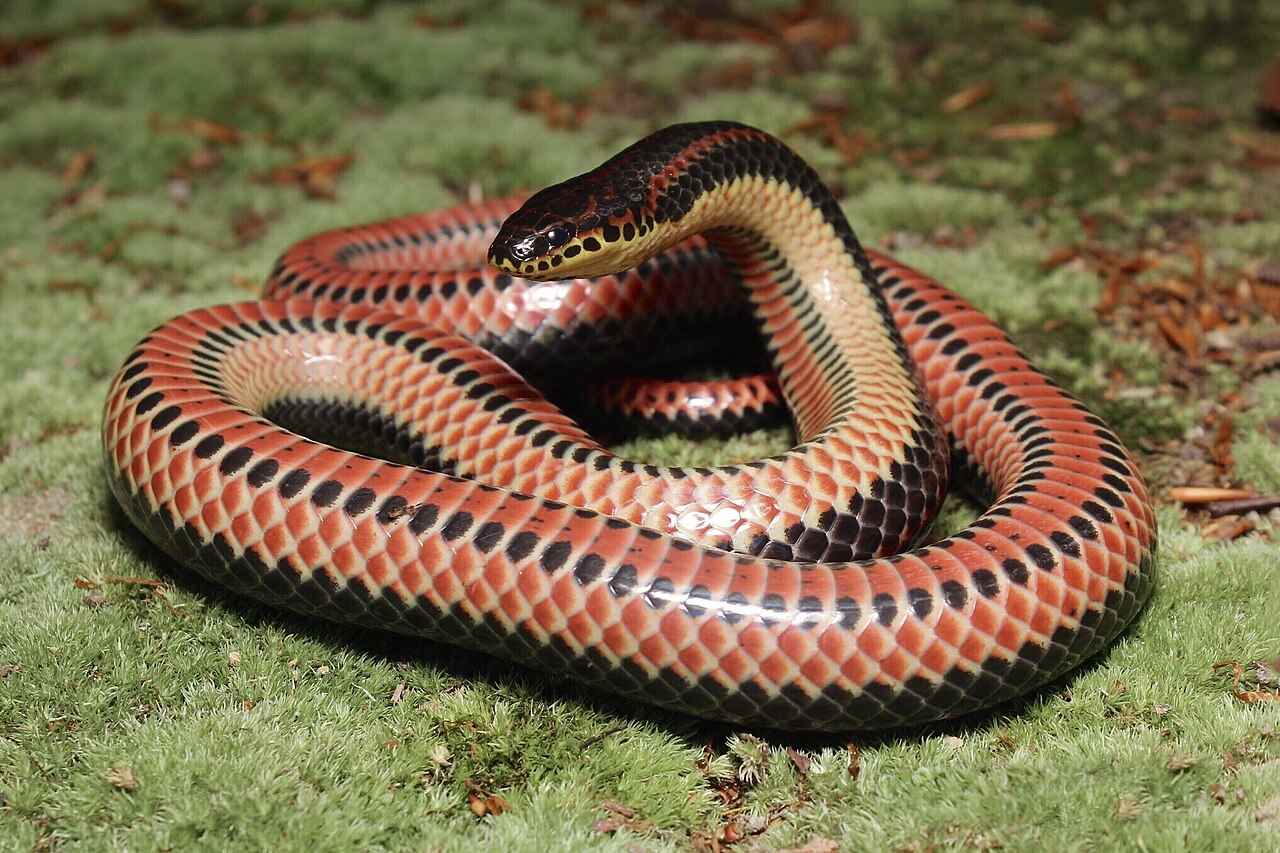
The mud snake’s close relative and the more spectacular of the two. Glossy blue black above with three red stripes running the length of the body, the rainbow snake catches light in bands of violet, green, and bronze that gave it its name. Adults reach 36 to 48 inches (90 to 120 cm) and look polished rather than merely shiny.
They are specialists on American eels and spend their lives in rivers, swamps, and adjacent wet woods from Maryland south to Florida and west to Louisiana. Sightings are rare enough that one Florida subspecies was declared extinct before a confirmed observation in 2020 reopened the question. Reliable natural history on both Farancia species is maintained by the Savannah River Ecology Laboratory at the University of Georgia.
North American Racer (Coluber constrictor)
The snake behind most backyard purple reports outside the Southeast. Racers are slender, fast, and uniformly dark, ranging from satin black in the East to blue gray and olive farther west, and a freshly shed adult in low sun can look clearly violet. Length runs 20 to 60 inches (50 to 152 cm).
They hunt by sight with the head raised above the grass, move quickly in the open, and will not tolerate handling. A cornered racer vibrates its tail, strikes repeatedly, and bites, which draws blood but carries no venom. Despite the scientific name they do not constrict; they pin prey under a body loop and swallow it. Compare them with the all black species in our guide to the black snakes of North America.
Western Rat Snake (Pantherophis obsoletus)
A heavy bodied climber of the central and southern states, 42 to 72 inches (107 to 183 cm) long, black above with a faint purple to charcoal wash and traces of a juvenile blotch pattern showing through on some individuals. The belly is a checkered gray and white, and the body in cross section is shaped like a loaf of bread rather than a cylinder.
Rat snakes climb into barns, attics, and tree cavities after rodents and bird eggs, which puts them in front of people more often than any other large black snake. They freeze, then rattle the tail in dry leaves, and most bites happen when someone grabs one. They are harmless and worth leaving alone given what they eat.
Purple-Glossed Snakes of Africa (Amblyodipsas)
These are the real thing. The common purple-glossed snake (Amblyodipsas polylepis) reaches about 40 inches (100 cm) and wears a uniform deep violet to purplish black that holds its color in shade, with a cylindrical body, tiny eyes, and a blunt head built for burrowing. Roughly nine species occur from Kenya and Tanzania south to South Africa.
They spend nearly all their time underground in sandy soil and old termite mounds, surfacing after heavy rain at night, and they eat burrowing reptiles. The rear fangs deliver a weak venom that matters to a legless skink and not to a person. Most of the striking purple snake images circulating online are these animals, which is why so many searches end in confusion about whether purple snakes live in America.
Sunbeam Snake (Xenopeltis unicolor)
If you want a snake that looks purple in a photograph, this is the famous one. The sunbeam snake of Southeast Asia is brown to blue black with a smooth, highly polished scale surface that splits sunlight into violet, green, and gold, an effect far stronger than anything in Farancia. Adults run 36 to 48 inches (90 to 120 cm).
They are nonvenomous constrictors, spend the day buried in soft soil near rice paddies and forest edges, and appear in the US pet trade as imports. They are poor beginner animals: wild caught stock arrives with parasites, they refuse food readily, and they need constant substrate moisture to keep the scales in the condition that produces the color.
Are Purple Pythons Real?
Not as a wild species. No python anywhere is purple in nature. What exists is a set of captive bred ball python (Python regius) color morphs with a lavender cast, most notably the lavender albino, first produced in 2001, which combines a pale yellow pattern with a soft lilac background instead of white.
Breeders also sell morphs named purple passion and mystic potion, which read as gray violet rather than true purple and shift with age and lighting. Prices for the original lavender albino ran into five figures when it appeared and have since fallen to the low hundreds. Any listing promising a vividly purple snake is either edited imagery or a dyed animal, which is both a scam and an animal welfare problem.
Why Snake Scales Look Purple
The outer scale surface of many snakes carries microscopic ridges spaced on the order of the wavelength of visible light. Light reflecting off those structures interferes with itself and returns specific colors to the eye, with violet and green dominating in the species above. Because the effect depends on angle, the color appears and disappears as the animal moves.
Two conditions sharpen it. A snake that has just shed has an unworn, perfectly smooth scale surface and looks its most iridescent for a few days afterward, and a wet snake coming out of water shows it strongly as well. Structural color works the same way in other animals, which is why a purple butterfly, a purple feathered bird, and a blue lizard all lose their color under a microscope.
What Does a Purple Snake Symbolize?
In dream interpretation and modern folk symbolism, purple carries associations with royalty, intuition, and spiritual change, and a snake carries transformation through shedding. Combined, a purple snake is usually read as a sign of personal change or heightened intuition. These are cultural readings rather than anything found in traditional Native American or classical sources, where purple snakes do not appear.
One practical note for anyone who saw the animal rather than dreamed it: the meaning question is often a search for reassurance after an unexpected encounter. The mud snakes and racers behind most US sightings do not pursue people, and a snake in the yard is a sign of a healthy rodent and amphibian population. Other color sightings are covered in our guides to pink snakes and blue snakes.
Frequently Asked Questions
Are there snakes that are purple?
Yes. Africa’s purple-glossed snakes in the genus Amblyodipsas are genuinely violet in color. In the United States no species is purple by pigment, but the eastern mud snake and rainbow snake both carry a strong purple iridescence over glossy black scales that reads as purple in sunlight.
What is the purple snake called?
In the US it is usually the eastern mud snake (Farancia abacura) or the rainbow snake (Farancia erytrogramma). Internationally, the common purple-glossed snake (Amblyodipsas polylepis) of southern Africa carries the name directly, and the Asian sunbeam snake is the most iridescent species in the pet trade.
Is a purple snake poisonous?
No. No snake is poisonous to touch, and every purple looking species in the United States lacks venom entirely. African purple-glossed snakes are rear fanged and mildly venomous toward small reptile prey, with bites on people causing only local swelling. None belongs on a list of dangerous snakes.
Why does my black snake look purple?
Because it recently shed or is wet. Microscopic ridges on fresh, unworn scales split light into violet and green, and the effect is strongest in low angle sun. Racers, rat snakes, and mud snakes all show it. The color vanishes as the scales wear and dull over the following weeks.
Where do purple snakes live in the US?
The two most purple species are southeastern. Mud snakes occupy swamps and blackwater from Virginia to Texas, and rainbow snakes live in rivers and wet woods from Maryland to Louisiana. Both are aquatic and secretive, so most encounters happen on wet roads at night or during pond draw downs.
Can you buy a purple snake as a pet?
You can buy a lavender albino ball python or a sunbeam snake, neither of which is truly purple. Ball python morphs are captive bred and hardy; sunbeam snakes are usually wild caught and difficult to keep. Avoid any seller advertising a brightly dyed or painted snake.