Coral Snake vs King Snake: The Rule and Its Limits
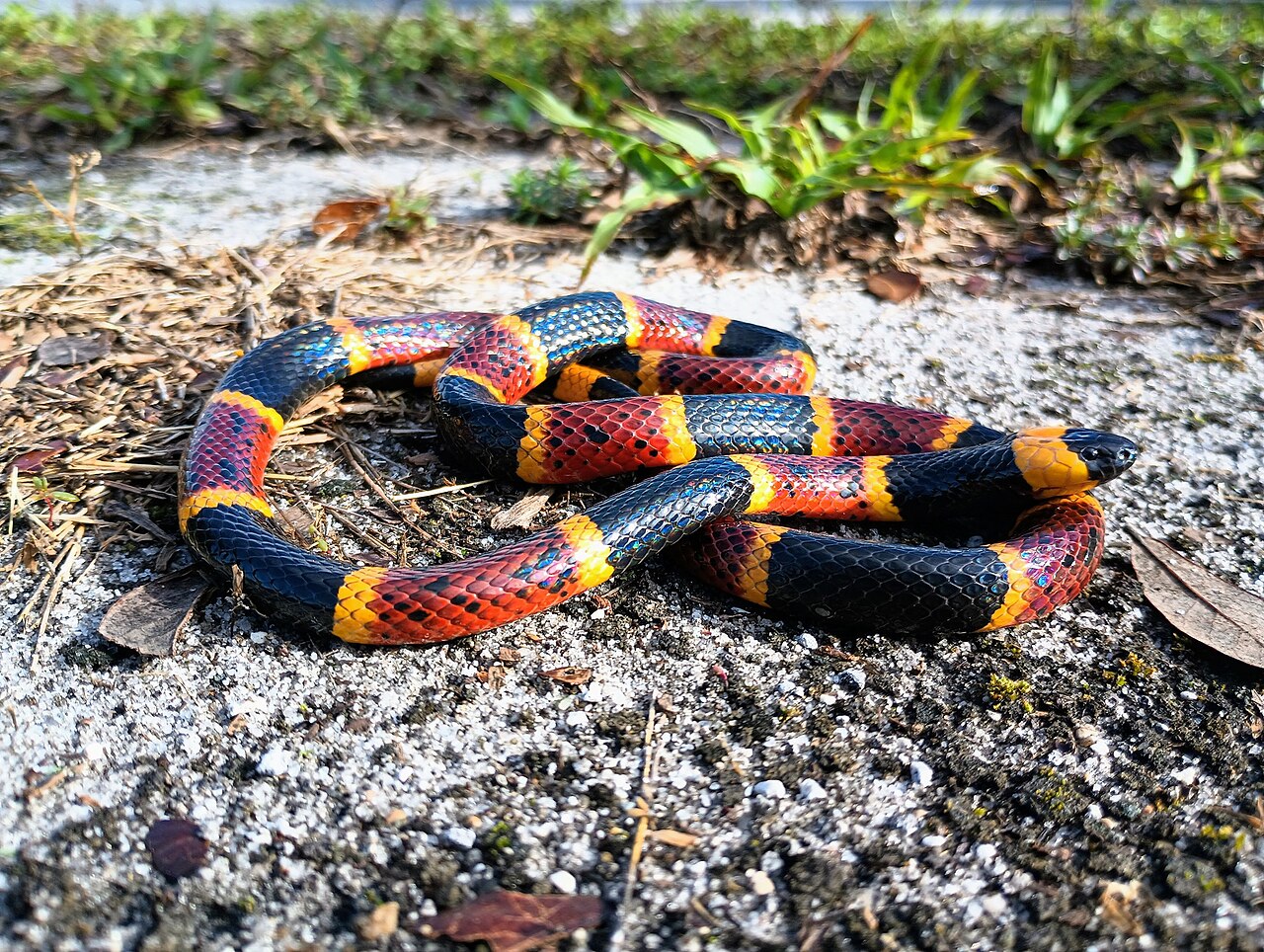
In the United States, a red, yellow, and black banded snake with red touching yellow is a venomous coral snake. If red touches black, it is a harmless scarlet king snake or milk snake. That rule is reliable within the United States and fails completely elsewhere, which is the most important qualification anyone repeating it should include.
Two features back it up and are worth learning, because band order is hard to read on a moving snake. Coral snakes have a blunt black snout, while the mimics have red or pale snouts. Coral snake bands wrap fully around the body including the belly, while some mimics show interrupted banding underneath. This guide covers the identification in detail, the species involved, the regional limits of the rhyme, what a coral snake bite actually does, and why the mimicry exists at all.
| Feature | Coral Snake | Scarlet King Snake and Milk Snake |
|---|---|---|
| Band order | Red touches yellow | Red touches black |
| Snout | Blunt and black | Red or pale, pointed |
| Venom | Potent neurotoxin | None |
| Family | Elapidae, related to cobras | Colubridae, constrictors |
| Behavior | Secretive, burrowing, rarely seen | Active hunter, often found under cover |
| Bite risk | Medical emergency | Harmless |
The Rhyme and Where It Works
Several versions circulate, the most common being red touch yellow, kill a fellow; red touch black, friend of Jack. All encode the same rule: on a coral snake the red bands are adjacent to the yellow bands, while on the harmless mimics the red bands are adjacent to the black.
Within the United States this holds for the three native coral snake species and their mimics, and it is genuinely useful. It is the reason so many harmless scarlet king snakes survive encounters with people who took a second to look.
Outside the United States it fails, and dangerously so. Central and South America hold more than 60 coral snake species with widely varying band arrangements, and plenty of them have red adjacent to black. Anyone applying the rhyme in Mexico, Costa Rica, or Brazil is relying on a rule that does not apply there, which is why the safe approach abroad is to treat every banded snake as unknown.
The Coral Snakes
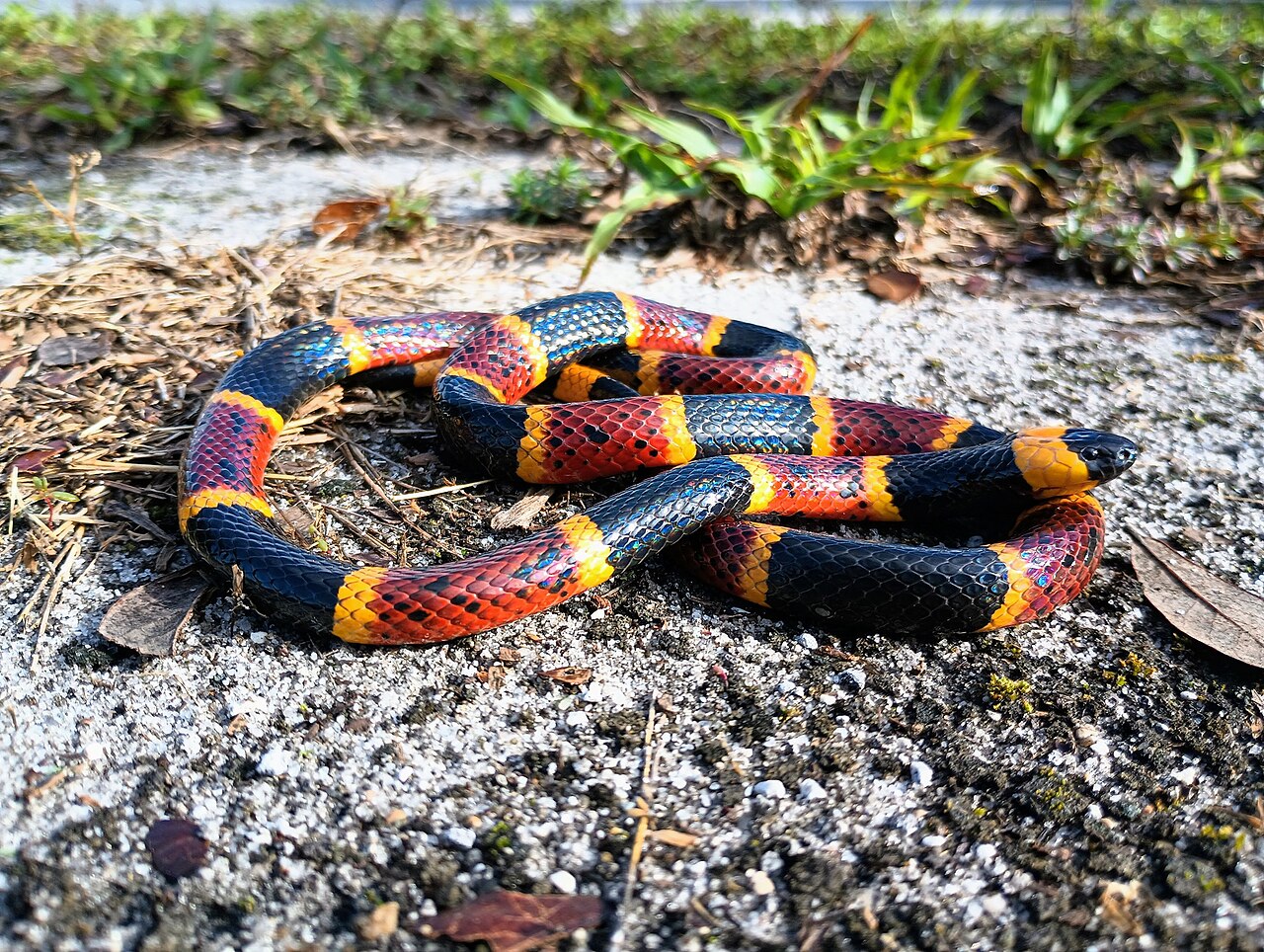
Three coral snake species occur in the United States. The eastern coral snake ranges across the southeastern states from North Carolina through Florida and west to Louisiana, the Texas coral snake occupies Texas and adjacent areas, and the Arizona coral snake occurs in the southwest and is smaller and less potent.
They are elapids, related to cobras, mambas, and sea snakes rather than to the pit vipers that account for most American snakebites. That family membership matters because it determines the venom type, the fang structure, and the clinical picture of a bite.
They are also slender, secretive, and largely fossorial, spending most of their time under leaf litter, logs, and loose soil, and they are active mainly at dawn, dusk, and after rain. Most people living in coral snake range for decades never see one, and encounters typically happen when someone moves debris or digs.
The Mimics
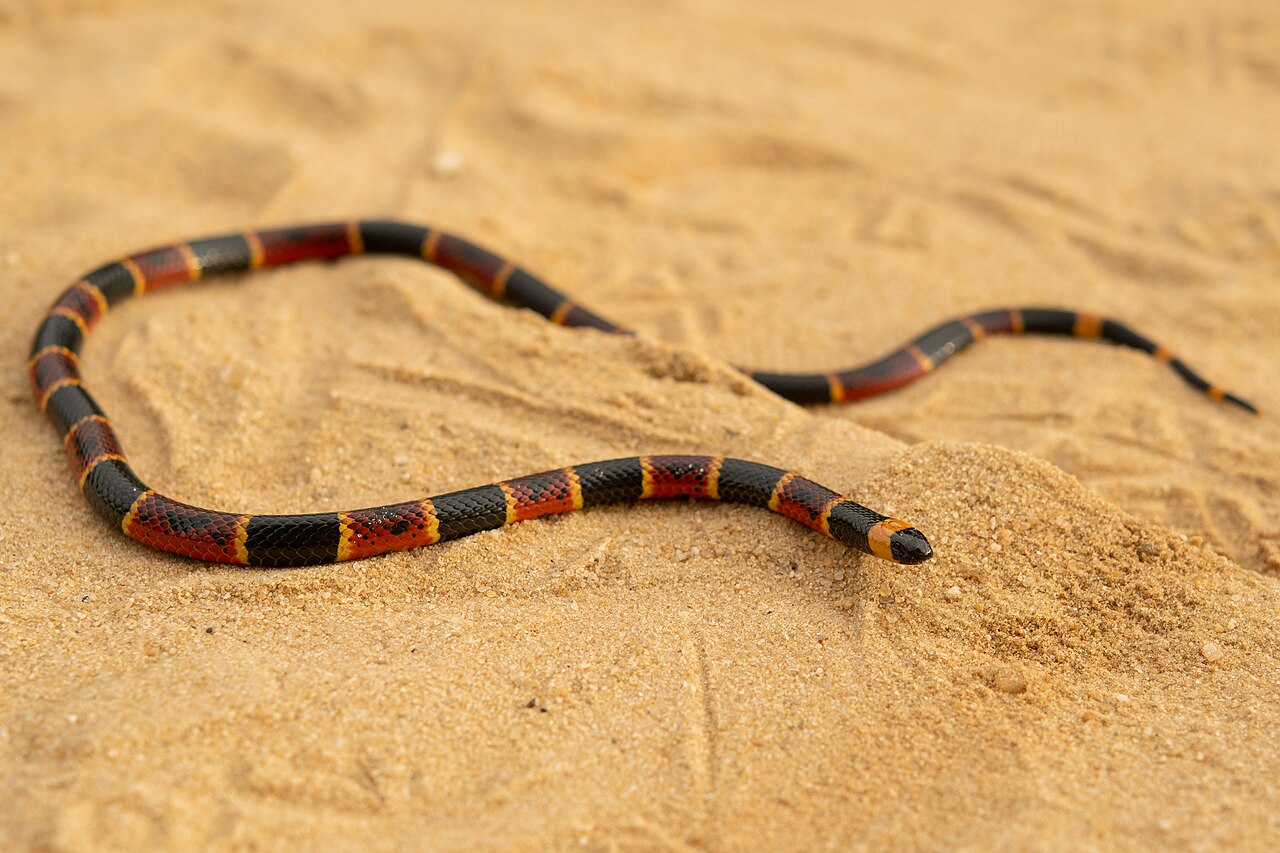
The scarlet king snake is the closest mimic and occurs across much of the same southeastern range. It is small, rarely exceeding 20 in, with bright red, black, and yellow or white bands, a red snout, and the harmless red-touching-black arrangement.
Milk snakes cover a much wider range and vary enormously across it. Eastern populations are blotched rather than banded and look nothing like a coral snake, while southern and western subspecies including the scarlet king snake are strongly banded. Our guide to the milk snake covers that variation in detail.
Both are members of the genus Lampropeltis, which makes them king snakes in the technical sense, and both are non-venomous constrictors that eat lizards, small snakes, and rodents. The larger members of the genus, covered in our guide to the king snake, actively hunt and eat venomous snakes and are substantially resistant to pit viper venom.
Why the Mimicry Exists
This is Batesian mimicry, in which a harmless species resembles a dangerous one and gains protection from predators that have learned to avoid the model. It requires that the dangerous species be common enough for predators to encounter and learn from.
Field experiments have tested it directly using plasticine replica snakes placed in different regions and scored for predator attack marks. Replicas with coral snake banding were attacked significantly less often than plain replicas within coral snake range, and the protective effect diminished outside it, which is close to a textbook confirmation of the mechanism.
An interesting complication emerged from the same work. The mimicry appears to work best where the model is present but not overwhelmingly abundant, and in areas where coral snakes are absent the resemblance provides less benefit and mimic populations show more variable patterning. Predator learning, not snake intention, drives the whole system.
Coral Snake Venom
Coral snake venom is a potent neurotoxin and behaves quite differently from the hemotoxic venom of rattlesnakes and copperheads. Rather than causing immediate severe pain and tissue damage, it interferes with signal transmission between nerves and muscles.
That difference produces a dangerous clinical picture. The bite itself may cause little pain and minimal local swelling, and symptoms can be delayed by several hours to as much as 12, which leads people to assume they were not seriously envenomated. When symptoms arrive they include slurred speech, double vision, drooping eyelids, difficulty swallowing, muscle weakness, and in severe cases respiratory paralysis.
The delivery system limits the danger somewhat. Coral snakes have short fixed fangs rather than the long hinged fangs of vipers, and they need to chew to work venom in effectively, so a glancing bite may deliver little. That is a matter of degree rather than safety, and every suspected coral snake bite is a medical emergency regardless of how minor it looks.
What to Do If You Are Bitten
Call emergency services immediately and get to a hospital, and do this on suspicion rather than waiting for symptoms. Because onset is delayed, the absence of pain or swelling tells you nothing useful in the first hours.
Keep the person calm and still, keep the bitten limb at or below heart level, remove rings, watches, and tight clothing before any swelling starts, and note the time. Poison control in the United States is reachable at 1-800-222-1222 and can advise while you travel.
Do not cut the wound, do not attempt suction, do not apply ice, do not use a tourniquet, and do not give alcohol. Antivenom exists for North American coral snakes, and hospitals in coral snake range stock or can source it, with treatment also including respiratory support if paralysis develops. Deaths are extremely rare in the United States, and the reason is that people get treated, so the whole strategy rests on going in early.
How Common Are Coral Snake Bites?
Rare, and the reasons are behavioral. Coral snakes are not aggressive, they are secretive and spend most of their time hidden, and their small mouths and short fangs make it difficult for them to bite an adult human anywhere except on a finger or a fold of skin.
Bite records consistently show that most incidents involve deliberate handling. Someone picks up a snake to identify it, move it, kill it, or photograph it, and gets bitten in the process, which is the same pattern seen across venomous snake bites generally in the United States.
The practical consequence is that this is among the most avoidable venomous encounters in North America. Leave banded snakes alone, watch where you put your hands when moving logs and debris, wear gloves when clearing brush, and the risk approaches zero. Our guide to the baby snake covers the identification of juveniles, which is where uncertainty is highest.
Other Banded Snakes People Confuse
Several harmless species carry red, black, and yellow or white banding and get killed on mistaken identity. Beyond the scarlet king snake and milk snakes, the scarlet snake of the southeastern states is a small burrowing species with red blotches on a pale background, and it has a pointed red snout.
Long-nosed snakes of the southwest are banded in black, white, and red with speckling within the bands, and they are harmless. Some ground snakes and shovel-nosed snakes carry banding in similar colors at smaller sizes.
The safe general approach for any unfamiliar banded snake is distance plus a photograph. Pupil shape, snout color, and band order are all readable from a phone photo taken from several feet away, and local herpetology groups identify photographs quickly. Nothing about identification requires being close, and our guide to the black and white snake works through the wider set of banded species.
Living With Coral Snakes
If you live in coral snake range, the practical measures are the same ones that reduce snake encounters generally. Keep grass mown, remove brush piles and debris that provide cover, stack firewood off the ground and away from the house, and control rodents, since rodent populations attract the snakes that eat them.
Coral snakes themselves eat mostly other snakes and lizards rather than rodents, so they are less drawn to buildings than rat snakes are. A coral snake near a house is usually passing through leaf litter rather than hunting a food source you have provided.
Killing them is both unnecessary and often illegal, since several states protect native snakes, and it puts the person at more risk than leaving the animal alone would. If one is somewhere it cannot stay, call a professional removal service. The harmless species in the same habitat, including those covered in our guides to the hognose snake and the baby rattlesnake, benefit from the same restraint.
Frequently Asked Questions
How do you tell a coral snake from a king snake?
In the United States, red touching yellow means a venomous coral snake and red touching black means a harmless scarlet king snake or milk snake. Coral snakes also have blunt black snouts while the mimics have red or pale snouts, which is easier to read at a glance.
Does the red touch yellow rhyme always work?
Only in the United States. Central and South America have more than 60 coral snake species with varying band arrangements, many with red adjacent to black. Outside the United States the rhyme is unreliable and every banded snake should be treated as unknown.
How dangerous is a coral snake bite?
Serious and a medical emergency, though deaths are extremely rare because people get treated. The venom is a neurotoxin, so the bite may cause little pain and symptoms can be delayed up to 12 hours before slurred speech, double vision, weakness, and breathing difficulty appear.
What should I do if a coral snake bites me?
Call emergency services immediately on suspicion rather than waiting for symptoms, keep still, keep the limb at or below heart level, and remove rings and tight clothing. Do not cut, suck, ice, or tourniquet the wound. Antivenom exists and hospitals in range stock or can source it.
Why do king snakes look like coral snakes?
Batesian mimicry, in which a harmless species resembles a dangerous one and gains protection from predators that have learned to avoid the model. Field experiments with plasticine replicas confirmed that coral-patterned models are attacked less often within coral snake range.
Are coral snake bites common?
No. Coral snakes are secretive, non-aggressive, and have small mouths with short fixed fangs, and most recorded bites involve someone deliberately handling the snake. Leaving banded snakes alone reduces the risk to almost nothing.
What other snakes look like coral snakes?
Scarlet king snakes and several milk snake subspecies are the main mimics, along with the scarlet snake of the southeast and long-nosed snakes of the southwest. All are harmless. Photograph any unfamiliar banded snake from several feet away rather than approaching.