Poison Dart Frog Adaptations: 5 Traits That Keep It Alive
Poison dart frog adaptations all serve one strategy: be impossible to eat and stop hiding. Instead of the camouflage most frogs rely on, these Central and South American amphibians advertise themselves in scarlet, gold, and cobalt, back the display up with alkaloid poisons taken from their prey, and hunt in broad daylight while other frogs wait for dark.
The family Dendrobatidae holds more than 200 species, and the same package of traits runs through them: warning coloration, diet-derived toxins, sticky toe pads for climbing, small bodies suited to forest leaf litter, and parental care that carries tadpoles up into the trees. Each one only makes sense alongside the others, which is what makes this group a textbook case of traits evolving as a set.
Poison dart frogs survive through five linked adaptations: bright warning coloration that signals danger, alkaloid toxins stored from a diet of ants and mites, adhesive toe pads for climbing, daytime activity made safe by those toxins, and parental care that ferries tadpoles to water held in plants.
| Adaptation | How it works | What it replaces |
|---|---|---|
| Aposematic color | Signals toxicity to birds and snakes | Camouflage |
| Stored alkaloids | Toxins taken from ants, mites, and beetles | Speed and size |
| Adhesive toe discs | Grip on wet leaves and bromeliads | Webbed feet for swimming |
| Diurnal habits | Feeds when ant prey is active | Night activity |
| Tadpole transport | Carries young to water in plants | Pond spawning |
| Small body, 0.6 to 2.4 in (15 to 60 mm) | Fits leaf litter and tree cavities | Bulk as a defense |
What Are 5 Adaptations of a Frog Like This One?
The five that matter most are warning color, stored poison, climbing toe pads, daytime foraging, and tadpole transport. Read them in that order and the logic follows: the poison makes the color worth having, the color makes daylight safe, daylight gives access to the ants that supply the poison, and the toe pads reach the plant pools where the young are raised.
Nothing in that chain includes the traits most people expect from a frog. These animals are poor swimmers with reduced webbing, they do not leap far, and several species walk more than they hop. Compare that with a pond specialist such as the American green tree frog and the tradeoff is obvious.
Bright Skin as a Warning Rather Than a Disguise

Aposematic coloration is the advertisement that the rest of the system pays for. Birds and snakes that sample one frog learn the pattern and avoid it afterward, so conspicuous individuals survive better than cryptic ones once a population is genuinely toxic. The signal is strong enough that harmless species copy it, and some mimicry complexes in Peru include several frogs converging on one local color scheme.
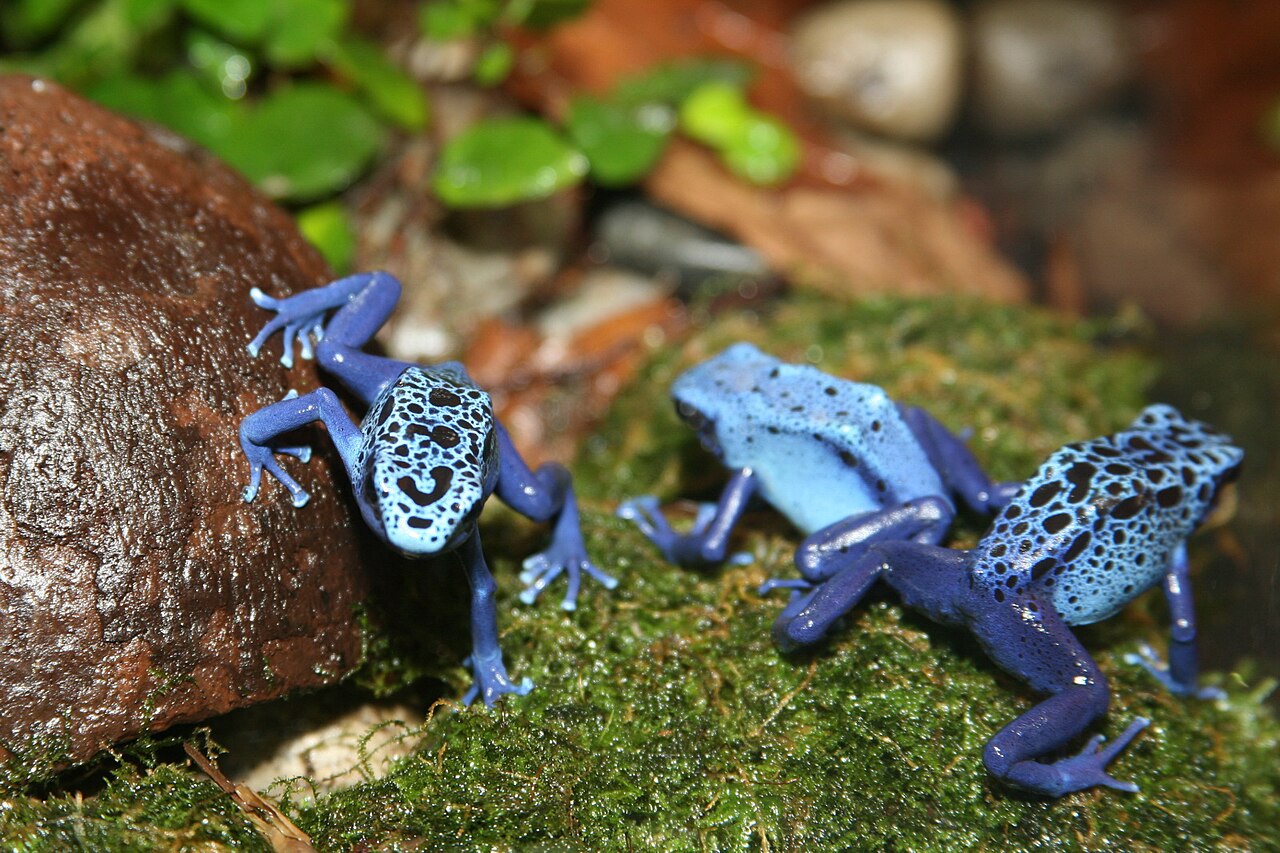
Color also varies sharply between populations of a single species. The strawberry poison dart frog appears in dozens of local morphs across Panama, while the blue poison dart frog holds one striking pattern across a small range in Suriname.
Poison Built From What They Eat
Poison dart frogs do not manufacture their toxins. They sequester lipophilic alkaloids from prey, chiefly ants, mites, and small beetles, and concentrate them in glands in the skin. More than 800 alkaloids have been identified across the family, and the mix on any one frog reflects the local menu, which is why toxicity differs between populations of the same species.
The consequence is easy to test: frogs raised in captivity on crickets and fruit flies are not poisonous at all. The frogs themselves resist their own chemistry through changes in the sodium channels the toxins target, an autoresistance that had to evolve alongside the storage.
How Have Poison Dart Frogs Evolved These Defenses?
The sequence ran from poison to color, not the other way around. Ancestral dendrobatids were small, cryptic, daytime foragers that specialized on ants, and ant-heavy diets deliver alkaloids whether the frog wants them or not. Once even mild toxicity was in place, being visible stopped being fatal and started paying off, and bright lineages diverged repeatedly.
Batrachotoxin, the compound that makes the golden poison frog (Phyllobates terribilis) the most dangerous member of the family, turns up only in three Phyllobates species and traces to melyrid beetles in their diet. That narrow distribution is why only those frogs were ever used on hunting darts. The Smithsonian’s National Zoo and Conservation Biology Institute keeps several dendrobatid species in its collections.
Parental Care in a Forest Without Ponds
Rainforest floors offer few permanent pools, so these frogs raise their young in the water trapped by bromeliads and tree holes. Eggs are laid on land in leaf litter, one parent guards and moistens them, and after hatching the tadpoles wriggle onto the adult’s back to be carried, sometimes 40 feet (12 m) up a trunk, and deposited one per pool.
In Oophaga species the female returns for weeks to lay unfertilized eggs as food for her tadpole, a level of investment almost unknown among amphibians. Behavior this involved leaves no room for the dormant seasons discussed in our piece on frog hibernation, and it contrasts with the mass spawning of most temperate species.
Frequently Asked Questions
Why can’t you touch a poison dart frog?
Wild frogs carry alkaloids in their skin glands that can pass through cuts or reach your eyes and mouth from your hands. Handling also strips the mucus layer that protects the frog from bacteria and dehydration. Captive-bred individuals are not toxic, but the risk to the animal remains.
Can a human hold a poison dart frog?
Physically yes, and keepers do it briefly with captive-bred frogs using clean wet gloves. With a wild frog it is a bad idea in both directions: you risk absorbing alkaloids, and the frog risks skin damage. No dendrobatid benefits from being held.
What kills a poison dart frog?
Habitat loss is the leading cause, followed by the chytrid fungus Batrachochytrium dendrobatidis and collection for the pet trade. Natural predators are few, and the best documented is the snake Erythrolamprus epinephelus, which tolerates the toxins. Spiders and large arthropods take some froglets.
What is the deadliest frog on Earth?
The golden poison frog (Phyllobates terribilis) of coastal Colombia, which carries roughly 1 mg of batrachotoxin, enough to be lethal to several adults in theory. It is the only frog whose skin secretions were used directly on blowgun darts, and no recorded human death has come from casual contact.
Taken together these traits describe an animal that traded hiding for chemistry and then reorganized its whole life around that bet, from daylight hunting to backpacking tadpoles into the canopy. For the species accounts behind the pattern, start with our overview of the poison dart frog and the transparent-skinned glass frog that solved the same predation problem the opposite way.