Skink Poop Identification: Size, Color and 3 Lookalikes
Skink poop is a small dark pellet with a chalky white cap at one end, roughly 0.2 to 0.5 in (5 to 13 mm) long, and almost always full of crushed insect parts. That white cap is the giveaway: it is dried urate, the pasty waste lizards and birds pass along with their droppings, and no rodent produces it.
Getting this right matters, because the same pellet can mean a harmless insect eater under your deck or a rodent problem that needs action this week. Below are the measurements, the three droppings most often mistaken for skink poop, and what the CDC says about handling reptile waste.
Skink droppings are cylindrical pellets 0.2 to 0.5 in (5 to 13 mm) long, dark brown to black, with a white or cream tip of dried urate at one end. They hold visible insect fragments such as legs and wing cases, and they collect in small groups on warm outdoor surfaces rather than scattered indoors.
| Feature | Skink droppings |
|---|---|
| Length | 0.2 to 0.5 in (5 to 13 mm) |
| Shape | Cylinder, rounded or slightly tapered ends |
| Color | Dark brown to black, glossy when fresh |
| White tip | Yes, a chalky urate cap at one end |
| Contents | Insect legs and wing cases, no seeds or fur |
| Where found | Patios, steps, sills, woodpiles, garage floors, warm rocks |
| Amount | 3 to 10 pellets in one reused spot |
What Does Lizard Stool Look Like Up Close?
A fresh skink pellet looks like a short dark sausage with a white dot stuck to one end. The dark part is digested food, the white part is urate. Reptiles pass no liquid urine; they excrete nitrogen as a semi solid paste through the same opening, so the two come out joined. Within a day or two the dark section dulls to gray brown and the white cap turns powdery.
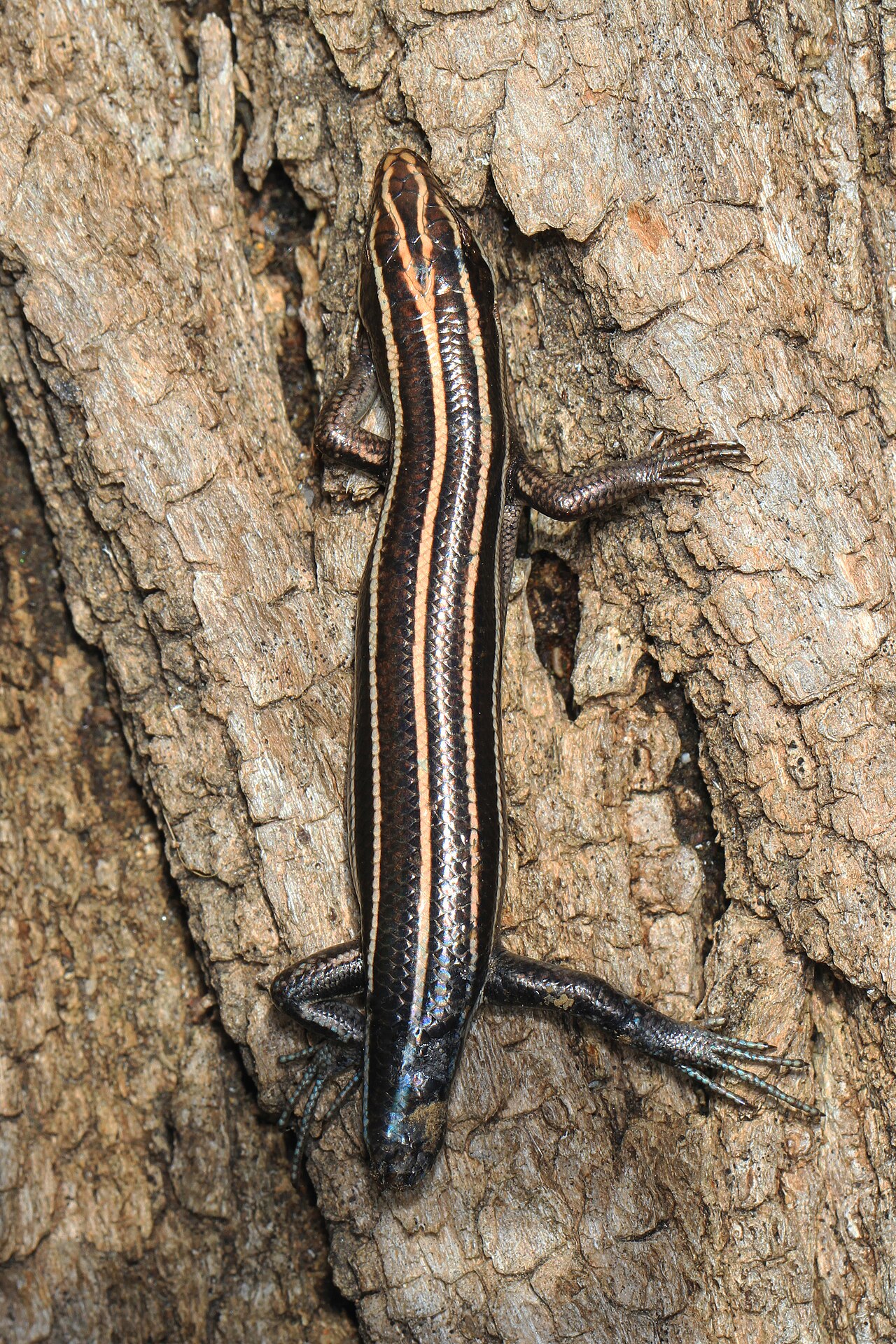
Break a dry pellet apart with a stick and you see the diet. Skinks in the United States, including the common five-lined skink (Plestiodon fasciatus) and the little brown skink (Scincella lateralis), live on crickets, ants, beetles and spiders, and chitin does not digest, so wing cases and ant heads sit in the pellet as shiny black flecks. For the other reptile group people confuse here, see frog and lizard droppings.
Where Skink Droppings Turn Up and Why They Cluster
Skinks are daytime hunters that must warm up before they can digest, so their droppings follow sunlight: concrete steps, flagstone patios, the flat top of a retaining wall, a sunny sill, a deck rail, the south facing side of a woodpile. Indoor finds are usually just inside a garage door or in a basement window well, where a skink gets trapped rather than where it lives.
Clustering is normal. A skink that finds a safe basking slab returns for weeks, so three to ten dry pellets sit in the same square foot with nothing scattered around them. Rodents work the opposite way and defecate as they travel, leaving trails along baseboards and across pantry shelves. Height separates skinks from geckos too, which is covered in our guide to gecko droppings.
Skink Poop vs Mouse Poop
Size and the white tip settle this in seconds. House mouse droppings are 0.1 to 0.25 in (3 to 6 mm) long, pointed at both ends, uniformly dark with no white cap, and smooth rather than flecked. A skink pellet is two to three times longer, blunter and studded with insect fragments.
Volume is the second test. One mouse leaves 50 to 75 droppings a day, so a mouse problem shows up as dozens of pellets inside cabinets and behind appliances within a week, while a resident skink leaves a handful outdoors. Mouse droppings also crumble to dust when dry; a skink pellet holds its shape because of the chitin inside. Our lizard and mouse droppings comparison has the borderline measurements.
Skink Poop vs Rat Poop
Rat droppings are far larger. Norway rat (Rattus norvegicus) pellets run 0.5 to 0.75 in (12 to 19 mm) with blunt ends, roof rat pellets slightly shorter with tapered ends, and both are thicker through the middle than any skink pellet and lack the urate cap.
Where lengths overlap, read contents and location. Rat droppings carry ground grain, kibble and paper fibers and appear along interior walls, in attics and behind bins; skink pellets carry insect parts and sit on sun exposed outdoor surfaces. Rats also leave greasy rub marks and gnaw damage, a skink leaves nothing but droppings and a shed skin. See lizard versus rat droppings and rat versus mouse droppings for the full tables.
Skink Poop vs Gecko Poop
These two are genuinely hard to separate, and anyone who claims otherwise from a photo alone is guessing. Both animals are lizards, both pass a urate cap, and both produce insect packed cylinders, so a large house gecko dropping and a mid sized skink dropping can match in length, color and shape.
Use habitat and height instead. Geckos are nocturnal climbers living on walls and ceilings, often indoors in the southern states, so their droppings fall onto sills from above and streak painted walls. Skinks are diurnal ground foragers, so their waste sits flat on outdoor stone. Squirrel droppings are a third outdoor lookalike, rounder and full of seed husks; see squirrel droppings compared with mouse droppings.
Is Skink Poop Dangerous, and How Should You Clean It?
Yes, lizard poop can be dangerous, and the reason is Salmonella. The CDC reports that reptiles commonly carry Salmonella in their intestines without appearing sick, and the bacteria pass out in their droppings. Infection reaches people through hand to mouth contact after touching contaminated surfaces, and children under five and anyone immunocompromised face the highest risk.
Clean wet, never dry. Wear disposable gloves, dampen the pellets with household disinfectant or a bleach solution, let it sit several minutes, lift them with a paper towel, bag them, wipe the surface again and wash your hands with soap afterward. Do not sweep or vacuum dry droppings. None of this is a reason to remove the skink, which eats crickets, ants, roaches and spiders in your yard all season for free.
Frequently Asked Questions
What does lizard stool look like?
Lizard stool is a dark cylindrical pellet with a chalky white tip at one end, which is dried urate. Length depends on the species, from 0.2 in (5 mm) for a little brown skink to over 1 in (25 mm) for a large iguana. Insect eating lizards leave visible wing cases and legs in the pellet.
What does a skink look like?
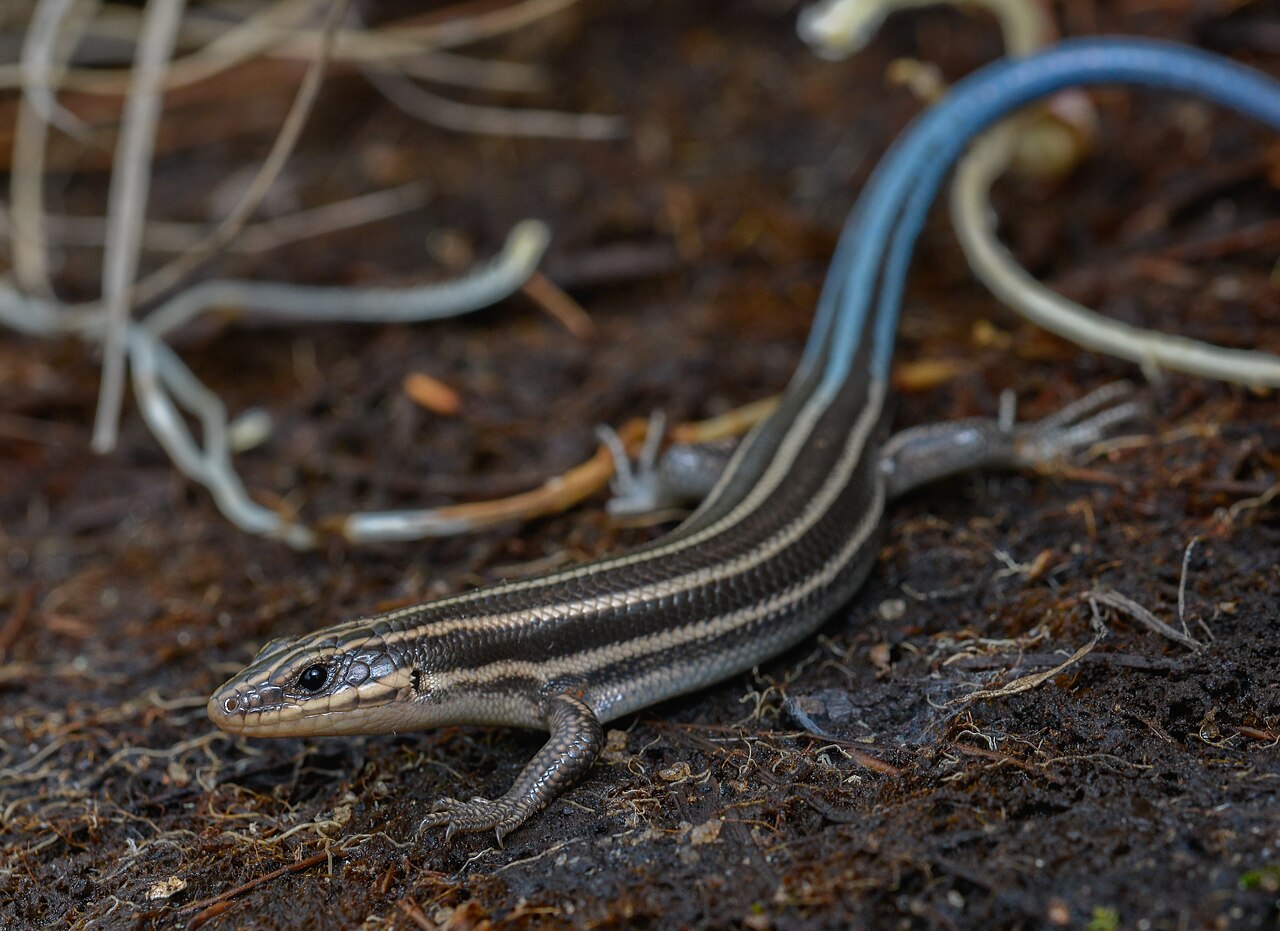
Skinks are smooth, glossy lizards with small legs, a long tapering tail and no spines or crest. North American species run 3 to 8 in (8 to 20 cm) including the tail. Juvenile five-lined skinks have bright blue tails and crisp pale stripes, and adult males develop an orange red head in spring.
How often does a blue tongue skink poop?
A healthy adult blue tongue skink (Tiliqua scincoides) in captivity usually passes stool once every two to four days, depending on diet, temperature and protein in the last meal. Hatchlings and juveniles go far more often, sometimes daily. A gap of more than a week in an adult warrants a check on enclosure temperatures.
What happens if a skink bites you?
Very little. Skinks are not venomous and their jaws are too weak for real damage, so a bite from a wild skink feels like a firm pinch and often does not break the skin. Wash the area with soap and water because of the Salmonella risk rather than because of the bite itself.
Is it good to have skinks in your yard?
Yes. Skinks are insect specialists that eat crickets, ants, beetles, roaches, spiders and slugs, which makes them free pest control around a foundation or garden bed. They damage no plants, structures or stored food and they avoid people. Leaving a woodpile or rock edge undisturbed is enough to keep them.