Coyote vs Fox Tracks in Snow: The One Inch Difference
Coyote vs fox tracks in snow come down to about one inch of width and one small ridge of callus. A coyote print runs 2.5 inches (6.4 cm) long with four forward toes and visible nails, while a red fox print is narrower, hairier, and carries a raised bar across the heel pad that no coyote shows.
Both canids trot in near straight lines, both hunt the same field edges, and both leave tracks that look identical from standing height. Measured against a ruler and read over several strides, however, they separate cleanly every time.
Coyote tracks measure 2.25 to 2.75 inches (5.7 to 7 cm) long with a two lobed heel pad and clear claw marks. Red fox tracks measure 1.75 to 2.25 inches (4.4 to 5.7 cm), look furry and indistinct, and show a horizontal bar across the heel pad. Fox strides run 10 to 14 inches, coyote strides 13 to 16 inches.
Coyote vs Fox Tracks at a Glance
Three numbers do most of the work: print length, heel pad detail, and stride. Everything else, including trail straightness and depth, supports the call rather than making it.
| Feature | Coyote | Red fox | Gray fox |
|---|---|---|---|
| Print length | 2.25 to 2.75 in (5.7 to 7 cm) | 1.75 to 2.25 in (4.4 to 5.7 cm) | 1.25 to 1.75 in (3.2 to 4.4 cm) |
| Print clarity | Crisp pads and toes | Furry, often a smudge | Fairly crisp |
| Heel pad | Two lobes, no bar | Raised bar across pad | Small, no bar |
| Claw marks | Prominent | Fine, sometimes faint | Often faint, semi retractable |
| Walking stride | 13 to 16 in (33 to 41 cm) | 10 to 14 in (25 to 36 cm) | 9 to 12 in (23 to 30 cm) |
| Body weight | 20 to 45 lbs (9 to 20 kg) | 8 to 15 lbs (3.6 to 6.8 kg) | 7 to 13 lbs (3.2 to 5.9 kg) |
What Coyote Tracks Look Like in Snow
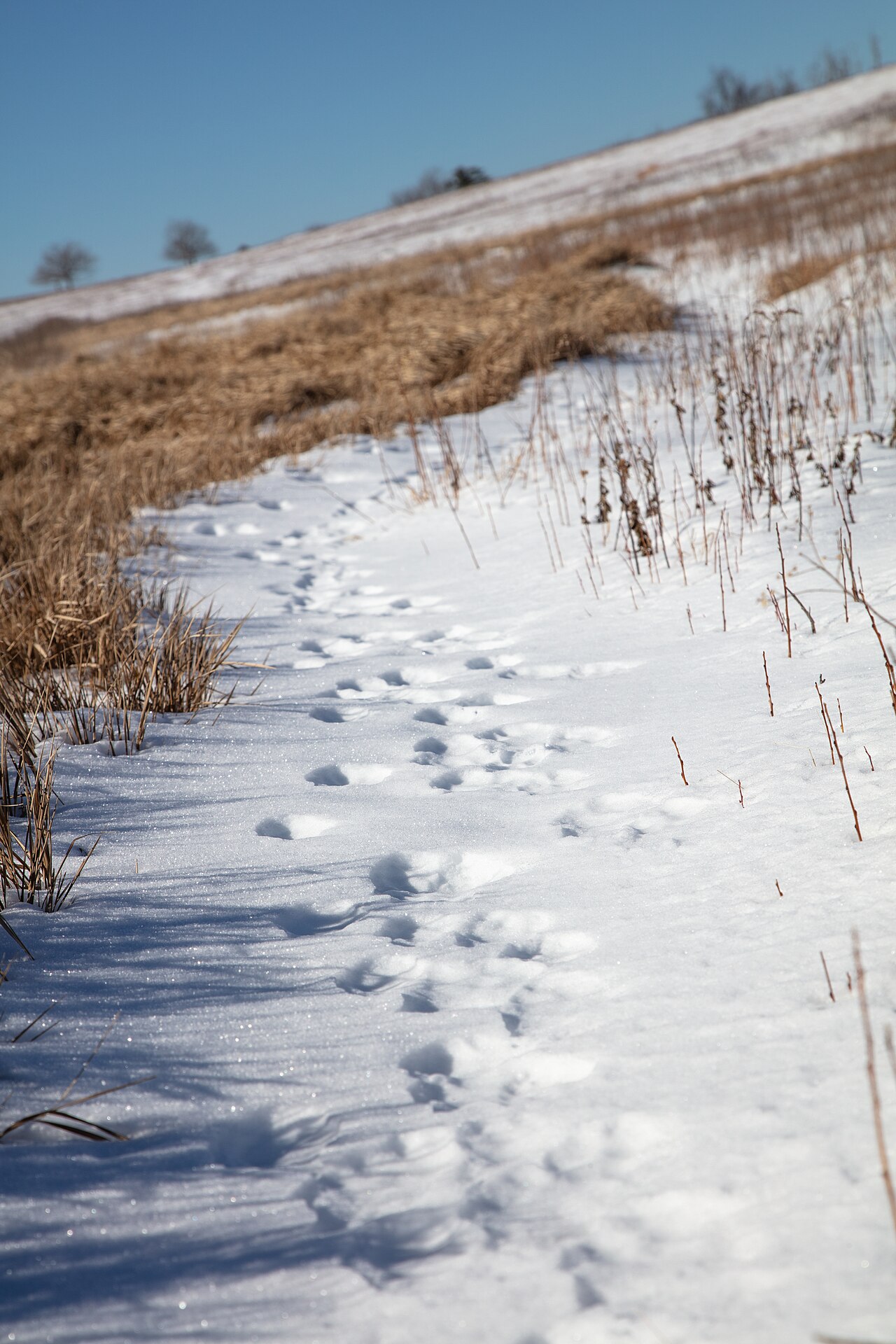
A coyote print in snow is a tight oval with the two central toes set forward and close together, two outer toes flanking them, and blunt claw points above the central pair. The front print is larger than the hind print by roughly a quarter inch.
Weight shows in the depth. At 20 to 45 lbs (9 to 20 kg) a coyote pushes several inches into powder and often plows a shallow channel in snow over 10 inches (25 cm) deep, which a fox at a third of the weight will not do.
The heel pad reads as a triangle with two lobes at the rear and no interruption across the middle. Read our full coyote track guide for mud, dust, and gait variations.
What Red Fox Tracks Look Like in Snow

Red fox prints look soft and incomplete because the feet are heavily furred in winter. Instead of four clean toes you often get an oval smudge with faint nail scratches at the leading edge, especially in cold dry powder.
Under that fur sits the single best diagnostic in North American tracking: a chevron or bar of raised callus running across the heel pad. When a fox prints in firm snow or mud, that bar leaves a gap in the middle of the pad impression.
Fox prints also sit shallow. An 8 to 15 lb (3.6 to 6.8 kg) animal walks on top of crust that a coyote breaks through, so fox trails often run over snow a coyote avoided entirely. More in the red fox track guide.
Size: The One Inch Difference That Settles Most Cases
Overlap exists, but it is smaller than people assume. A print measured at 2.5 inches (6.4 cm) or longer, excluding claw marks, is a coyote in almost every case, and anything under 2 inches (5 cm) is a fox or a small domestic dog.
Measure print length from the back of the heel pad to the front of the toes, not including nails, and do it on the clearest front print you can find. Snow adds apparent size, so a print right at 2.25 inches (5.7 cm) needs a second opinion from the stride.
Width is less useful because fur spreads a fox print sideways. In a fresh powder trail, a fox print can measure as wide as a coyote print while being obviously shorter.
Claw Marks, Fur and the Bar Across the Heel Pad
Coyote nails are thick and leave broad points that sometimes connect to the toe pad in a slurred line. Fox nails are fine and leave thin scratches, which disappear completely in loose snow but show up in crust and wet mud.
Look for the fox bar in prints pressed into shallow slush or on packed trails. It appears as a thin ridge or an empty line across the heel pad impression, running left to right, and no wild canid in North America except the red fox has it.
Gray fox (Urocyon cinereoargenteus) lacks the bar and has less foot fur, so its prints look like small, crisp dog prints with faint claws. Elevation and habitat help: gray fox prefers brushy woodland and climbs trees.
What Animal Makes Straight Line Tracks?
The red fox is the champion, and that habit is a legitimate identification clue. A trotting fox places each foot almost exactly in line, producing a row of single prints so narrow it looks like one animal walked a tightrope.
Coyotes trot in a similarly straight line, which is why straightness alone cannot separate them, but a coyote trail shows a slightly wider straddle and more frequent stops at scent posts. Domestic dogs almost never hold the line for more than a few yards.
Bobcats also walk very straight, and their round clawless prints make the distinction easy once you look at a single print. See the bobcat and coyote comparison for that pairing.
Did I Just See a Fox or a Coyote?
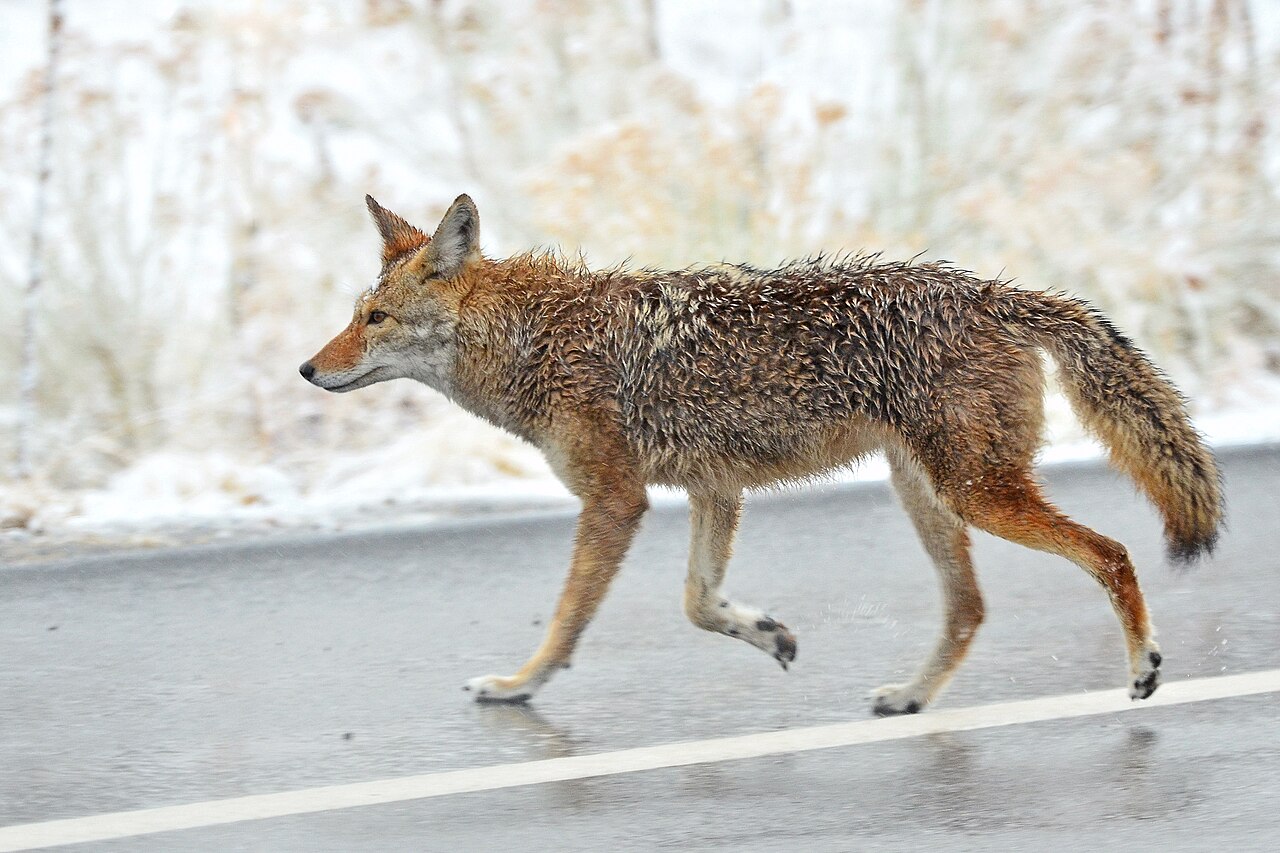
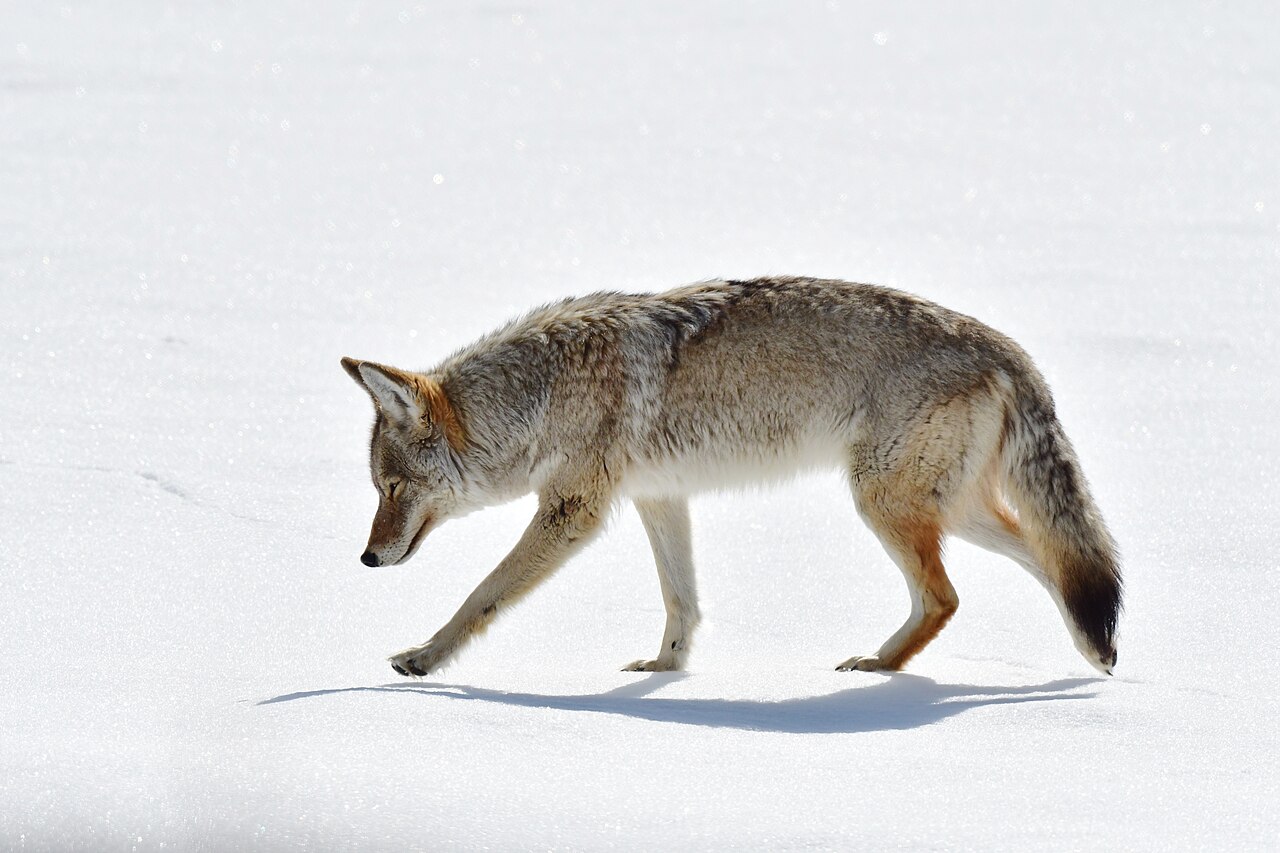
If the animal stood as tall as a medium dog with long legs, a grizzled gray coat, and a bushy tail carried low and straight, it was a coyote. A red fox is knee high, rusty orange with black stockings, and carries a thick white tipped tail almost horizontally.
Movement separates them further. Coyotes trot steadily and look over their shoulder at you; foxes bounce, pounce, and often circle back out of curiosity. At night, eyeshine height alone is a good clue: coyote eyes sit near 20 inches (51 cm), fox eyes near 12 inches (30 cm).
Voice is decisive. Coyotes yip and group howl, while red foxes give a harsh single scream or a short bark. Our fox versus coyote comparison covers the full behavioral picture.
Tracks in Mud and Sand
Mud is where you confirm what snow only suggested. Both species print pads, toes, and nails clearly in damp soil, and the fox heel bar shows at its best, so a creek crossing or a puddle on a dirt road is worth a detour.
Dry sand slumps and inflates both prints by 15 to 20 percent, enough to turn a fox print into coyote numbers. On sand, measure the stride over five prints and ignore the outlines entirely.
Wet sand near lake margins behaves like mud and holds excellent detail for a few hours. Early morning, before wind and sun work the surface, is the productive window.
Gray Fox and Domestic Dog: The Other Two Suspects
Dogs account for most misidentified coyote reports. A dog print is rounder, splayed, and blunt nailed, with a large heel pad relative to the toes, and the trail wanders in loops with no economy of movement.
Gray fox prints are the smallest of the group and can look like a house cat print until you spot the claw marks. Unlike red fox, gray fox leaves prints with visible toe separation and no fur blur.
When a trail runs alongside a road or a house and shows no purpose, call it a dog. Wild canids cross human corridors; they rarely follow them aimlessly.
What Do Bobcat Tracks Look Like Next to These?
Bobcat prints are round rather than oval, 1.75 to 2.5 inches (4.4 to 6.4 cm) wide, carry no claw marks, and show three lobes on the rear edge of the heel pad against the canid two. The toes sit asymmetrically, so left and right are obvious.
That makes a bobcat the easiest animal to exclude in this set, as long as the print is clean. In filled or wind blown snow, fall back on stride: bobcats step 9 to 13 inches (23 to 33 cm), shorter than both coyote and fox at a trot.
Clawless prints over 3 inches (7.6 cm) wide are a different animal entirely and point toward Canada lynx in the northern states.
Where and When to Look for Coyote and Fox Tracks
Both species are active through winter, and fresh snow overnight gives the cleanest record at dawn. Field edges, frozen creek beds, powerline cuts, and the margins of plowed roads concentrate trails because the animals use easy travel routes.
Red foxes stay closer to farmland, suburbs, and open country, while coyotes range wider and cross large blocks of forest. Both hunt rodents under snow, so pounce craters with a hole in the center mark productive ground.
Track surveys after a 24 hour snowfall are the standard method used in extension wildlife programs, including guidance published by Penn State Extension on identifying furbearer sign.
Frequently Asked Questions
Are coyotes in snow?
Yes, coyotes stay active all winter and do not hibernate or migrate. They hunt voles under the snowpack, scavenge winter killed deer, and travel plowed roads and packed trails to save energy, which is why their tracks are easiest to find after fresh snowfall.
Can a coyote pick up a 20 pound dog?
A large coyote can kill and drag a 20 lb (9 kg) dog, and attacks on small pets happen regularly in suburban areas. Coyotes rarely carry such weight far, but the risk is real enough that small dogs should be leashed and supervised at dawn and dusk.
What do squirrel tracks look like?
Squirrel tracks come in bounding sets of four prints, with the two larger hind feet landing ahead of or beside the smaller front feet. Prints show four toes in front and five behind, each about 1 to 1.5 inches (2.5 to 3.8 cm), and trails run tree to tree.
What are skunk tracks like?
Skunk tracks show five toes on both front and hind feet with long front claw marks set well ahead of the pads, a flat footed look, and a waddling trail with a wide straddle. Prints measure 1 to 1.5 inches (2.5 to 3.8 cm) and appear in clusters near den sites.
What could be mistaken for a bobcat?
A large house cat, a lynx, or a young mountain lion in track form, and a red fox at a distance in the field. Track width settles it: house cat near 1.25 inches, bobcat near 2 inches, lynx and cougar over 3 inches (7.6 cm).
What should you do if you see a bobcat in your yard?
Watch from a distance and let it leave. Bring pets inside, secure poultry and rabbits, and remove food that attracts prey. If the animal lingers, make noise and appear large, and contact your state wildlife agency if it shows no fear of people.
With print length, heel pad detail, and stride recorded, most winter trails resolve on the spot. For the broader cat side of the picture, start with bobcat track identification.