Black Spider With White Spots: It Is Almost Always This One
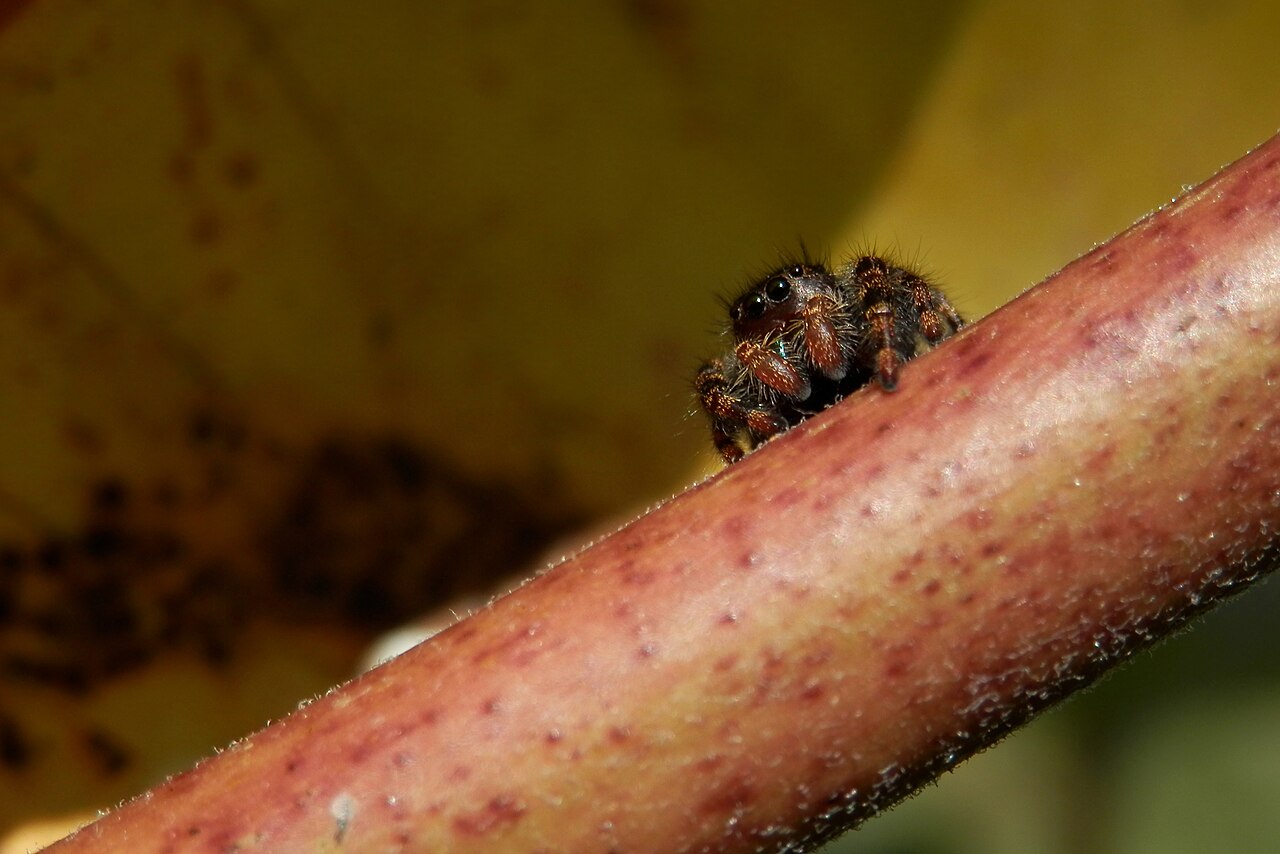
A black spider with white spots on its back is almost always a bold jumping spider (Phidippus audax), the most common black and white spider in the United States. It carries one large white or cream triangle on the abdomen plus two smaller dots behind it, measures 0.3 to 0.6 in (8 to 15 mm), and is harmless to people. The second most likely answer is an immature black widow, which does have white markings and does matter.
Those two spiders are easy to separate once you know what to look at, and the test takes about five seconds: body shape, leg thickness, and where the spider is sitting. Everything below starts with the safety question, because that is the one worth answering first.
Black spiders with white spots in the US are usually bold jumping spiders, which are not dangerous. Their bite causes brief local pain and swelling, like a bee sting. The exception is a juvenile black widow, which shows white or cream stripes and spots before it develops the red hourglass, and should not be handled.
| Spider | Size | White markings | Risk |
|---|---|---|---|
| Bold jumper (Phidippus audax) | 0.3 to 0.6 in | One triangle plus 2 dots on abdomen | Harmless |
| Regal jumper (Phidippus regius) | 0.4 to 0.9 in | Bands and spots, females paler | Harmless |
| Twin-flagged jumper (Anasaitis canosa) | 0.2 in | Two white dashes on the head | Harmless |
| Zebra jumper (Salticus scenicus) | 0.2 in | White bands, not round spots | Harmless |
| Juvenile black widow (Latrodectus) | 0.2 to 0.4 in | White and cream stripes, side spots | Venomous |
| False widow (Steatoda grossa) | 0.2 to 0.4 in | Faint pale crescent or none | Minor |
Is a Black Spider With White Spots on Its Back Poisonous?
No. Spiders are venomous rather than poisonous, and the bold jumping spider’s venom has no medical significance for humans. A bite happens only when the spider is squeezed or trapped against skin, and it produces a sharp pinch, a small red welt and some itching that fades within a day or two.
Jumping spiders would rather watch you than bite. They have the best vision of any spider, they track movement with their large forward eyes, and their default response to a hand is to turn, face it, then jump away. Washington State University’s entomology department and other extension programs list them among the beneficial spiders, and WSU Entomology keeps identification notes online.
What Looks Like a Black Widow but Has White Spots?

Immature black widows do. Young Latrodectus spiderlings hatch with white and cream stripes and spots on a dark abdomen and gain the red hourglass over several molts, so a small shiny black spider with white markings in a garage or woodpile deserves a second look rather than a hand.
Three features separate it from a jumper. A widow has a smooth glossy globe-shaped abdomen, thin delicate legs, and hangs upside down in a tangled web in a dark corner. A bold jumper is fuzzy and compact, has short thick front legs, often shows metallic green fangs, and walks in the open during the day without a web. If you find the real thing, our guide on whether to kill a black widow covers the decision.
What Kind of Spider Is Black and White Speckled?
Speckled rather than spotted usually means a different jumper. The zebra jumping spider (Salticus scenicus) wears white bands that read as stripes on walls and fences, and the twin-flagged jumping spider (Anasaitis canosa) is a 0.2 in southeastern species with two bright dashes on its head that flicks its palps as it walks.
In the Southeast the regal jumper (Phidippus regius) is the heavyweight, with females reaching 0.9 in and showing pale bands and spots on a dark body. All of these are daytime hunters with no web of consequence. For the broader group, see our overview of black and white spiders in the US.
Black Spider With White Spots in the House
Indoors, a bold jumper is almost always a single wanderer that came in through a door or on firewood, hunting flies on sunny window sills and walls. It does not build a web to catch prey, does not colonize a room, and does not lay eggs in bedding. A silk retreat behind a picture frame is where it sleeps.
Spiders that do spin webs in the corners of a US house are usually cellar spiders, cobweb spiders or the dark black house spider. If you are finding dozens of small dark spiders at once rather than one alert jumper, the identification is probably one of those instead.
What to Do When You Find One
Leave it alone if you can, or cup it in a glass with a sheet of paper and release it outside. Bold jumpers eat flies, mosquitoes, moths and small garden pests, and a yard with jumpers in it has fewer of all four. They are the species most often kept as beginner pet spiders for the same reason: curious, visual and slow to bite.
Skip the insecticide. Sprays rarely reach a wandering hunter, and the long-term fix is sealing door sweeps and window screens so fewer insects and fewer spiders get inside. The large web builders in the yard, like the black and yellow garden spider and the banana spider, are doing the same work on a larger scale and are also worth keeping.
Frequently Asked Questions
What kind of spider has white dots on it?
In the United States the usual answer is the bold jumping spider, which has one large white triangle and two smaller white dots on a black abdomen. Regal jumpers, twin-flagged jumpers and zebra jumpers also show white markings, and immature black widows carry white stripes and side spots before turning solid black.
What spider is mistaken for a black widow?
False widows in the genus Steatoda are the most frequent mix-up, since they are dark, glossy and build similar tangled webs. Bold jumpers get called widows because of the black body, and cellar spiders get blamed for widow webs. The reliable marks are the red hourglass underneath and the smooth globe-shaped abdomen.
What is the deadliest house spider?
In the US the two spiders of medical concern are the black widow and the brown recluse. Widow bites can cause severe cramping and need medical attention, and recluse bites can produce slow-healing skin damage. Deaths are very rare, with no confirmed US spider fatalities in most recent years.
Is it okay to squish a black widow?
Crushing one with a shoe or a thick wad of paper works, but reaching into a dark space to do it is how bites happen. Vacuuming the spider and its web from a safe distance is better, and spraying it first is unnecessary. Wear gloves when moving woodpiles, pots or boxes where widows hide.