Spider Ball Python: The Wobble, the Price and the Ethics Debate
A spider ball python is a color morph of Python regius with a thin, web-like pattern, and it comes with a neurological defect that no breeder has ever separated from the look. Every spider carries some degree of the wobble: head tremors, corkscrewing, and loss of coordination that gets worse under stress.
That is the whole story of this morph. The pattern is striking and cheap, the genetics are simple, and the ethics are genuinely contested inside the hobby. Anyone considering one should understand the wobble before the price.
The spider ball python is a dominant Python regius morph showing thin dark webbing on a tan background. All spiders carry a neurological condition called the wobble, ranging from a slight head tilt to corkscrewing. They cost $75 to $200, are legal in the US, and live 20 to 30 years.
| Trait | Spider Ball Python |
|---|---|
| Inheritance | Dominant, no viable super form |
| Pattern | Thin dark webbing, reduced side markings |
| Wobble | Present in every spider, severity varies |
| Price | $75 to $200 for a single gene spider |
| Adult size | 2.5 to 3.5 ft males, 3.5 to 5 ft females |
| Lifespan | 20 to 30 years in captivity |
What Is a Spider Ball Python?
The spider is a single gene morph of the ball python that first appeared in 1999 from a wild-caught import. It expresses as a dominant trait, so one copy is enough and roughly half the clutch inherits it when a spider is bred to a normal.
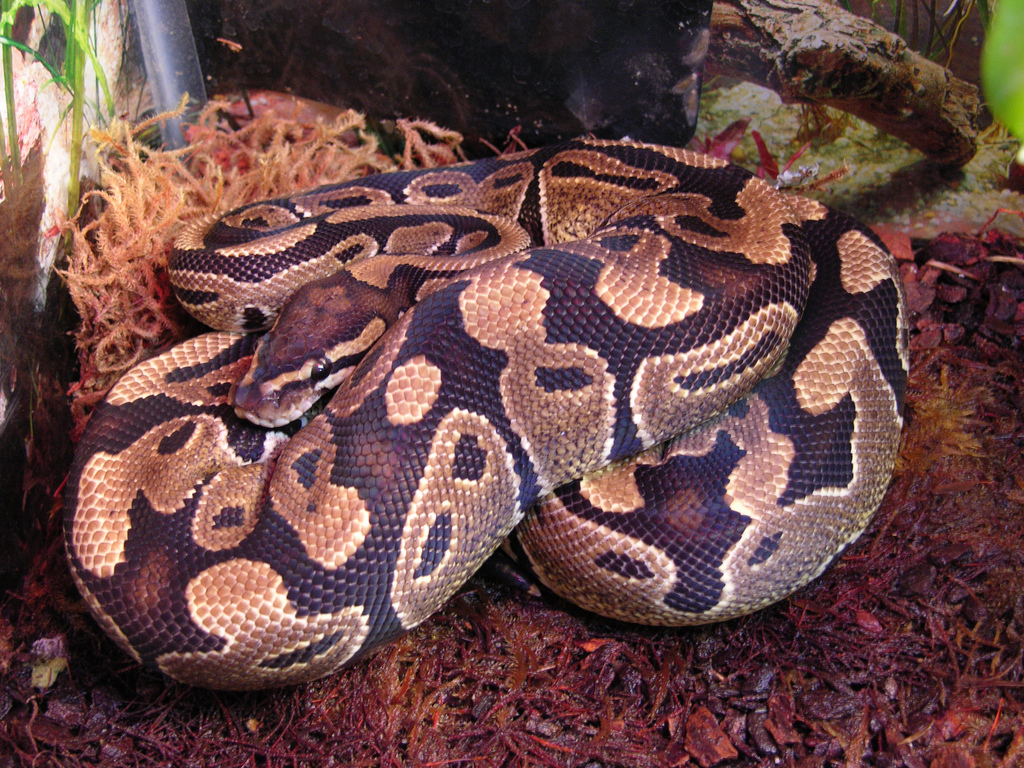
What the gene does is reduce dark pigment and pull the pattern into narrow lines. Where a normal ball python has heavy brown blotches with pale keyholes, a spider has a gold or tan background crossed by thin black webbing and a clean white belly.
How to Tell If a Ball Python Is a Spider

Look at the sides of the snake. A spider has almost no dark pigment low on the flanks, so the pale belly runs unusually high up the body, and the dark markings that remain are thin and connected rather than blotchy.
The head helps too. Spiders usually show a clean, reduced head pattern with a distinct dark stripe through the eye. Compare that with the banana ball python, which keeps a normal pattern shape and changes the color instead.
The behavioral tell is the most reliable one. Set the snake down and watch it move. Even a mild spider tends to hold its head slightly off level or make a small correcting motion when it tracks something.
The Spider Wobble: What It Is and Why It Happens

The wobble is a neurological condition linked to the same gene that makes the pattern. Affected snakes show head tremors, tilting, and in bad cases full corkscrewing where the head rolls upside down. It is present from hatching and it does not go away.
Severity varies widely between individuals and it is not predictable from the parents. Many spiders live and feed normally with a tremor visible only when they are excited or handled. Others miss strikes at prey repeatedly and need assisted feeding.
The best supported explanation is a defect in the inner ear structures that control balance, which develops alongside the pigment changes. No breeder has produced a spider without it in more than two decades of trying, which is the strongest evidence that the two effects come from the same mutation.
Are Spider Ball Pythons Illegal?

They are legal to own, breed, and sell in the United States, and no state currently restricts the morph specifically. Ball pythons in general are legal across most of the country, with a handful of city-level restrictions on large constrictors that do not apply to a species this size.
The restrictions that exist are private. The International Herpetological Society banned spiders and other wobble-carrying morphs from its shows in the UK in 2017, and several European breeders and expos have followed. Those are trade decisions rather than law.
How Much Does a Spider Ball Python Cost?
A single gene spider runs $75 to $200 in the US, which puts it among the cheaper named morphs. Prices collapsed from the four figure range of the early 2000s as the gene spread through the hobby.
Combinations cost more because the spider pattern layers well. A bumblebee, which is spider plus pastel, sits around $150 to $300, and multi-gene designer combos reach four figures. Compare that with a pied ball python, where the recessive genetics keep prices higher.
Are Spider Ball Pythons Good Pets?
As a snake to keep, yes. Ball pythons are slow, tolerant of handling, and undemanding once the enclosure is right, and a spider is no different in temperament from an albino ball python or any other morph.
The reservation is the wobble, and it is a real one. A severely affected animal may strike past its prey, struggle to right itself, and visibly stress during handling. If you buy one, buy it in person, watch it move, and watch it eat before money changes hands.
The wider question is whether to buy at all. Deliberately producing animals with a known neurological defect is the reason the morph is contested, and demand is what keeps it in production. That is a decision worth making consciously rather than at a table at an expo.
Why There Is No Super Spider
Breeding two spiders together should produce a homozygous super form, the way two pastels produce a super pastel. It does not. No confirmed super spider has ever hatched, and clutches from spider to spider pairings show the missing quarter as dead eggs or full term deaths.
The accepted conclusion is that two copies of the gene are lethal in the egg. Most responsible breeders therefore pair spiders only to non-spiders, which keeps clutch sizes normal and avoids producing embryos that cannot survive.
Spider Ball Python Morphs and Combinations
The spider gene is popular with breeders because it layers cleanly over almost everything else. Adding pastel produces the bumblebee, the single most common spider combo and usually the cheapest way into the look, with a bright yellow background and the same thin webbing.
Stacking further gives the killer bee, which is super pastel plus spider, and the spinner, which is spider plus pinstripe and reduces the pattern to fine dark lines on gold. Spider combined with the recessive pied or clown genes produces the high-end designer animals that carry four figure price tags.
Every one of these carries the wobble, because the spider gene is what they all have in common. A bumblebee is not a milder spider, and neither is a spinner. Breeders who tell you a particular combo reduces the neurological effect are describing luck with individual animals, not a property of the combination.
Care, Size and Lifespan
Females reach 3.5 to 5 ft (1.1 to 1.5 m) and males 2.5 to 3.5 ft (0.8 to 1.1 m). An adult needs an enclosure of at least 4 x 2 ft (1.2 x 0.6 m) with two hides, one at each end.
Run a warm side of 88 to 92 F (31 to 33 C) on a thermostat, an ambient of 78 to 80 F (26 to 27 C), and humidity of 55 to 65 percent, raised to 70 percent during a shed. Feed an appropriately sized rodent every 7 to 14 days and expect seasonal fasting in winter. Checking waste is the simplest health monitor you have, and our guide to snake poop covers what normal looks like.
Ball pythons are West African and the species is listed as Near Threatened by the IUCN Red List because of the scale of the export trade. Captive-bred animals like a spider carry none of that burden, which is one good argument for buying from a breeder rather than an importer. Unlike garter snakes, they are solitary, so a group of snakes is not something you should house together.
Handling and Feeding a Snake With a Wobble
Stress makes the wobble worse, so the practical goal is to keep the snake calm. Support the body fully when you lift it, avoid sudden movements above the head, and keep sessions to 10 or 15 minutes. A spider that starts corkscrewing during handling should go back in the enclosure rather than being worked through it.
Feeding is where severity shows. A mild spider strikes and coils normally. A heavily affected one misses, grabs the wrong end, or loses the prey mid-coil. The fix is to use long tongs, offer the rodent head first at a steady height, and give the snake room to strike without hitting a wall.
If the snake repeatedly fails, switch to assisted feeding: place the prey item at the mouth and let the snake take it without a strike. Many wobbly spiders feed reliably this way for their whole lives. Feed inside the enclosure, not in a separate tub, since the move itself adds stress.
Health Problems Beyond the Wobble
The usual ball python problems apply and none of them are caused by the spider gene. Respiratory infection shows as open mouth breathing, wheezing, or bubbles at the nostrils, and it almost always traces back to an enclosure that is too cold or too damp.
Scale rot and blister disease come from substrate that stays wet. Incomplete sheds, particularly stuck eye caps, come from humidity that is too low during the shed cycle. Both are husbandry faults rather than bad luck, and both resolve once the numbers are right.
Mites arrive on new animals and spread fast in a collection. Quarantine anything new for 60 days in a separate room, check under the chin and around the eyes, and treat before the animal joins the rest. A vet with reptile experience is worth finding before you need one.
Frequently Asked Questions
Will a ball python bite hurt?
Barely. A ball python has small recurved teeth and the bite feels like a set of pinpricks, usually drawing a few spots of blood at most. They are among the least defensive snakes in the hobby, and an adult that bites is normally reacting to a feeding cue rather than to you. Wash the area and move on.
Can a ball python choke you out?
No. An adult ball python weighs 3 to 5 lb and lacks the muscle mass to restrict an adult human’s breathing or blood flow. The species is named for curling into a ball when frightened, which is the opposite of an attack. Never drape any constrictor around your neck, but the risk here is negligible.
Do ball pythons get attached to their owners?
Not in the way a dog or a parrot does. Snakes lack the social brain structures for attachment, though they do habituate: a regularly handled ball python stops treating your hand as a threat and becomes visibly calmer. That is learned tolerance rather than affection, and it is worth having.
What snake is worth $100,000?
The record prices belong to first ever ball python morphs. A lavender albino sold for around $40,000 in 2001, and a handful of new recessive combinations have reportedly changed hands near six figures in their debut year. Prices fall fast once a gene is reproduced, which is exactly what happened to the spider.
Does the spider wobble get worse with age?
Usually not. The condition is present at hatching and most keepers report it staying roughly stable through the snake’s life, with the visible severity rising and falling according to stress, temperature, and whether the animal is in shed. A sudden worsening in an adult points to illness or a husbandry problem rather than the gene itself, and is worth a vet visit.
What is the least bitey snake?
The ball python is the usual answer, along with the corn snake and the rosy boa. All three are slow, tolerant of handling, and far more likely to hide than to strike. Any young snake is more defensive than an adult, so a nervous baby snake is normal rather than a sign of a bad temperament.