Weasel Poop: 6 ID Clues and 3 Lookalike Droppings
Weasel poop looks like a thin, dark, rope-like cord with twisted ends, usually 1 to 2 inches (2.5 to 5 cm) long and no thicker than a pencil lead. Break one open and you find fur and splinters of bone, because weasels eat almost nothing but meat. That combination of thin, twisted, and hairy separates weasel droppings from nearly every other scat you find around a yard, barn, or stone wall.
Weasels in the United States come in three sizes, and so does their scat. The long-tailed weasel (Mustela frenata) leaves the largest droppings, the short-tailed weasel or stoat (Mustela erminea) leaves medium ones, and the least weasel (Mustela nivalis) leaves scat so small it is easy to walk past. All three use the same habit of depositing on raised, obvious surfaces, which is the single best clue you have.
Weasel poop is a thin black or dark brown cord 1 to 2 inches (2.5 to 5 cm) long and about 1/8 inch (3 mm) thick, with twisted, tapered ends and a kinked shape. It contains visible fur and bone fragments, smells strongly musky, and is left on rocks, logs, and stone walls, often in small accumulating piles near a den.
What Do Weasel Droppings Look Like?
Weasel droppings look like a dark shoelace that has dried in place. The classic sample is tubular, tapered to a point at one or both ends, and twisted along its length, often folded back on itself in a hook or kink rather than lying straight. Fresh scat is glossy black and soft; after a day or two it fades to dark brown and turns brittle.
The width matters more than the length for identification. Weasel scat stays around 1/8 inch (3 mm) thick, which is thinner than almost any other carnivore dropping you encounter. If what you found is thicker than a pencil, you are looking at mink, marten, or a rodent dropping instead.
Smell is the last confirmation. Weasels are mustelids, and their scat carries a sharp musky odor that lingers on your gloves. It is not the ammonia bite of rodent urine and not the sweet, fermented smell of a berry-fed omnivore.
Weasel Poop Identification Chart

Use the measurements below as a field reference. Length varies with the size of the last meal, so judge thickness, shape, and contents first.
| Feature | What you see |
|---|---|
| Length | 1 to 2 in (2.5 to 5 cm), least weasel under 1 in (2.5 cm) |
| Diameter | 1/8 to 1/4 in (3 to 6 mm), pencil lead to pencil |
| Shape | Thin cord, twisted, tapered points, often kinked or folded |
| Color | Glossy black when fresh, dark brown and chalky when old |
| Contents | Fur, tiny bones, teeth, feather shafts, no seeds or plant matter |
| Location | Rocks, logs, stone walls, trail junctions, beams in barns |
| Grouping | Single pieces on travel routes, small piles at latrines near dens |
What Does Least Weasel Poop Look Like?

Least weasel poop looks like a miniature version of the same cord, roughly 1/2 to 1 inch (1.3 to 2.5 cm) long and barely 1/16 inch (1.5 mm) thick. At that size people routinely mistake it for a twig, a bit of dried vine, or an insect casing. The giveaway is still the twist and the fur.
The least weasel is the smallest carnivore in North America, weighing about 1.5 ounces (43 g), and it hunts almost exclusively voles and mice. Its scat is therefore almost pure fur, which makes it lighter and more fibrous than a long-tailed weasel dropping of the same length.
If you find these in a basement or crawlspace, look along the wall base. Least weasels follow rodent runways, and their latrines sit right at the entrance to the tunnel they have taken over.
Next question: Weasel Tracks: How to Identify Them in Snow, Mud and Sand
Where You Find Weasel Scat

Weasels place their scat where other weasels will find it, which means raised and conspicuous surfaces. Stone walls are the single most productive place to look in the Northeast and Midwest. Fallen logs, boulders in a field, culvert entrances, woodpiles, and the top rail of a fence all work the same way.
Inside buildings the pattern shifts to beams, shelf edges, and the corners of feed rooms. Poultry keepers usually find weasel scat near the point of entry rather than in the open floor, often alongside a few scattered feathers.
A weasel that has claimed a den builds a latrine. Instead of one piece you find a dozen droppings of different ages in a patch the size of a dinner plate, sometimes mixed with fur and bone from cached prey. That accumulation is a residency sign, not a passing visit.
Weasel Poop vs Mink Poop
Mink poop is the lookalike that fools the most people, because mink are mustelids with the same rope-like scat shape. The difference is size and diet. Mink droppings run 2 to 3 inches (5 to 7.5 cm) long and 1/4 to 3/8 inch (6 to 10 mm) thick, noticeably stouter than a weasel cord.
Contents settle it. Mink hunt in and near water, so their scat holds fish scales, crayfish shell, and frog bones, and it often has a rank, fishy smell. Weasel scat holds mammal fur. Location helps too: mink scat sits on rocks and logs within a few feet of a stream, pond, or marsh edge, often near beaver sign along the bank.
Weasel Poop vs Rat Poop
Rat poop is the second common mix-up, especially in barns and basements where both animals hunt the same corridors. Rat droppings are discrete pellets, not cords: 1/2 to 3/4 inch (1.3 to 2 cm) long, blunt or slightly pointed, smooth, and scattered loosely wherever the rat traveled.
A rat pellet never twists and never contains fur. It is dense and uniform because rats eat grain, fruit, and garbage, so a broken pellet shows a pasty, seed-flecked interior. For the finer distinctions between rodent species, the rat and mouse comparison covers size overlap in detail, and bat guano adds a third indoor possibility that crumbles to shiny dust.
Weasel Poop vs Skunk Poop
Skunk poop is also tubular, which puts it on the suspect list, but it is roughly twice as thick at 1/2 inch (13 mm) and has blunt, broken ends rather than drawn-out points. Skunks are omnivores, so the contents are the tell: insect wing cases, beetle legs, berry seeds, and grass.
Skunks also leave their scat on open lawns and in shallow diggings rather than on elevated perches. If the dropping sits in the middle of a mowed yard next to a cone-shaped hole, think skunk. If it sits on top of a wall with fur in it, think weasel. Plant content is a reliable divider across species, as the deer and rabbit pellets show at the other extreme.
How Do You Tell If You Have Weasels?
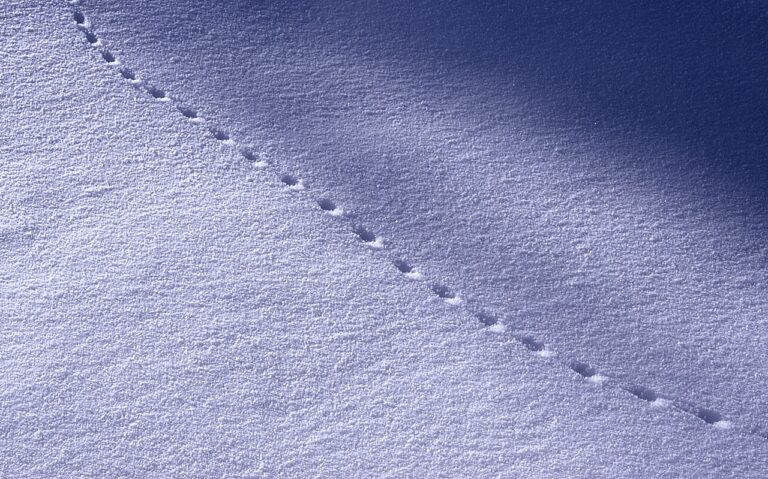
Scat is the first sign, but weasels leave a recognizable package of evidence. Look for narrow tracks in pairs with a bounding pattern, entry holes about 1 inch (2.5 cm) across, and prey killed by a bite at the base of the skull rather than torn open. Poultry losses with the head removed and the body left behind point to a weasel rather than a fox or raccoon.
Fur caches are the second confirmation. Weasels store surplus kills, so a pocket of dried voles or chicks in a wall void, under a floor, or behind feed sacks is characteristic. A musky smell in an enclosed space completes the picture.
Is Weasel Poop Dangerous?
Treat weasel scat as a disease risk, not a curiosity. Mustelids and the rodents they eat can carry Salmonella, Leptospira, Giardia, and roundworms, and weasels are listed among the mammals susceptible to rabies even though cases are rare. Fleas that ride on weasels and their prey are the usual route for plague and tularemia in the western states. The CDC and your state wildlife agency publish current guidance for your region.
Clean up wet, never dry. Wear disposable gloves and an N95 mask, mist the droppings and the surface with a disinfectant or a 1 to 10 bleach solution, let it sit for five minutes, then lift everything with paper towels into a sealed bag. Sweeping or vacuuming dry scat throws particles into the air, which is the exposure you are trying to avoid. Wash hands and launder clothing afterward.
What Attracts Weasels to Your House?
Weasels follow prey, so a mouse or vole population is the magnet. Spilled birdseed, pet food in the garage, compost with kitchen scraps, and a cluttered woodpile all build the rodent base that brings a weasel in behind it. Poultry and rabbits are a second draw, especially coops with gaps.
Shelter matters almost as much. Stone foundations, rock walls against the house, dense brush at the wall line, and crawlspaces with open vents give a weasel the tight, protected spaces it prefers. Removing the cover usually does more than removing a single animal.
How Do I Get Rid of a Weasel in My House?
Exclusion is the only durable answer. Weasels squeeze through openings as small as 1 inch (2.5 cm), so seal gaps with 1/4 inch (6 mm) hardware cloth rather than chicken wire, which they pass through easily. Close coop vents with the same mesh, cover dirt floors, and fit tight latches. Then cut the food supply by controlling rodents and securing feed.
Smell-based repellents are unreliable. People report that weasels avoid strong ammonia, mothballs, and predator urine, but no deterrent holds against an animal with a food source behind the barrier, and mothballs used outdoors are both ineffective and a legal problem in many states. Weasels are classified as furbearers nearly everywhere, so trapping is regulated by season and permit. Call your state wildlife agency before setting anything.
Frequently Asked Questions
What time of day do weasels come out?
Weasels are active around the clock in short bursts because their metabolism forces them to eat every few hours. In practice you see them most at dawn and dusk, and least weasels are often abroad in full daylight. Winter pushes activity into daytime, since hunting under snow is warmer than hunting at night.
What animals are sometimes mistaken for weasels?
Mink, martens, and young fishers are the usual confusions, along with ferrets that have escaped captivity. Ground squirrels and chipmunks get misidentified at a distance when they run with a long body posture. The reliable separators are tail length, tail tip color, and size: a weasel in white winter coat with a black tail tip is unmistakable.
What smell do weasels hate?
Weasels react to strong ammonia, predator urine, and heavy mint or clove oils, and keepers sometimes report short term success with them. None of these smells beats an accessible food source, and rain washes them off within days. Spend the effort on 1/4 inch (6 mm) hardware cloth instead.
Is a weasel bite poisonous?
No, weasels are not venomous or poisonous, and their droppings are not toxic to touch through gloves. The real risk from a bite is bacterial infection and, in rare cases, rabies exposure, so any bite that breaks the skin needs washing and a call to a doctor. Handling scat barehanded is the more common way people get sick.
What is weasel poop coffee?
Weasel poop coffee is a marketing name for kopi luwak, and the animal involved is not a weasel. The beans pass through the Asian palm civet (Paradoxurus hermaphroditus), a viverrid from Southeast Asia that Vietnamese sellers call a weasel. No North American weasel is involved in any coffee production.
What should I do if I see a weasel?
Watch it and leave it alone. Weasels are not aggressive toward people, and a sighting in a field or wall usually means the local rodent population is being kept down for free. If it is inside a coop or house, open a clear exit route, close the door behind it, then find and seal the entry hole the same day. Compare your other yard sign against the larger mammal droppings if you are still unsure what you found.
Explore more: Animal Poop Identification: A Field Guide by Species