Mouse Tracks: How to Identify Them and Tell Them From Rats
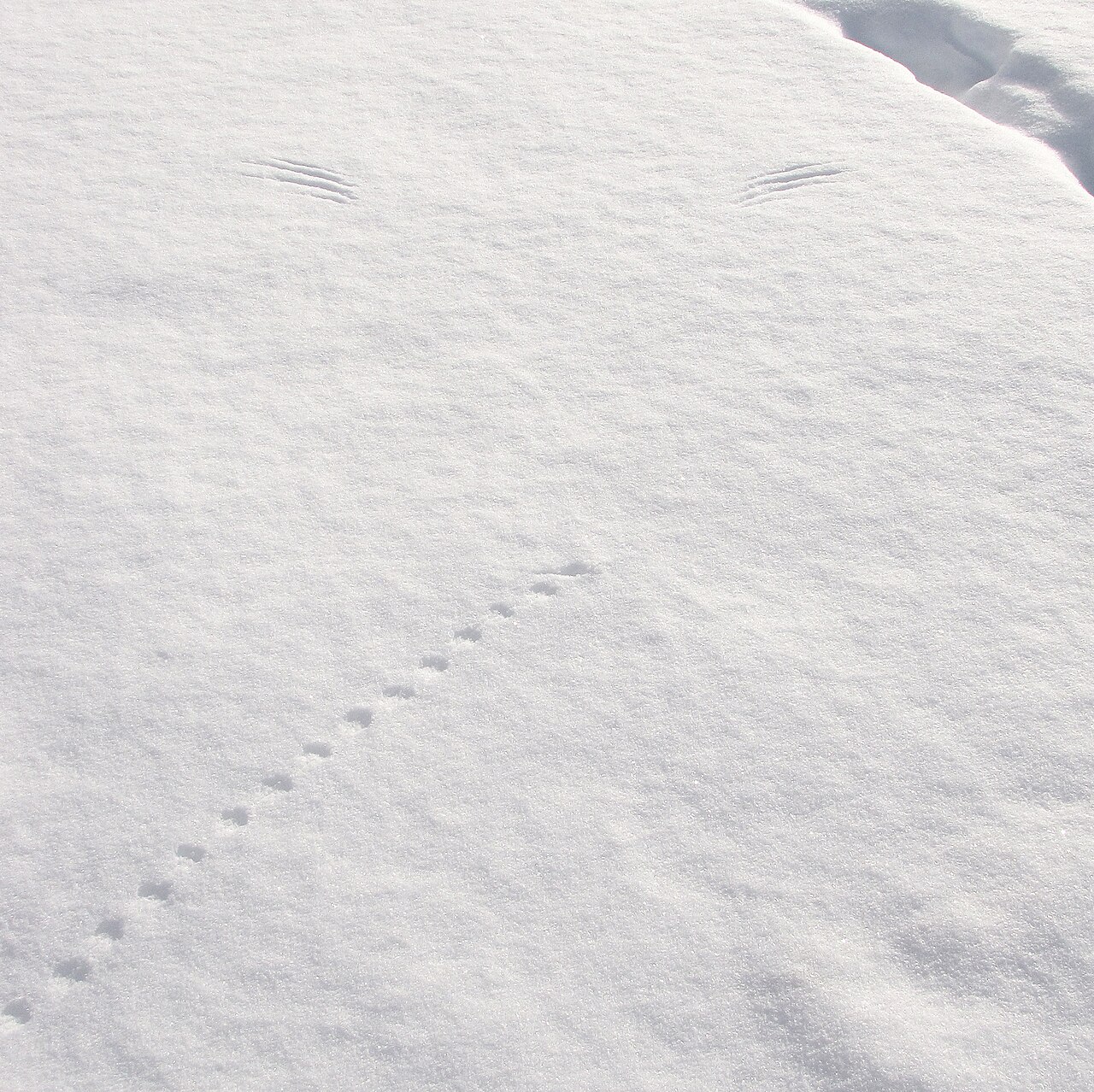
Mouse tracks are tiny four print groups with a tail drag line down the middle: a front foot showing four toes at about 3/8 in (1 cm) long, a hind foot showing five toes, and a bounding pattern that repeats every 3 to 8 in (7.5 to 20 cm). Once you can see the tail line, you have a mouse and not a vole, shrew or young rat.
House mice (Mus musculus) and deer mice (Peromyscus maniculatus) leave the smallest mammal tracks most people will ever find, and they leave them in two very different places: fresh snow in the yard and fine dust along a wall or attic joist. Both tell you the same things if you know what to measure, and the indoor set tells you where the animals are living.
A mouse track group covers about 1 in (2.5 cm) and holds four prints: two front feet with four toes each and two hind feet with five toes each, all under 1/2 in (1.3 cm) long. Groups repeat every 3 to 8 in, and a thin continuous tail drag runs between them. Claws print as fine pinpricks.
| Measurement | Mouse | Rat | Vole |
|---|---|---|---|
| Front foot, toes | 4 | 4 | 4 |
| Hind foot, toes | 5 | 5 | 5 |
| Front print length | 3/8 in (1 cm) | 3/4 in (1.9 cm) | 3/8 in (1 cm) |
| Hind print length | 3/8 to 1/2 in (1 to 1.3 cm) | 3/4 to 1.5 in (1.9 to 3.8 cm) | 1/2 in (1.3 cm) |
| Track group width | about 1 in (2.5 cm) | 2 in (5 cm) | 1 in (2.5 cm) |
| Typical gait | Bound, groups of four | Bound or walk | Trot, alternating |
| Stride | 3 to 8 in (7.5 to 20 cm) | 8 to 20 in (20 to 50 cm) | 2 to 4 in (5 to 10 cm) |
| Tail drag | Thin, almost always present | Thick, often present | Rare, tail is short |
How to Identify Mouse Tracks
Count toes first. A mouse front foot registers four toes around a small palm pad, and the hind foot registers five, with the two outer toes angled sideways so the print looks like a little hand. Claws are present and cannot retract, so in fine material they show up as pinpricks just ahead of each toe pad rather than as the gouges a dog leaves.
Then measure. Front prints run about 3/8 in (1 cm) long and hind prints 3/8 to 1/2 in (1 to 1.3 cm), which means the whole four print group fits inside a quarter. Anything appreciably larger is a rat, a chipmunk or a young squirrel, and this is where most misidentification happens: people judge the size of the trail instead of the size of one foot.
Mouse Tracks in Snow
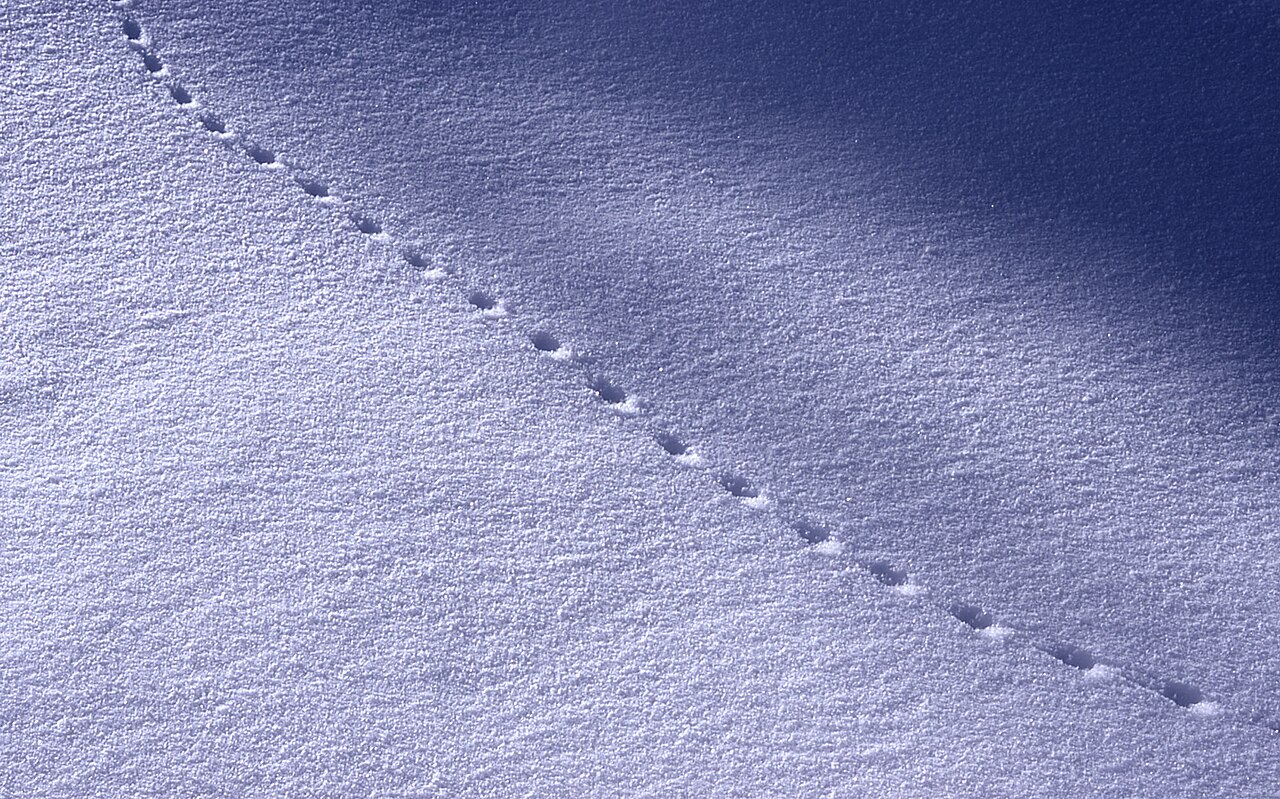
Winter is when mouse tracks become obvious, because mice stay active all year and a dusting of snow records every trip. Look along foundations, woodpiles, brush edges and the base of bird feeders at first light. In 1/4 to 1 in (0.6 to 2.5 cm) of light snow over crust you get complete toe detail; in anything deeper the animal tunnels and you find only entry and exit holes with a groove between them.
The trail pattern carries further than the prints. A bounding mouse pushes off with both hind feet and lands with the fronts first, producing tight clusters of four every 3 to 8 in, almost always running from one piece of cover to another in a straight dash. Between clusters you see the tail line, a continuous thread about as wide as pencil lead. Compare that with the much larger bounding groups of mink tracks along the same creek bank and the difference in scale is immediate.
Mouse Tracks in Mud and Sand
Mud holds the best detail of the three surfaces, and the places to check are the margins of puddles, tire ruts, garden beds and the silt at the mouth of a drain pipe. In damp silt you can see individual claw marks and the texture of the palm pads. A print that stays sharp after a day in the shade is firm evidence that mice are resident, not passing through.
Dry sand is the least reliable surface. Grains collapse inward, toes merge, and a mouse print swells until it reads like a rat’s. In sand, trust the stride and the tail drag rather than the outline: a stride under 8 in with a thin continuous tail line is a mouse regardless of how bloated the individual prints look. Blowing sand also erases tracks within hours, so morning checks are the only useful ones.
Mouse Footprints in Dust: Tracks Inside the House
Indoors, mice leave tracks in dust, flour, drywall sand, and the greasy film along a baseboard. Mice are creatures of habit that run the same route against a wall every night, and repeated passes build a visible runway: a clean strip through the dust with smudged prints at the edges and sometimes dark rub marks where fur oil has transferred to the surface.
To make the sign readable, dust a suspected route yourself. Sift a thin layer of unscented talc or plain flour in a strip 6 in (15 cm) wide along the wall, behind the stove, under the sink and across attic joists, then look the next morning. Fresh prints with a tail line through your powder confirm activity and show you the direction of travel, which is what you actually need before setting anything.
Mouse Tracks vs Rat Tracks
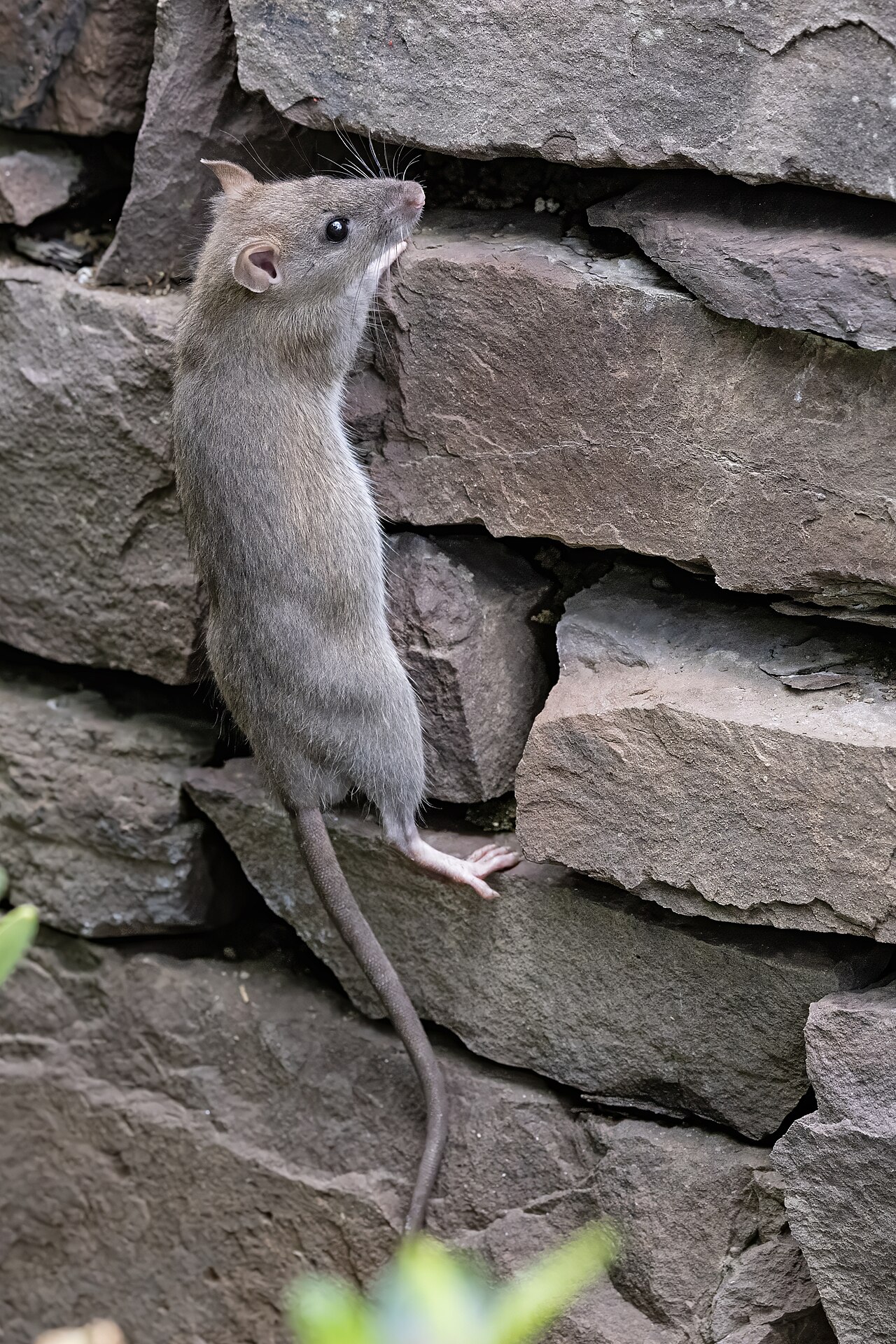
Rats are the most common mix up because the foot plan is identical: four toes in front, five behind, claws showing. The separation is purely size. A Norway rat hind print runs 3/4 to 1.5 in (1.9 to 3.8 cm) long, roughly double a mouse, and the four print group spans about 2 in (5 cm) instead of 1 in.
Stride and tail confirm it. A rat trail stretches 8 to 20 in (20 to 50 cm) between groups and the tail drag is a broad smear rather than a thread. Rats also leave heavier rub marks at wall corners and under gaps, since the animal weighs ten times what a mouse does. A juvenile rat can print in mouse range, so if the stride says rat and the prints say mouse, treat it as a rat.
Mouse Tracks vs Vole and Shrew Tracks
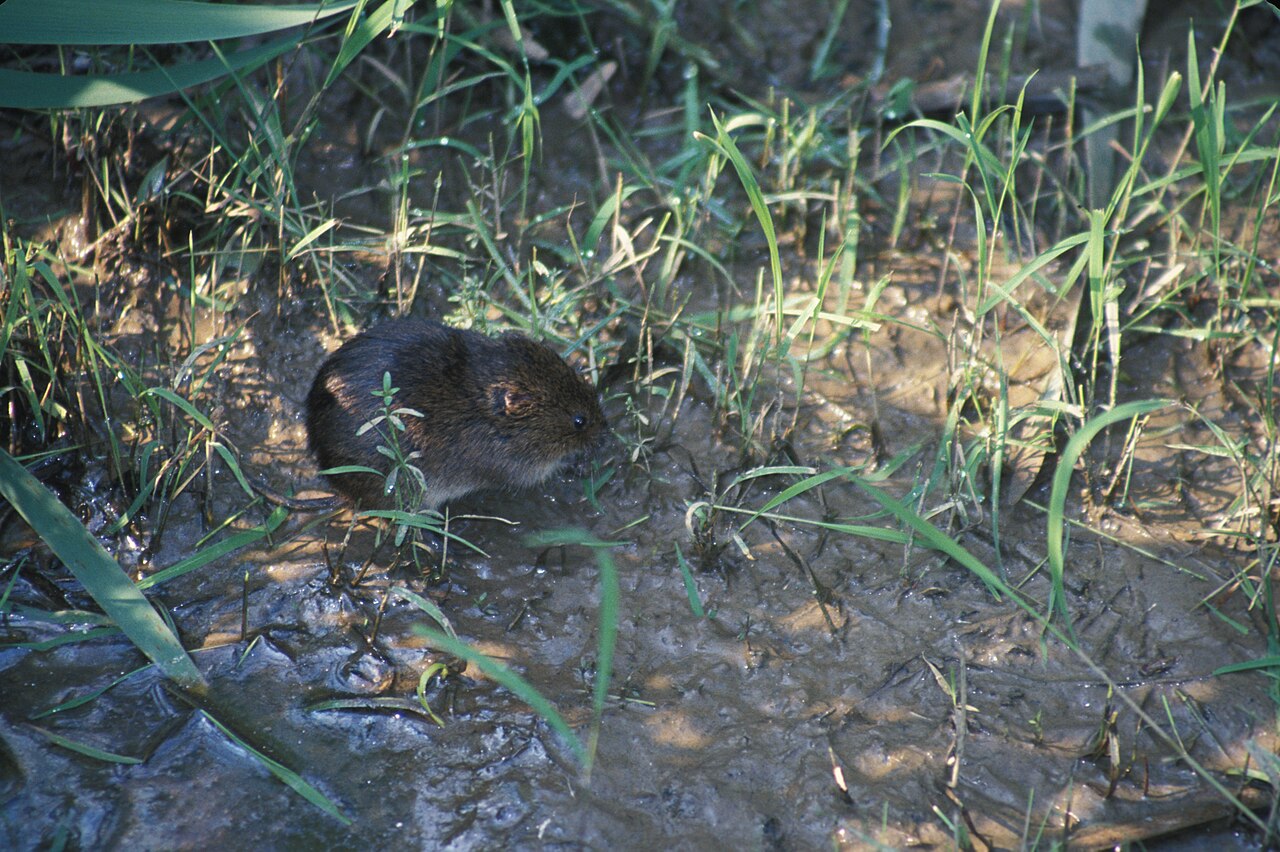
Voles overlap mice almost exactly in print size, and the difference is behavior written into the trail. Voles trot rather than bound, so their prints alternate left and right in two rough lines with a stride of only 2 to 4 in (5 to 10 cm), and they stay inside surface runways through grass. Their tails are short, so a tail drag is rare.
Shrews are separated by a single detail: five toes on the front foot as well as the hind, the only small mammal in this group with that pattern. Shrew trails are frantic, with sudden turns and tunnel entrances every few feet, and the prints are even smaller than a mouse at under 1/4 in (0.6 cm). Shrews also eat insects rather than seed, so you will not find them working a feeder spill.
Mouse Tracks vs Squirrel and Chipmunk Tracks
Chipmunks and squirrels share the four and five toe plan but are much larger. A chipmunk hind print runs 1 to 1.25 in (2.5 to 3.2 cm), a gray squirrel 1.5 to 2.5 in (3.8 to 6.4 cm), and both bound with the hind feet landing ahead of the front feet, producing a group that is wider than it is long.
Squirrel trails also run tree to tree and end at a trunk, while mouse trails hug cover and vanish into ground level holes. In snow, squirrels dig conical caching pits, a sign no mouse produces. For straight line travel at a much larger scale, see fox tracks.
The Tail Drag: The Mark That Confirms a Mouse
The tail drag is the most useful mouse sign in snow and dust, and the one most people overlook. A house mouse tail is as long as its body, and in soft material it leaves a continuous line that threads between the track groups, sometimes swinging side to side as the animal turns.
Three readings follow from it. A thin line means mouse, a broad smear means rat, and no line at all in good snow points to a vole. The line also shows direction of travel, because it trails behind the final push off point of each bound. Bird trails are the other common find in the same snow and show no drag of this kind at all: see bird tracks for that comparison.
How to Locate Mice in a House Using Their Tracks
Work the perimeter from the inside. Mice travel against vertical surfaces, so run a flashlight at a low angle along baseboards, the backs of cabinets, the gap behind the refrigerator, under the sink and across attic joists. A low raking light throws shadows into tracks that overhead light erases completely.
Follow the prints to where they stop. Tracks that converge on a pipe penetration, a dryer vent, a gap under a door, or a hole in a soffit have found you the entry. Add in droppings and gnaw marks at the same spot and you have the active route. Noise alone misleads: scratching overhead can also be birds or squirrels, and ground level grunting outdoors is something else entirely, as covered in feral hog sounds.
What Can Be Mistaken for Mouse Droppings?
Several things. Cockroach droppings are smaller, blunt at both ends and often ridged. Bat guano crumbles to shiny insect fragments when crushed and piles up in one spot under a roost rather than scattering along a runway. Dark seed hulls, mouse shaped mulch fragments and dried sausage spice pellets in a pantry all get reported as mice every year.
Real mouse droppings are 1/8 to 1/4 in (3 to 6 mm) long, pointed at both ends, and scattered in dozens along a travel route. Do not sweep or vacuum them dry. Rodent droppings and urine can carry hantavirus and other pathogens, and the CDC recommends wetting the area with disinfectant first and wearing gloves.
What Do Mice Eat in Winter? Reading the Sign Around the Tracks
Mice do not hibernate, so winter tracks lead to food: grass and weed seed heads, cached acorns, spilled birdseed, pet food, compost and the cambium of young shrubs under snow. Indoors it is grain, crumbs and grease. The trail runs between nest and food on a fixed loop.
Use that: tracks around a shed or a chickadee feeding station show how many animals work the area and from which direction. Clean up the spill and the pattern changes within a few nights. Larger trails crossing the same yard, like deer tracks or a mountain lion in the West, follow different food.
Frequently Asked Questions
What is the 5 day mouse rule?
It is a pest control rule of thumb: if traps or bait stations show no activity for five consecutive days after a run of catches, the local population is likely cleared. It assumes you kept stations in the same spots the whole time, and it does not replace sealing the entry points.
What gets rid of mice immediately?
Nothing is truly immediate, but snap traps placed perpendicular to an active runway with the trigger against the wall are the fastest reliable method, often working the first night. Ultrasonic devices and scent repellents do not clear an infestation, and bait takes days while the animals die out of reach.
How do you encourage mice to leave?
Remove the food and the harborage, then close the openings. Mice fit through a gap the width of a pencil, about 1/4 in (6 mm), so seal pipe penetrations with copper mesh and sealant, fit door sweeps, and store food in hard containers. Once the route stops paying, the animals shift to a neighboring space.
What is the number one killer of mice?
Predation. Owls, snakes, foxes, weasels and house cats take enormous numbers, and most wild mice live less than a year. Indoors the practical answer is the snap trap, which lets you remove the carcass instead of leaving it in a wall cavity.
Do mouse tracks mean I have a nest nearby?
Usually yes. House mice forage within about 10 to 30 ft (3 to 9 m) of the nest, so indoor prints put the nest in the same room or the adjacent wall or cabinet. Outdoor tracks in snow can come from further away, but still point toward cover within a short distance.
Can you tell how many mice made the tracks?
Not precisely. Multiple overlapping trails with different stride lengths indicate several animals, and prints of noticeably different sizes mean adults and juveniles together, which indicates breeding. A powdered strip helps: a single tidy line of prints suggests one animal, a trampled strip means many.