How Long Do Koi Fish Live? 25 to 35 Years, and What Changes It
Koi fish live 25 to 35 years in a well-built pond, and individuals passing 40 years are documented in Japan. That range is not a property of the fish so much as a property of the water it sits in: the same genetics that produce a 30 year koi in a deep, filtered, lightly stocked pond produce a 5 year koi in an undersized tank. Koi are domesticated Amur carp (Cyprinus rubrofuscus), a species built for cool, slow, oxygen-rich water and decades of slow growth.
The gap between the average pet store koi and the record holders is where most of the useful information sits. Below is what the lifespan actually depends on, setting by setting, plus the honest state of the famous claim that a koi named Hanako reached 226 years.
Most koi live 25 to 35 years in a properly sized outdoor pond, while koi kept in aquariums or crowded ponds often reach only 5 to 15 years. Japanese bloodlines average longer than mass-produced domestic koi, and the strongest predictors of a long life are water volume, depth, filtration and stocking density.
| Setting | Typical Lifespan | Limiting Factor |
|---|---|---|
| Deep outdoor pond, good filtration, low stocking | 25 to 35 years | Disease and predators |
| Small or shallow garden pond | 10 to 18 years | Temperature swings, ammonia, oxygen |
| Indoor aquarium | 5 to 15 years | Volume, stunted growth, water quality |
| Japanese show bloodlines, expert care | 30 to 50 years | Genetics and husbandry both favorable |
| Mass-produced domestic koi | 10 to 20 years | Weaker stock, early disease exposure |
| Wild or feral carp populations | 15 to 25 years | Predation, food, habitat |
How Long Do Koi Fish Live on Average?
The realistic average for a well-kept koi in the United States is 25 to 35 years, and the average across all koi ever sold is much lower, closer to 10 to 15. Both numbers are true at once, because the population includes thousands of fish bought as three inch juveniles for a 500 gallon water feature that never had the volume or filtration to carry an adult reaching 24 to 36 in (60 to 90 cm).
Koi are slow to mature, reaching breeding size at 3 to 4 years and continuing to grow for a decade. That long developmental arc is the reason care mistakes compound: a fish that spends its first two years in poor water carries the damage to its gills, kidneys and immune system for the rest of a life that should have lasted three decades. Basic biology and variety background are covered in our overview of the koi fish.
How Long Do Koi Fish Live in a Pond?

In a pond built to koi specifications, 25 to 35 years is the normal outcome and 20 years is a disappointment. The specification that matters most is volume per fish. The working standard among koi keepers is 250 gallons of water for the first adult koi and 100 to 250 gallons for each additional fish, which puts a modest six fish pond at 1,000 to 1,500 gallons minimum.
Depth does the second half of the work. At least 3 ft is required and 4 to 6 ft is better, because deep water holds a stable temperature, gives the fish a thermal refuge in both summer and winter, and puts them out of reach of wading predators. Everything else being equal, the deeper pond produces the older fish. Our guide to building and maintaining a koi fish pond covers the construction side.
How Long Do Koi Live in an Aquarium?

Koi in indoor aquariums typically reach 5 to 15 years, well short of their potential, and the reason is size rather than neglect. A koi that would hit 26 in in a pond stops at 8 to 12 in in a tank, and that stunting is not a harmless adaptation. It reflects a suppressed growth axis, deformed spinal and fin development in bad cases, and a fish whose organs continue growing against a body that did not.
A 180 gallon tank can hold one or two young koi for a few years as a grow-out stage, not as a permanent home. If indoor keeping is the only option, a stock tank or indoor pond of 300 gallons or more with heavy filtration and monthly water changes is the honest version. Anyone wanting a long-lived ornamental fish for a real aquarium is better served by goldfish, whose ceiling is described in our piece on how long goldfish live.
Can Koi Fish Live for 100 Years?

A koi living past 100 years is possible in principle and almost never verified in practice. The famous case is Hanako, a scarlet koi in Gifu Prefecture, Japan, whose age was estimated at 226 years in the 1970s by counting growth rings in a removed scale, a technique borrowed from fish aging studies. The professor who made the claim published it, and it has been repeated ever since.
The problem is that scale ring counts in carp are reliable for perhaps the first 15 to 20 years and become ambiguous afterward, ring formation depends on feeding and temperature cycles rather than calendar years, and there was no independent verification or written record spanning those two centuries. Treat 226 years as a strong local tradition rather than a measurement. Verified koi in the 40 to 60 year bracket do exist, and they are in cold, spring-fed Japanese ponds.
Japanese Koi vs Domestic Koi Lifespan

Japanese bred koi, particularly from the established Niigata breeders, generally outlive domestic and Israeli or Southeast Asian production stock by a wide margin, often 30 years or more against 10 to 20. This is a genuine genetic difference, not marketing. Japanese breeders cull heavily across generations for body conformation, skin quality and vigor, and the surviving fish come from lines selected for decades.
Mass production works the other way. High-density rearing ponds, early antibiotic exposure and minimal culling put weaker fish into the retail chain, and those fish arrive already carrying parasites or a suppressed immune system. This is also why hardy hybrids and finnage variants such as butterfly koi vary so much in longevity between sources. Buy from a dealer who quarantines and can name the breeder.
Water Quality: The Factor That Ends Most Koi
Poor water kills more koi than disease and predators combined, because ammonia and nitrite damage gills continuously and invisibly. The targets are simple: ammonia and nitrite at 0 ppm, nitrate under 40 ppm, pH between 7.0 and 8.6 and stable, dissolved oxygen above 6 mg per liter, and KH above 100 ppm so the pH does not crash overnight.
Koi are large, heavy feeding fish that produce a lot of waste, so the filter, not the pond, is the real life support system. A mechanical stage to pull solids out plus a biological stage with enough media to process the full daily feed is the minimum, sized to turn the entire pond volume over once every one to two hours. Test weekly rather than when something looks wrong.
Feeding for a Long Life
Overfeeding shortens koi lives twice over: it fouls the water and it loads the fish with fat around the organs. A useful rule is what the fish clear in five minutes, once or twice a day in warm weather, with a protein level matched to temperature. Above 70 F (21 C) a 35 to 40 percent protein growth food is appropriate, and between 50 and 65 F (10 to 18 C) a wheat germ based low protein food digests far better.
Below 50 F (10 C) stop feeding entirely. Koi digestion effectively shuts down in cold water, and food left in the gut ferments. Vary the diet with occasional greens, orange segments or a small amount of shrimp, and keep color enhancing feeds occasional rather than constant, since carotenoid-heavy diets can dull whites over time. Feeding also shapes the pigment patterns discussed in our guide to koi fish colors.
Winter Survival and Temperature Swings
Koi handle cold water well and handle sudden change badly. In a pond at least 3 ft deep in most of the continental US they overwinter safely at 39 to 45 F (4 to 7 C) at the bottom, metabolism near zero, needing only an open hole in the ice for gas exchange. A floating de-icer or a small air stone near the surface provides that, while running a full waterfall all winter drags the warmer bottom water up and is counterproductive.
The dangerous months are spring and fall. Water between 50 and 60 F (10 and 16 C) suppresses koi immune function while bacteria and parasites remain active, which is why ulcers and Aeromonas infections appear as ponds warm. Slow, stable temperature transitions and no feeding until the water holds above 50 F for several days prevent most of it.
Diseases That Cut a Koi’s Life Short
The list is short and each item is manageable if caught early. Koi herpesvirus (KHV) is the serious one, killing 70 to 100 percent of an infected population at 63 to 77 F (17 to 25 C) with no cure, which makes quarantine and source control the only defense. Aeromonas and Pseudomonas ulcers follow stress or injury and respond to clean water plus targeted treatment.
Parasites including flukes, Trichodina, Chilodonella and anchor worm cause flashing, clamped fins and rubbing against surfaces before they cause deaths. Swim bladder problems and dropsy are usually late signs of internal organ failure rather than diseases in themselves. A koi that stops eating, sits on the bottom or hangs at the surface gasping needs a water test the same day, not next weekend.
Predators and Physical Hazards
A pond can lose a 15 year old koi in one morning. Great blue herons, raccoons, kingfishers, otters and neighborhood cats all take koi, and herons in particular will visit repeatedly once a pond is on their route. The defenses that work are depth of at least 3 ft, steep rather than gradual pond edges, a fish cave or overhanging shelf, and netting or a motion-activated sprinkler during migration season.
Non-animal hazards matter too. Koi jump, so low walls and open skimmer boxes cost fish, and a pump failure on a hot night can strip the oxygen from a heavily stocked pond within hours. Lawn chemicals, run-off from treated concrete and untreated tap water added straight from the hose, with its chlorine or chloramine, all cause sudden unexplained losses.
How to Tell If Your Koi Are Thriving
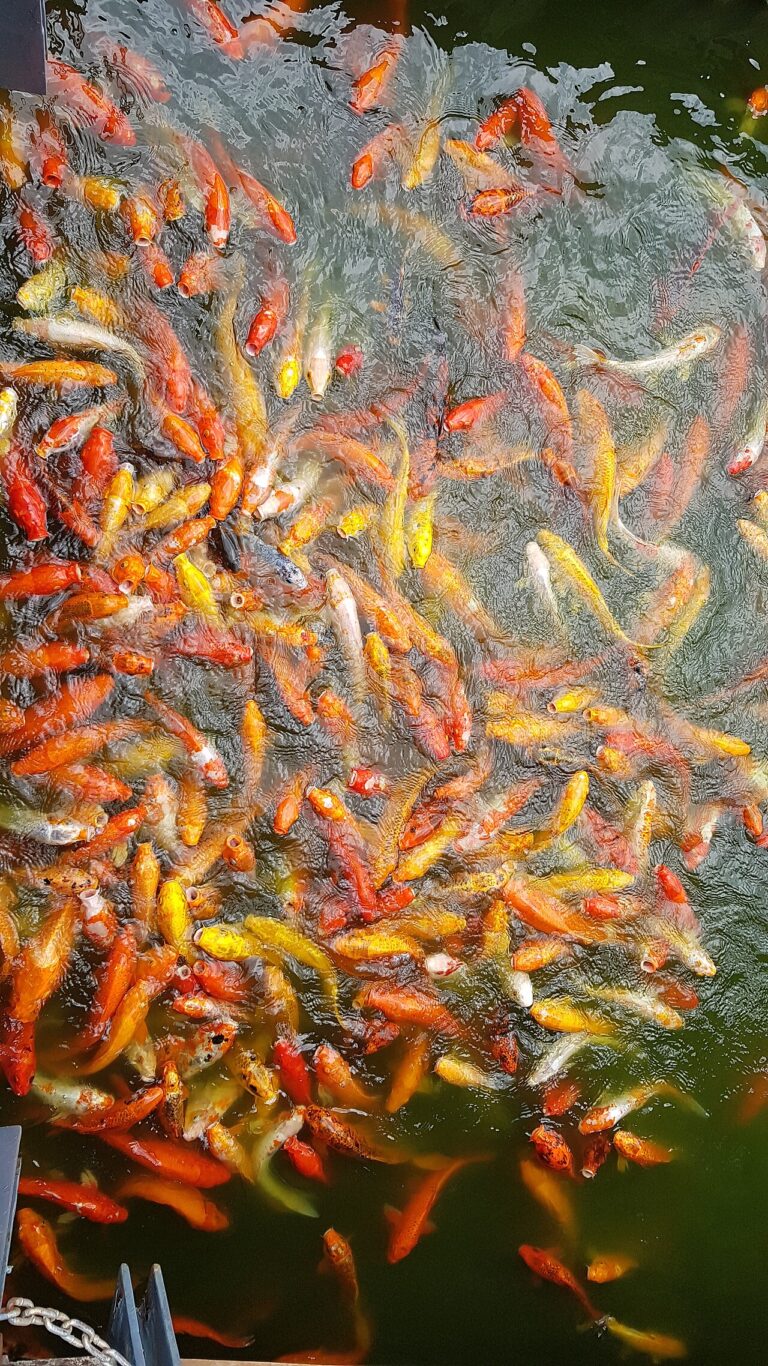
A healthy koi swims actively in open water, eats eagerly, holds its fins erect and shows clean, glossy skin with no red streaks, raised scales or white film. Wondering how to tell if koi fish are happy has a practical answer: they come to the surface when you approach, they forage along the bottom, and they spawn in late spring, which fish under chronic stress do not.
Watch for changes in routine rather than absolute behavior. A fish that used to lead the feeding group and now hangs at the back, or one that isolates near an inlet, is telling you something weeks before physical symptoms appear. Keep a simple log of water tests, feed amounts and any losses; over a 30 year lifespan, patterns in that log are worth more than any single reading. Species with much shorter arcs, such as the fish in our guide to how long betta fish live, leave far less room for that kind of correction.
Frequently Asked Questions
Do koi recognize their owners?
Koi learn to associate specific people with food and will approach the pond edge for a familiar keeper while scattering from a stranger. Studies on carp show they discriminate between shapes, colors and even sounds, and many koi accept hand feeding from one person only. It is learned recognition rather than affection, and it takes a few months to establish.
Why put salt in a koi pond?
Salt at 0.3 percent, about 2.5 lb per 100 gallons, reduces osmotic stress on damaged gills and skin, kills many external parasites and blocks nitrite from binding in the blood. It is a treatment, not a permanent additive, since sustained salt harms pond plants and some biological filtration. Add it gradually over 24 hours and let water changes remove it afterward.
How many babies do koi fish usually have?
A mature female releases 50,000 to several hundred thousand eggs in a single spring spawn, and a large fish can exceed half a million. Almost none survive: the parents and other pond fish eat the eggs and fry, and hatch rates in an open pond are often under 1 percent. Breeders move eggs to separate tanks to raise any meaningful number.
Does a koi fish bite hurt?
No, a koi bite does not hurt and cannot break skin. Koi have no teeth in the front of the mouth, only crushing pharyngeal teeth deep in the throat for grinding snails and plant matter. Hand feeding feels like a firm, wet suction pull, which is why koi are considered safe for supervised children to feed.
Do koi like being petted?
Some individual koi tolerate and appear to seek out light contact during feeding, rolling slightly under a hand. Even so, touching removes part of the protective slime coat that shields the fish from bacteria and parasites, so it should stay rare and brief. Never handle a koi with dry hands or lift one out of the water for a photo.
What are koi fish scared of?
Shadows passing overhead, sudden noise or vibration transmitted through the ground, and any large shape at the pond edge trigger a flight response, because all three read as heron or raccoon. New koi are also frightened by bright light and open water with no cover. A shaded area, a fish cave and plants over part of the surface make a pond calm enough that the fish stay visible.
Taxonomic and biological data for the wild ancestor of the koi, including growth and longevity records, are cataloged on FishBase.