Baby Copperhead Snake: Identification, Venom, and Safety
A baby copperhead snake is a venomous pit viper from birth, measuring about 7 to 10 inches long and roughly the width of a pencil. It carries the same hourglass-shaped crossbands as an adult but adds one feature adults lack: a bright, almost neon yellow or yellow-green tail tip. That tail is the fastest reliable way to identify a baby copperhead, and it fades as the snake enters its second year.
Late summer and early fall are when people encounter them, because copperheads give birth to live young in August and September rather than laying eggs. The newborns disperse immediately into leaf litter, mulch beds, woodpiles, and stone walls, which is exactly where hands and bare feet go. Most of the fear surrounding these snakes comes from a widely repeated myth about baby venom, and the reality is both less dramatic and more useful to know.
| Scientific name | Agkistrodon contortrix, eastern copperhead |
| Size at birth | 7 to 10 inches, pencil-width |
| Key marking | Bright yellow or yellow-green tail tip |
| Venom type | Hemotoxic, present from birth |
| Birth season | Late August through September |
| Litter size | 2 to 10 live young, occasionally more |
| Fatality risk | Bites are painful but almost never fatal |
What a Baby Copperhead Looks Like
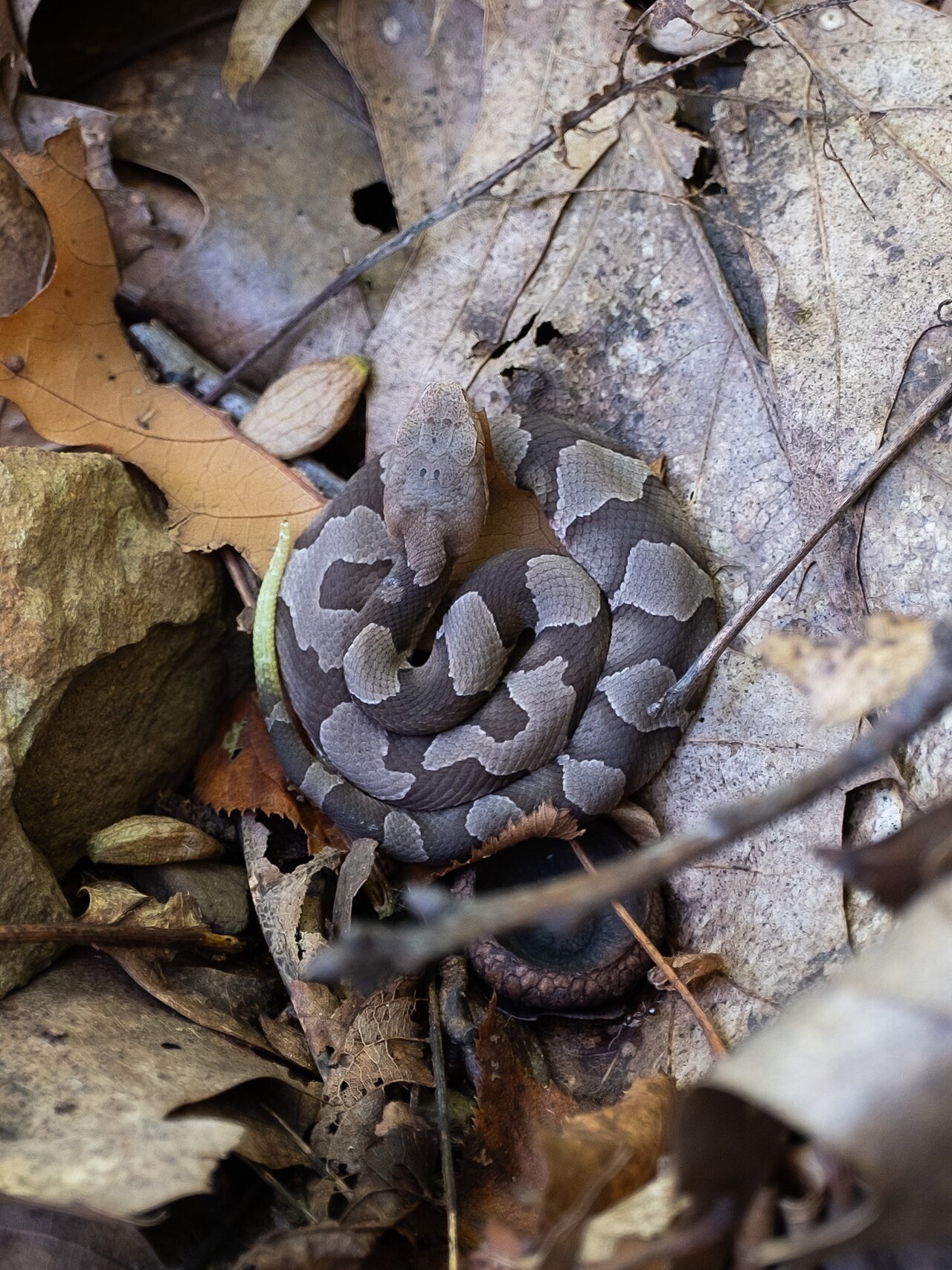
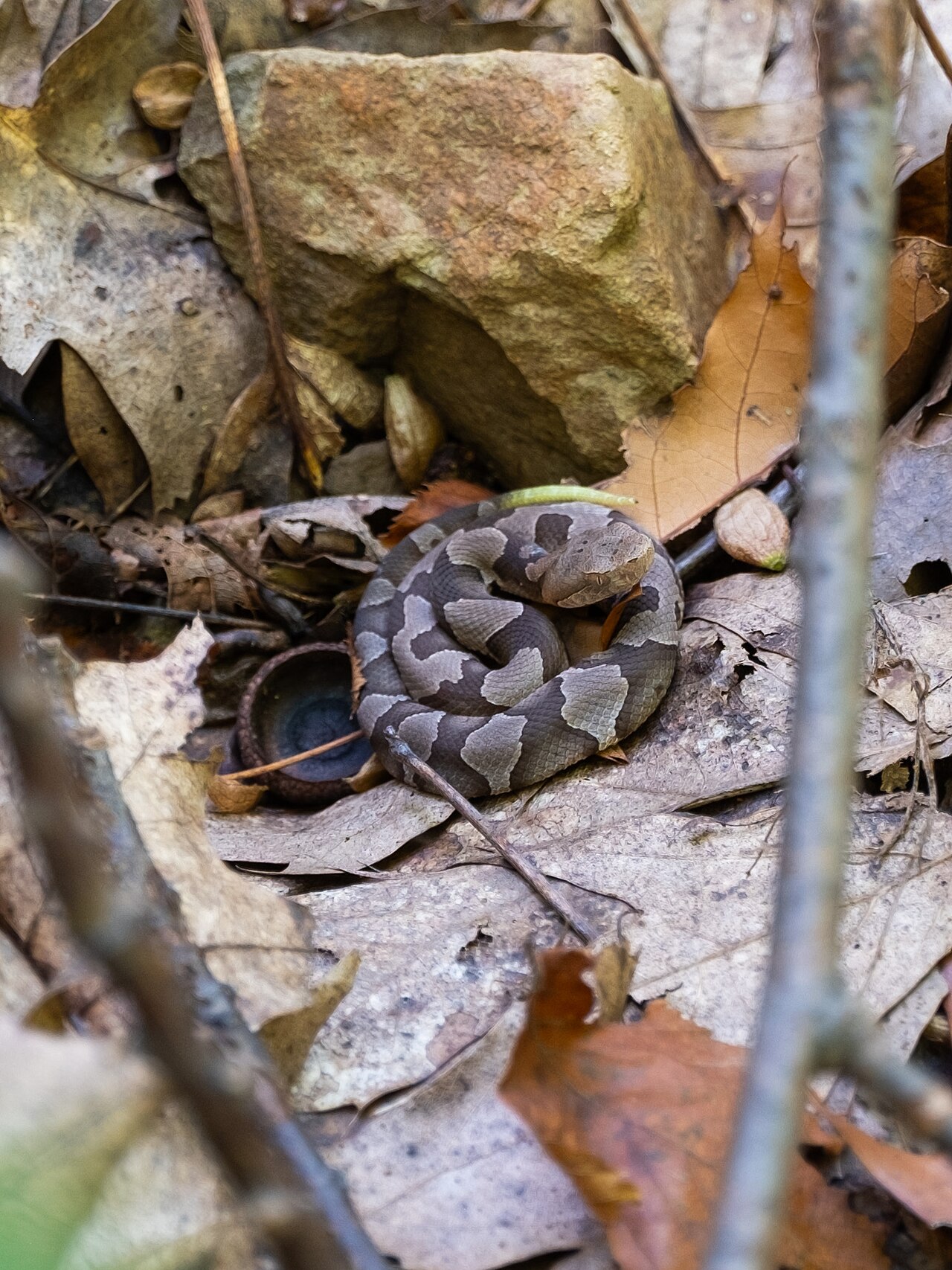
Newborn copperheads are miniature versions of the adults in almost every respect except the tail. The body is pinkish tan, light brown, or gray, crossed by darker chestnut bands that are wide along the sides and pinch narrow across the spine. Viewed from above, those bands look like a row of hourglasses; viewed from the side, each one looks like a Hershey’s Kiss standing on the ground. That side profile is the shape most field guides describe, and it is the pattern element that separates copperheads from nearly every harmless lookalike.
The head is broad, triangular, and distinctly wider than the neck, with a coppery to orange-brown wash that gives the species its name. Pupils are vertical slits like a cat’s rather than round, and a heat-sensing pit sits between each eye and nostril. These features are genuinely diagnostic, but checking them requires being close enough to see detail on a snake the width of a pencil, which is not a reasonable identification strategy for anyone standing in their own yard.
Size is what fools people most often. At 7 to 10 inches and about as thick as a pencil, a newborn copperhead looks nothing like the two to four foot adult in the warning posters. Homeowners regularly assume anything that small must be harmless, or mistake it for an earthworm-sized juvenile of some common yard snake. Understanding what other baby snakes look like in the same habitat is the practical fix for that assumption.
The Yellow Tail Tip Is the Best Single Clue
The tail tip on a newborn copperhead is a vivid sulfur yellow, sometimes shading toward yellow-green, and it contrasts sharply against the muted body pattern. Reptile educators describe it as almost neon and easily seen from several feet away, which makes it far more practical for field identification than pupil shape or head geometry. The color persists for roughly the first year of life and then fades gradually into the same brown as the rest of the tail.
That tail is not decorative. Young copperheads use it as a caudal lure, holding the body still and wiggling the bright tip like a moving caterpillar to draw frogs, lizards, and small prey within striking range. The behavior is well documented across several pit viper species and explains why the coloration exists only during the phase when the snake hunts small, visually oriented prey. Once the snake is large enough to take rodents, the lure loses its usefulness and the color goes.
One important caveat: the yellow tail is not unique to copperheads. Juvenile cottonmouths carry the same bright tail tip and use it the same way, and the two species overlap across much of the southeastern United States. Both are venomous, so the practical conclusion is identical either way, but anyone trying to name the species should compare the full body pattern rather than the tail alone. The differences between them are covered in more detail in the guide to the baby cottonmouth snake.
Are Baby Copperheads Venomous
Yes. Baby copperheads are venomous from their first breath, with functional fangs and venom glands at birth. There is no juvenile grace period during which the snake is harmless, and treating a newborn as safe because it is small is the mistake that produces avoidable bites. Copperhead venom is hemotoxic, which means it damages tissue and disrupts blood components in the area around the bite rather than attacking the nervous system.
The persistent myth is that baby vipers are more dangerous than adults because they cannot control how much venom they inject. Researchers who study snake venom have consistently found no support for this. Juveniles carry substantially less venom overall simply because they are smaller, so the total dose an adult can deliver is greater. Adult snakes do meter their venom, but the practical outcome is that an adult copperhead bite is generally the more serious of the two, not the reverse.
None of which makes a baby copperhead bite trivial. Bites are genuinely painful and produce swelling that spreads through the limb over hours. According to Poison Control (poison.org), symptoms typically evolve over 8 to 12 hours after a copperhead bite, serious systemic effects are rare, and roughly 15 percent of bites are minor with limited symptoms. Copperhead bites are almost never fatal, though most patients experience real pain and swelling, and a minority report lingering symptoms for months.
When and Where Baby Copperheads Appear
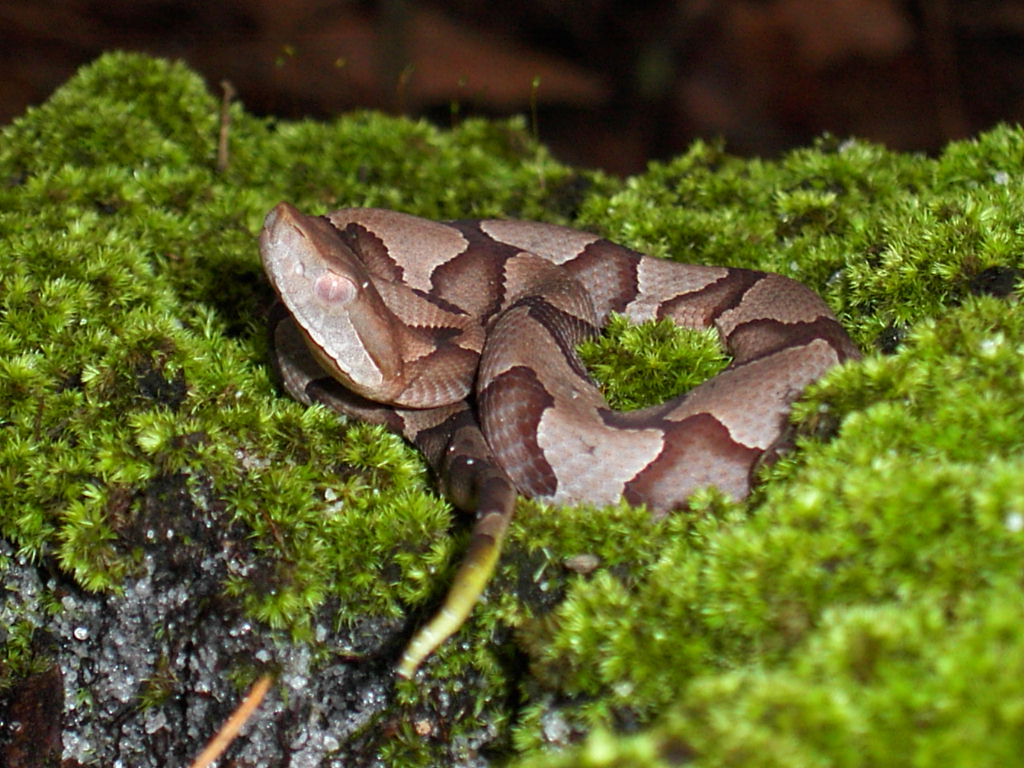
Copperheads are ovoviviparous, meaning eggs develop inside the female and the young are born live. Birth happens in late August and September across most of the range, producing a litter of roughly 2 to 10 young, occasionally more in large healthy females. The newborns receive no parental care at all: they are independent from the moment of birth, already able to hunt and defend themselves. That timing is why encounters spike in a narrow window each year and why late summer generates the seasonal wave of identification requests.
Newborns immediately seek cover, and their preferences overlap almost perfectly with residential landscaping. Leaf litter, mulch beds, brush piles, stacked firewood, stone and landscape walls, tarps, and the gaps under decks and sheds all provide the cool, humid, concealed conditions they need. Rocky wooded slopes and the edges of streams are the classic natural habitat, but suburban yards that back onto woods reproduce the same conditions on a smaller scale.
Habitat loss pushes the effect further. Reptile educators working in rapidly developing areas report that construction displaces snakes into residential neighborhoods, so people encounter them more often precisely when new subdivisions cut into woodland. The snakes are not becoming more aggressive or more numerous; the boundary between their habitat and human activity is simply moving. That same pattern explains why baby black snakes and other harmless juveniles turn up in the same yards at the same time of year.
Baby Copperhead Versus Common Lookalikes
Most snakes reported as baby copperheads are something else entirely. Juvenile eastern ratsnakes are the single most common misidentification: they hatch with gray bodies and dark blotches that superficially resemble copperhead bands, but the blotches are irregular rectangles rather than side-wide hourglasses, and the pattern fades to solid black as the snake matures. The guide to the baby rat snake covers the pattern change in detail.
Northern water snakes are the second frequent case. Young water snakes have bold dark crossbands on a lighter body, and near water in poor light they read as copperheads to almost everyone. The band shape is the tell: water snake bands are widest across the back and narrow toward the belly, the exact inverse of the copperhead hourglass. Dekay’s brownsnake, a small brown yard snake with two rows of dark spots, gets reported constantly as well, and it is entirely harmless.
Milk snakes and eastern hognose snakes complete the usual list. Both have blotched patterns that overlap loosely with copperhead coloring, and the hognose snake adds a dramatic threat display that convinces people they are looking at something dangerous. Pattern-based identification of small snakes is genuinely hard, which is the argument for the same rule applied to the coral snake and king snake confusion: keep your distance from any snake you cannot identify with confidence, photograph it from a safe range, and let an expert confirm it.
What to Do If a Baby Copperhead Bites
Treat every copperhead bite as a medical situation requiring professional evaluation, regardless of the snake’s size. Stay calm and limit movement, since raised heart rate speeds venom distribution. Remove rings, watches, and anything tight from the affected limb immediately, because swelling develops fast and jewelry becomes a tourniquet. Immobilize the bitten area and keep it roughly at or below heart level, and mark the leading edge of the swelling with a pen and note the time so clinicians can gauge how fast it is spreading.
What not to do matters just as much. Do not apply a tourniquet or constricting band, do not pack the wound in ice, do not cut the bite, do not attempt to suck out venom, and do not use electric shock. Every one of these traditional remedies causes additional tissue damage without removing meaningful venom. Do not drink alcohol, and do not try to capture or kill the snake, since a second bite while attempting that is a common way people make the situation worse. A photograph from a safe distance is more than sufficient for identification.
Go to the nearest hospital rather than waiting to see whether symptoms develop. The national Poison Help line at 1-800-222-1222 connects to a poison center that can advise while you travel. Antivenom is available and is used when local symptoms are significant, and most patients resume normal daily activities within 2 to 4 weeks. Look for two puncture marks roughly half an inch to an inch apart, though a single puncture is also possible.
Keeping Baby Copperheads Out of Your Yard
Habitat removal is the only approach that works reliably, and it targets exactly what newborns need. Clear leaf litter, especially against foundations and along walkways. Move firewood off the ground and away from the house. Break down brush piles, keep grass short, and think carefully about deep mulch beds and decorative stone walls next to doors, which are close to ideal copperhead shelter. Sealing gaps under sheds, decks, and porches removes the larger refuges that draw both snakes and the rodents they eventually hunt.
Behavior change handles the rest, because most bites follow a predictable script. Reptile educators report that the single most common bite scenario is someone taking out trash after dark barefoot or in flip-flops, and the second most common is weeding or clearing leaves by hand during late summer. Closed-toe shoes outdoors, a flashlight after dark, gloves and a rake for yard work, and long pants in wooded areas eliminate the great majority of realistic exposure.
Killing snakes is neither necessary nor especially effective, and in several states native nonvenomous species are legally protected, which matters given how often harmless snakes are killed by mistake. Copperheads control rodent and insect populations, and removing one from a yard simply opens territory for another. If a snake must be moved, a professional wildlife removal service handles it safely. Encouraging natural predators helps too, since hawks, owls, and larger kingsnakes all take young copperheads.
What Baby Copperheads Eat
Newborn copperheads target prey scaled to their size, which means insects, small frogs, salamanders, lizards, and the occasional newborn mouse. Cicadas are a notable seasonal favorite in parts of the range, and caterpillars make up a meaningful share of the early diet. This is the reason the caudal lure exists: a wiggling yellow tail tip resembles a grub or caterpillar closely enough to draw small predators into range without the snake needing to chase anything.
Hunting style is ambush rather than pursuit. A young copperhead coils in leaf litter, relies on camouflage that makes it nearly invisible against dead leaves, and waits. Heat-sensing pits between eye and nostril detect warm-blooded prey in complete darkness, while vision and the lure handle cold-blooded targets. After a strike, the snake typically releases small prey and follows the scent trail, or simply holds smaller items.
As the snake grows, the diet shifts toward rodents, and by adulthood mice and voles dominate. That transition is why copperheads persist in suburban areas: they follow the rodent populations that yards, sheds, and bird feeding stations support. Recognizing what a snake leaves behind can confirm one is present before anyone sees it, and the identification points in snake droppings are a useful part of a yard check.
Frequently Asked Questions
Are baby copperheads more dangerous than adults?
No. The idea that juveniles cannot control their venom is a myth with no research support. Baby copperheads carry considerably less venom than adults simply because they are smaller, so an adult bite is generally more serious. Both should be treated as medical situations requiring evaluation.
How big is a baby copperhead?
Newborns measure roughly 7 to 10 inches long and are about as thick as a pencil. They are born fully formed with functional fangs and venom. Adults reach two to four feet, so the size difference between newborn and adult is dramatic.
Do all baby copperheads have yellow tails?
Nearly all newborns have a bright yellow to yellow-green tail tip that fades during the first year. The color is used as a lure to attract small prey. Juvenile cottonmouths share the same feature, so a bright tail confirms a venomous juvenile but not the exact species.
What time of year are baby copperheads born?
Copperheads give birth to live young in late August and September across most of their range. Litters usually contain 2 to 10 young, and the newborns disperse immediately with no parental care. Encounters cluster sharply in that late summer window.
What snake looks like a baby copperhead?
Juvenile eastern ratsnakes, young northern water snakes, Dekay’s brownsnakes, milk snakes, and eastern hognose snakes are the most common misidentifications. The copperhead’s crossbands are widest along the sides and narrowest across the spine, forming an hourglass from above. Most lookalikes have the opposite arrangement or irregular blotches.
What should I do if I find a baby copperhead in my yard?
Keep your distance, keep children and pets away, and photograph it from a safe range if identification matters. Most snakes move on within hours if left alone. For removal, contact a professional wildlife removal service rather than attempting it yourself, since handling attempts cause a large share of bites.
How long does a copperhead bite take to heal?
Most patients return to normal daily activities within two to four weeks, though pain and swelling can be significant during that period. Symptoms typically develop over the first 8 to 12 hours after the bite. A minority of patients report residual symptoms lasting considerably longer.