How to Identify a Baby Copperhead Snake: 6 Marks and 4 Lookalikes
Learning how to identify a baby copperhead snake comes down to one pattern check: a true copperhead wears dark bands that are wide on the sides and pinch to a narrow waist across the spine, like a row of hourglasses. Almost every snake people mistake for one, from juvenile ratsnakes to water snakes, carries blotches or saddles instead, and those never pinch in the middle.
Newborn copperheads (Agkistrodon contortrix) arrive in late summer at roughly the length of a pencil, and most of them show a bright yellow-green tail tip that no adult has. That tail, the hourglass pattern, and a copper-toned head are enough to name the snake from a safe distance without ever touching it. The sections below work through each mark in the order a photo lets you check it, then line the baby copperhead up against the four snakes it gets confused with most.
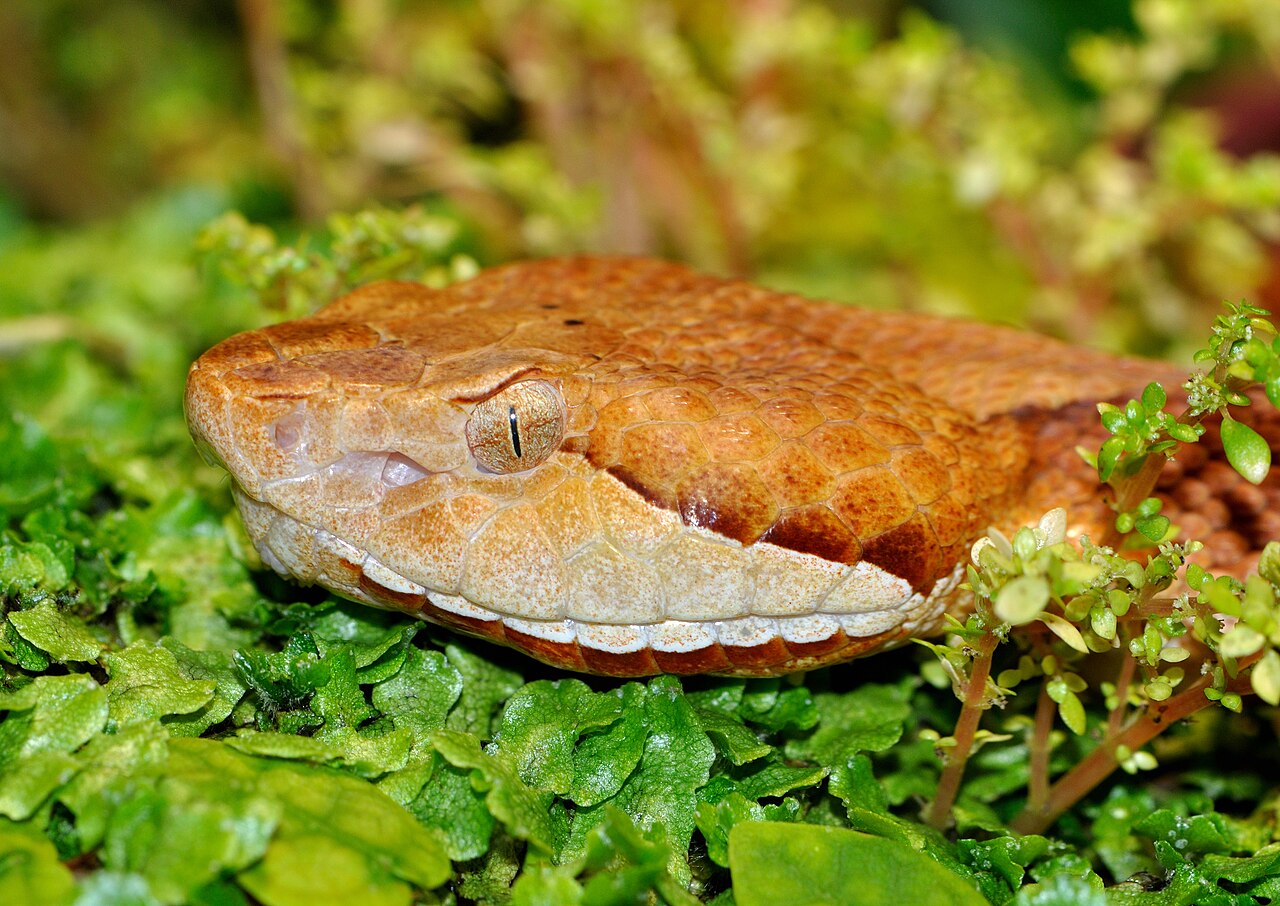
A baby copperhead is 7 to 10 inches (18 to 25 cm) long, tan to pinkish brown, with dark chestnut crossbands shaped like hourglasses that are wide on the flanks and narrow over the spine. Most have a sulphur yellow or greenish tail tip. The head is coppery, unmarked, and wider than the neck.
| Feature | Baby copperhead | What the lookalikes show |
|---|---|---|
| Pattern | Hourglass bands, narrow over the spine | Blotches or saddles, widest over the spine |
| Tail tip | Yellow to yellow-green for the first year | Same color as the rest of the tail |
| Head | Solid copper to orange-tan, no markings | Striped, spotted, or blotched crown |
| Pupil | Vertical and elliptical | Round |
| Between eye and nostril | Deep heat-sensing pit | Nostril only |
| Length at birth | 7 to 10 in (18 to 25 cm) | Ratsnakes and water snakes hatch longer, 9 to 14 in (23 to 36 cm) |
How to Tell If a Baby Snake Is a Copperhead
Run three checks in order and you will settle most cases in under a minute. First, look at the crossbands where they meet the spine: copperhead bands narrow there and widen again at the belly line, so the snake looks like it is wearing a chain of hourglasses. Second, look for a yellow or yellow-green tail tip. Third, look at the head, which should be an even copper to orange-tan with no stripes, spots, or crown markings.
If any one of those three fails, the odds drop fast. A banded snake with a striped head is a juvenile gartersnake, not a pit viper. A patterned snake whose dark shapes are widest on the back is almost certainly a ratsnake or a water snake. Only when all three marks line up is it worth treating the animal as venomous and backing away.
Size and Body Shape of a Newborn Copperhead
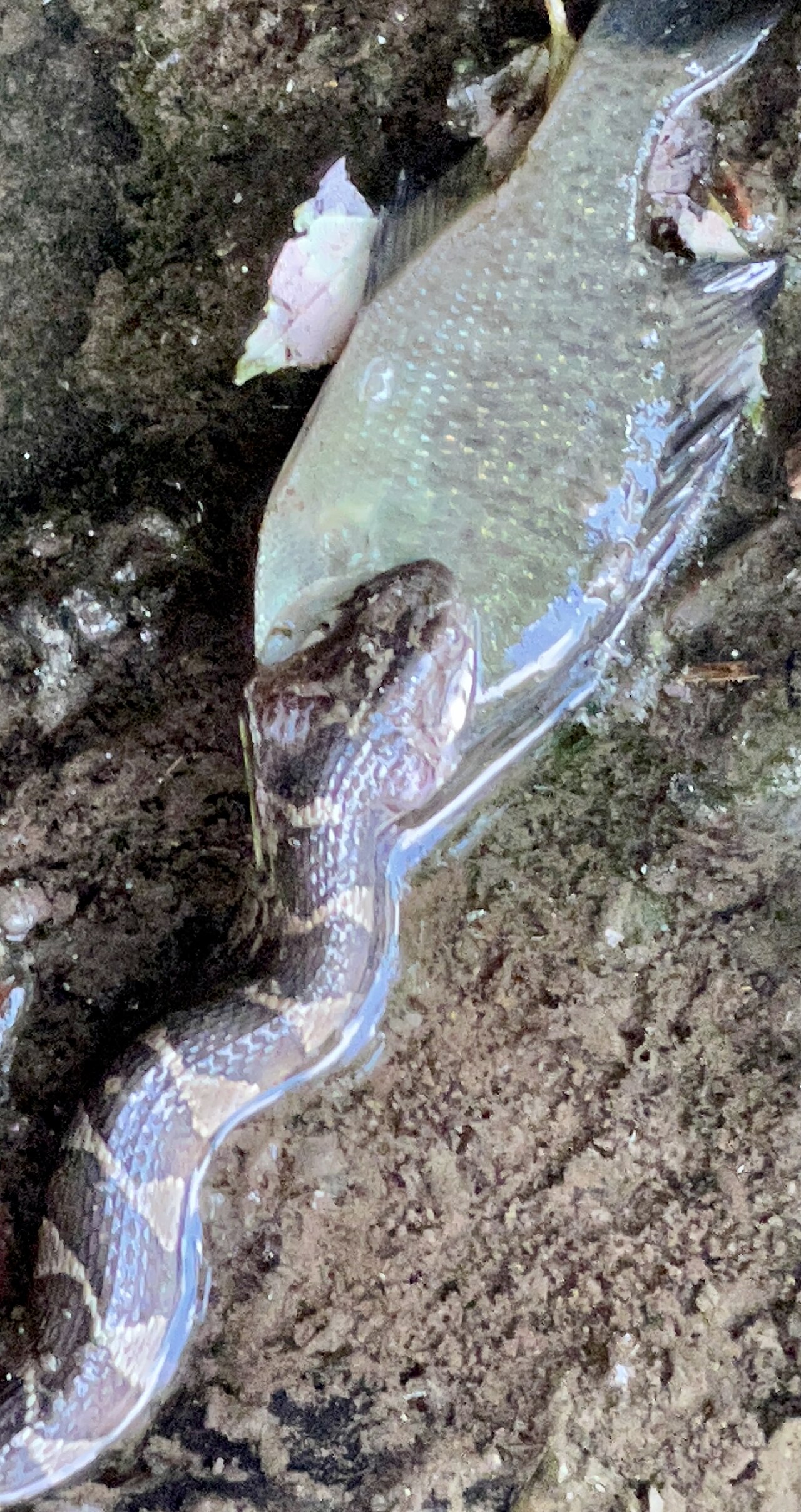
Copperheads give birth to live young rather than laying eggs, and litters of 3 to 10 arrive between late August and early October across most of the range. A neonate measures 7 to 10 inches (18 to 25 cm) and is noticeably stout for its length, with a body that looks heavy rather than whiplike. That thickness is a useful early filter: most harmless yard snakes of the same length are slender and quick.
The head sits on a distinctly narrow neck, so the outline steps down behind the jaws. Newborns are fully formed miniatures of the adult, not washed-out versions, which is why the pattern is often crisper on a baby than on a weathered adult. For a full profile of the animal at this age, see our guide to the baby copperhead snake.
The Yellow-Green Tail Tip and When It Fades
The brightest clue on a newborn copperhead is the last half inch of tail, colored sulphur yellow to pale green. It is a hunting tool: the snake coils, holds the tail up, and wiggles it to draw frogs and lizards within striking range, a behavior called caudal luring. Juvenile cottonmouths and some rattlesnake young do the same thing, so a yellow tail means pit viper, not copperhead specifically.
The color dulls through the first year and is usually gone by the time the snake reaches 18 to 20 inches (46 to 51 cm). A banded snake with a plain tail is therefore either an older copperhead, which you judge on pattern alone, or something harmless. No North American colubrid in the copperhead’s range uses a bright tail tip this way.
Hourglass Bands: The Pattern Test That Decides Most Cases
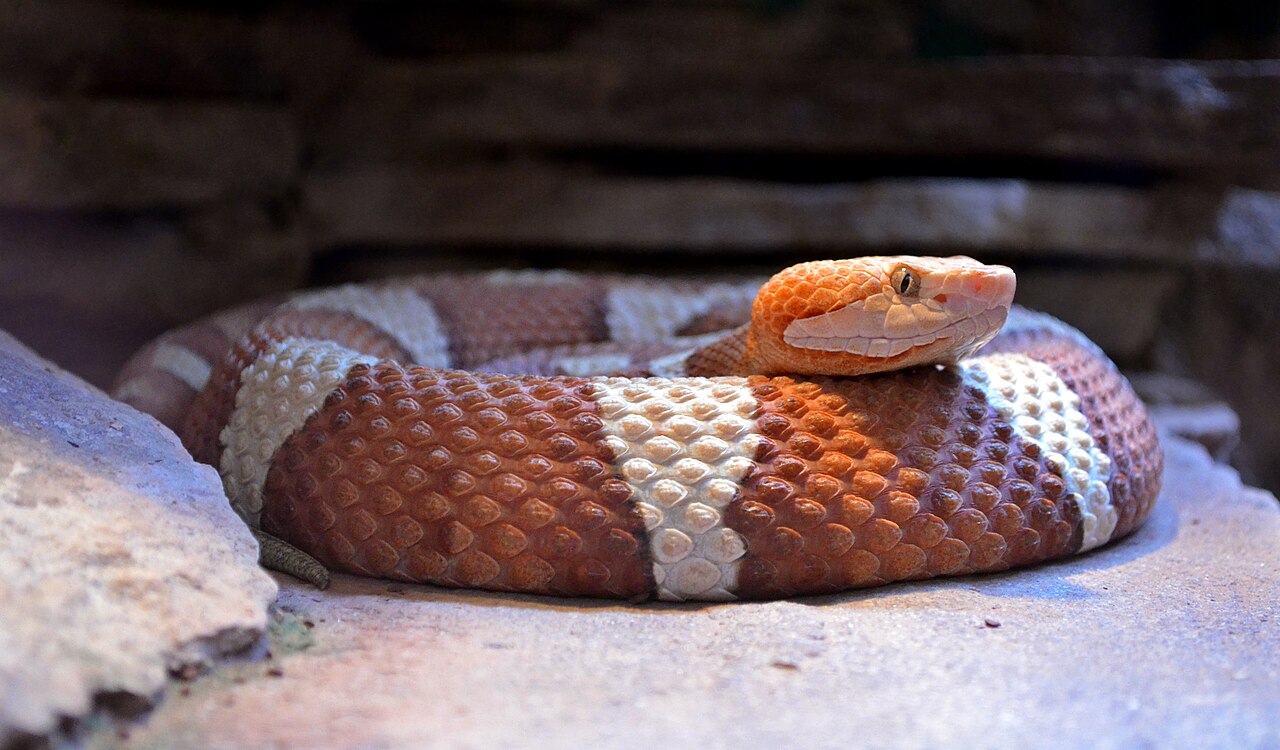
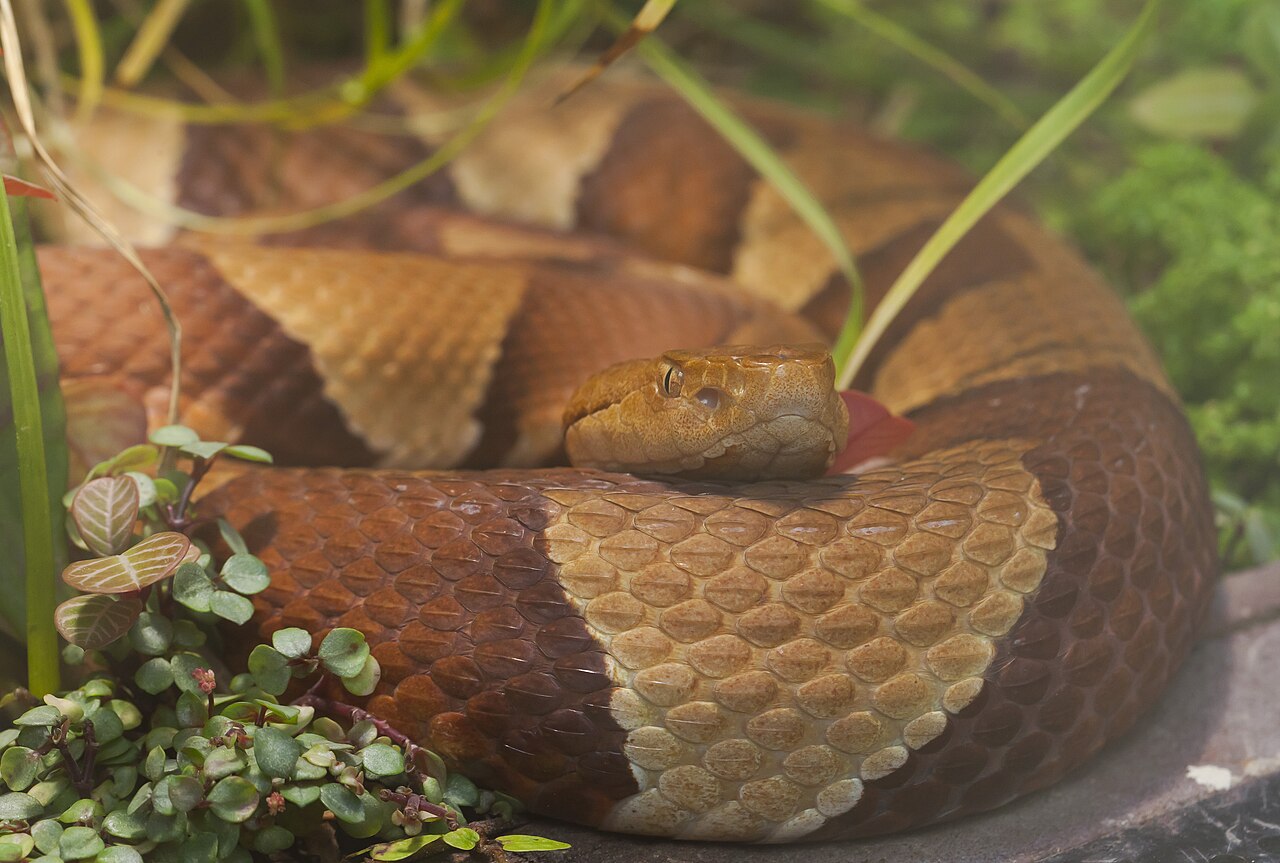
Seen from directly above, a copperhead’s crossbands look like dark dumbbells laid across the back. Seen from the side, each band looks like a chocolate drop or a Hershey’s Kiss with the point facing up. Both descriptions come from the same fact: the dark marking is broad along the flank and pinched thin where it crosses the spine, and the pale ground color often breaks through in the middle of the pinch.
Every common impostor inverts that geometry. A juvenile eastern ratsnake carries gray blotches that are widest on the spine and fade before they reach the belly. A young diamondback water snake shows dark chainlike markings that are heaviest on the back. If the dark shapes grow narrower as they descend the sides, the snake is not a copperhead.
Head Shape, Pupils, and the Heat-Sensing Pit
A copperhead’s head is broad, roughly triangular, and set off sharply from the neck, but head shape alone is the weakest of the standard tests. Water snakes, hognose snakes, and even ratsnakes flatten and flare their heads when threatened, and a frightened harmless snake can look more triangular than a calm copperhead. Treat the outline as a hint, then confirm with a feature that cannot be faked.
Two features cannot. The pupil is a vertical slit rather than a circle, and there is a deep pit between the eye and the nostril that senses heat. Both are visible in a sharp photo taken from the side, which is exactly how you should be looking: through a lens or binoculars, from at least 6 feet (1.8 m) away, never by moving in for a closer look.
Scale and Belly Details Worth Checking in a Photo
If you already have a clear image, two more details raise confidence. Copperhead dorsal scales are weakly keeled, meaning each scale carries a faint ridge down the center, so the back looks matte rather than glossy. Ratsnakes share this texture, but water snakes have strongly keeled scales and corn snakes are noticeably smooth and shiny.
The belly tells you more. A copperhead’s underside is pinkish cream with dark smudges along the edges and a single row of scales under the tail. Water snakes show bold half-moons or squares on a yellow belly, and a young corn snake has a black and white checkerboard that no copperhead ever shows. A photo of the underside is rarely available, so use it as a tiebreaker rather than a first step.
What Snake Is Commonly Mistaken for a Copperhead?
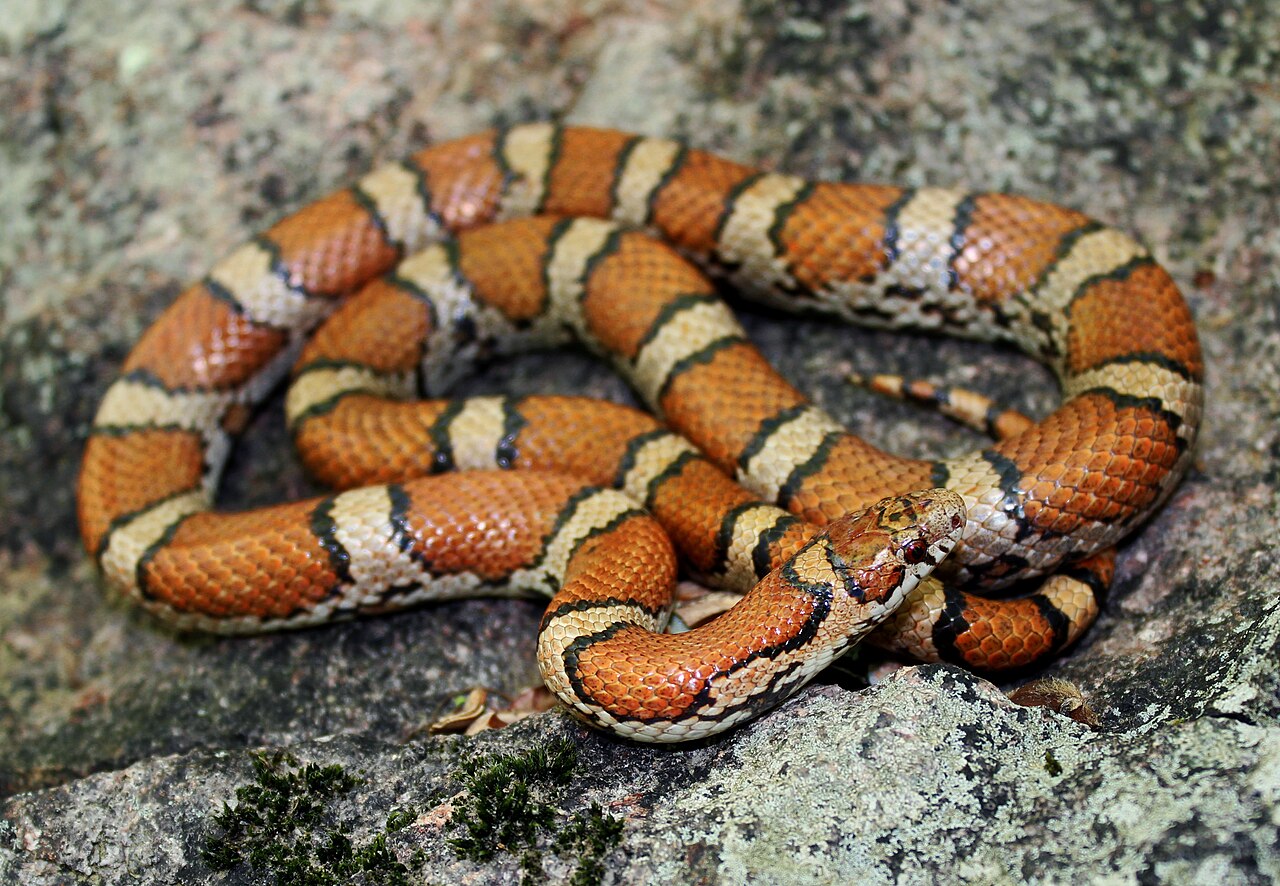
The juvenile eastern ratsnake (Pantherophis alleghaniensis) is the single most common false alarm. Hatchlings are pale gray with dark dorsal blotches, they turn up in garages and basements in exactly the same weeks copperheads are born, and at 12 inches (30 cm) they are close enough in size to trigger the same reaction. The blotches, the round pupil, and the checkered belly separate them.
Behind the ratsnake come the northern water snake (Nerodia sipedon), the eastern hognose, and DeKay’s brownsnake (Storeria dekayi), the small gray snake with a pale dorsal stripe and two rows of dark dots that shows up under mulch. Unrelated banded snakes cause trouble further south, which is why pattern logic matters more than color rather than the other way around.
Baby Ratsnakes and Water Snakes Side by Side
Put a young ratsnake next to a baby copperhead and the difference reads instantly once you know where to look. The ratsnake’s markings sit on top of the body like saddles and never wrap the flanks; the copperhead’s wrap all the way down and widen as they go. The ratsnake also tapers to a whip of a tail and moves in long confident lines, while a copperhead holds still and relies on camouflage.
Water snakes are the harder call because their bands do wrap the body. The test is which end is wider: a water snake’s bands are broad on the spine and pinch toward the belly, the exact reverse of the copperhead. Water snakes also flatten out and flee toward water, and they bite readily without being venomous, which is the usual reason a harmless snake ends up killed.
What Month Do Baby Copperheads Come Out?
Baby copperheads appear from late August through October, with September the peak month across most of the eastern United States. Litters are born in or near the female’s summer range, and the young disperse within days of their first shed. That timing is why late summer brings a spike in small banded snakes in woodpiles, window wells, and pool skimmers.
By November most have moved toward rocky south-facing slopes and communal den sites, where they spend the cold months in the state of reduced activity covered in our piece on snake hibernation. They emerge again in April, still under a foot long, which puts a second smaller wave of tiny copperheads in yards each spring.
If You Find One Baby Copperhead, Are There More Around?
Often yes, at least for the first few days. A litter of 3 to 10 is born in one place, and the young stay near the birth site until their first shed, so finding one newborn in September means its siblings may be within a few yards. After that the litter scatters, and there is no family group to break up.
What matters more is why the snake chose that spot. Flat cover over warm ground, such as plywood, tarps, stacked firewood, or landscape timber, holds both copperheads and the rodents and frogs they hunt. If a yard offers that cover, the useful assumption is not that more babies are hiding nearby but that more will keep arriving each season until the cover is gone.
Are Baby Copperheads Venomous, and How Bad Is a Bite?
Baby copperheads are venomous from birth, with venom as potent as an adult’s and a smaller volume to deliver. There is no stage at which a copperhead is harmless, and the old claim that the young are more dangerous than adults because they cannot control the dose is not supported by bite data. Either way the answer for a homeowner is identical: stay outside striking distance, which is roughly half the snake’s body length.
Copperheads account for more venomous snakebites in the United States than any other species, yet deaths are extremely rare, on the order of one in a thousand bites or fewer. Bites are painful and cause swelling and tissue damage that need medical evaluation. Call your regional poison center or 911, keep the limb still and below heart level, and do not cut, suck, ice, or tourniquet the wound; guidance from the Centers for Disease Control and Prevention is consistent on all of those points. A defensive bite from a harmless species, described in our note on the garter snake bite, needs nothing more than soap and water.
What Smell Do Copperheads Hate, and What Actually Works
No smell reliably repels copperheads. Mothballs, sulphur, ammonia, garlic, cinnamon oil, and the commercial granules built from them have failed in controlled tests, and naphthalene mothballs scattered outdoors are both ineffective and illegal to use that way in the United States. Snakes navigate largely by scent, but repelling them is not the same as offending them.
What works is removing what the snake came for. Keep grass short, move firewood off the ground and away from the house, clear boards and debris piles, seal gaps under sheds and at foundation vents, and control the rodents that draw larger snakes in. Species that eat rodents heavily thrive under the same conditions, so tidy ground cover reduces snake traffic generally rather than only copperheads.
Frequently Asked Questions
How to tell if a baby snake is a copperhead?
Check three marks from a distance: dark crossbands that narrow over the spine and widen on the flanks, a yellow to yellow-green tail tip, and a solid copper head with no stripes or spots. If the dark shapes are widest on the back, or the head is patterned, it is not a copperhead.
Is it true if you see one snake, are there more?
Not as a rule. Adult copperheads are solitary through the active season and defend no group territory. The exceptions are newborn litters in September, communal winter dens on rocky slopes, and spring mating, when several adults may gather in one place for a few days.
If I find a baby snake in my house, are there more snakes around?
Usually it means one snake found one gap. Search the same route rather than the same room: check foundation cracks, dryer vents, gaps under exterior doors, and crawlspace openings, and look for rodent signs. A house with mice supports snakes indoors, and sealing the entry matters more than counting the animals.
What month are snakes most active?
In the copperhead’s range, activity runs April through October, peaking in May and June and again in September. Summer heat shifts them to dusk and night, so daytime sightings are most likely in spring and early fall. Movement also spikes after warm rain at any point in the season.
How long will a snake stay in one spot?
A baby copperhead may hold the same cover for several days, and longer while digesting a meal or preparing to shed. Adults move a few hundred feet between rest sites and often reuse favored spots for weeks. Remove the cover object and the snake almost always leaves on its own.
What should I do if I find a baby copperhead in my yard?
Move people and pets back, keep the snake in view from at least 6 feet (1.8 m), and photograph it from the side for confirmation. Most will leave within hours if left alone. If it must be removed, call animal control or a licensed removal service instead of handling it, since most bites happen during attempts to kill or move a snake.
The pattern test carries almost all the weight here: hourglasses that pinch over the spine mean copperhead, and blotches that sit on the spine mean something harmless. Pair that with the yellow tail tip in late summer and an unmarked copper head, and a tiny snake in the mulch stops being a guess. For how long these snakes live once they clear their first winter, see our data on the lifespan of a similar-sized colubrid.