Murder Hornet: What It Is and What Happened to It
The murder hornet is the northern giant hornet (Vespa mandarinia), the world’s largest hornet at up to 2 in long with a wingspan approaching 3 in. It reached North America around 2019, was found in a small area of Washington State and neighboring British Columbia, and became the subject of a media panic considerably larger than the actual threat.
The nickname was coined by journalists, not entomologists, and the real concern was never primarily human safety. A single group of these hornets can destroy an entire honey bee colony in hours, decapitating tens of thousands of workers, and it was that threat to beekeeping and pollination that drove the eradication effort. This guide covers what the hornet actually is, the sting, the bee-killing behavior, how the North American incursion ended, and what people are far more likely to be seeing instead.
| Quick Facts | Northern Giant Hornet |
|---|---|
| Scientific name | Vespa mandarinia |
| Size | Up to 2 in, queens largest |
| Native range | East and Southeast Asia |
| North America | Detected 2019, small area of Washington and BC |
| Main threat | Honey bee colonies, not people |
| Nests | Underground, usually in abandoned rodent burrows |
What the Murder Hornet Actually Is
Vespa mandarinia is native to temperate and tropical East and Southeast Asia, from Japan and Korea through China and into India and Thailand. It is a social wasp that nests underground, usually taking over abandoned rodent burrows or hollows among tree roots.
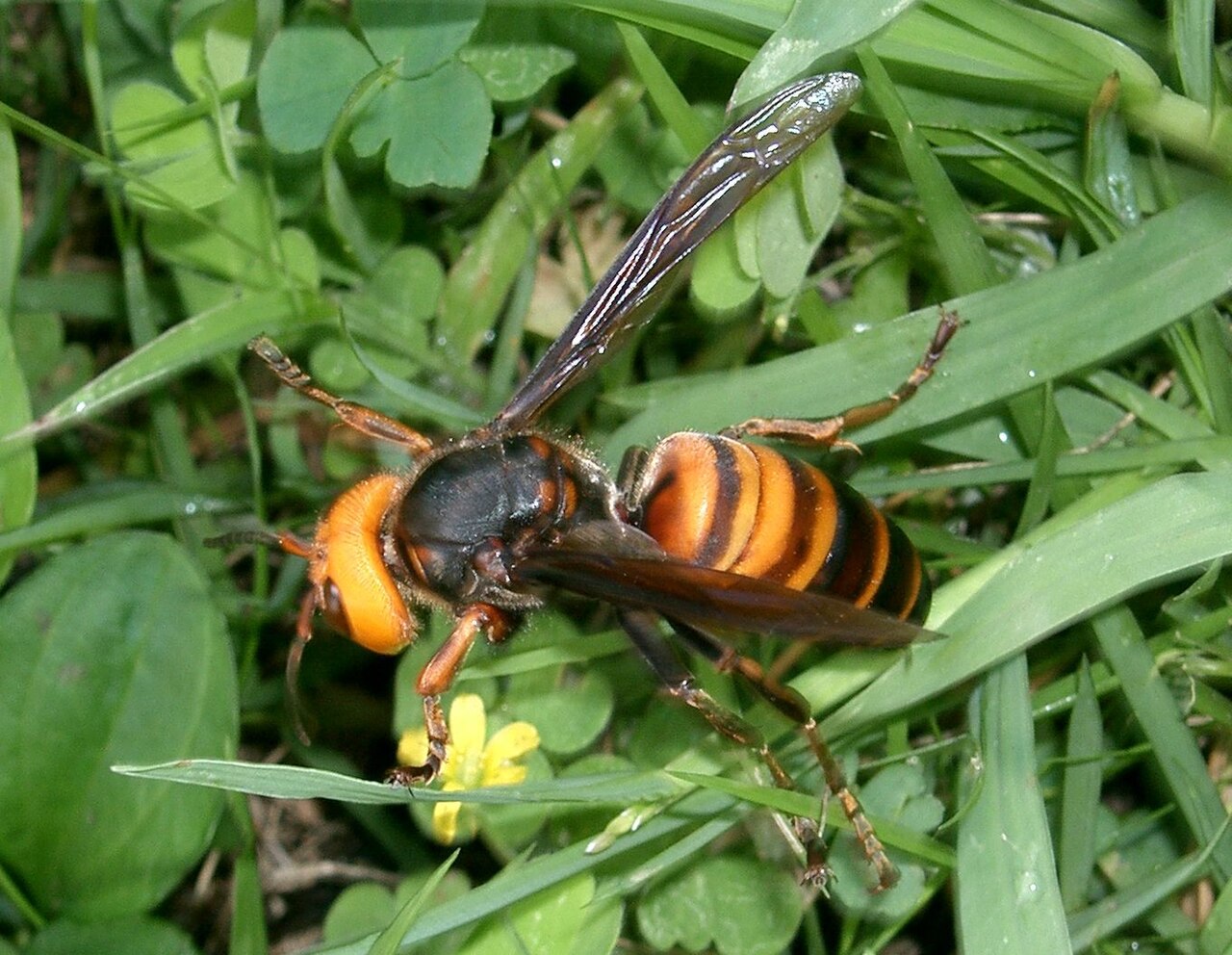
Size is what makes it striking. Queens reach about 2 in with a wingspan near 3 in, workers are somewhat smaller, and the head is disproportionately large and bright orange-yellow with prominent dark eyes and powerful mandibles. The abdomen carries alternating dark brown or black and orange-yellow bands.
The official common name in North America is northern giant hornet, adopted by the Entomological Society of America in 2022 specifically to replace the sensationalized nickname. The change was deliberate, since murder hornet drove public reaction out of proportion to the risk and led to large numbers of harmless native insects being killed by alarmed homeowners.
The Sting
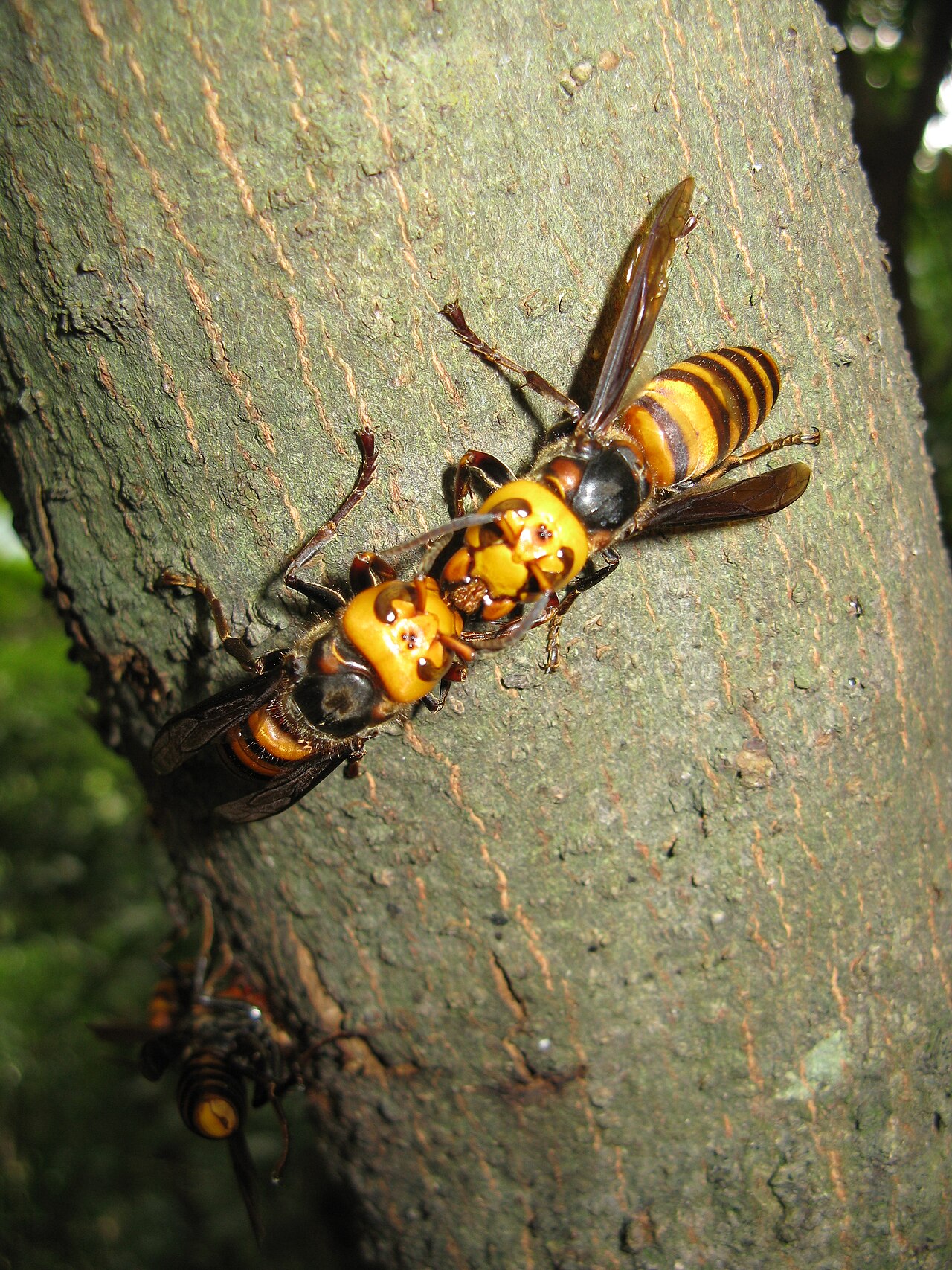
The sting is genuinely more serious than that of a common wasp, and the reasons are mechanical as much as chemical. The stinger reaches about a quarter inch, long enough to penetrate standard beekeeping suits, and it is smooth rather than barbed, so a hornet can sting repeatedly.
Venom volume is the main difference. Vespa mandarinia delivers a larger dose than smaller wasps, and the venom contains a mix of compounds including mandaratoxin along with substances that break down tissue, producing intense burning pain, significant swelling, and sometimes localized tissue damage.
Deaths occur but are rare and context-specific. Japan records roughly 30 to 50 deaths annually from hornet stings across all species, and the large majority involve anaphylaxis in allergic individuals or multiple stings from a disturbed nest. A single sting to a non-allergic adult is extremely painful and not life-threatening, and the risk profile is comparable to other large stinging insects rather than categorically different.
The Attack on Honey Bee Colonies
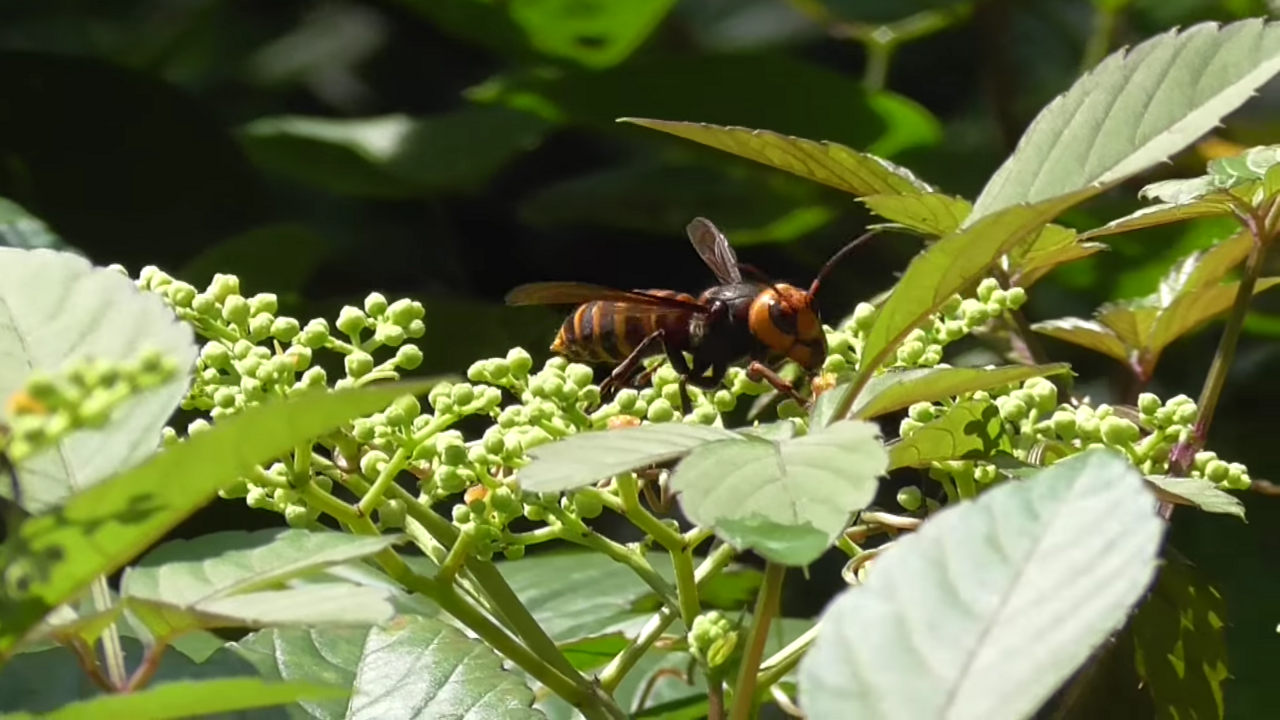
This is the behavior that earned the nickname and the reason agencies took the incursion seriously. In late summer, giant hornets switch from hunting individual insects to raiding social bee colonies, and the raid proceeds in a way that has no equivalent among native North American wasps.
A scout locates a hive and marks it with pheromone, then a group of workers arrives and enters what entomologists call the slaughter phase. Using their mandibles, they decapitate worker bees systematically, and a few dozen hornets can kill 30,000 bees in a matter of hours, leaving the ground carpeted with bodies.
They then occupy the hive and harvest the brood, carrying larvae and pupae back to feed their own young. European honey bees, the species kept commercially throughout North America, have no evolved defense against this and are essentially defenseless, which is why the arrival of the hornet threatened an industry rather than merely an ecosystem.
How Japanese Honey Bees Fight Back
The native Japanese honey bee evolved alongside the hornet and developed one of the more remarkable defenses in the insect world. When a scout hornet arrives at a hive, the bees do not flee.
Several hundred workers swarm the hornet and form a tight ball around it, then vibrate their flight muscles in unison. The ball reaches around 116 F, and combined with elevated carbon dioxide inside the cluster, those conditions kill the hornet while remaining just below the temperature the bees themselves can tolerate.
The margin is narrow, roughly a few degrees, which makes the behavior a genuinely precise piece of physiology rather than brute force. European honey bees do not perform it, and attempts to teach or breed the behavior into commercial stock have not produced a practical defense, which is why exclusion and eradication were the only options available in Washington.
The North American Incursion
The first confirmed North American detections came in late 2019 in Washington State and just across the border in British Columbia. Agencies including the Washington State Department of Agriculture and the USDA mounted an intensive response involving public reporting, trapping grids, and radio tagging of captured hornets to trace them back to nests.
Several nests were located and destroyed between 2020 and 2021, with the tracking method involving attaching tiny transmitters to live hornets and following them home. Trapping continued for years afterward with no further confirmed detections.
In December 2024 the USDA and Washington State declared the northern giant hornet eradicated from the United States, following three consecutive years without a confirmed sighting. That is the current status as far as the announcements go, though the possibility of undetected populations or fresh introductions through shipping cannot be ruled out entirely, and monitoring continues. Anyone reading this later should check current agency guidance rather than assuming the situation is unchanged.
Why the Panic Was Overblown
The gap between coverage and risk was substantial, and it had real costs. Coverage in 2020 frequently implied a spreading threat to human life across the continent, when the confirmed range was a small area of the Pacific Northwest and the documented threat was to honey bee colonies.
Two things drove the disproportion. The nickname itself, which no entomologist had used, and the timing, since the story broke in spring 2020 into an audience with a strong appetite for alarming news.
The consequence was a wave of insect killing. Extension offices across the country received thousands of reports, almost all of them cicada killers, European hornets, bald-faced hornets, and various large native wasps, and countless harmless and beneficial insects were destroyed by people acting on a name. Native pollinators and predatory wasps are already under pressure, including the beetles covered in our guide to the ladybug infestation question, and a panic-driven cull is exactly the wrong response, as our guide to getting rid of Japanese beetles argues in a different context.
What You Are Actually Seeing
Several large native and naturalized insects get reported as murder hornets, and knowing them prevents needless killing. The cicada killer is the most common case, a large wasp up to 2 in that digs burrows in lawns, hunts cicadas, and is almost entirely non-aggressive toward people despite its size.
The European hornet is the closest genuine lookalike, established in the eastern United States since the 1800s, reaching about 1.4 in with a brown and yellow pattern. Bald-faced hornets are black and white and build the large papery aerial nests people find in trees, and they are actually yellowjackets rather than true hornets.
Size and head color separate the giant hornet from all of them. Vespa mandarinia is larger than any of these at up to 2 in, and the head is distinctly large and bright orange-yellow rather than matching the body pattern. If the head is not conspicuously oversized and orange, it is something else.
Nests and the Annual Colony Cycle
Giant hornet colonies are annual, like those of most social wasps. A mated queen overwinters alone, emerges in spring, and starts a nest by herself, usually in an abandoned rodent burrow or a hollow among tree roots rather than in the aerial paper nests people picture.
The colony builds through summer and peaks in late summer and early autumn, which is exactly when the raids on bee colonies occur and when the hornets are most conspicuous. A mature nest may hold several hundred workers.
Everything then collapses. New queens and males are produced late in the season, they mate, and the founding queen, the workers, and the males all die with the first hard frosts, leaving only mated queens to overwinter. That underground nesting habit is what made the Washington eradication difficult, since nests are invisible from the surface and had to be traced by radio-tagging live hornets.
What to Do About Large Hornets Generally
The advice holds regardless of species. Never disturb a nest yourself, since a disturbed social wasp nest of any species can produce dozens of stings, and underground nests are particularly easy to strike accidentally with a mower.
Give a wide berth and note the location. Underground nests in lawns and banks are common in late summer, and marking the spot lets you avoid it and gives a professional something to work with if removal is needed.
Call a pest professional or your state department of agriculture for anything you cannot identify or cannot avoid. Wasps and hornets are valuable predators that consume enormous numbers of caterpillars, flies, and other insects, and most nests in an out-of-the-way location can simply be left alone until they die off naturally in autumn. Our guides to the baby praying mantis, crickets versus grasshoppers, and the giant millipede cover other large invertebrates that alarm people without cause.
Frequently Asked Questions
What is a murder hornet?
The northern giant hornet, Vespa mandarinia, the world’s largest hornet at up to 2 in with a wingspan near 3 in. It is native to East and Southeast Asia. The nickname was coined by journalists, and the official common name was changed in 2022 to reduce the panic it caused.
Are murder hornets still in the United States?
The USDA and Washington State declared the species eradicated from the United States in December 2024 after three consecutive years without a confirmed detection. Monitoring continues, and fresh introductions through shipping remain possible, so check current agency guidance for the latest status.
How dangerous is the sting?
More serious than a common wasp sting because of the larger venom dose and a quarter-inch smooth stinger that can penetrate beekeeping suits and sting repeatedly. A single sting to a non-allergic adult is extremely painful but not life-threatening. Deaths involve allergy or many stings.
Why are they called murder hornets?
Because of what they do to honey bee colonies rather than to people. A few dozen hornets can decapitate 30,000 bees in hours, then occupy the hive and harvest the brood. European honey bees have no evolved defense against this.
How do Japanese honey bees defend themselves?
They swarm a scout hornet, form a tight ball around it, and vibrate their flight muscles to raise the temperature inside to roughly 116 F, which kills the hornet while staying just below what the bees themselves tolerate. European honey bees do not do this.
What am I probably seeing instead?
Most likely a cicada killer, a European hornet, or a bald-faced hornet. The giant hornet is larger at up to 2 in and has a conspicuously oversized bright orange-yellow head that does not match the body pattern. If the head is not obviously oversized and orange, it is something else.
What should I do if I find one?
Photograph it from a distance and report it to your state department of agriculture rather than killing it. Photographic reports were central to the Washington eradication, and the overwhelming majority of reports turn out to be harmless native insects.