Green Grasshopper: ID, Safety, and Garden Impact
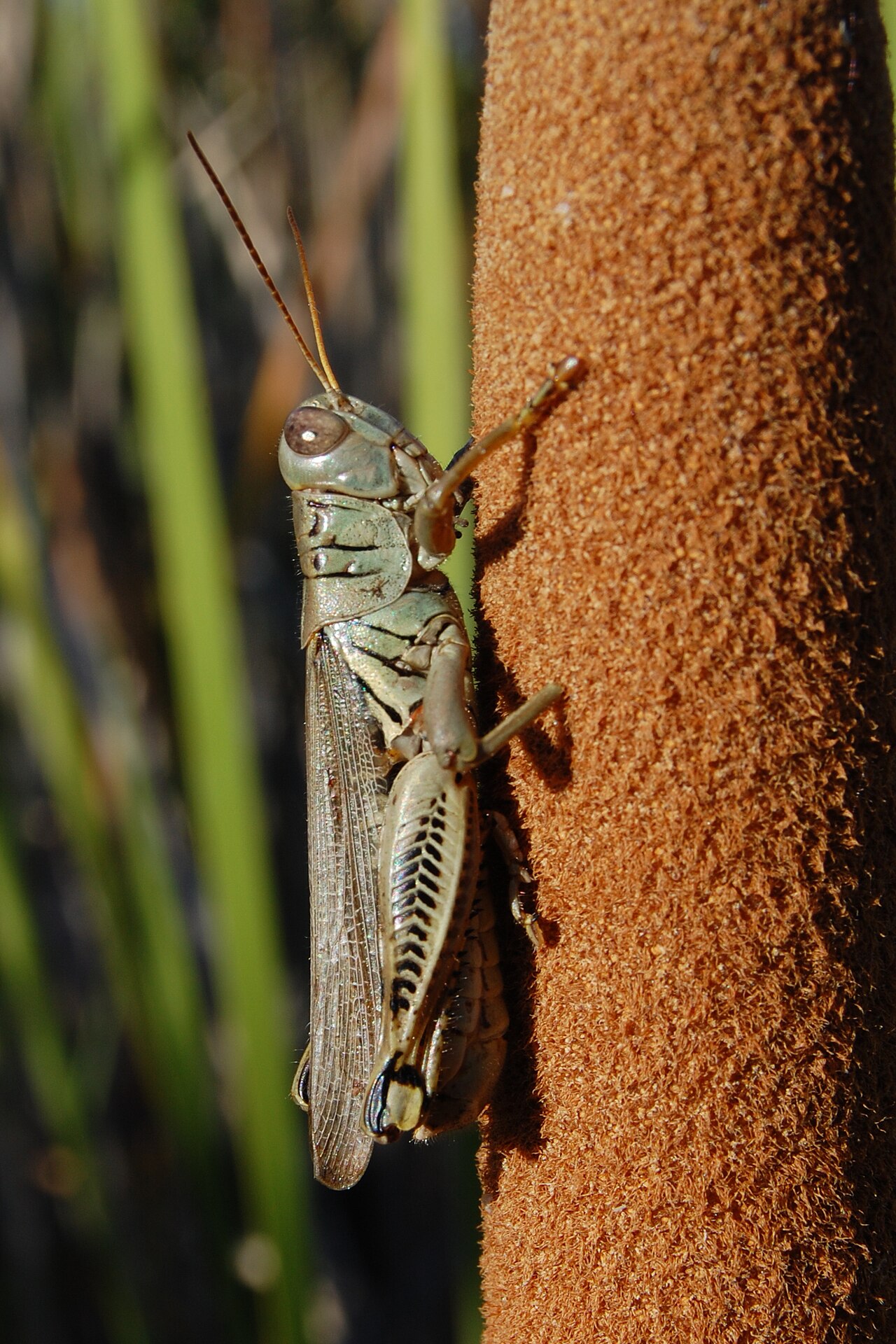
A green grasshopper is not one species but a colour that dozens share, and in North America the green insect most people find is usually a differential grasshopper, a red-legged grasshopper, a meadow grasshopper, or, very often, not a grasshopper at all but a katydid. All are harmless: green grasshoppers do not bite meaningfully, do not sting, and are not venomous.
The quickest way to sort them out is the antennae. Grasshoppers have short thick antennae well under half the body length; katydids and crickets have thread-like antennae longer than the whole body. That single check resolves most of what people are actually asking when they photograph a green insect on a screen door. This guide covers identification, the harmless question, garden damage, and what to do with one indoors.
Green grasshoppers are several species rather than one, and they are harmless: no sting, no venom, and a bite that cannot break skin. Short thick antennae identify a grasshopper; long thread-like antennae mean a katydid. Most fly well. Damage to gardens is minor except in outbreak years driven by warm dry weather.
| Feature | Green Grasshopper |
|---|---|
| Antennae | Short and thick, under half body length |
| Katydid comparison | Antennae longer than the whole body |
| Active | Daytime; katydids sing at night |
| Sting or venom | None |
| Bite | A pinch at most; cannot break skin |
| Flight | Most adults fly well |
| Defence | Jumping, flight, and regurgitated brown fluid |
What Kind of Grasshopper Is Green?
Many. Green is one of the two default grasshopper colours along with brown, and species across several families come in green forms, sometimes with green and brown individuals in the same population. Colour alone identifies almost nothing.
In North America the common green candidates include the differential grasshopper, the red-legged grasshopper, the two-striped grasshopper, various meadow and slant-faced grasshoppers, and the American bird grasshopper, which is large and a strong flier. In Europe the great green bush-cricket is the usual answer, and it is a katydid rather than a grasshopper.
Colour is often environmental rather than fixed. Many grasshopper species develop greener forms in lush vegetation and browner forms on dry ground, and some can shift between moults, which means the same species looks different in a meadow and on a scorched verge. The cricket vs grasshopper guide covers the family-level differences.
Is It a Grasshopper or a Katydid?
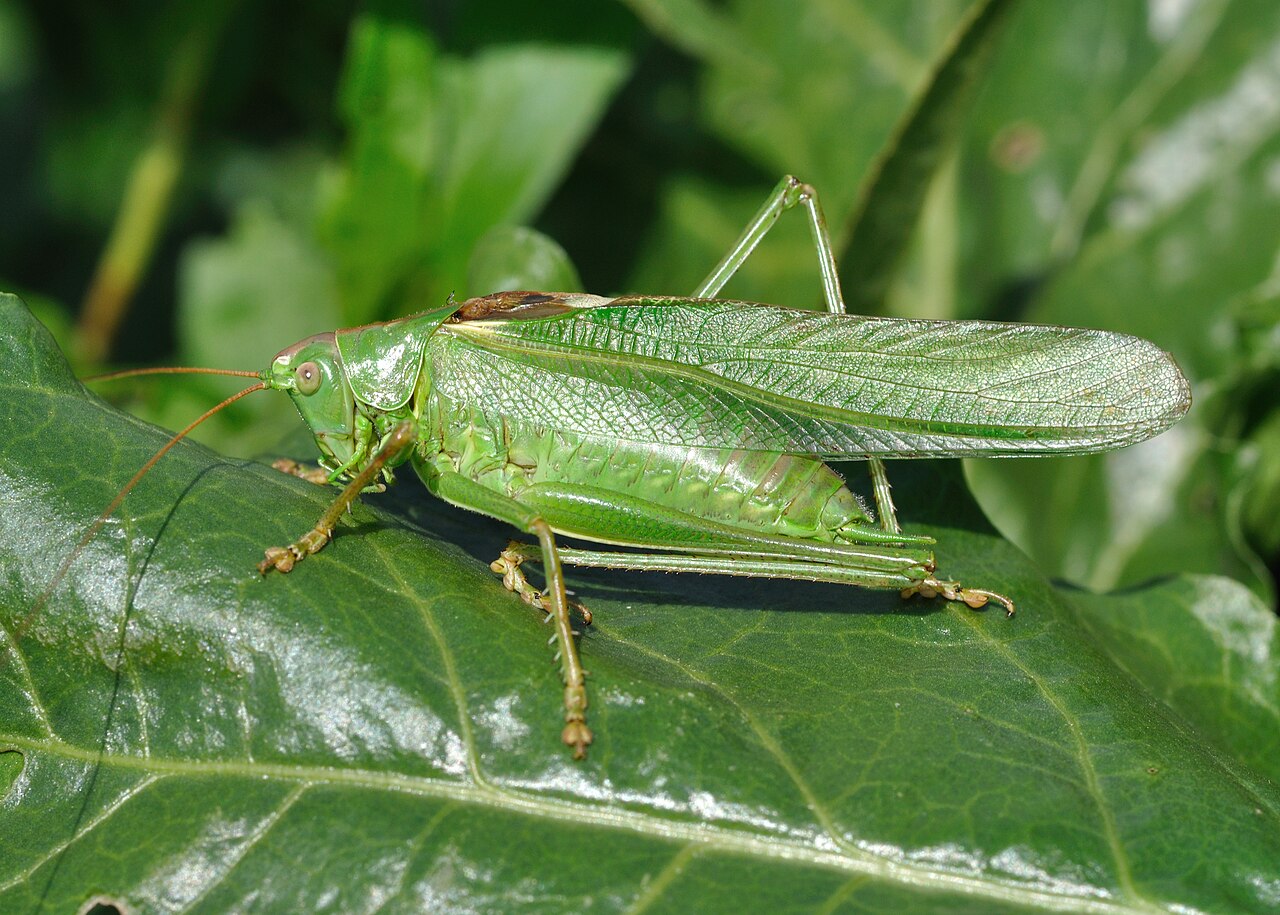
Check the antennae, and the answer takes a second. Grasshoppers have short, thick, straight antennae, typically well under half the body length. Katydids and crickets have fine thread-like antennae that are longer than the entire body, often dramatically so.
Behaviour confirms it. Grasshoppers are active by day and sing, where they sing at all, by rubbing a hind leg against a wing, producing a soft buzzing or clicking. Katydids sing at night by rubbing the wings together, producing the harsh rhythmic rasp that fills late summer evenings.
Body shape helps at a glance. Katydids have wings held tented over the back that often mimic leaves in shape and venation, giving a flattened, leaf-like profile, while grasshoppers have a more cylindrical body with wings folded flat along the sides. The katydid sounds guide covers the nocturnal half of the confusion.
Are Green Grasshoppers Dangerous?
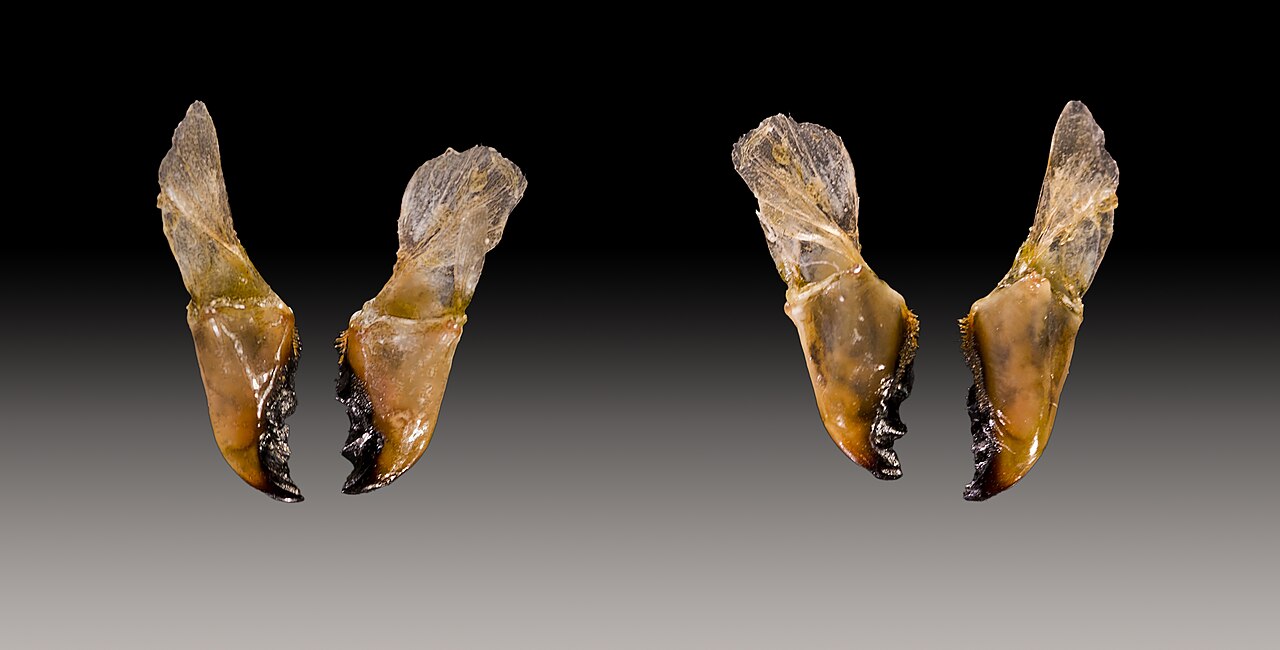
No. Grasshoppers have no sting, no venom, and no capacity to injure a person. The mouthparts are built for chewing plant material, and while a large individual held tightly may pinch, it cannot break skin in any meaningful way.
What they do have are two mild defences. Many regurgitate a brown fluid when handled, commonly called tobacco juice, which stains fingers and tastes foul to a predator, and the strong spined hind legs can scratch when the insect kicks free. Neither is harmful, though the stain takes some scrubbing.
The exception worth knowing is the eastern lubber grasshopper of the southeastern United States, which is not green but yellow, orange, and black, and is genuinely toxic if eaten, having killed birds and being a real risk to pets. Bright warning colours in a large slow flightless grasshopper mean leave it alone. The guide to birds that eat grasshoppers covers that toxicity in detail.
Can Green Grasshoppers Fly?
Most adults can, and well. Grasshoppers have two pairs of wings: leathery forewings that protect the folded membranous hindwings underneath, and the hindwings do the flying. Many species fly strongly enough to cover considerable distances.
Jumping comes first, though. A grasshopper can launch itself around twenty times its own body length using hind legs that store energy in a spring-like tendon and release it far faster than muscle alone could, and flight usually starts from the top of a jump rather than from standing.
Not all fly. Nymphs have no functional wings at all, developing them progressively through five moults, and some adult species including the eastern lubber have wings too short for flight. A large green insect that jumps but cannot get airborne is usually either a nymph or a flightless species. The guide to what grasshoppers eat covers the feeding side.
Are Green Grasshoppers Good or Bad?
Both, depending on numbers. In ordinary years grasshoppers are a normal part of grassland and garden ecology, converting vegetation into a form other animals can use and feeding a long list of predators including kestrels, shrikes, meadowlarks, turkeys, skunks, lizards, and spiders.
Damage in a garden is usually minor and scattered. Grasshoppers chew ragged holes from leaf edges inward, and a few individuals working through a vegetable bed cause cosmetic rather than serious loss. Chewing damage from the edge inward is one way to distinguish grasshopper feeding from caterpillar feeding, which is more often holes within the leaf.
Outbreak years are a different matter and are driven by weather rather than by anything a gardener did. Consecutive warm dry summers and mild autumns favour egg survival, and densities can reach dozens per square yard across large areas, stripping pasture and crops. Wet springs collapse them again through fungal disease.
Why Do Grasshoppers Suddenly Appear?
Because they all mature at once. Grasshoppers overwinter as eggs in pods buried an inch or two in soil, hatch over a few weeks in late spring, and pass through five nymphal instars before reaching adult size in midsummer. The nymphs are small and inconspicuous; the adults are neither.
That is why a garden with no visible grasshoppers in June is full of them in August. Nothing arrived; the same population simply became large enough to notice, and the adults are also more mobile and more likely to fly into view.
Weather concentrates them further. Dry conditions push grasshoppers off scorched rough ground toward irrigated gardens and green field margins, so a drought year sends them into exactly the places people notice, which is often mistaken for an increase in numbers rather than a shift in location.
What Should You Do With One in the House?
Put it out. A grasshopper indoors is lost rather than invading: they do not infest houses, do not breed indoors, do not damage anything, and will die within a day or two without plant material and moisture.
The simplest method is a glass and a piece of card, the same as for a spider. Grasshoppers jump unpredictably when chased, so approaching slowly and placing the glass over the insect works far better than trying to catch one by hand. Release into vegetation rather than onto paving.
Entry is almost always through an open door or window, or on plants and cut flowers brought inside. If they are coming in repeatedly, screens and door seals fix it. No insecticide, deterrent, or ultrasonic device is needed or effective, and the various smells grasshoppers are said to hate, including garlic and hot pepper, have limited evidence behind them as repellents.
Why Are So Many Insects Green?
Camouflage, and it is one of the most repeatedly evolved solutions in the insect world. Green against foliage breaks up an outline for predators hunting by sight, particularly birds, and grasshoppers, katydids, caterpillars, mantises, aphids, and lacewings have all arrived at it independently.
Insects cannot make green pigment easily. Most green colouring comes from combining a yellow pigment with a blue one, or from bile-derived pigments related to those in plant chlorophyll, and some species achieve it structurally instead through microscopic layers in the cuticle that reflect green wavelengths.
The colour is also frequently switchable. Many grasshoppers develop greener forms in wet lush conditions and browner ones on burnt or dry ground, adjusting between moults to match the background, which is why the same species can look like two different insects in adjacent fields.
How Do You Reduce Them in a Garden?
Encourage the predators and use physical barriers. Floating row covers over vulnerable crops exclude grasshoppers entirely, and they are the only method that works reliably in an outbreak year. Fine mesh needs securing at the edges because grasshoppers walk under loose covers.
Habitat for predators does real work over time. Kestrel and bluebird boxes, perches over open ground, unmown grass margins for grassland birds, and cover for toads and snakes all raise predation pressure, and studies excluding birds from grassland plots consistently find more grasshoppers and more plant damage inside the exclosures.
Autumn tillage of known egg-laying areas, which are usually undisturbed grassy margins rather than the cultivated beds themselves, destroys egg pods before they hatch. Nosema locustae bait applied early when nymphs are small is a targeted biological option, and poultry, particularly guinea fowl, are effective on a small scale. Extension services such as Colorado State (colostate.edu) publish thresholds for when treatment is worth doing at all. The guide to birds that eat caterpillars covers the same habitat approach for other prey.
Frequently Asked Questions
What kind of grasshopper is green?
Many species, including differential, red-legged, two-striped, and meadow grasshoppers in North America. Colour is often environmental, with greener forms in lush vegetation and browner ones on dry ground.
Is it a grasshopper or a katydid?
Check the antennae. Grasshoppers have short thick antennae under half the body length; katydids have thread-like antennae longer than the whole body. Grasshoppers are diurnal, katydids sing at night.
Are green grasshoppers venomous?
No. They have no sting, no venom, and cannot break skin. Some regurgitate a brown fluid when handled and the spined hind legs can scratch, but neither is harmful.
Can a green grasshopper fly?
Most adults fly well, using membranous hindwings protected by leathery forewings. Nymphs cannot fly at all, and a few adult species including the eastern lubber are flightless.
Are green grasshoppers good or bad?
Mostly neutral to good. They feed a long list of predators and cause only scattered cosmetic damage in ordinary years. Outbreak years driven by warm dry weather are the exception.
What do you do if a grasshopper is in your house?
Put it out with a glass and a piece of card. They do not infest, breed, or damage anything indoors and will die within a day or two without plants and moisture.
Why do grasshoppers suddenly appear?
They mature all at once. Nymphs hatch in late spring and are small and inconspicuous through five moults, then reach adult size in midsummer. Drought also pushes them toward irrigated gardens.

Similar Posts
Corn Snake: Identification, Copperhead Lookalikes, and Bite Risk
How to identify a corn snake in seconds, why it is not a copperhead, and what to do when one turns up in the garage.
Groundhog Sounds: The Whistle and Every Other Call Explained
Groundhog sounds decoded: the alarm whistle behind the whistle pig nickname, teeth chattering, distress squeals, and why night noise is almost never a groundhog.
Snake Tattoo Meaning: Rebirth, Medicine, and Danger Explained
Snake tattoo meaning spans rebirth from shedding skin, medical healing, Egyptian royalty, and Western temptation. Full symbolism across cultures explained.
Pastel Ball Python: Cost, Size and Care of the Morph Behind Everything
Pastel is the cheapest ball python morph and the base gene behind hundreds of designer combinations. What it costs, how big it gets, and how to keep one.
Turtle Sounds: 6 Noises They Make and What Each One Means
Turtles hiss, grunt, squeak and click. Which sounds are normal, which mean a respiratory infection, and when in the year you hear them.
Bee Spiritual Meaning: 7 Omens and What a Bee Visit Means
A bee is one of the clearest good omens in folk tradition. What a visit, a bee in the house, a swarm and a dead bee each mean, tradition by tradition.