Black and White Snake: Identification Guide by Species
A black and white snake in North America is most often a kingsnake. The California kingsnake wears bold alternating bands, the eastern kingsnake carries a chain-link pattern of white or yellow lines over glossy black, and both are harmless constrictors that actually eat other snakes, including venomous ones. Neither poses any danger to people.
Where the question gets serious is when red enters the pattern. A red, black, and white or yellow banded snake in the southern United States could be a harmless milk snake or scarlet kingsnake, or it could be a venomous coral snake, and the band order separates them. This guide covers every common black and white snake, the striped varieties, the red-banded lookalikes, and what to do when you find one.
| Species | Pattern and Range |
|---|---|
| California kingsnake | Bold black and white bands, western states |
| Eastern kingsnake | Chain-link white lines on glossy black, southeast |
| Speckled kingsnake | White or yellow speck on each black scale, central states |
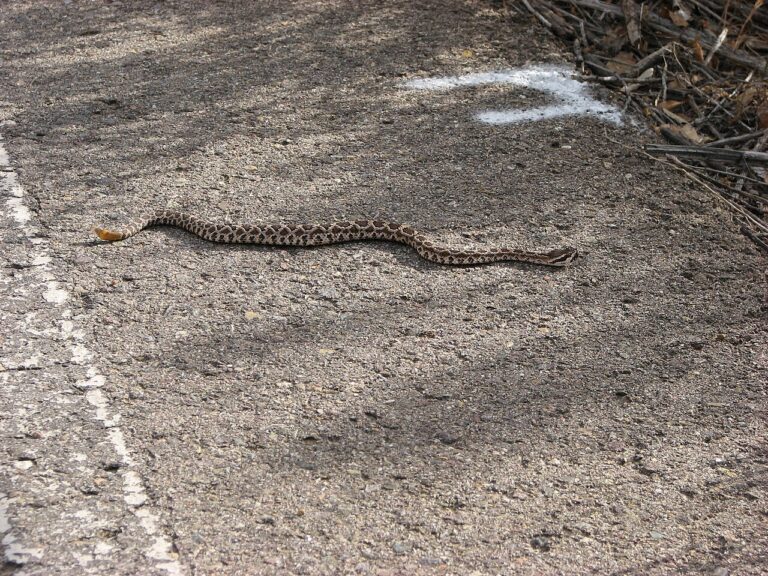
| Black rat snake juvenile | Gray and white blotches, fades with age |
| Common garter snake | Pale stripes on dark ground, nationwide |
| Eastern coral snake | Red, yellow, black bands, venomous, southeast |
What Black and White Snake Did You See?
Begin with the pattern geometry, because it splits the field immediately. Bands that wrap all the way around the body point to a kingsnake. Stripes running lengthwise down the snake point to a garter or ribbon snake. Blotches or saddles that sit on the back without wrapping point to a juvenile rat snake or a similar species.
Then consider where you are. The California kingsnake occupies the western states and is the classic boldly banded black and white snake, while the eastern kingsnake with its chain pattern occupies the southeast. A boldly banded snake in Ohio is not a California kingsnake, and range narrows the possibilities faster than pattern alone.
Finally check whether red is present anywhere. Pure black and white or black and yellow snakes in the United States are essentially all harmless. Red bands introduce the coral snake question, which is the only scenario in this color group that requires real caution.
California Kingsnake
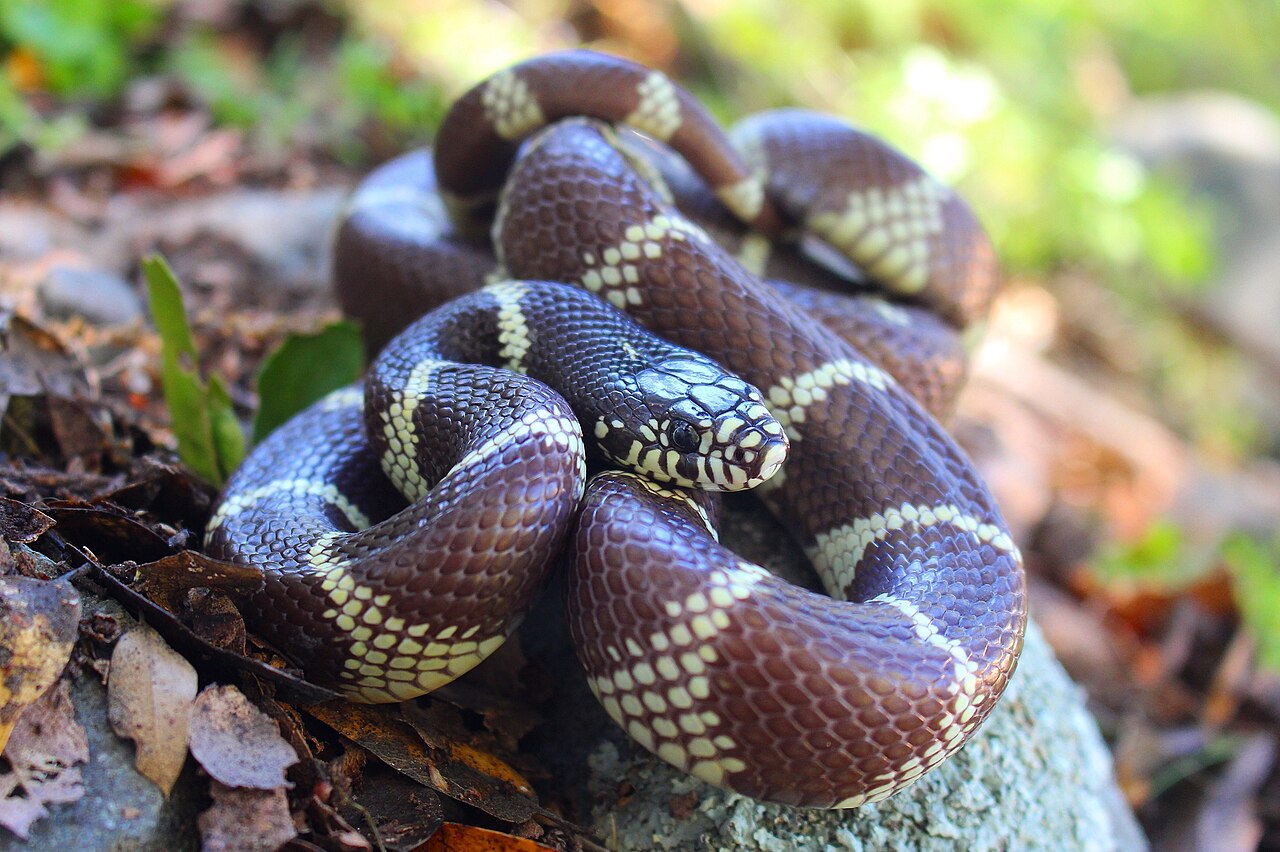
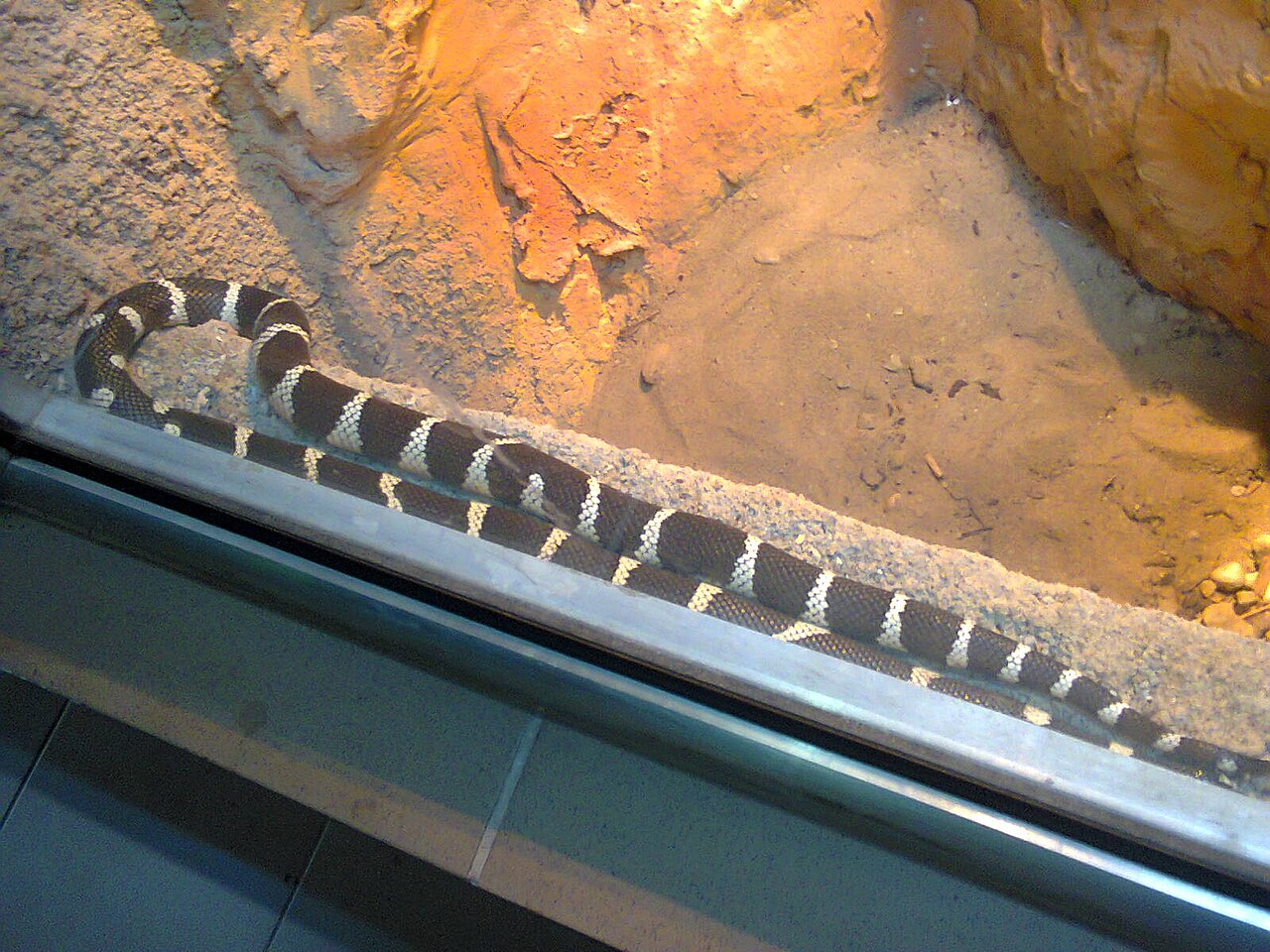
The California kingsnake (Lampropeltis californiae) is what most people picture when they think of a black and white snake. Adults reach 3 to 4 ft, and the typical animal wears alternating bands of glossy black or dark brown and bright white or cream, wrapping fully around the body including the belly.
They are constrictors and they are famously ophiophagous, meaning they eat other snakes. Their diet includes rattlesnakes, and they are substantially resistant to pit viper venom, which lets them take on prey that would kill most predators their size. They also eat rodents, lizards, birds, and eggs.
Behavior when cornered can be alarming without being dangerous. A California kingsnake may hiss, vibrate its tail against leaf litter to produce a rattling buzz, and strike, and it may release musk if picked up. None of it carries any medical significance. They are also among the most popular pet snakes, bred in many pattern morphs including striped, banded, and aberrant forms, the same selective breeding process described in our guide to the albino corn snake.
Eastern and Speckled Kingsnakes
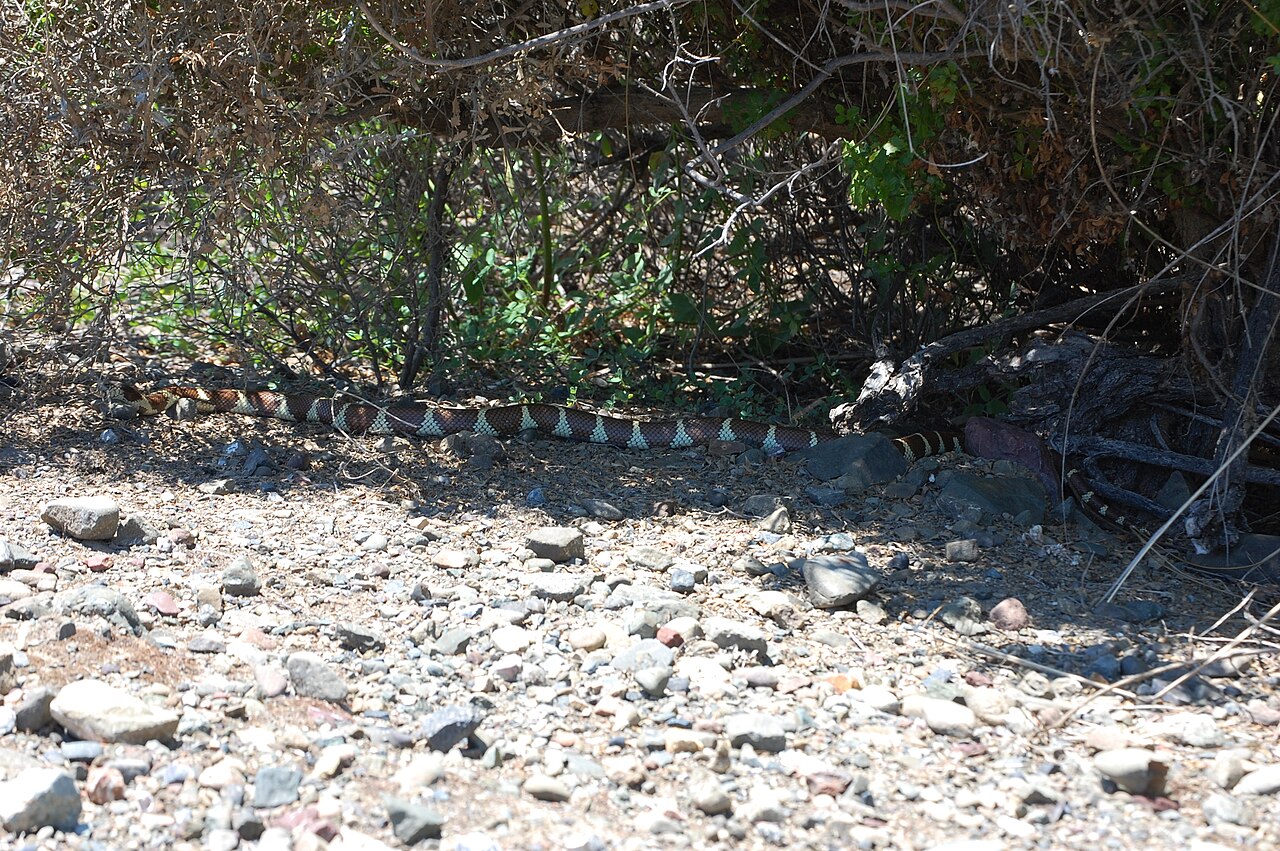
The eastern kingsnake (Lampropeltis getula) of the southeastern United States is glossy black with thin white or pale yellow crossbars that connect along the sides, producing a chain-link appearance that gives it the local name chain kingsnake. Adults reach 3 to 4 ft and the shine on a freshly shed animal is striking. For a closely related question, see our guide to black and white spider. For a closely related question, see our guide to red and black snake.
The speckled kingsnake of the central states takes a different approach, carrying a single white or yellow dot on each individual black scale, which at a distance reads as a greenish or salt-and-pepper wash. It is sometimes called the salt-and-pepper snake for that reason, and the pattern is unmistakable up close.
All the kingsnakes share the same ecological role and the same harmlessness. They are powerful constrictors for their size, they eat other snakes including venomous species, and none is a threat to humans or pets. A kingsnake on a property is a genuine asset, and killing one tends to increase the local venomous snake population rather than reduce it.
Black and White Striped Snakes
Stripes running the length of the body mean something different from bands. Garter snakes are the most widespread striped snakes in North America, typically showing one dorsal and two lateral pale stripes over a dark background, and while most are yellowish or greenish, some populations look convincingly black and white.
Ribbon snakes, close relatives of garters, are slimmer with proportionally longer tails and crisper stripes, and they stay near water. Both groups are harmless, active during the day, and eat amphibians, worms, fish, and small invertebrates. Neither constricts, and both flee readily.
Striped kingsnake morphs add a wrinkle. The California kingsnake has a naturally occurring striped form in which the pattern runs lengthwise instead of banding, and these appear both in the wild and abundantly in captivity. A boldly black and white striped snake in California or Arizona could be either a striped kingsnake or a garter, separated by body shape and scale texture, since kingsnakes are glossy with smooth scales while garters have keeled scales and a matte finish.
Red, Black, and White Snakes
This is the combination that matters. In the southeastern United States, the eastern coral snake carries red, yellow, and black bands and is genuinely venomous, with a potent neurotoxin. Its harmless mimics, the scarlet kingsnake and the milk snake, wear the same three colors in a different order.
The band order is the tell in the United States. On a coral snake, the red bands touch the yellow bands. On the mimics, the red bands touch the black bands. The rhyme about red touching yellow killing a fellow encodes this, and it works reliably within the United States. It fails in Central and South America, where coral snake species have different band arrangements, so it should never be applied while traveling.
Two structural features back it up. Coral snakes have a blunt black snout, while scarlet kingsnakes and milk snakes have red or pale snouts. Coral snakes also have bands that wrap fully around the body, small fixed fangs, and a secretive burrowing habit that makes encounters uncommon. Our guide to the milk snake covers the mimicry in detail, and any suspected coral snake bite is a medical emergency requiring immediate care regardless of how minor it looks.
Juvenile Snakes That Look Black and White
Young snakes frequently wear patterns their parents lose. Juvenile rat snakes are the leading example, showing strong gray and white or brown blotching at 10 to 14 in that fades toward the near-uniform dark adult coloration. They are killed constantly as suspected rattlesnakes, and they are entirely harmless.
Black racers undergo an even more dramatic change. Adults are uniformly glossy black and fast-moving, while juveniles are heavily blotched in gray, brown, and white and look like a completely different species. Anyone matching a small blotched snake against an adult photograph will draw the wrong conclusion.
The practical rule is to identify juveniles by structural features rather than color. Pupil shape, the presence or absence of a facial pit, head shape relative to the neck, scale texture, and belly pattern all remain consistent through life, while dorsal color and pattern often do not. Our guide to the baby snake works through that process, and the Texas rat snake guide covers one species where the juvenile confusion is especially common.
Black and White Snakes Outside North America
Travelers should know that the pattern carries different risks elsewhere. The banded krait of South and Southeast Asia is boldly banded in black and yellow, and the many-banded krait is black and white. Both are highly venomous elapids responsible for serious snakebite mortality, and both are primarily nocturnal.
Kraits behave differently from most venomous snakes in a way that matters. They are docile during the day and rarely bite when encountered in daylight, but they become active at night and bites frequently happen to people sleeping on floors. The bite is often nearly painless initially, which delays treatment dangerously.
Australia, Africa, and South America each have their own black and white banded species with varying danger levels. The general lesson is that identification rules are regional. The pattern that reliably means harmless kingsnake in California means something entirely different in Myanmar, and the red-touch-yellow rhyme has no validity outside the United States.
What to Do If You Find One
Leave it alone and give it room. Every North American snake will retreat if offered an exit, and the overwhelming majority of bites happen to people attempting to catch, kill, or move a snake. Standing back and letting it go costs nothing and resolves nearly every encounter.
Photograph it from a distance if you want an identification. Pupil shape, snout color, band order, and belly pattern are all readable in a phone photo taken from 10 ft away, and local herpetology groups identify photos quickly. Never approach an unidentified snake for a better picture.
If a snake is indoors, contain it with a box and stiff cardboard or call a professional removal service. Skip glue traps and commercial repellents, which cause suffering and do not work respectively, and address the habitat instead by clearing brush and debris, stacking firewood off the ground, sealing gaps at foundations and door sweeps, and reducing the rodent population. Kingsnakes in particular are worth keeping around, since a resident kingsnake actively suppresses the venomous snakes on a property. Our guide to the hognose snake covers another species that puts on an alarming display without any capacity to harm.
Frequently Asked Questions
What kind of snake is black and white?
In North America it is most often a kingsnake. The California kingsnake has bold alternating black and white bands, the eastern kingsnake shows white chain-link lines on glossy black, and the speckled kingsnake has a white dot on each black scale. All are harmless constrictors.
Are black and white snakes venomous?
Pure black and white banded snakes in the United States are harmless, and most are kingsnakes that actually eat venomous snakes. The exception involves red: a red, yellow, and black banded snake in the southeast may be a venomous coral snake, identified by red bands touching yellow bands.
What is a black and white striped snake?
Lengthwise stripes usually mean a garter or ribbon snake, both harmless and widespread. The California kingsnake also has a naturally occurring striped form. Kingsnakes have smooth glossy scales, while garter snakes have keeled scales and a matte finish.
How do I tell a coral snake from a milk snake?
In the United States, red bands touching yellow means coral snake, red touching black means a harmless milk snake or scarlet kingsnake. Coral snakes also have a blunt black snout, while the mimics have red or pale snouts. The rhyme does not work in Central or South America.
Do kingsnakes really eat rattlesnakes?
Yes. Kingsnakes are ophiophagous, meaning they eat other snakes, and they are substantially resistant to pit viper venom, which allows them to kill and consume rattlesnakes and copperheads. A resident kingsnake suppresses venomous snake numbers on a property.
Why does a black snake in my yard have white blotches?
It is probably a juvenile. Young rat snakes and black racers wear strong gray, brown, and white blotching that fades to near-uniform dark coloration in adulthood. Both are harmless, and both are killed frequently because people match them against adult photographs of venomous species.
Should I remove a kingsnake from my property?
No. Kingsnakes are non-venomous, avoid people, and eat rodents and other snakes including venomous ones. Removing one typically increases the venomous snake population rather than reducing it. If one is indoors, contain it with a box and release it outside, or call a removal service.