Yellow Butterfly: Sulphurs, Swallowtails, and Symbolism
A yellow butterfly spotted across most of North America is most often one of several sulphur species, small to medium-sized butterflies displaying clear, bright yellow wings sometimes marked with small dark spots or borders, though the considerably larger and more dramatically colored cloudless sulphur, capable of reaching a notably larger size than its smaller sulphur relatives, and the striking yellow-and-black tiger swallowtail represent two genuinely distinct yellow butterfly possibilities worth distinguishing from the more common, smaller sulphur species most people encounter regularly in gardens and open fields.
Beyond straightforward species identification, yellow carries genuinely rich and largely positive symbolic associations across numerous cultural traditions specifically, often connected to joy, optimism, and new beginnings, making yellow butterfly encounters a particularly cheerful sighting for those specifically drawn to interpreting wildlife encounters symbolically alongside their biological identification. This guide covers the most common yellow butterfly species found across North America, their specific distinguishing features and host plants, and the widespread positive symbolic traditions associated with this particular color.
| Species | Key Distinguishing Feature |
|---|---|
| Clouded sulphur | Common, small, clear yellow with dark border |
| Cloudless sulphur | Larger, brighter yellow, minimal markings |
| Orange sulphur | Yellow-orange, variable coloring |
| Tiger swallowtail | Large, yellow with black tiger stripes |
| Sleepy orange | Smaller, yellow-orange with dark border |
A yellow butterfly in North America is usually a sulphur, most often the clouded or cloudless sulphur, small to medium with clear yellow wings. The large yellow butterfly with bold black tiger stripes is an Eastern Tiger Swallowtail, a different family and roughly twice the size.
Clouded Sulphur: The Common Yellow Butterfly
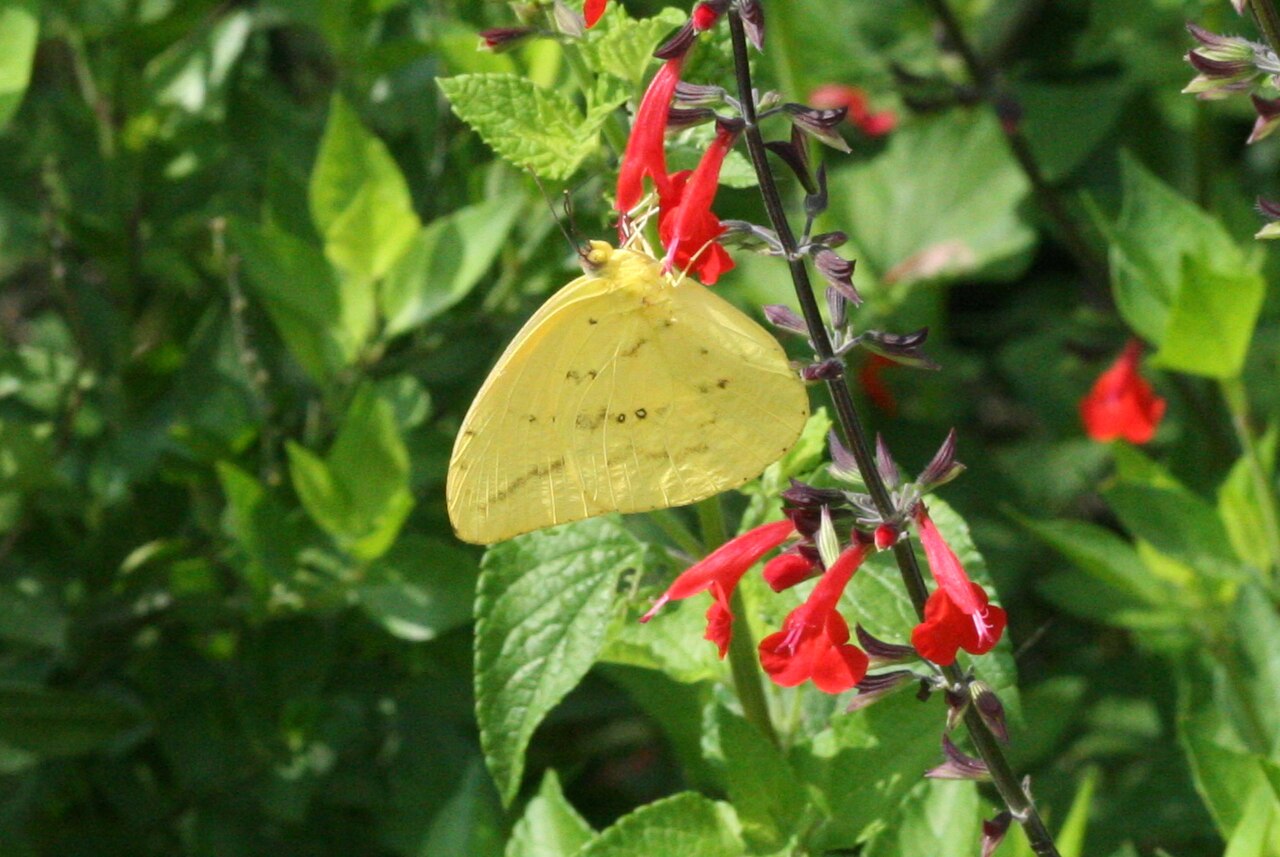
The clouded sulphur ranks among the most commonly encountered yellow butterflies across nearly all of North America, displaying clear, pale to medium yellow wings marked with a dark border, more pronounced in females, and typically a small dark spot near the center of the forewing, a genuinely widespread species that many casual observers encounter regularly without necessarily distinguishing it from the several other yellow butterfly possibilities covered throughout this guide.
This species favors open habitat including fields, meadows, and roadsides, with caterpillars feeding on various legume family plants including clover and alfalfa, host plant relationships that connect this common species directly to widespread agricultural and open-field habitat found across an enormous portion of the continental United States and southern Canada, making this genuinely one of the more geographically widespread butterfly species most casual observers will encounter regardless of their specific regional location within this broad range.
Clouded sulphurs produce multiple generations annually across much of their range, making them genuinely reliable, frequently encountered butterflies throughout most of the growing season from spring through fall, and their close relative the orange sulphur, showing more variable yellow-to-orange coloring and sometimes hybridizing with clouded sulphurs where their ranges overlap, adds further identification complexity worth noting for observers specifically interested in precise species-level identification across this closely related species pair.
Cloudless Sulphur: Larger and Brighter
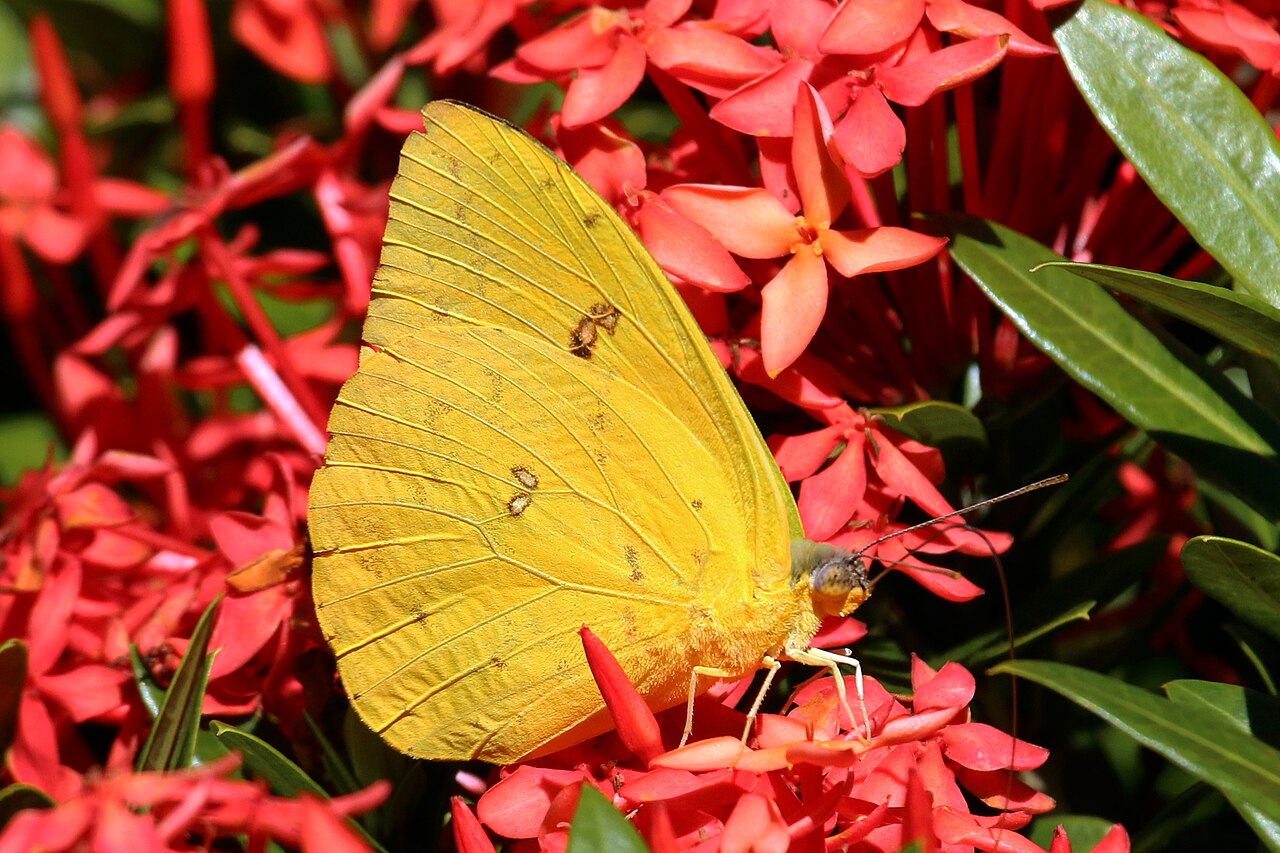
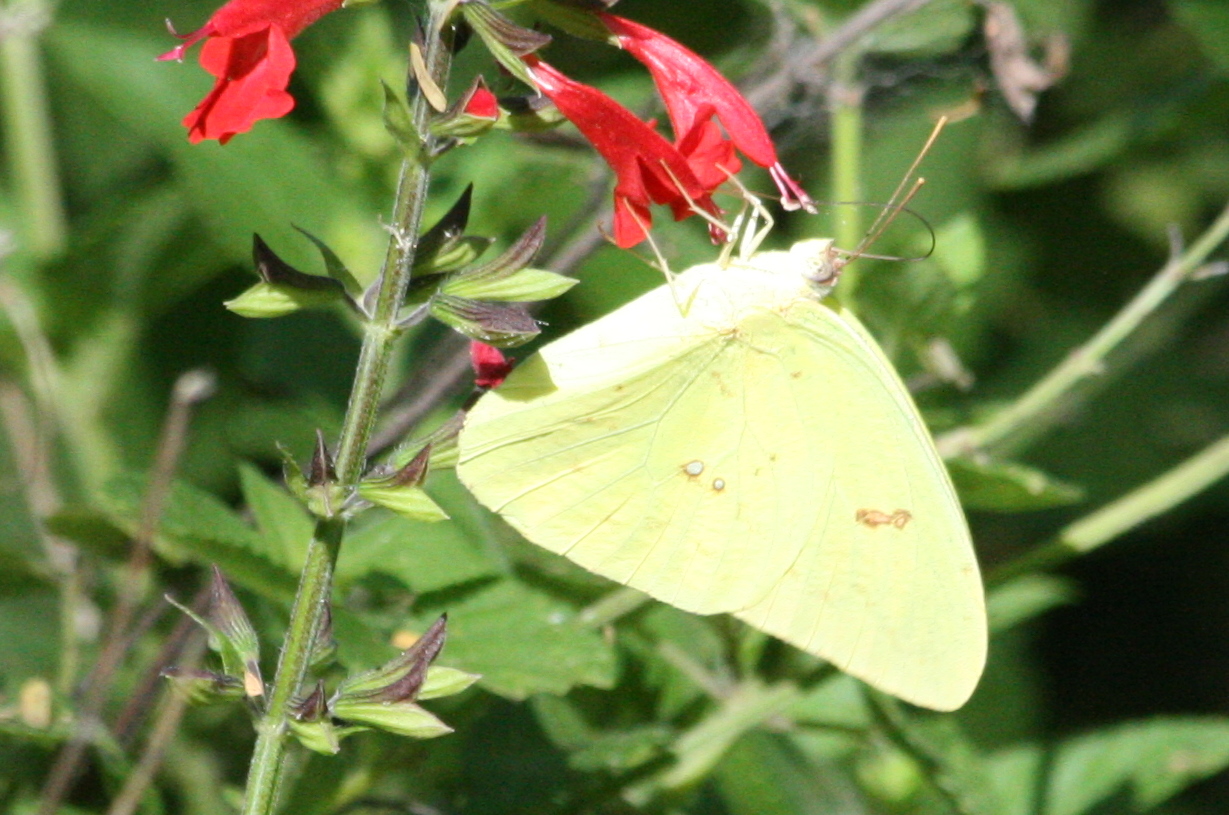
The cloudless sulphur presents a notably larger, brighter yellow butterfly compared to the more common clouded sulphur, displaying a considerably more vivid, saturated yellow coloring with minimal dark marking, sometimes just a small, subtle spot rather than the more pronounced border pattern the clouded sulphur characteristically shows, making size and color intensity together useful distinguishing features between these two commonly confused sulphur species.
This species favors similar open habitat to other sulphurs but shows a notably strong attraction to red and orange tubular flowers specifically, with caterpillars feeding on senna and cassia family plants rather than the clover and alfalfa the clouded sulphur favors, giving these two similar-looking yellow species genuinely distinct host plant relationships despite their superficially similar overall appearance.
Cloudless sulphurs also undertake notable seasonal migratory movements in some populations, particularly in southern regions, adding a genuinely interesting behavioral dimension beyond simple color-based identification for observers specifically interested in this species’ broader biology and seasonal movement patterns across its range.
Tiger Swallowtail: The Large Yellow-and-Black Species
The eastern tiger swallowtail represents a genuinely different category of yellow butterfly entirely compared to the smaller sulphur species covered above, displaying vivid yellow wings marked with bold, parallel black stripes creating a striking tiger-inspired pattern, alongside a considerably larger overall size and the distinctive tail projections that place this species within the swallowtail family rather than the sulphur group.
This species shows a genuinely interesting complication specifically in females, which occur in two distinct color forms, the typical yellow-and-black pattern matching males, and a separate dark form appearing almost entirely black, meaning not every tiger swallowtail individual actually displays yellow coloring despite the species’ common association with this color, a nuance covered in complete detail in our companion swallowtail identification resources for anyone specifically encountering an unexpectedly dark, non-yellow swallowtail specimen.
Distinguishing tiger swallowtails from the smaller sulphur species covered earlier relies primarily on size and pattern complexity, since the swallowtail’s considerably larger wingspan and bold black striping contrasts clearly against the smaller, more simply patterned sulphur species, making confusion between these genuinely different butterfly families relatively uncommon once basic size and pattern complexity are considered together, a comparison covered in additional family-level detail across our broader swallowtail identification guide.
What Lepidoptera Research Says About Sulphur Identification
Entomological research on sulphur butterfly identification, including work referenced through institutions studying lepidoptera classification broadly, confirms that clouded and orange sulphurs hybridize frequently enough where their ranges overlap that even experienced researchers sometimes rely on genetic testing rather than visual identification alone to definitively separate these two closely related species in certain populations.
This documented hybridization complexity means casual observers should not feel discouraged if a specific sulphur sighting resists confident species-level identification, since this genuine biological overlap represents an active area of ongoing taxonomic study rather than any failure of observational skill, meaning general sulphur-group recognition alone is a genuinely reasonable and perfectly acceptable identification goal for most casual butterfly watchers rather than requiring definitive species-level certainty in every single encounter they happen to have.
Beyond the clouded and orange sulphur complex specifically, the considerably more visually distinct cloudless sulphur and tiger swallowtail covered elsewhere in this guide present less identification ambiguity overall, meaning the genuine complexity in yellow butterfly identification concentrates specifically within this smaller sulphur species cluster rather than applying uniformly across all yellow butterfly identification challenges covered throughout this guide.
Sleepy Orange and Other Smaller Yellow Species
The sleepy orange presents a smaller yellow-orange butterfly with a distinctive dark border pattern, favoring similar open habitat to other sulphur species but showing a somewhat more consistently orange-tinted yellow coloring compared to the clearer, more purely yellow tones typical of clouded and cloudless sulphurs, adding further nuance to the broader yellow-butterfly identification challenge this guide addresses.
Various other regional sulphur and yellow butterfly species exist across different parts of North America, each showing subtle variations in specific shade, marking pattern, and host plant preference, meaning readers in particular regions may encounter locally common yellow species beyond the primary options covered throughout this guide, making regional field guides genuinely valuable supplements for complete local identification specific to any given area or state.
This diversity of smaller yellow species reinforces the broader identification principle running throughout this guide: checking size, specific shade of yellow, marking pattern, and host plant or habitat context together, similar to the approach covered in our green butterfly guide, generally resolves yellow butterfly identification with genuine confidence, even accounting for the considerable variety of similarly colored species sharing this general yellow coloring across different specific species and regional populations.
Yellow Butterfly Symbolism Across Cultures
Yellow carries genuinely widespread positive symbolic associations across numerous cultural traditions, commonly connected to joy, optimism, and new beginnings, drawing on yellow’s broader association with sunlight, warmth, and positive energy found across many independent cultural contexts, making yellow butterfly encounters a particularly cheerful sighting for those specifically drawn to symbolic interpretation of wildlife encounters.
Some traditions specifically connect yellow butterflies to messages of hope or encouragement, particularly meaningful during difficult periods, drawing on the broader butterfly transformation symbolism explored throughout our butterfly tattoo meaning guide but layering yellow’s specifically bright, optimistic color association onto this foundational transformation theme rather than the more solemn or complex associations sometimes carried by darker-colored butterfly encounters.
This generally positive yellow symbolism contrasts meaningfully with some other butterfly colors carrying more complex or culturally variable associations, such as the soul-and-spirit connections explored in our white butterfly guide or the rarer, more mysterious associations sometimes connected to purple butterfly sightings, making yellow among the more consistently and straightforwardly positive butterfly colors across the broader landscape of color-based butterfly symbolism.
Attracting Yellow Butterflies to Your Garden
Successfully attracting the sulphur species covered throughout most of this guide benefits from planting legume family plants including clover, alfalfa, and various native pea family species for clouded and orange sulphurs specifically, while cloudless sulphurs specifically require senna or cassia family host plants, meaning host plant selection should target the specific yellow species a gardener hopes to attract rather than assuming any single planting approach serves all yellow butterfly possibilities equally well.
For gardeners specifically hoping to attract the considerably larger tiger swallowtail instead, appropriate host trees including wild cherry, tulip tree, or ash provide the specific woody host plants this species requires, a genuinely different planting approach entirely from the smaller herbaceous legume plants sulphur species depend on, reflecting these species’ fundamentally different life history and host plant requirements despite sharing overlapping general yellow coloring.
Beyond specific host plants, providing nectar-rich flowering plants supports adult feeding needs across all yellow butterfly species covered throughout this guide, while avoiding broad-spectrum insecticide use protects the eggs and caterpillars of whichever specific yellow species a garden’s particular host plant selection happens to successfully attract and support through their complete life cycle from egg through adult emergence and eventual reproduction into subsequent generations.
Related reading: Red Butterfly.
Tiger Swallowtail vs Sulphur: Size Settles It
Wingspan separates these two before any pattern detail. A clouded or cloudless sulphur spans roughly 1.5 to 2.5 inches and reads as a small, quick, restless yellow butterfly that rarely holds still. An Eastern Tiger Swallowtail spans 3.5 to 5.5 inches, glides between wingbeats, and is unmistakably large in flight.
Pattern confirms it. The tiger swallowtail carries four bold black stripes across each yellow forewing, black wing margins with yellow spots, and tails trailing from the hindwings. Sulphurs are plain yellow with at most a dark border or a small dark spot, and they have no tails at all. Sulphurs also nearly always perch with wings closed above the back, so you see the underside rather than the upper pattern.
When Yellow Butterflies Appear Through the Year
Clouded sulphurs are among the longest-flying butterflies in North America, on the wing from early spring through to hard frost with several overlapping broods, which is why they are the default yellow butterfly for most of the season. Cloudless sulphurs push north through summer and are most abundant in late summer and autumn, sometimes in noticeable migratory streams along the southeast coast.
Tiger swallowtails run a shorter calendar, typically two broods from late spring into late summer in the north and three further south. The practical consequence is that a yellow butterfly in March or in late October is almost certainly a sulphur, while the peak weeks of midsummer are when both are on the wing together. The Smithsonian’s butterfly information sheet covers brood cycles and how they vary with latitude.
Frequently Asked Questions
What is the most common yellow butterfly?
The clouded sulphur, found across nearly all of North America, displaying clear pale to medium yellow wings with a dark border, particularly pronounced in females, and typically a small dark spot near the forewing center.
What is the largest yellow butterfly?
The eastern tiger swallowtail, considerably larger than sulphur species, displaying bold black tiger stripes on yellow wings, though females sometimes occur in an entirely dark, non-yellow color form.
What does a yellow butterfly mean spiritually?
Across many traditions, yellow butterflies symbolize joy, optimism, and new beginnings, drawing on yellow’s broader association with sunlight and positive energy across numerous independent cultural contexts.
How can I tell a clouded sulphur from a cloudless sulphur?
Check size and brightness: cloudless sulphurs are notably larger with brighter, more saturated yellow coloring and minimal marking, while clouded sulphurs are smaller with a more pronounced dark border pattern.
What plants attract yellow butterflies?
Legume family plants like clover and alfalfa attract clouded and orange sulphurs, senna or cassia plants attract cloudless sulphurs, and host trees like wild cherry or tulip tree attract tiger swallowtails specifically.
Is a yellow butterfly always a sulphur species?
No, the tiger swallowtail is also commonly yellow, though considerably larger with bold black stripes, making size and pattern complexity important additional checks beyond color alone.
Why do some tiger swallowtails not appear yellow?
Female tiger swallowtails occur in two color forms, the typical yellow-and-black pattern and a separate dark form appearing almost entirely black, meaning not every individual of this species displays yellow coloring.