White Caterpillar: Identification, Rash Risk, and What They Become
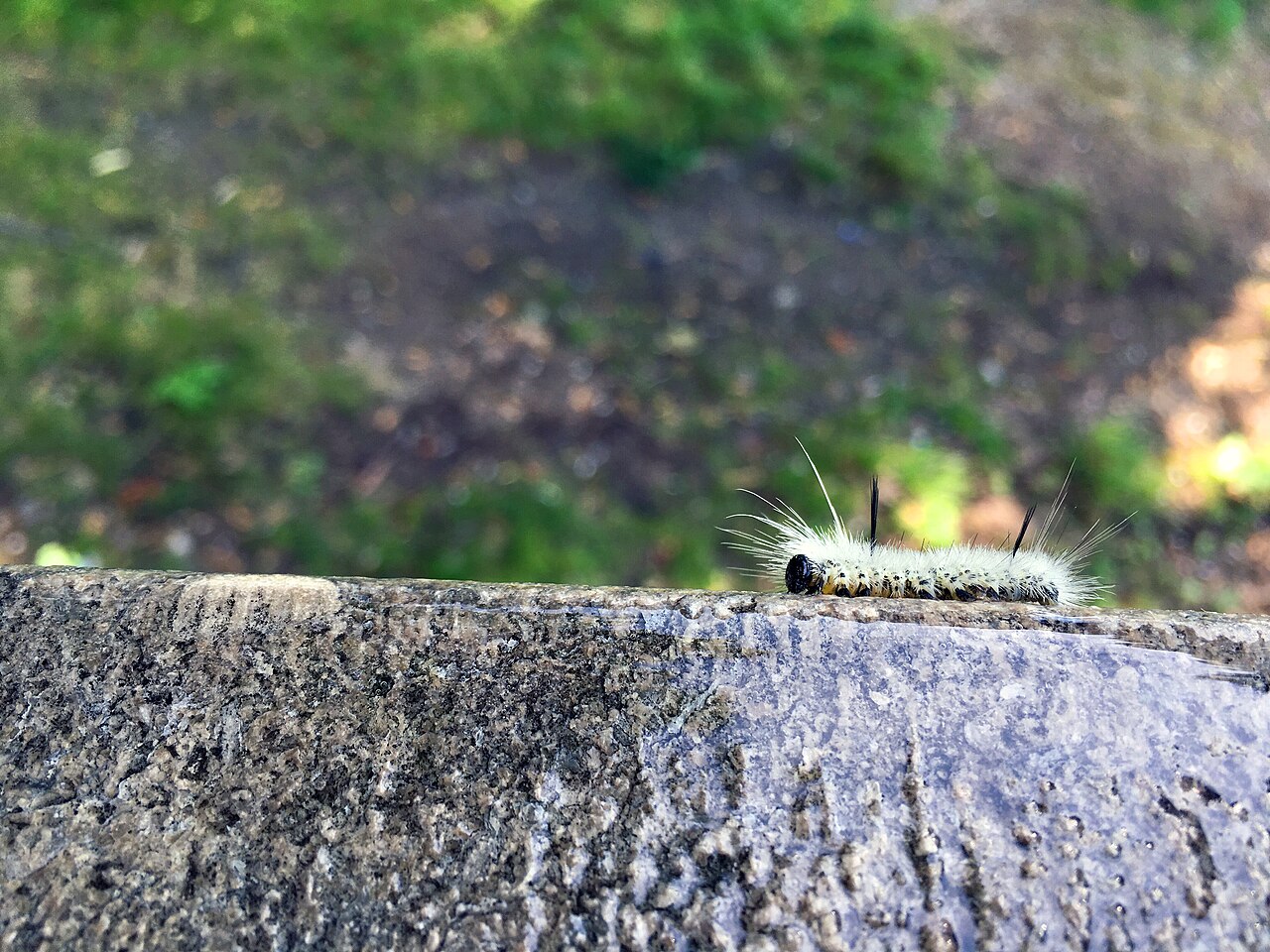
A white caterpillar is most often the larva of a tussock moth, a webworm, or a white butterfly, and the first thing worth knowing is that several of them can leave a rash on bare skin. The hickory tussock caterpillar, with its dense white hair and short black hair pencils, is the species most people photograph and ask about across the eastern United States. Fall webworms, white-marked tussock larvae, and the pale green-white caterpillars of the cabbage white butterfly account for most of the rest.
Getting the identification right matters more here than with most color groups. Some white caterpillars are harmless leaf feeders that turn into ordinary moths, while others carry hollow defensive hairs that break off in skin and release irritants. The differences are visible if you know which features to look at.
Most white caterpillars in North America are tussock moth larvae, fall webworms, or cabbage white butterfly larvae. Hickory tussock and white-marked tussock caterpillars have irritating hairs that cause rashes and should never be handled. Fall webworms are harmless. White caterpillars become moths far more often than butterflies.
| Caterpillar | Appearance | Irritating? | Becomes |
|---|---|---|---|
| Hickory tussock moth | White hairs, black mid-line tufts | Yes, common rash source | Tan moth with dark spots |
| White-marked tussock moth | Yellow-white with 4 white tufts, red head | Yes, strong reaction possible | Gray moth, flightless female |
| Fall webworm | Pale white to tan, long fine hairs, in webs | No | Pure white moth |
| Cabbage white butterfly | Smooth, pale green-white, velvety | No | White butterfly |
| Sycamore tussock moth | Creamy white, orange hair pencils | Mild | Pale gray moth |
| Salt marsh moth | Variable white to buff, dense bristles | Mild | White moth with black dots |
What Kind of Caterpillars Are White?
White caterpillars fall into three structural groups that are easy to separate once you look past color. The first is the tussock moth group, recognizable by dense tufts of hair arranged in distinct bundles rather than an even coat. The second is the webworm and tiger moth group, covered in long fine hairs of roughly even length. The third is the smooth-bodied group, mostly white butterfly larvae with no visible hair at all.
Color itself is a poor identification tool in caterpillars because many species change dramatically between instars. A larva that is pure white in its third molt may be gray-brown two weeks later, and individuals within the same brood can vary from cream to yellow. Body shape, hair arrangement, head capsule color, and host plant carry far more information.
Season narrows things quickly. Hickory tussock and fall webworm larvae peak from July through September, which is why late-summer walks generate the most sightings. Cabbage white larvae appear on brassicas from spring through fall, and white-marked tussock produces two or three broods across the warm months.
Hickory Tussock Caterpillar: The Most Reported White Caterpillar
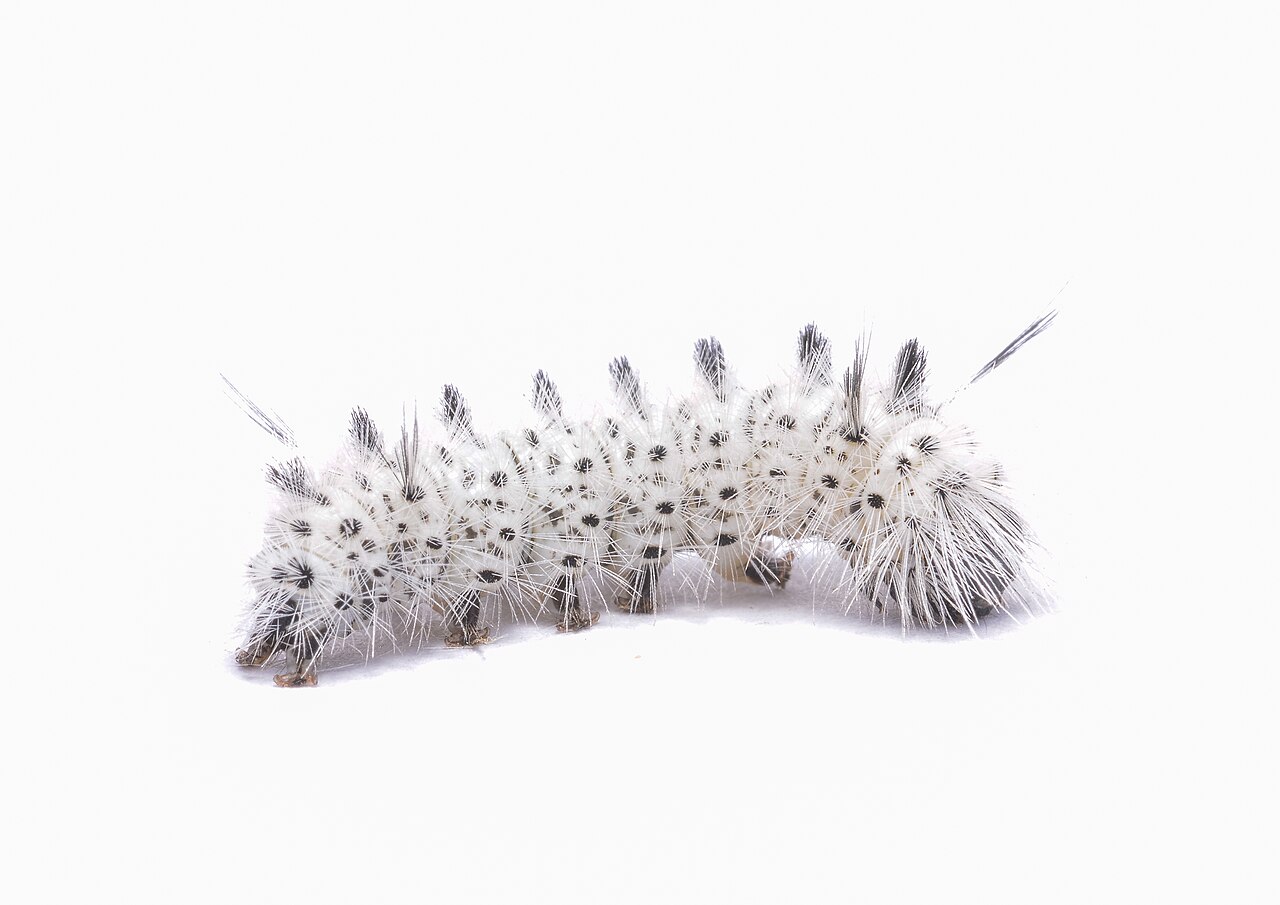
The hickory tussock caterpillar is white and densely hairy with a distinct row of black tufts down the center of the back and long black hair pencils projecting from both ends. Mature larvae reach roughly 1.5 in and are usually found alone on the leaves of hickory, walnut, oak, ash, or elm. They wander widely in late summer looking for pupation sites, which is why they turn up on sidewalks, porches, and playground equipment.
The hairs are the reason this species dominates search traffic. They are hollow and connected to glands at the base, and when they break off in skin they release compounds that produce itching, burning, and a red rash that can persist for several days. Reactions vary widely between people, and children who handle several caterpillars in a row tend to react most strongly.
Removal is straightforward if it happens. Lift embedded hairs with the sticky side of tape rather than rubbing, wash with soap and water, and use a cold compress for the burning. State extension services across the Northeast issue advisories about this species every August, and the consistent advice is simple avoidance rather than treatment.
White-marked Tussock Caterpillar and Its Red Head
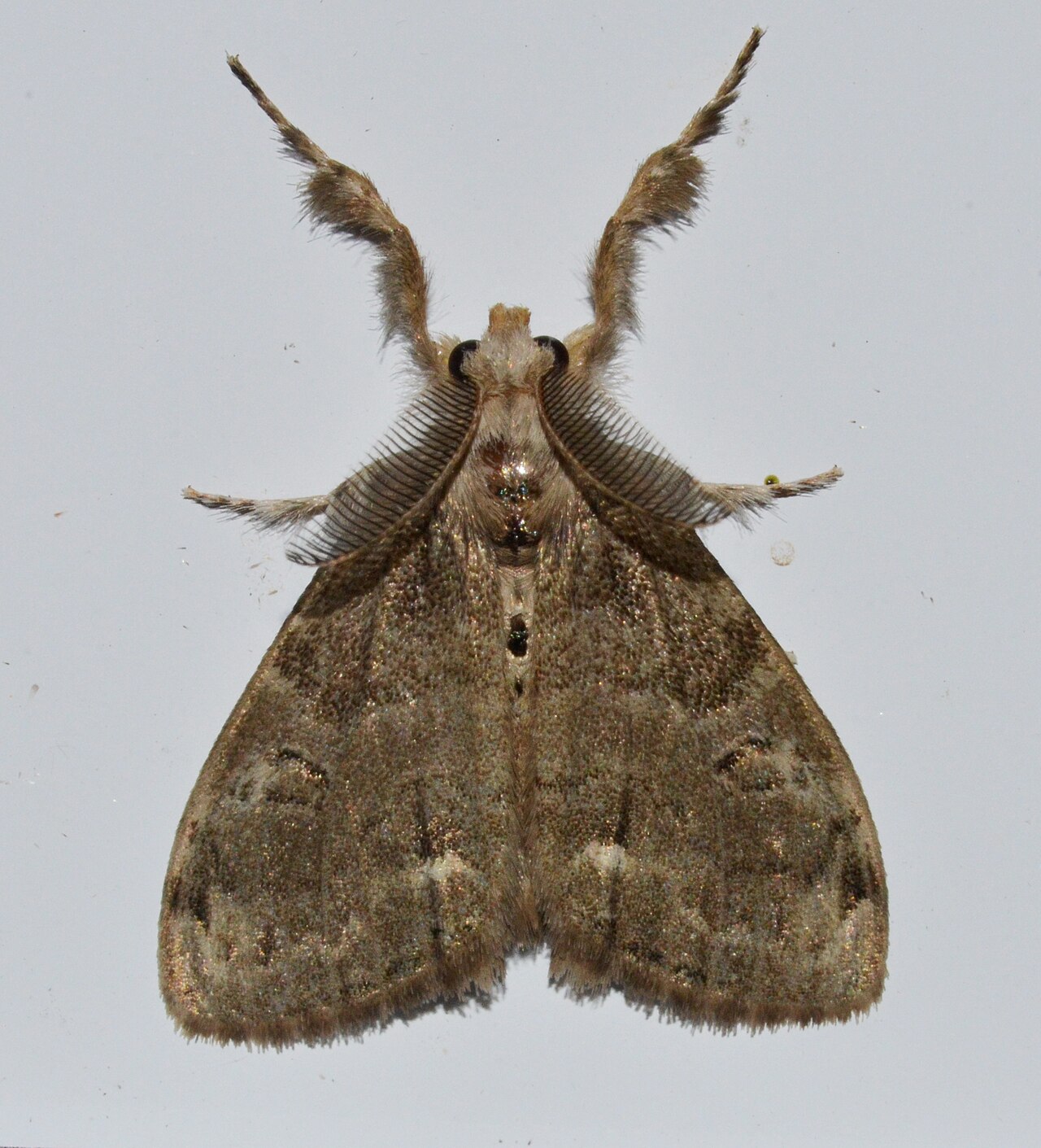
The white-marked tussock caterpillar is the most ornate larva in this group and the easiest to name once seen. It carries a bright red head capsule, four dense cream-white tufts standing upright on the back like a brush cut, two long black hair pencils projecting forward, and one projecting backward. A yellow stripe runs along each side of the body.
Host range is unusually wide, covering more than a hundred species of deciduous trees and shrubs including apple, oak, maple, birch, and rose. Populations occasionally reach outbreak levels in urban street trees, where larvae defoliate whole branches before dropping on silk threads. Those dangling larvae account for most human contact.
Adult females are flightless, which shapes the whole life cycle. She emerges wingless, mates on the surface of her own cocoon, and lays a frothy white egg mass directly onto it, so populations build in place year after year on the same tree. Scraping visible egg masses off trunks in winter is the standard control for homeowners.
Fall Webworm: White Caterpillars Inside a Tent
Fall webworms build the loose gray silk tents that enclose the tips of branches in late summer, and the caterpillars inside are pale white to tan with long fine hairs and a row of dark spots along the back. Two races exist, one with a black head and one with a red head, and the red-headed form tends to run more orange overall. Mature larvae reach about 1 in.
These are harmless to handle and harmless to the tree in any meaningful sense. The webs appear in August and September, after trees have already completed most of their annual growth, so defoliation at that point costs the tree very little. Pruning out the webs is cosmetic rather than protective.
They are also frequently confused with eastern tent caterpillars, which are a completely different animal. Tent caterpillars build tight silk tents in branch forks in spring, are dark with a white back stripe, and leave the tent to feed. Webworms build loose tents at branch tips in late summer and feed inside the web, expanding it as they go.
Cabbage White Caterpillar: The Smooth Green-White One
The cabbage white butterfly larva is the one white-ish caterpillar most gardeners meet, and it looks nothing like the hairy species. It is smooth, velvety, and pale green with a faint white or yellow stripe down the back, roughly 1 in long at maturity, and it sits motionless along the midrib of a leaf where it blends almost perfectly. There are no hairs, tufts, or spines.
Host plants are strictly brassicas, which means cabbage, broccoli, kale, collards, Brussels sprouts, and their wild relatives. Damage shows as irregular holes chewed between leaf veins, accompanied by dark green frass pellets collecting in the leaf axils. Heavy infestations can strip a young transplant in days.
The adult is the small white butterfly with one or two black forewing spots seen in every vegetable garden in North America, introduced from Europe in the 1860s. Row cover over young plants is the most effective home control, and Bacillus thuringiensis is the standard organic treatment. For the broader picture of the adult stage, the guide to white butterflies covers the look-alikes.
Sycamore Tussock and Other Regional White Tussocks
The sycamore tussock caterpillar is creamy white to pale yellow with dense even hair and two pairs of long orange hair pencils, one pair forward and one back. It feeds almost exclusively on sycamore and London plane, which makes host plant alone nearly diagnostic. Mature larvae reach about 1 in and, like hickory tussock, wander in late summer.
Banded tussock moth larvae overlap with both in range and appearance but run more yellow-gray than white, with black and white hair pencils at each end. Definite separation usually comes down to the hair pencil color and the host plant, since banded tussock feeds on a much wider set of trees including alder, birch, and hazel.
Milkweed tussock caterpillars complete the group in a different direction. Early instars are pale and fuzzy enough to read as white before they develop the black, orange, and white tufts of the mature larva. They feed in clusters on milkweed, which is a strong contextual clue that no other tussock provides.
Salt Marsh and Virginian Tiger Moth Caterpillars
The salt marsh caterpillar is one of the most variable larvae in North America, appearing white, cream, buff, yellow, or nearly black within a single population. White individuals are densely bristled with hairs of even length radiating in all directions, giving a rounded shaggy outline rather than the tufted profile of a tussock. Mature larvae reach about 2 in and move quickly when disturbed.
Despite the name, this species is not restricted to coastal marshes. It feeds on more than a hundred plants including soybean, cotton, clover, cabbage, and many garden ornamentals, and it appears across most of the continent. Late-season individuals often cross roads and driveways in large numbers as they search for overwintering sites.
The Virginian tiger moth larva, better known as the yellow bear, produces pale cream to white individuals just as often as yellow ones. It is separated from salt marsh larvae by longer, more sparse hairs that stick out well beyond the body outline. Both cause only mild skin irritation at most, well below what the tussock species produce.
Small White Caterpillars Found Indoors
White larvae found inside a house are almost never caterpillars from the garden. The most common candidates are Indian meal moth larvae, which are off-white with a brown head and turn up in stored grains, cereal, flour, birdseed, and dry pet food. They are smooth, about 0.5 in, and leave fine silk webbing in the packaging.
Clothes moth larvae are the second candidate, cream-white, smaller, and found in wool, felt, or fur rather than food. Casemaking clothes moth larvae carry a portable silk tube that they drag along, which is unmistakable once noticed. Both species indicate a source that needs locating rather than treating.
Carpet beetle larvae get lumped in constantly but are not caterpillars at all. They are bristly, tapered, and banded brown rather than white, and their shed skins accumulate along baseboards. If a rash is involved alongside indoor larvae, the carpet beetle rash is a more likely explanation than any moth.
Are White Caterpillars Poisonous?
No North American caterpillar is poisonous in the sense of being dangerous to touch or fatal if handled, but several are urticating, meaning their hairs mechanically irritate skin. Hickory tussock and white-marked tussock are the two white species that regularly cause reactions, and both produce contact dermatitis rather than true envenomation. Symptoms are local, uncomfortable, and self-limiting.
The reaction typically starts within minutes as burning and itching, followed by red raised welts that trace where the hairs contacted skin. Severity depends on individual sensitivity, contact duration, and how many hairs are embedded. Reactions on the face, neck, or inner forearm tend to be worse than on the hands.
Medical attention is warranted in a narrow set of cases: hairs in the eye, swelling of the lips or tongue, difficulty breathing, or a spreading reaction well beyond the contact site. Guidance from poison control centers and hospital systems including Mayo Clinic treats these as contact reactions managed with washing, antihistamines, and cool compresses.
What Do White Caterpillars Turn Into?
Most white caterpillars become moths rather than butterflies, which surprises people who assume every caterpillar produces something spectacular. Hickory tussock larvae become a modest tan moth with rows of dark spots on the forewing. Fall webworms become a pure white moth, sometimes speckled with black, that is common at porch lights in early summer.
White-marked tussock produces a mottled gray-brown male moth and a wingless, nearly larval-looking female that never leaves her cocoon. Sycamore tussock adults are pale gray with a faint pattern and a distinct yellow tuft on the thorax. None of these are showy, and most people never connect the adult to the caterpillar they photographed.
The main butterfly exception is the cabbage white, whose smooth green-white larva becomes the familiar white butterfly of vegetable gardens. Beyond that, white larvae almost always signal a moth ahead. The broader separation between the two groups is worth understanding, and the moth versus butterfly comparison lays out the structural differences.
How to Get Rid of White Caterpillars
Control depends entirely on which species is present, and in most cases no control is needed at all. Wandering tussock caterpillars on a deck or sidewalk are transient, headed for pupation sites, and will be gone within a week. Sweeping them into a dustpan and relocating them to a wooded edge solves the problem without chemicals.
On garden brassicas, cabbage white larvae respond well to floating row cover installed before the butterflies begin flying, hand picking in small plantings, and Bacillus thuringiensis applied to leaf undersides. Timing matters more than product choice, since young larvae are far easier to kill than mature ones.
For tussock outbreaks on ornamental trees, scraping egg masses from bark in winter is more effective than spraying in summer. Broad insecticide applications during larval season kill the parasitic wasps and flies that normally suppress these populations, which reliably makes the following year worse. Birds do meaningful work here too, and the birds that eat caterpillars include several common yard species.
Telling White Caterpillars Apart in the Field
Work through four features in order and most identifications resolve in under a minute. First, hair: tufted bundles mean tussock, even long hair means webworm or tiger moth, no hair means butterfly larva. Second, head capsule color, since the red head of white-marked tussock is diagnostic on its own.
Third, behavior and setting. A larva inside a loose silk web at a branch tip is a fall webworm regardless of its exact shade. A larva alone on a leaf in late summer is likely a tussock, and one motionless on a cabbage leaf is a cabbage white. Fourth, host plant, which eliminates most of the remaining candidates.
Photograph rather than handle, and get one shot from directly above and one from the side. Overhead shows tuft arrangement and body stripes, side shows the hair pencils and head. Anyone comparing against the wider fuzzy caterpillar group or the woolly bear will need both angles.
Frequently Asked Questions
What does a white caterpillar turn into?
Most white caterpillars become moths rather than butterflies. Hickory tussock larvae become a spotted tan moth, fall webworms become a pure white moth, and white-marked tussock produces a gray male moth with a flightless female. The main butterfly exception is the smooth pale green-white cabbage white larva.
Is it safe to touch a white caterpillar?
Not reliably. Hickory tussock and white-marked tussock caterpillars have hollow hairs that break off in skin and cause burning, itching, and a rash lasting several days. Fall webworms and cabbage white larvae are harmless. Since telling them apart at a glance is unreliable, treating every hairy white caterpillar as irritating is the safer habit.
What are the white fuzzy caterpillars in late summer?
In the eastern United States, white fuzzy caterpillars appearing on sidewalks and decks in August and September are usually hickory tussock moth larvae searching for pupation sites. Sycamore tussock larvae do the same thing near sycamore and London plane trees. Both wander well away from their host plants at that stage.
How do I treat a rash from a white caterpillar?
Lift embedded hairs with sticky tape rather than rubbing, then wash the area with soap and water. Cold compresses reduce the burning, and oral antihistamines or hydrocortisone cream help with itching. Seek medical care if hairs enter the eye, if the face or throat swells, or if the reaction spreads well beyond the contact site.
What are the tiny white caterpillars in my kitchen?
Small off-white larvae in a pantry are almost always Indian meal moth larvae, which infest grains, cereal, flour, birdseed, and dry pet food and leave fine silk webbing in packaging. Check every dry good, including unopened boxes, since they chew through thin packaging. Discard infested containers and clean shelf seams thoroughly.
Do white caterpillars damage trees?
Rarely in any way that matters. Fall webworms feed in late summer after trees have finished their annual growth, so the defoliation costs the tree almost nothing. Tussock moth outbreaks can strip ornamental trees in bad years, but healthy established trees refoliate the following spring without lasting harm.